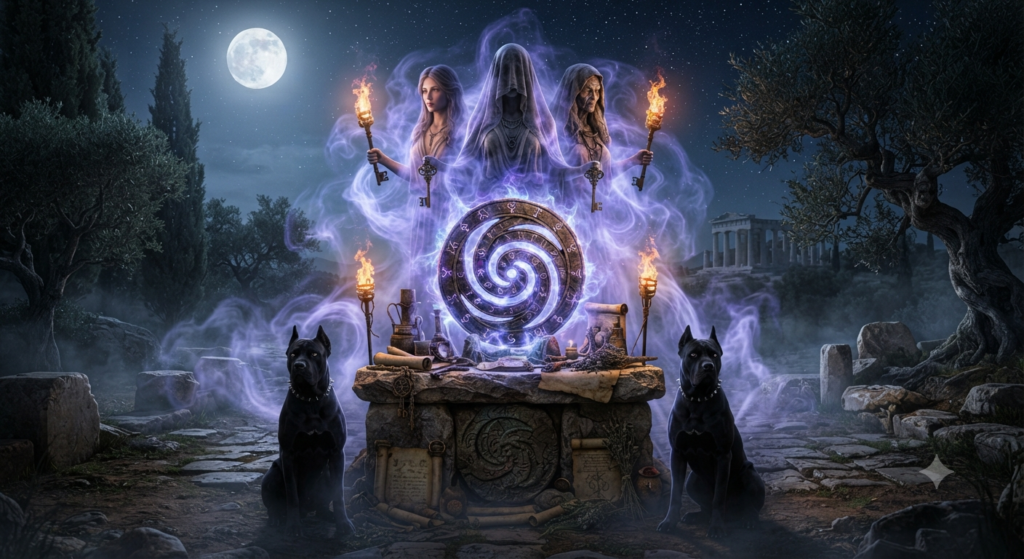
Hecate’s Wheel, often called the Strophalos, is one of the more enigmatic symbols associated with the Greek goddess Hecate. It appears as a circular emblem, usually with radiating shapes that suggest rotation, motion, or a star within a wheel. Unlike the major divine figures of Greek myth, Hecate’s Wheel is not explained in a single authoritative ancient narrative; its meaning is reconstructed from scattered references, images, inscriptions, and later interpretations. That makes it a symbol shaped as much by cult practice and scholarly reading as by myth itself.
Hecate’s Wheel and the Strophalos Name
The term strophalos comes from Greek language associated with twisting, turning, or spinning. In later usage it became linked to Hecate’s Wheel, though ancient sources do not always describe the same object in the same way. Some references suggest a ritual implement, while modern readers usually mean the circular symbol with a central hub and radiating arms or cross-like forms. Because of this, “Hecate’s Wheel” and “the Strophalos” are related terms, but not always identical in ancient usage.
Hecate herself was a goddess of boundaries, roads, night, and magical power, so a turning wheel suited her symbolic world. A wheel moves between positions without stopping at any one point, just as Hecate stands at thresholds and junctions rather than inside a single domain. The name strophalos captures that sense of motion and rotation, which may be why later traditions embraced it as a visual sign of her presence.
Origins of the Hecate’s Wheel Symbol
The origins of Hecate’s Wheel are not straightforward, and no single ancient author explains when it first appeared. Many scholars see it as part of the broader language of geometric and apotropaic symbols in the ancient Mediterranean, where circles, stars, and turning forms often signaled divine power, cosmic order, or protection. In that sense, the wheel may have developed gradually in ritual and visual culture rather than being created at one exact moment.
Its final association with Hecate likely emerged because her cult was especially receptive to boundary symbols, night imagery, and magical signs. The goddess was honored in contexts that already leaned toward ambiguity: crossroads, doorways, tombs, and domestic protection. A rotating emblem would have fit that atmosphere well, suggesting movement between worlds, and perhaps the turning of fate, lunar cycles, or ritual transformation.
Hecate in Greek Myth and Cult Practice
In Greek myth, Hecate is a goddess whose power is ancient and wide-ranging. Hesiod’s Theogony presents her as a honored deity with influence over earth, sea, and sky, not merely a later underworld figure. Other sources emphasize her role in magic, night, and liminal spaces. She is not defined by one myth alone, but by the steady accumulation of functions across poetry, cult, and later literature.
Cult practice gives the clearest sense of why her symbol mattered. Hecate was linked to offerings at crossroads, monthly rites, and household protection, especially in places where boundaries needed divine care. Her worship appears in both public and private settings, and this dual presence helped make her visually associated with signs that could guard, mark, or consecrate a space. A wheel-like emblem would have suited a goddess invoked at the points where safety and danger meet.
The Wheel as a Magical and Protective Sign
Hecate’s Wheel is often treated as an apotropaic sign, meaning a symbol meant to ward off harm. In Greek religion and magic, visual forms could protect a person, place, or object by invoking divine authority. A wheel, because of its enclosed shape and dynamic motion, could suggest containment, continuity, and control over chaotic forces. For a deity associated with witches, ghosts, and transitions, that protective logic is easy to understand.
The symbolic force of the wheel also lies in its mobility. Unlike a fixed boundary stone or altar, the wheel implies movement that can be repeated and renewed, much like a spoken charm or ritual circle. This may explain why later magical traditions found it useful. Even when ancient texts do not explain the emblem in detail, the association with defense, purification, and sacred power remains consistent with Hecate’s wider religious role.
Ancient Images, Inscriptions, and Amulets
Direct ancient evidence for Hecate’s Wheel is limited, but related visual material survives in the form of engraved gems, amulets, and ritual objects. Some of these display circular or star-like motifs that modern scholarship connects cautiously to Hecate, especially when found in magical contexts. Because ancient symbols can be difficult to identify with certainty, interpretation often depends on accompanying inscriptions or the broader archaeological setting.
Inscriptions and dedications to Hecate show that her name was invoked for protection and favor, sometimes alongside other divine powers. Amulets from the Greco-Roman world often combined divine names, figures, and geometric patterns in ways meant to concentrate efficacy. The wheel motif fits naturally within that environment, even if not every circular design should be labeled Hecate’s Wheel without reservation. The symbol’s history is therefore real, but fragmentary.
Hecate’s Triple Form and Lunar Associations
Hecate is famously associated in later art with a triple form, standing in three bodies or three directions at once. This imagery reflects her presence at crossroads and her ability to look outward in multiple directions. Although the triple form is not the same thing as the wheel, both symbols express the goddess’s power over transition, multiplicity, and divided space. The wheel can be read as a visual cousin to the triadic image.
Her lunar associations belong mostly to later developments, especially in Hellenistic and Roman periods, when Hecate became more closely linked with the moon, night sky, and hidden knowledge. The wheel’s circular shape encouraged comparison with the moon, though ancient texts are not uniform on this point. In some traditions Hecate merges with Selene or Artemis in symbolic language, while in others she remains distinct. The wheel thus participates in a wider pattern of lunar and nocturnal imagery without fully replacing older meanings.
Mystery Cults, Crossroads, and Threshold Rites
Hecate’s power was especially strong at thresholds, and that is one reason her symbol resonates so deeply with mystery traditions. Crossroads were places of decision, danger, and offering, where paths split and destinies could change. Hecate was honored there as a guardian of passage, but also as a deity who could see across divisions. The wheel, with its central point and outward spokes, visually echoes that crossing of directions.
Rites at doorways, gates, and junctions expressed the same religious logic. These were not merely practical spaces; they were symbolic sites where the human and divine could meet, or where unwanted forces needed to be kept out. Hecate’s ritual presence at such sites made her an ideal figure for symbols that marked transition. The strophalos can therefore be understood as part of a larger sacred geography in which turning, crossing, and entering were all spiritually charged acts.
Later Interpretations in Roman and Byzantine Texts
By the Roman period, Hecate had become even more closely tied to magic, nocturnal rites, and esoteric knowledge in literary imagination. Authors such as Ovid and later commentators helped shape a more elaborate image of the goddess, although not always with direct reference to the wheel itself. Roman religious and magical traditions were highly receptive to symbolic objects, and Hecate’s visual identity continued to broaden.
Byzantine and late antique references preserve fragments of older ritual vocabulary, including terms like strophalos, but these texts are often distant from the earliest cult settings. At times they describe ceremonial devices, charms, or spinning objects associated with divine invocation. Because the evidence is scattered and late, scholars are careful not to project later meanings back too confidently. Still, these sources show that the idea of Hecate’s Wheel remained alive long after classical Greek religion had changed.
Modern Pagan Uses of the Strophalos Symbol
In modern Pagan, Wiccan, and Hellenic polytheist contexts, Hecate’s Wheel has become a recognizable emblem of the goddess. It is used on altars, jewelry, ritual tools, and devotional artwork, often as a sign of protection, liminality, and magical authority. For many practitioners, the symbol offers a way to honor Hecate as a guide through uncertainty and as a keeper of thresholds.
Modern use, however, is a reinterpretation rather than a simple continuation. Contemporary devotees often blend historical fragments with personal gnosis, reconstructed ritual, and modern esoteric symbolism. Some emphasize the wheel’s protective aspect; others focus on its connection to crossroads, lunar cycles, or the turning of spiritual transformation. The symbol’s endurance lies partly in its openness: it can be ancient in tone without being frozen in a single ancient meaning.
What Scholars Can Say About Its Meaning
Scholars can say with confidence that Hecate’s Wheel is a later symbolic expression tied to the goddess’s cultic and magical associations, but they cannot reduce it to one fixed ancient definition. The evidence suggests a symbol of rotation, boundary, and protection, shaped by Hecate’s role as a deity of crossroads and transitions. Its meaning developed through a blend of ritual practice, visual culture, and later interpretation rather than through a single canonical myth.
What remains most important is the symbol’s coherence with Hecate herself. Whether seen as a wheel, a strophalos, or a magical emblem of turning power, it expresses the same sacred logic found throughout her worship: movement between worlds, guardianship at the edge, and presence where paths divide. That is why the symbol continues to endure. It does not merely represent Hecate; it reflects the ancient Greek understanding that some powers live most fully at the turning point.

Orin Vale has spent the better part of two decades tracing the threads that connect the world’s oldest stories — from the halls of Asgard to the banks of the Nile, from Olympus to the jungles of the Maya. What began as a childhood fascination with flood myths and trickster gods grew into years of independent study across comparative mythology and ancient religion, always chasing the same question: what did these stories mean to the people who first told them? Orin writes for readers who want more than trivia — the ones looking for the beliefs, fears, and truths that myths were built to carry.