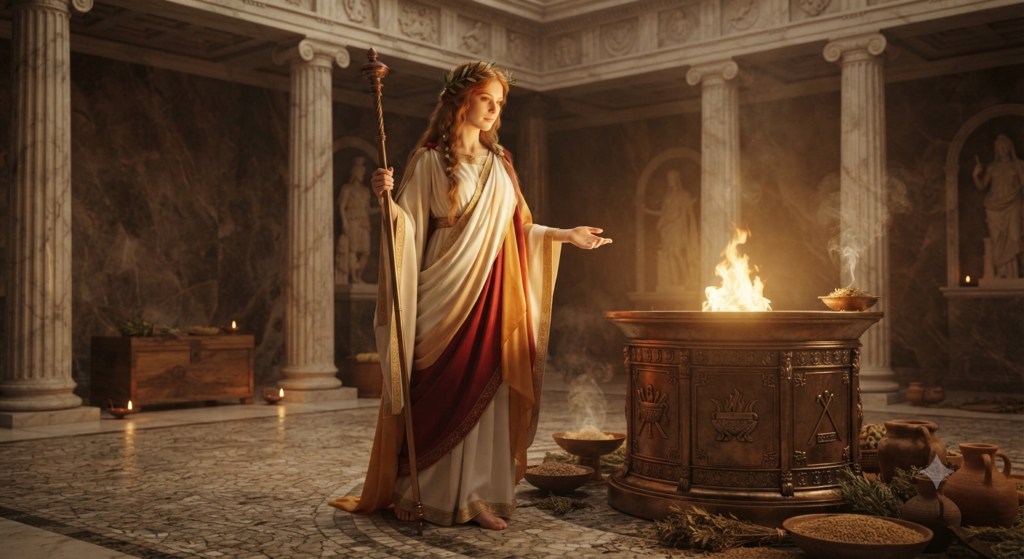
Hestia is the Greek goddess of the hearth, domestic order, and the sacred fire that held a household together. Unlike deities whose imagery is crowded with weapons, storms, or animals, her presence is quieter and more elemental, and the colors associated with her arise from flame, ash, metal, linen, and the calm interior of the home. Classical sources do not preserve a fixed “official” palette for Hestia, but later tradition and ritual practice make certain tones feel especially fitting: white, ember red, gold, bronze, and the earthy shades of hearth and stone.
Hestia’s Colors in Greek Myth and Cult
Hestia’s color associations come less from dramatic mythic scenes and more from the nature of her worship. In Homeric Hymns and in broader Greek practice, she is the goddess of the central hearth, the fire that marked both domestic continuity and civic unity. That place naturally evokes pale ash, warm flame, polished metal, and the clean brightness of an ordered interior rather than lush or warlike colors. Her domain was sacred precisely because it was ordinary: the fire that cooked, warmed, purified, and received offerings.
Because Hestia is a divinity of presence rather than spectacle, her colors are best understood symbolically. White suggests purity and the unblemished character of ritual flame; red and orange belong to the living fire itself; gold and bronze reflect the vessels and lamps used in household and civic worship. Earth tones appear as well, since the hearth was built into stone and clay, close to the ground and to the material life of the household.
White and the Purity of the Hearth Flame
White is one of the most natural colors linked with Hestia, even if ancient texts do not insist on it explicitly. In Greek ritual life, white often signified cleanliness, consecration, and a state fit for sacrifice. Since the hearth fire was the first sacred fire of the home, its purity mattered, and the goddess presiding over it would readily be imagined in light, unadorned tones. White garments also suited rites of restraint and reverence, which align well with Hestia’s character.
The association is reinforced by the visual language of flame and smoke. A bright hearth can seem nearly white at its hottest center, while the smoke that rises from it drifts into gray and pale silver. These subdued colors fit a goddess who rarely appears in vivid mythic drama but remains constantly present in the background of domestic and civic life. White, in this sense, becomes the color of steady sanctity rather than display.
Firelight, Ember Red, and Sacred Warmth
Firelight gives Hestia her most immediate color range. The hearth flame is not a single color but a shifting field of reds, oranges, and deep glowing amber. These are the colors of warmth, cooking, protection, and the offering fire. They suit Hestia because her power is felt in the stable center that keeps life habitable, not in destruction or battle. Even when fire is forceful, her version of it is contained and ordered.
Ember red is especially fitting because it suggests endurance. A live ember keeps heat after the larger flame has settled, just as Hestia’s presence endures quietly in the home and in the polis. This makes red less a sign of aggression than of latent vitality. In a mythic sense, the ember is Hestia’s own emblem of continuity: modest, persistent, and capable of renewal.
Gold and Bronze in Domestic Ritual Objects
Gold and bronze belong to Hestia through the ritual objects that gathered around the hearth. Greek households and sanctuaries used metal tripods, bowls, lamps, and offering vessels, and these gleaming surfaces would catch firelight beautifully. Gold suggests consecration and honor, while bronze adds a more utilitarian sacredness, linking divine reverence to the practical materials of daily life. Together they reflect Hestia’s unique position between home and cult.
Bronze is particularly important because it is neither extravagant nor plain. It has the weight of permanence and the sheen of use, which suits a goddess who governs durable domestic order. Gold, by contrast, appears in festive and civic contexts, where Hestia’s fire stood at the center of communal ritual. Neither metal is mentioned as her exclusive color in the sources, but both belong naturally to her atmosphere.
Votive Offerings and Hestia’s Symbolic Palette
Offerings made to Hestia help explain her symbolic palette. In Greek ritual, libations, first portions of food, and clean, carefully prepared gifts were central to honoring gods of the household. Such offerings suggest pale bread, wine-dark liquid, fresh grain, and the white of milk or flour, all presented at the hearth. The visual effect would be restrained but meaningful, tied to nourishment and purity rather than luxury.
At the same time, votive practice created a layered field of color around her. Clay vessels brought the red-brown of earth, while polished metal reflected flame in gold and bronze. Ash and soot marked the hearth stone itself, adding gray and black to the scene. Hestia’s colors therefore emerge from ritual atmosphere as much as from myth: a palette of devotion, domestic labor, and sacred use.
Garlands, Veils, and the Goddess’s Quiet Presence
Garlands and veils are often associated with Greek religious decorum, and they fit Hestia’s restrained dignity well. White or pale garlands would suit her as symbols of purity and festal order, especially in domestic ceremonies or public offerings where the hearth was honored first. A veil, meanwhile, suggests modesty, inwardness, and the hidden nature of sacred fire within the household.
These soft textiles also create a contrast with flame and metal. Where fire is bright and active, cloth absorbs light and calms the eye. That contrast is part of Hestia’s visual identity: she is not a goddess of movement and spectacle, but one of containment, stillness, and balance. In later imagination, a veiled Hestia often appears in muted white, ivory, or cream, colors that emphasize her reserved sacredness.
The Hearth Stone and Earth-Toned Temple Hues
The hearth itself grounds Hestia in earth-toned color. Stone, clay, soot, and ash dominate the physical space of her worship, and these materials naturally suggest browns, grays, and dark mineral shades. In Greek homes and sanctuaries, the hearth was not abstract; it was built into the architecture, a fixed center where fire met the ground. Those material tones are inseparable from Hestia’s identity.
Temple and household settings dedicated to her would therefore feel visually calm and grounded. Earthen reds from clay, muted beige from plaster, and charcoal from burned residue all belong to her world. Such hues reinforce the sense that Hestia’s sacredness is embedded in the ordinary structures of life. Her color world is not distant from human dwelling; it is the color of dwelling made holy.
Classical Sources and Hestia’s Associated Colors
Classical sources do not provide a catalog of Hestia’s colors in the way later iconography sometimes does. Hesiod presents her among the Olympians, and the Homeric Hymns emphasize her honor in sacrifice and domestic order, but they do not assign her a fixed visual palette. Pausanias and other writers on cult likewise focus on worship practices, sanctuaries, and ritual precedence rather than color symbolism. For that reason, any discussion of her colors must remain interpretive.
Still, the sources strongly support the imagery behind the colors most often linked to her. The hearth fire itself, the first libation, the sacred place of the home, and the civic hearth at prytaneion all point toward light, warmth, ash, and metal. These are not arbitrary aesthetic choices but visual extensions of what the ancient evidence says about her function. The color associations are therefore grounded in cultic reality, even when the texts remain silent on palette.
Artistic Depictions of Hestia in Later Tradition
Later art often depicts Hestia in a way that reflects these subdued associations. Vase painting, sculpture, and Roman or later neoclassical renderings tend to show her as a composed, veiled, and modest figure, frequently in draped garments of white, cream, or soft earth tones. When fire is present, it is usually understated, serving as an attribute rather than a spectacle. The overall impression is one of quiet authority.
In modern and post-classical reception, Hestia is often visually paired with warm interior light: candle-gold, bronze, and muted red. Artists rarely give her the brilliant colors of gods like Zeus or Athena; instead, they favor restrained tones that echo stillness and domestic sanctity. This visual language has become so familiar that it now feels almost traditional, even though it arises more from interpretation than from ancient prescription.
Interpreting Hestia’s Colors in Modern Reception
Modern readers often associate Hestia with a small but coherent range of colors: white for purity, red and orange for flame, gold and bronze for ritual light, and browns and grays for hearth and stone. These colors work because they reflect the goddess’s role rather than a single mythic episode. Hestia is the divine center of home and order, so her palette is elemental, grounded, and stable.
That stability is what gives her colors their power. They do not announce themselves loudly; they create atmosphere. In contemporary retellings, devotional art, and symbolic design, Hestia is often rendered through warm minimalism, with light against shadow and fire against stone. Her colors are those of a sacred center that endures quietly, illuminating human life without ever needing to dominate it.
The colors associated with Hestia are best understood as the colors of the hearth itself: white, ember red, gold, bronze, ash gray, and the muted earth tones of stone and clay. Classical sources leave much to interpretation, yet the ritual life of ancient Greece makes her visual world clear enough. Hestia belongs to warmth, purity, and permanence, and her palette reflects the steady flame at the center of home and city alike.

Orin Vale has spent the better part of two decades tracing the threads that connect the world’s oldest stories — from the halls of Asgard to the banks of the Nile, from Olympus to the jungles of the Maya. What began as a childhood fascination with flood myths and trickster gods grew into years of independent study across comparative mythology and ancient religion, always chasing the same question: what did these stories mean to the people who first told them? Orin writes for readers who want more than trivia — the ones looking for the beliefs, fears, and truths that myths were built to carry.