What Happens During the Weighing of the Heart Ceremony in Egyptian Mythology?
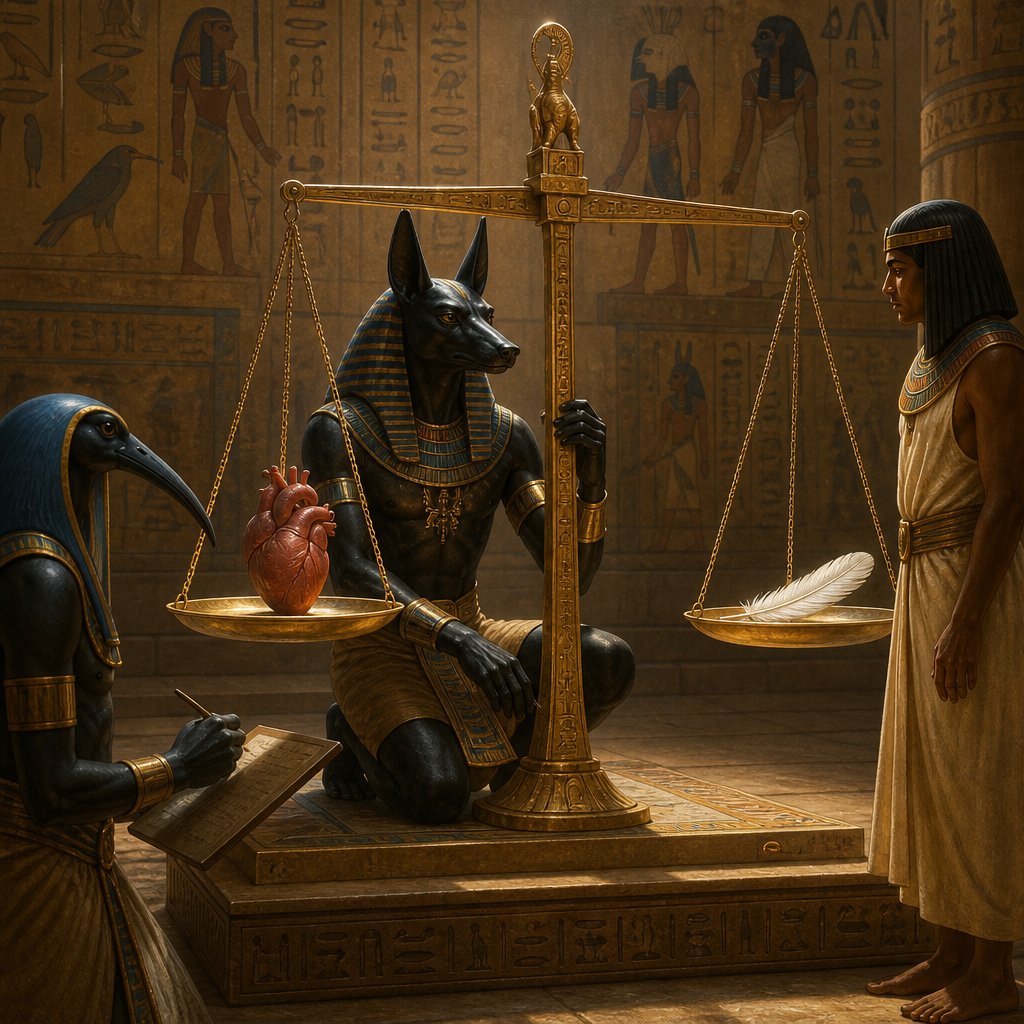
The weighing of the heart ceremony in Egyptian mythology is one of the most famous scenes from ancient Egyptian beliefs about the afterlife. It appears in funerary texts, tomb paintings, and especially in the Book of the Dead, where it represents the final judgment of a person’s soul.
For the ancient Egyptians, death was not the end. It was a passage into another existence. But reaching the peaceful afterlife required more than burial rituals and offerings. The deceased had to prove that they had lived a moral life. This proof came through the dramatic and symbolic weighing of the heart.
The Journey to the Hall of Judgment
After death, the soul of the deceased entered the underworld, often called the Duat. This was a mysterious realm filled with dangers, gates, divine beings, and tests. The dead needed spells, knowledge, and protection to pass safely through it.
Eventually, the soul arrived at the Hall of Two Truths, also known as the Hall of Ma’at. This was the place of divine judgment. Here, the gods determined whether the person was worthy of entering the afterlife.
The ceremony was not just about punishment or reward. It was about balance, truth, and cosmic order.
The Role of Ma’at
At the center of the weighing of the heart ceremony in Egyptian mythology is Ma’at, the goddess and concept of truth, justice, harmony, and order. Ma’at represented the proper balance of the universe. Pharaohs were expected to uphold Ma’at on earth, and ordinary people were expected to live according to her principles.
Ma’at is often shown wearing an ostrich feather on her head. This feather became the symbol used in the judgment ceremony.
The question was simple but profound: Was the heart of the deceased as light as the feather of Ma’at?
Why the Heart Was Weighed
Ancient Egyptians believed the heart was the seat of a person’s thoughts, emotions, memory, and moral character. Unlike some internal organs, the heart was usually left inside the body during mummification because it would be needed in the afterlife.
The heart was thought to contain the truth of a person’s life. It could not lie. Even if someone spoke well in their defense, the heart would reveal whether they had acted justly.
This made the weighing of the heart a powerful symbol of accountability. Every action, choice, and intention mattered.
The Main Figures in the Ceremony
Several important gods and beings took part in the weighing of the heart ceremony.
Anubis
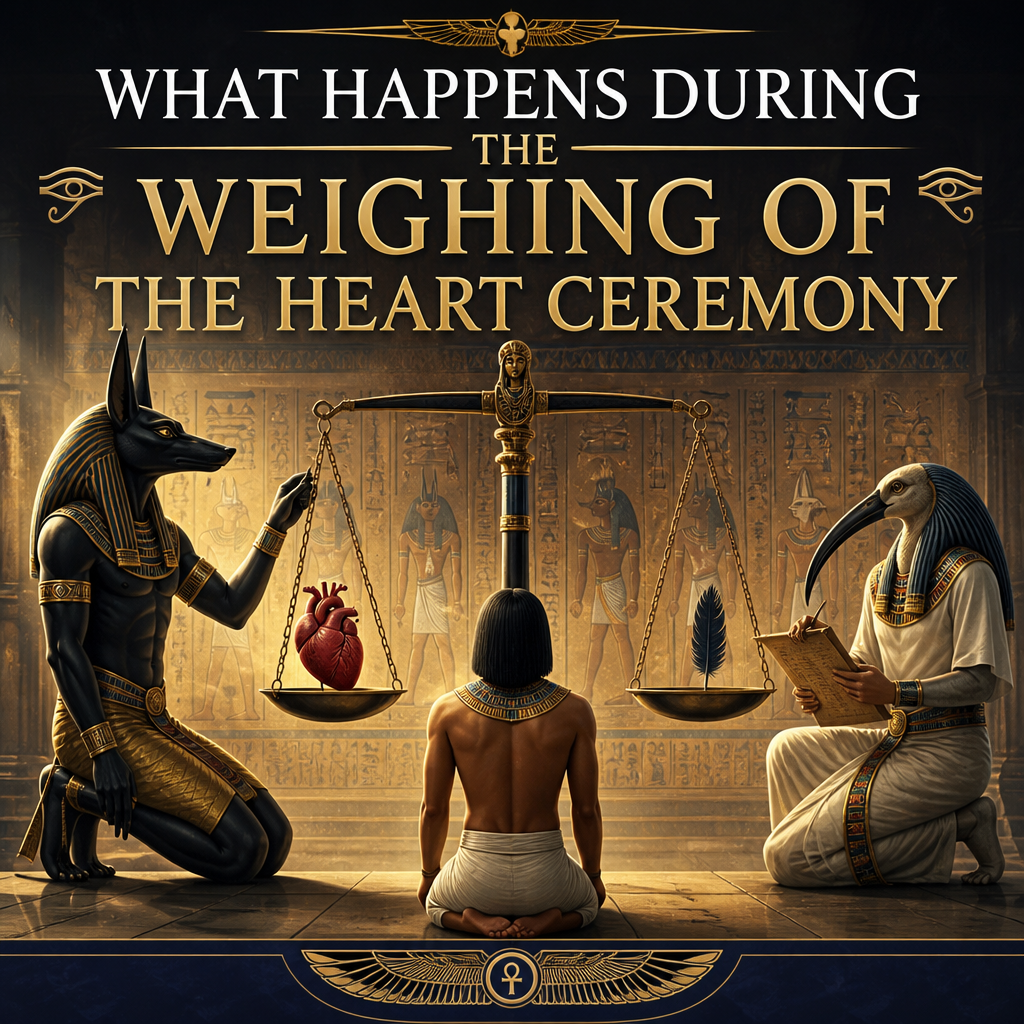
Anubis, the jackal-headed god of embalming and the dead, guided the deceased into the Hall of Judgment. He also supervised the weighing of the heart. In many images, Anubis is shown adjusting or watching the scales carefully.
His role was to make sure the judgment was fair and accurate.
Thoth
Thoth, the ibis-headed god of wisdom, writing, and knowledge, recorded the result of the weighing. As divine scribe, he noted whether the heart balanced with the feather.
Thoth’s presence emphasized that the judgment was official, truthful, and permanent.
Osiris
Osiris, lord of the underworld and god of resurrection, presided over the ceremony. He sat as the final judge, often shown enthroned with other gods nearby.
If the deceased passed the test, they were allowed to enter the blessed afterlife under Osiris’s rule.
Ammit
One of the most feared figures in the ceremony was Ammit, sometimes called the “Devourer of the Dead.” She was a terrifying creature with parts of a crocodile, lion, and hippopotamus.
Ammit waited beside the scales. If the heart failed the test, she devoured it. This did not mean ordinary death—it meant total spiritual destruction. The person would be denied eternal life.
The Negative Confession
Before or during the judgment, the deceased often recited a series of statements known as the Negative Confession. These were declarations of innocence, such as:
- “I have not stolen.”
- “I have not killed.”
- “I have not told lies.”
- “I have not caused pain.”
- “I have not cheated others.”
These statements were meant to show that the person had lived according to Ma’at. The exact list varied in different versions of the Book of the Dead, but the purpose was the same: to demonstrate moral purity before the gods.
The Weighing of the Heart
The central moment came when the heart was placed on one side of a scale. On the other side was the feather of Ma’at.
If the heart balanced with the feather, it meant the person had lived a just and honest life. Their heart was not heavy with wrongdoing. They were declared “true of voice,” meaning justified or vindicated.
If the heart was heavier than the feather, it showed that the person had been burdened by sin, dishonesty, or chaos. In that case, Ammit consumed the heart, and the soul was destroyed.
This judgment was final. There was no appeal.
What Happened If the Soul Passed?
If the deceased passed the weighing of the heart ceremony in Egyptian mythology, they were welcomed into the afterlife. This blessed realm was often called the Field of Reeds.
The Field of Reeds was imagined as an ideal version of life in Egypt. There were fertile fields, flowing water, food, family, and peace. The dead could live eternally in comfort, continuing the best parts of earthly life without suffering or disorder.
Passing the ceremony meant joining a state of harmony with the gods and the universe.
What the Ceremony Reveals About Egyptian Beliefs
The weighing of the heart ceremony reveals how deeply ancient Egyptians valued morality, balance, and truth. Their afterlife was not granted simply through wealth, status, or ritual. A person’s conduct mattered.
The ceremony also shows that Egyptian religion connected everyday behavior with cosmic order. To lie, steal, harm others, or act unjustly was not only a personal failure. It was a disruption of Ma’at itself.
Why the Weighing of the Heart Still Fascinates Us
The image of a heart being weighed against a feather remains powerful because it expresses a timeless idea: people are responsible for how they live. The ancient Egyptians turned this idea into one of the most memorable judgment scenes in world mythology.
The weighing of the heart ceremony in Egyptian mythology combines beauty, fear, justice, and hope. It reminds us that in Egyptian thought, the path to eternal life depended on living with truth, balance, and integrity.

Orin Vale has spent the better part of two decades tracing the threads that connect the world’s oldest stories — from the halls of Asgard to the banks of the Nile, from Olympus to the jungles of the Maya. What began as a childhood fascination with flood myths and trickster gods grew into years of independent study across comparative mythology and ancient religion, always chasing the same question: what did these stories mean to the people who first told them? Orin writes for readers who want more than trivia — the ones looking for the beliefs, fears, and truths that myths were built to carry.