How Did the Ancient Egyptians Believe the World Was Created?
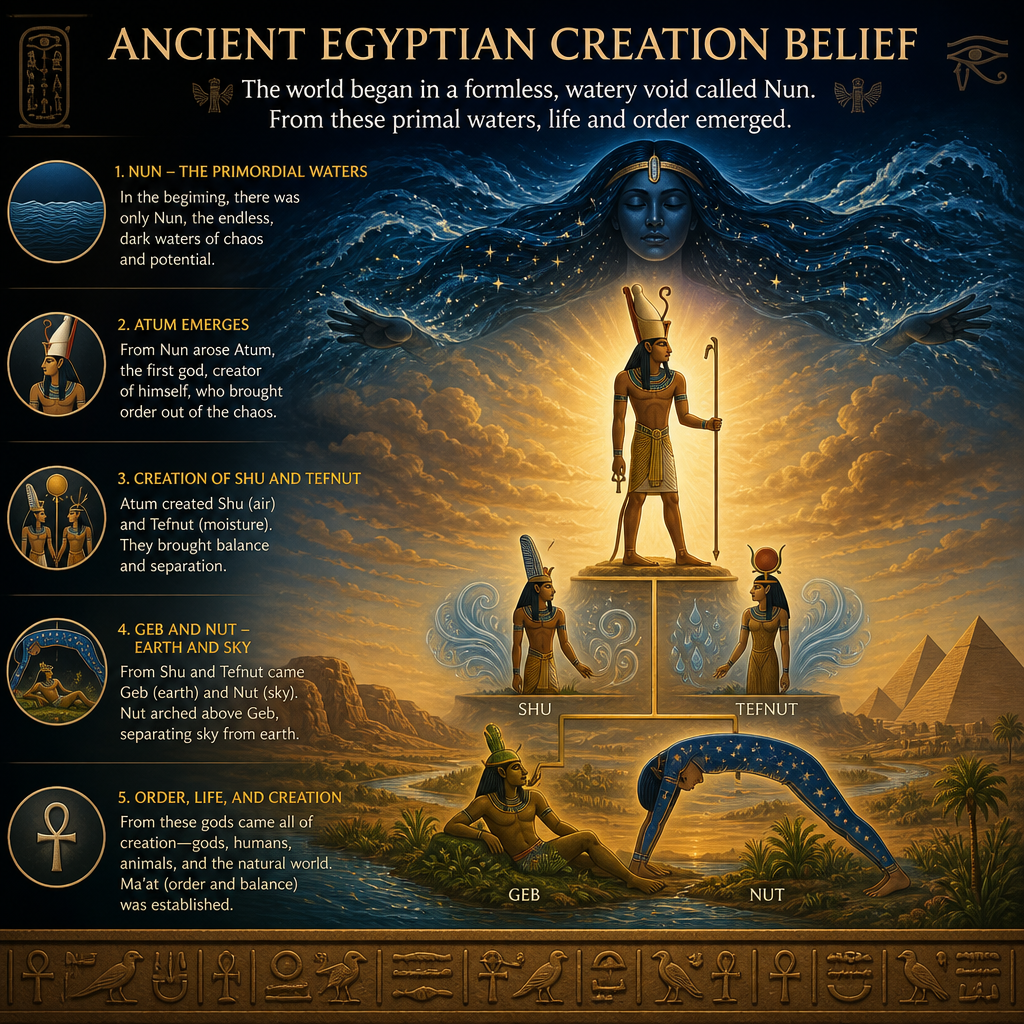
The question how did the ancient Egyptians believe the world was created has more than one answer. Ancient Egypt lasted for thousands of years, and different cities developed their own creation myths. These stories changed over time, but they shared a common idea: before the world existed, there was a dark, endless, watery chaos. From this chaos, order, land, gods, and life emerged.
For the ancient Egyptians, creation was not just a distant event in the past. It was an ongoing process. Every sunrise, every Nile flood, and every successful harvest renewed the world and held back chaos.
The Beginning: A Watery Chaos Called Nun
Most Egyptian creation stories begin with Nun, the infinite waters of chaos. Nun was not an ocean in the ordinary sense. It was a dark, formless deep that existed before the sky, earth, sun, or gods.
Nothing was solid. There was no time, no light, and no life.
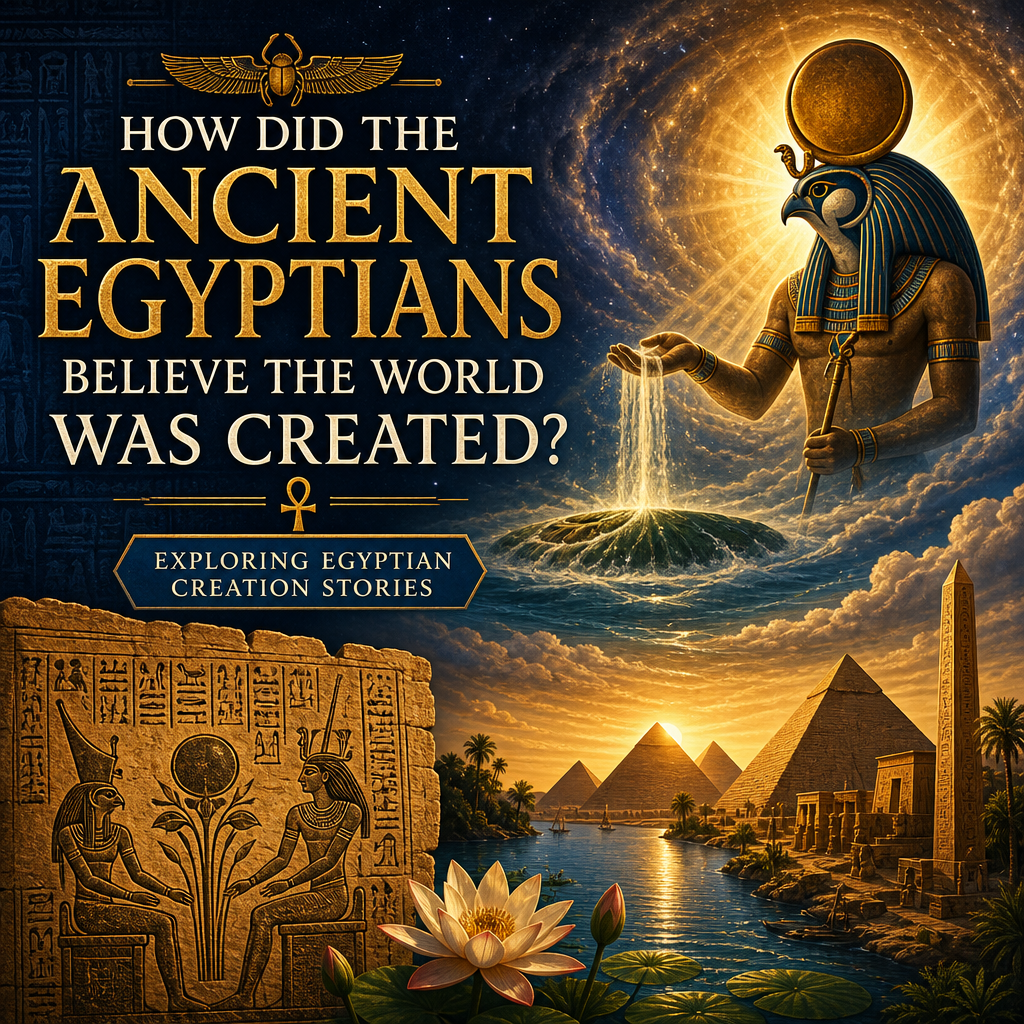
Out of this watery nothingness came the first point of land. This idea may have been inspired by the Nile River. Each year, the Nile flooded Egypt and then receded, leaving fertile soil behind. To Egyptians, the first mound of earth rising from Nun mirrored the way dry land appeared after the floodwaters withdrew.
This first mound became the sacred place where creation began.
The Heliopolitan Creation Myth
One of the most influential creation stories came from Heliopolis, a major religious center near modern Cairo. In this version, the first god was Atum.
Atum and the First Mound
Atum rose from the waters of Nun and stood upon the first mound of land. He was self-created, meaning he brought himself into existence without parents. As the first being, Atum contained the potential for all life.
Atum then created the first divine pair:
- Shu, the god of air
- Tefnut, the goddess of moisture
From Shu and Tefnut came:
- Geb, the earth god
- Nut, the sky goddess
Geb and Nut then gave birth to several major gods, including Osiris, Isis, Seth, and Nephthys.
Together, these gods formed a divine family known as the Ennead, meaning a group of nine. This family helped explain the structure of the universe: sky above, earth below, air between them, and divine order governing all things.
The Memphite Creation Myth
Another major answer to how did the ancient Egyptians believe the world was created comes from Memphis, an important political and religious city. In this version, the creator god was Ptah.
Ptah Creates Through Thought and Speech
The Memphite myth presented a more intellectual form of creation. Ptah did not create the world by physical action. Instead, he created it through his heart and tongue.
In Egyptian thought, the heart was the center of the mind and will. Ptah imagined the world in his heart and then spoke it into existence with his tongue.
This myth gave great power to words. Speech was not just communication; it was creative force. To name something was to help bring it into reality.
Ptah was especially important to craftsmen, builders, and artists. His creation story reflected the idea of a divine craftsman shaping the universe with wisdom, planning, and skill.
The Hermopolitan Creation Myth
A third important creation tradition came from Hermopolis. This myth focused on a group of eight ancient gods called the Ogdoad.
The Eight Gods of Chaos
The Ogdoad consisted of four male-female pairs. They represented the mysterious qualities of the world before creation, such as darkness, hiddenness, and infinity.
These eight gods existed in the waters of chaos before the ordered world appeared. In some versions, they created a cosmic egg. From this egg came the sun god, whose first light began creation.
In other versions, a lotus flower rose from the waters, and the young sun god emerged from it. When the sun appeared, darkness was pushed back and the world began to take form.
This myth emphasized light as the beginning of order.
The Role of the Sun in Creation
The sun was central to Egyptian ideas about creation. Each sunrise was seen as a daily rebirth of the world. The sun god, often known as Ra, traveled across the sky during the day and through the underworld at night.
At dawn, Ra was reborn and brought light back to the earth.
This daily cycle reflected the larger pattern of creation:
- Darkness gives way to light
- Chaos gives way to order
- Death gives way to renewal
Because of this, the ancient Egyptians did not see creation as something that happened only once. They believed the universe had to be renewed every day.
Ma’at: The Order of the Created World
A key concept in Egyptian belief was Ma’at, meaning truth, balance, justice, and cosmic order. Creation was the act of establishing Ma’at out of chaos.
The gods, kings, priests, and ordinary people all had roles in maintaining Ma’at. If order failed, chaos could return.
Pharaohs were especially important because they were believed to protect Egypt’s harmony through rituals, laws, and offerings to the gods. Temples were not just places of worship; they were centers where the created order was preserved.
Why Were There Different Creation Myths?
Modern readers may wonder why the ancient Egyptians had several creation stories. To them, these myths did not necessarily contradict one another. Each story expressed a different truth about creation.
One myth described creation as birth. Another described it as speech. Another described it as the first sunrise. Together, they offered a rich picture of how the world came from chaos into order.
Different cities promoted different creator gods because local temples and priesthoods emphasized their own traditions. Yet the shared themes remained remarkably consistent.
Conclusion
So, how did the ancient Egyptians believe the world was created? They believed the world emerged from a dark, watery chaos called Nun. From this chaos came the first land, the first god, the sun, and eventually all life.
Whether through Atum rising on the first mound, Ptah speaking the world into being, or the sun emerging from a cosmic egg or lotus, Egyptian creation myths all focused on the triumph of order over chaos.
For the ancient Egyptians, creation was not only the beginning of the universe. It was a daily miracle, renewed with every sunrise and protected through Ma’at, the sacred order that held the world together.

Orin Vale has spent the better part of two decades tracing the threads that connect the world’s oldest stories — from the halls of Asgard to the banks of the Nile, from Olympus to the jungles of the Maya. What began as a childhood fascination with flood myths and trickster gods grew into years of independent study across comparative mythology and ancient religion, always chasing the same question: what did these stories mean to the people who first told them? Orin writes for readers who want more than trivia — the ones looking for the beliefs, fears, and truths that myths were built to carry.