What Happens When Ra Travels Through the Underworld at Night?
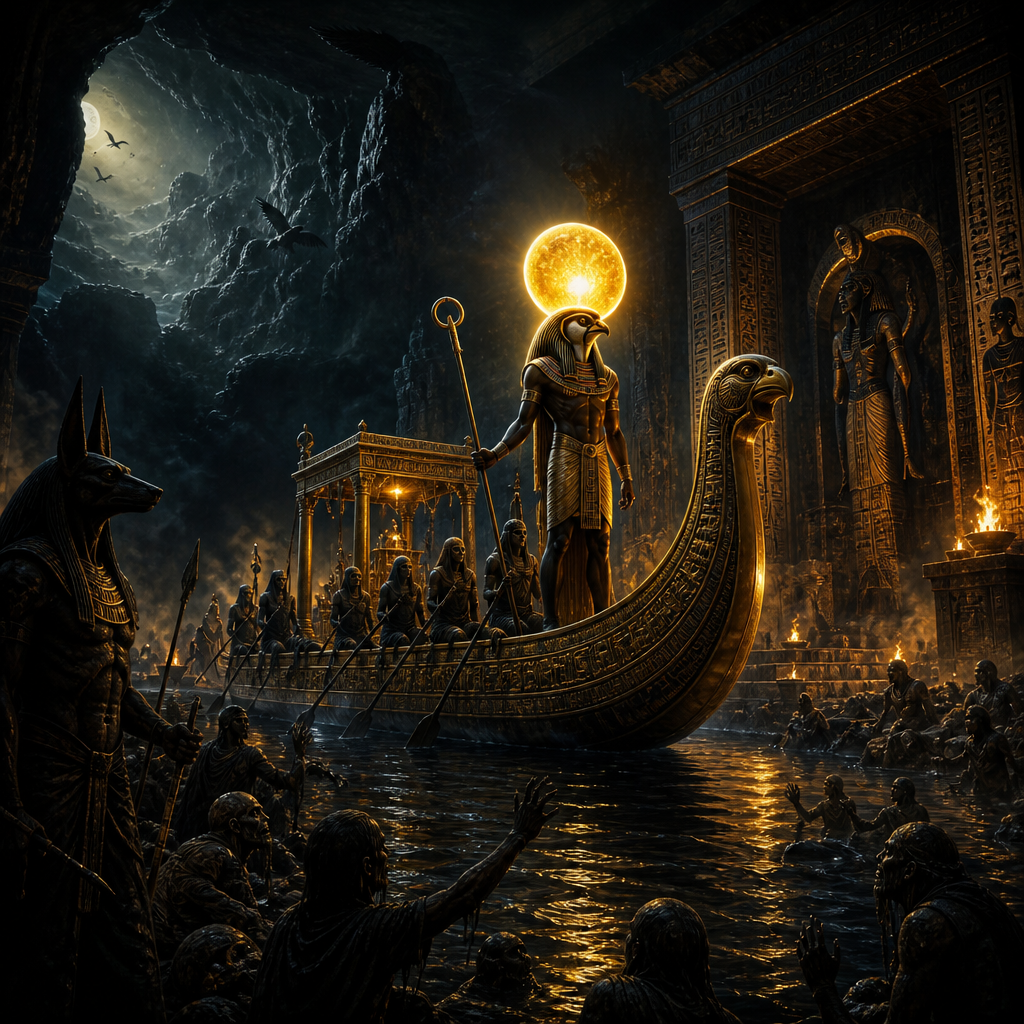
In ancient Egyptian mythology, the sun did not simply disappear at sunset. Each evening, the sun god Ra began a dangerous and sacred journey through the underworld, a mysterious realm known as the Duat. This nightly voyage explained the cycle of sunset and sunrise, but it also carried deep spiritual meaning for life, death, rebirth, and cosmic order.
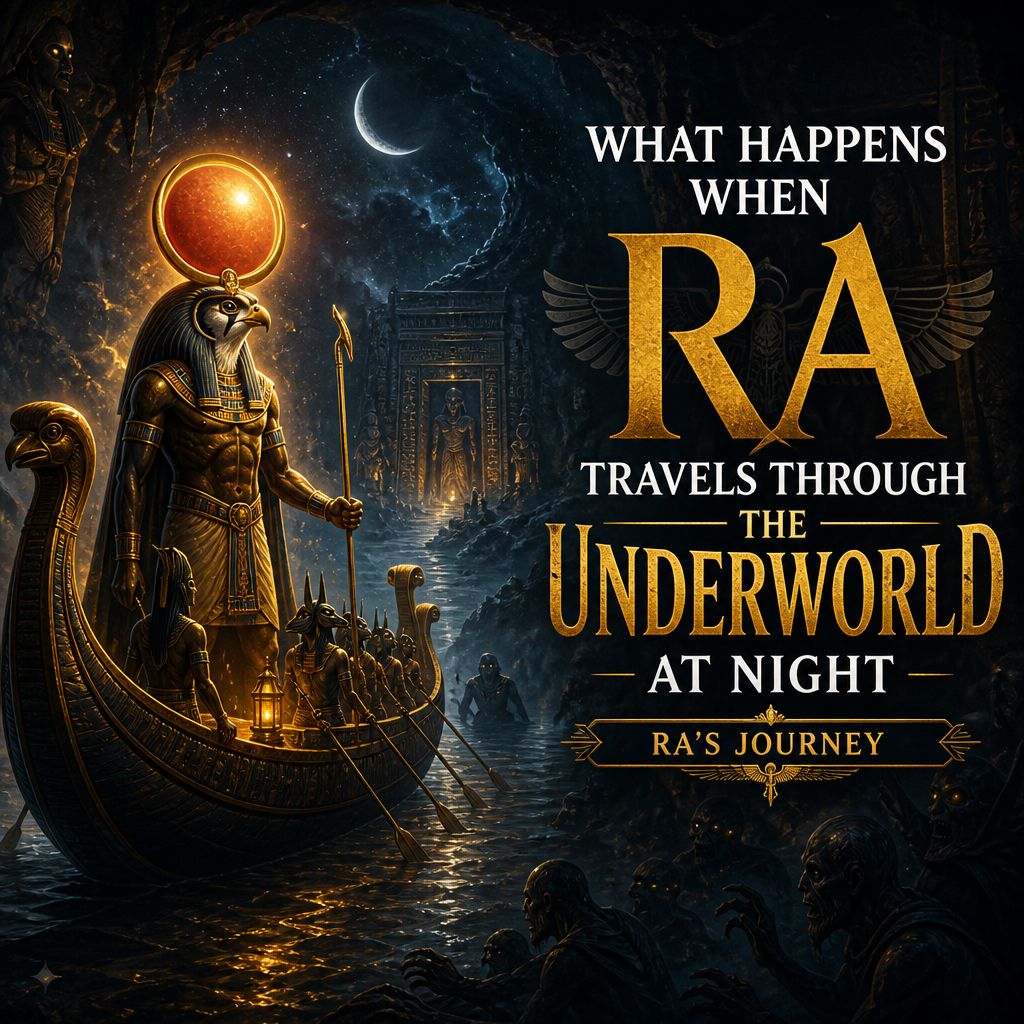
So, what happens when Ra travels through the underworld at night? According to Egyptian belief, Ra sails through the Duat in his solar barque, faces powerful enemies, brings light to the dead, and is reborn with the dawn.
Ra and the Daily Cycle of the Sun
Ra was one of the most important gods in ancient Egypt. As the sun god, he represented light, warmth, creation, and life itself. During the day, Ra crossed the sky in his solar boat, bringing sunlight to the world.
At sunset, however, Ra entered the western horizon and passed into the underworld. This was not seen as an ending, but as part of an eternal cycle. Night was the hidden half of Ra’s journey, where he traveled through darkness before rising again in the east.
To the ancient Egyptians, sunrise was proof that Ra had survived the dangers of the night and restored balance to the universe.
The Underworld: The Realm of the Duat
The Egyptian underworld, called the Duat, was not simply a place of punishment. It was a complex spiritual realm filled with rivers, caverns, gates, gods, spirits, monsters, and the souls of the dead.
The Duat was often imagined as a hidden landscape beneath the earth or beyond the western horizon. It was divided into stages or hours of the night. In many funerary texts, Ra’s journey through the underworld lasted twelve hours, matching the twelve hours of darkness.
Each hour brought a new region, challenge, and transformation.
Ra’s Solar Barque
Ra traveled through the underworld in a sacred boat known as the solar barque. During the daytime, he sailed across the sky in one boat, and at night he used another to pass through the Duat.
He was not always alone. Other gods and divine beings accompanied him, helping guide and protect the vessel. These companions could include deities such as Sia, who represented perception, and Hu, who represented divine command. Together, they helped Ra maintain order during his passage through chaos.
The solar barque was more than transportation. It symbolized the movement of the sun, the journey of the soul, and the ongoing renewal of creation.
The Twelve Hours of the Night
Ancient Egyptian texts such as the Amduat and the Book of Gates describe Ra’s journey in great detail. The night was divided into twelve hours, each with its own landscape and events.
The Early Hours
In the first hours after sunset, Ra enters the Duat and is welcomed by underworld deities. His presence brings light to the dead, who depend on his nightly arrival. For a brief time, the souls in the underworld are revived by his radiance.
Ra’s journey also restores order to the hidden world. Just as he brings life to the living during the day, he brings renewal to the dead at night.
The Middle Hours
The middle of the night is the most dangerous part of the journey. Ra passes through deeper and darker regions of the Duat. Here, the forces of chaos become stronger.
This is also where one of the most important events occurs: Ra unites with Osiris, the god of the dead. This union represents a powerful mystery. Ra, the living sun, joins with Osiris, the ruler of the afterlife. Through this meeting, both gods are renewed.
This moment reflects one of the central ideas of Egyptian religion: death and rebirth are connected.
The Final Hours
In the last hours of the night, Ra prepares for rebirth. The solar barque moves toward the eastern horizon, and the darkness begins to weaken.
Ra is transformed and rejuvenated, often associated with the scarab beetle god Khepri, who represents the rising sun. As dawn approaches, Ra emerges from the underworld and rises into the sky once more.
The sunrise is not just a natural event. It is a victory over darkness, danger, and chaos.
Ra’s Battle with Apophis
The most famous danger Ra faces in the underworld is Apophis, also called Apep. Apophis is a giant serpent and the enemy of the sun god. He represents chaos, destruction, and the threat of nonexistence.
Every night, Apophis tries to stop Ra’s boat and prevent the sun from rising. If Apophis succeeded, the world would fall into darkness and disorder.
Ra’s defenders fight the serpent using spells, weapons, and divine power. In some myths, the god Set plays a role in protecting Ra by striking Apophis down. Though Apophis is defeated each night, he is never destroyed forever. The battle must happen again and again.
This endless conflict reflects the Egyptian belief that cosmic order, or ma’at, had to be constantly protected from chaos.
Why Ra’s Night Journey Mattered
Ra’s travel through the underworld was more than a myth about the sun. It helped ancient Egyptians understand the universe and their place within it.
The journey symbolized:
- The cycle of life, death, and rebirth
- The triumph of light over darkness
- The renewal of the sun each morning
- The hope of rebirth after death
- The need to maintain cosmic order
For the dead, Ra’s nightly passage was especially important. His light brought them temporary life and nourishment. Funerary texts often included spells and images from Ra’s underworld journey to help the deceased navigate the afterlife.
The Meaning of Ra’s Rebirth
When Ra rises at dawn, he is renewed. The old sun of yesterday has passed through deathlike darkness and returned as the young morning sun. This rebirth gave the Egyptians hope that death was not final.
Just as Ra emerged from the Duat each morning, a person’s soul could also be renewed in the afterlife if properly prepared and judged worthy.
This is why Egyptian tombs, coffins, and funerary texts often included images of the solar journey. They connected the deceased with Ra’s eternal cycle and offered the promise of transformation.
Conclusion
What happens when Ra travels through the underworld at night is one of the most powerful stories in ancient Egyptian mythology. He sails through the Duat in his solar barque, lights the realm of the dead, unites with Osiris, battles the chaos serpent Apophis, and is reborn at sunrise.
For the ancient Egyptians, this journey explained the daily return of the sun and revealed a deeper truth: darkness is temporary, order must be defended, and life can be renewed after death.

Orin Vale has spent the better part of two decades tracing the threads that connect the world’s oldest stories — from the halls of Asgard to the banks of the Nile, from Olympus to the jungles of the Maya. What began as a childhood fascination with flood myths and trickster gods grew into years of independent study across comparative mythology and ancient religion, always chasing the same question: what did these stories mean to the people who first told them? Orin writes for readers who want more than trivia — the ones looking for the beliefs, fears, and truths that myths were built to carry.