Who Is Hodr in Norse Mythology?
Hodr, sometimes written as Höðr or Hoder, is one of the most tragic figures in Norse mythology. He is best known as the blind god who unknowingly kills Baldr, the beloved son of Odin and Frigg. While Hodr does not appear in as many stories as gods like Thor, Loki, or Odin, his role is central to one of the most important myths in the Norse tradition: the death of Baldr and the beginning of the events leading toward Ragnarök.
To understand who Hodr is in Norse mythology, it is important to look at his family, his blindness, his connection to Loki, and the deeper meaning behind his tragic act.
Hodr’s Place Among the Norse Gods
Hodr belongs to the Æsir, the main tribe of Norse gods who live in Asgard. He is usually described as a son of Odin, the All-Father, making him a brother of Baldr. In some sources, his mother is not clearly named, though Baldr’s mother is Frigg, the queen of the gods.
Unlike many other Norse gods, Hodr is not associated with a major domain such as thunder, war, fertility, or wisdom. His identity is shaped mostly by one defining feature: he is blind. This blindness is not only physical but also symbolic, as it plays a key part in the story that makes him famous.
Hodr is not presented as evil in the traditional myths. Instead, he is often seen as an innocent or helpless figure who is manipulated into committing a terrible deed.
The Death of Baldr
The most famous story involving Hodr begins with Baldr, the shining and beautiful god loved by nearly everyone. Baldr starts having disturbing dreams about his own death. Since dreams were taken seriously in Norse culture, the gods become worried.
Baldr’s mother, Frigg, tries to protect him by traveling through the worlds and asking every living thing and object to swear never to harm her son. Fire, water, metals, stones, animals, diseases, and many other forces all make this promise.
Because of this, Baldr becomes invulnerable. The gods turn his protection into a kind of game. They throw weapons, stones, and other objects at him, and everything harmlessly bounces away. It becomes a strange celebration of his apparent immortality.
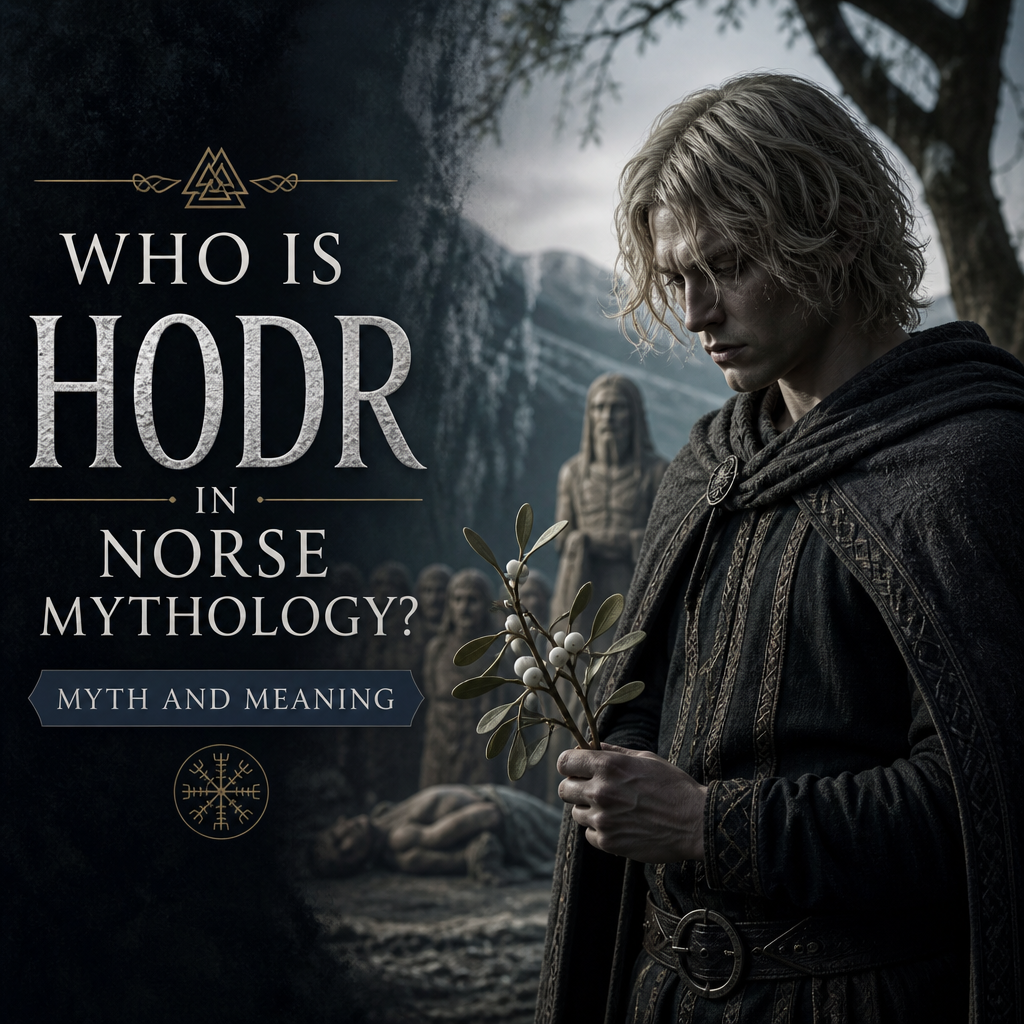
However, Frigg overlooks one small plant: mistletoe. She considers it too young or too harmless to require an oath.
Loki’s Role in Hodr’s Tragedy
Loki, the trickster god, discovers this weakness. In many versions of the myth, he disguises himself and questions Frigg until he learns that mistletoe was never made to promise not to harm Baldr.
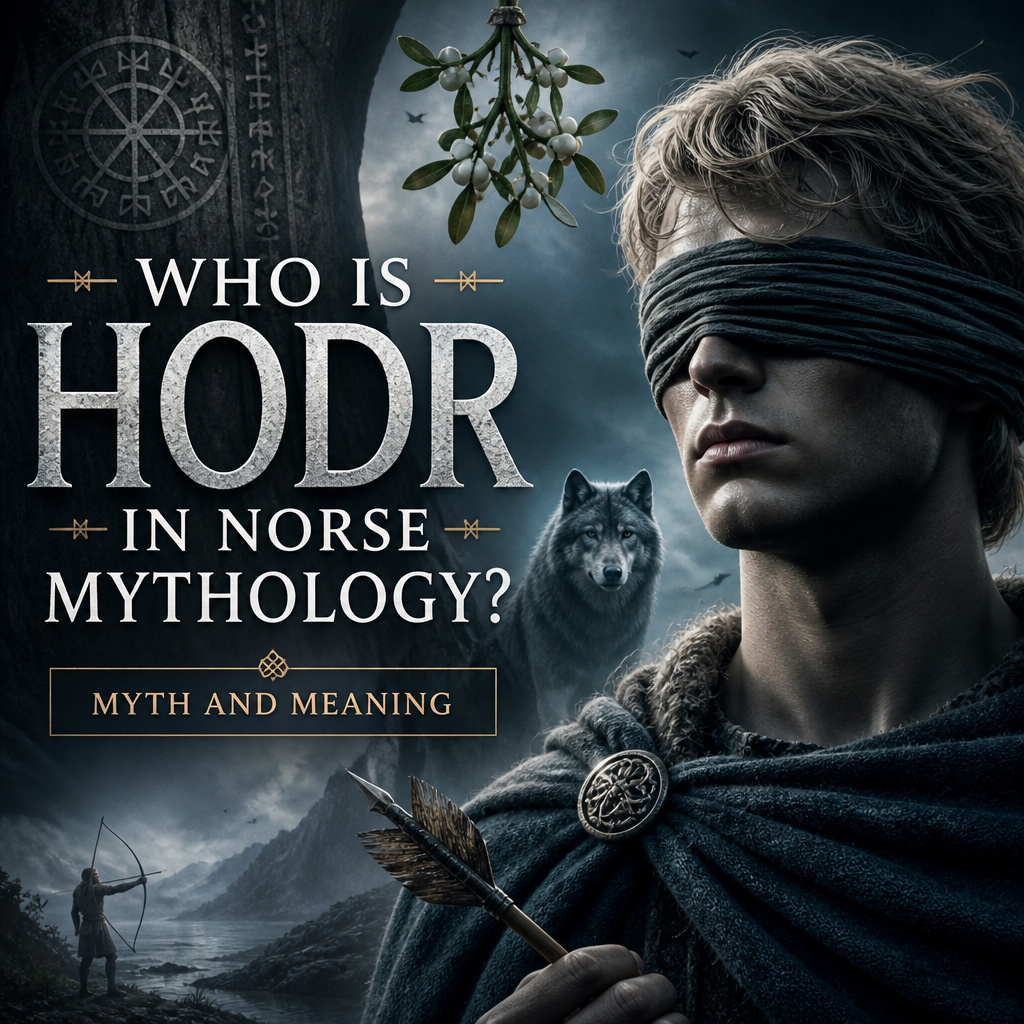
Loki then makes a weapon from mistletoe, often described as a dart, arrow, or spear. He approaches Hodr, who is standing aside from the game because he cannot see.
Loki asks Hodr why he is not joining the others. Hodr explains that he is blind and has no weapon. Loki offers to guide his hand and gives him the mistletoe weapon. Trusting Loki, Hodr throws it toward Baldr.
The mistletoe strikes Baldr, and Baldr dies instantly.
This moment is one of the most heartbreaking scenes in Norse mythology. Hodr does not understand what he has done until it is too late. Loki is the true mastermind behind the killing, but Hodr is the one whose hand delivers the fatal blow.
Is Hodr a Villain?
Hodr is usually not considered a villain in the same way Loki can be seen as one. His action is fatal, but it is not intentional. He is deceived and used as a tool.
This makes Hodr a tragic character rather than a purely wicked one. His blindness emphasizes his lack of knowledge and control. He cannot see the weapon, he cannot see Baldr, and he cannot see Loki’s real motive.
In this sense, Hodr represents innocence caught in a larger web of fate. Norse mythology often shows that even the gods cannot escape destiny. Baldr’s death is not merely an accident; it is part of the chain of events that leads to Ragnarök, the final battle and destruction of the old world.
Hodr’s Death and Vali’s Revenge
After Baldr’s death, the gods are overcome with grief and rage. In Norse tradition, the killing of a family member demands vengeance, even when the act is complicated by deception.
Odin fathers a son named Vali, who grows to adulthood in a single day. Vali’s purpose is to avenge Baldr. He kills Hodr, fulfilling the demand for revenge.
This part of the story adds another layer of tragedy. Hodr kills Baldr without meaning to, and then Hodr himself is killed in return. The cycle of death cannot be avoided.
Hodr After Ragnarök
Although Hodr dies before Ragnarök, some sources say he returns after the great destruction. In the renewed world that rises after Ragnarök, both Baldr and Hodr come back and dwell together in peace.
This reunion is significant. It suggests healing after cosmic disaster. The brothers who were divided by death and tragedy are restored in the new world. Their return represents renewal, forgiveness, and the possibility of a better age after the fall of the old gods.
What Does Hodr Symbolize?
Hodr’s story can be interpreted in several ways. Like many figures in Norse mythology, he is not simple or one-dimensional.
Hodr may symbolize:
- Blindness and ignorance: He acts without understanding the consequences.
- Innocence manipulated by evil: Loki uses him to carry out a harmful plan.
- The power of fate: Even the gods cannot prevent Baldr’s death.
- Tragic responsibility: Hodr is guilty in action, though not in intention.
- Renewal after suffering: His return with Baldr after Ragnarök suggests reconciliation.
These themes help explain why Hodr remains memorable despite appearing in relatively few myths.
Why Hodr Matters in Norse Mythology
Hodr matters because his story is tied to one of the most important turning points in Norse myth. Baldr’s death marks the beginning of the end for the gods. It signals that the perfect order of Asgard is breaking down and that Ragnarök is approaching.
When asking “who is Hodr in Norse mythology,” the answer is not simply “the blind god who killed Baldr.” He is also a symbol of tragedy, fate, and the dangerous power of manipulation. His story shows how a single act, even one done unknowingly, can change the destiny of the cosmos.
Hodr’s tale is brief, but its impact is enormous. Through him, Norse mythology explores guilt, innocence, destiny, and the hope of restoration after ruin.

Orin Vale has spent the better part of two decades tracing the threads that connect the world’s oldest stories — from the halls of Asgard to the banks of the Nile, from Olympus to the jungles of the Maya. What began as a childhood fascination with flood myths and trickster gods grew into years of independent study across comparative mythology and ancient religion, always chasing the same question: what did these stories mean to the people who first told them? Orin writes for readers who want more than trivia — the ones looking for the beliefs, fears, and truths that myths were built to carry.