Roman mythology’s sacred objects reinforced both religious devotion and civic identity, from the household shrine to the battlefield standard. This guide brings together the essential symbols of Roman mythology, organized by the powers they represent, from Jupiter’s thunderbolt to the she-wolf that nursed Rome’s legendary founders.
Symbols of State and Military Power
Fasces
The fasces, a bundle of rods bound around a bronze axe, symbolized the authority and power of Roman magistrates to punish and execute, later becoming one of the most recognized emblems of Roman civic order.
Aquila (Roman Eagle Standard)
The Aquila, a golden eagle standard carried by every Roman legion, embodied both Jupiter’s authority and the honor of the unit itself; losing one in battle was considered a catastrophic disgrace.
Spear of Mars
Kept within the Regia in Rome, the sacred Spear of Mars was believed to move on its own as an omen of coming war, symbolizing the god’s watchful presence over the fate of the Roman state.
Laurel Wreath of Triumph
The laurel wreath, sacred to Apollo, crowned victorious Roman generals during triumphal processions, symbolizing honor, achievement, and divine favor granted through military success.
Founding and Legendary Rome
She-Wolf of Rome (Lupa Capitolina)
The she-wolf who nursed the abandoned twins Romulus and Remus became Rome’s most enduring founding symbol, representing survival, protection, and the city’s legendary origins.
Golden Bough
In Virgil’s Aeneid, the Golden Bough granted Aeneas safe passage into the underworld, symbolizing the rare privilege of crossing between the world of the living and the realm of the dead.
Palladium of Vesta
According to Roman tradition, the sacred Palladium was carried from Troy to Italy by Aeneas and kept safe in the Temple of Vesta, symbolizing Rome’s mythical inheritance of Trojan legitimacy and divine protection.
Divine Attributes of the Twelve
Thunderbolt of Jupiter
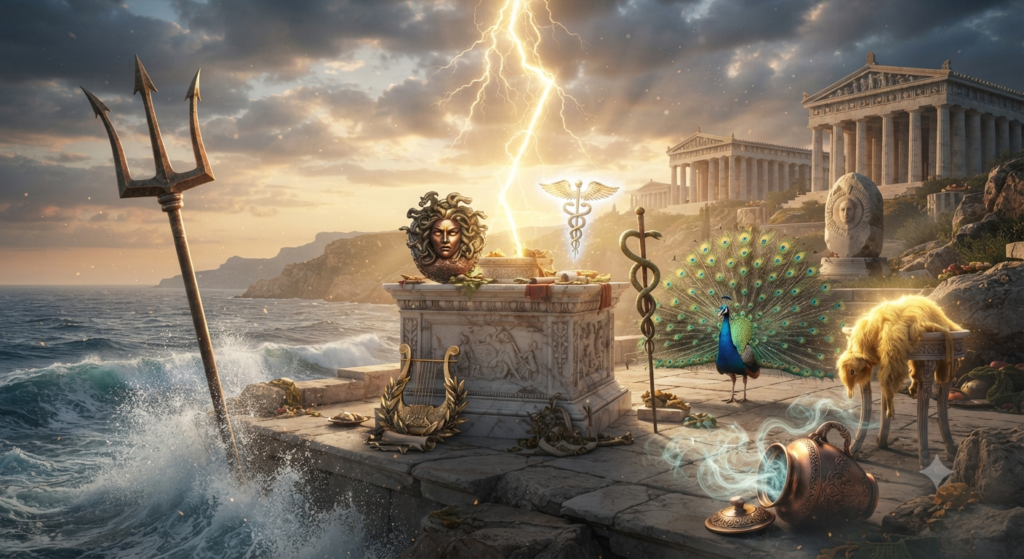
Jupiter’s thunderbolt symbolized his supreme authority over both gods and the Roman state, and unexplained lightning strikes were carefully interpreted by priests as direct messages from the god.
Trident of Neptune
Neptune’s trident symbolized his command over the seas, storms, and earthquakes, serving as the defining emblem of his power throughout Roman maritime religion and art.
Peacock of Juno
The peacock, with its striking eye-patterned tail, symbolized Juno’s regal authority and watchfulness as queen of the Roman gods and protector of the Roman state.
Owl of Minerva
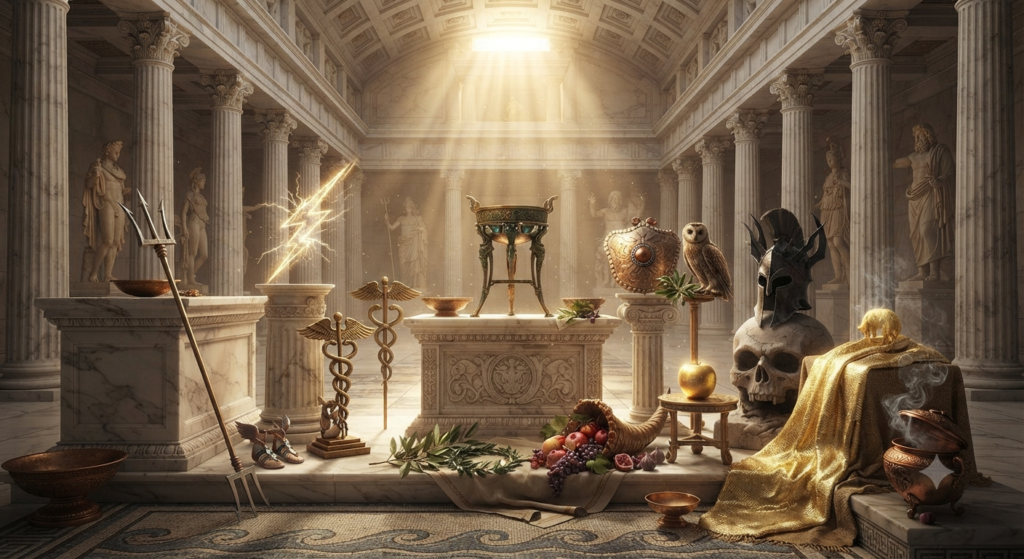
The owl symbolized Minerva’s wisdom, strategic insight, and mastery of crafts, reinforcing her role as one of Rome’s three great state deities alongside Jupiter and Juno.
Sickle of Saturn
Saturn’s sickle symbolized both the harvest and the passage of time, tying the old god to Rome’s agricultural roots and the legendary abundance of the mythical Golden Age.
Hammer and Anvil of Vulcan
The hammer and anvil symbolized Vulcan’s mastery over fire and metal, representing the divine craftsmanship behind the weapons and armor forged for gods and heroes alike.
Wheat Sheaf of Ceres
The bundled wheat sheaf symbolized Ceres’s dominion over agriculture and the harvest, representing the fertility of the land that sustained Rome’s growing population.
Messengers, Love, and Wine
Caduceus of Mercury
The winged, serpent-entwined caduceus symbolized Mercury’s role as messenger and patron of commerce, negotiation, and safe travel between the mortal world and beyond.
Winged Sandals of Mercury (Talaria)
Known as the Talaria, Mercury’s winged sandals granted him extraordinary speed, symbolizing swift communication and his unique freedom to move between the realms of gods, mortals, and the dead.
Girdle of Venus
Venus’s golden girdle was said to make its wearer irresistibly desirable, symbolizing the overwhelming and sometimes dangerous power of love and attraction in Roman mythology.
Bow and Arrows of Cupid
Cupid’s golden arrows inspired uncontrollable love, while his leaden arrows provoked aversion, symbolizing the unpredictable and often involuntary power of desire over gods and mortals alike.
Thyrsus of Bacchus
The ivy-wrapped thyrsus symbolized Bacchus’s connection to wine, fertility, and ecstatic ritual, carried by his followers during the sometimes-controversial Bacchanalia celebrations.
Fate, Boundaries, and Beginnings
Wheel of Fortuna
The ever-turning Wheel of Fortuna symbolized the unpredictable rise and fall of fortune in Roman life, a favorite image in literature and art for the instability of wealth, power, and fate.
Rudder of Fortuna
Fortuna’s ship’s rudder symbolized her power to steer the course of human fate, guiding fortune’s unpredictable direction much as a helmsman steers a vessel through uncertain seas.
Two Faces of Janus
Janus’s two faces, looking simultaneously backward and forward, symbolized transitions, doorways, and the connection between past and future, making him uniquely suited to preside over every beginning.
Key of Janus
As guardian of gates and doorways, Janus was often depicted holding a key, symbolizing his control over access, transitions, and the opening and closing of every significant undertaking.
Boundary Stone of Terminus
The simple stone marker representing Terminus symbolized the sanctity of property boundaries in Roman law and religion, considered too sacred to be moved once properly consecrated.
Household and Personal Religion
Lares and Penates
The Lares and Penates were protective household spirits honored daily at small family shrines, symbolizing the sanctity of the Roman home and the ever-present guardianship of ancestral and domestic deities.
Genius (Roman Guardian Spirit)
Every Roman individual, family, and even place was believed to have its own genius, a protective spirit representing its vital essence and guiding fortune throughout its existence.
Sacred Fire of Vesta
The unending sacred flame tended by the Vestal Virgins symbolized the continuity and stability of the Roman state itself, its extinguishing considered a grave omen for Rome’s future.
Ritual and Healing
Patera (Sacrificial Offering Bowl)
The patera, a shallow bronze bowl used to pour ritual libations, symbolized the proper performance of Roman religious duty, appearing constantly in depictions of sacrifice and prayer.
Cornucopia of Abundance
The cornucopia, or horn of plenty, symbolized inexhaustible abundance in Roman religion, frequently associated with Fortuna, Ceres, and other deities of prosperity and fertility.
Serpent of Aesculapius’s Arrival in Rome
According to Roman tradition, the healing god Aesculapius arrived in Rome in the form of a sacred serpent during a devastating plague, choosing Tiber Island as the site of his temple and lasting cult.
Clarifications and Distinctions
Fasces vs. SPQR
While the fasces was a religious and civic symbol of a magistrate’s authority to punish, SPQR (“The Senate and People of Rome”) was a political motto and administrative emblem rather than a mythological symbol tied to any specific god.
Difference Between Lares and Penates
While the Lares protected the household and its crossroads more broadly, the Penates specifically guarded the family’s stores and pantry, together forming the two pillars of Roman domestic religious practice.
What Is a Roman Genius
In Roman religion, a genius was the protective, guiding spirit believed to accompany every person, family, or place throughout its existence, a concept distinct from the modern English meaning of the word.
Aquila vs. Eagle of Jupiter
While Jupiter’s eagle is a mythological attribute symbolizing his authority in religious art and myth, the Aquila was a specific, physical military standard carried by Roman legions, invoking that same divine authority for the army’s protection and honor.
Frequently Asked Questions
What is the most important symbol in Roman mythology?
The fasces and the Aquila eagle standard are often considered the most important civic and military symbols, though the sacred fire of Vesta held equal importance for the religious stability of the state.
Why was the she-wolf so important to Roman identity?
The she-wolf represented Rome’s legendary founding story, symbolizing resilience and divine protection over the city from its very earliest, most vulnerable moment.
What does the Wheel of Fortuna represent?
The Wheel of Fortuna represents the unpredictable and cyclical nature of luck, wealth, and power, reminding Romans that fortune could rise or fall without warning.
Are Roman symbols still used today?
Yes — the fasces, laurel wreath, and eagle standard remain widely referenced in modern government emblems, military insignia, and popular culture around the world.
What is the difference between a Roman symbol and a Roman ritual object?
A symbol like the thunderbolt represents a god’s power conceptually, while a ritual object like the patera was a physical tool actually used in the performance of religious ceremonies.
Why did Romans keep guardian spirits like the Lares in their homes?
Household guardian spirits reflected the deeply personal and domestic side of Roman religion, extending state-level religious practice down to the level of individual families and homes.
What is the connection between Aeneas and Roman symbols?
Aeneas, the legendary Trojan ancestor of the Romans, is connected to several key symbols, including the Golden Bough and the Palladium, tying Roman religious identity directly back to Troy.
How did Roman symbols differ from Greek symbols?
While many Roman symbols were adapted from Greek equivalents, Roman symbols often placed greater emphasis on state authority, military honor, and civic order rather than personal mythological narrative alone.

Orin Vale has spent the better part of two decades tracing the threads that connect the world’s oldest stories — from the halls of Asgard to the banks of the Nile, from Olympus to the jungles of the Maya. What began as a childhood fascination with flood myths and trickster gods grew into years of independent study across comparative mythology and ancient religion, always chasing the same question: what did these stories mean to the people who first told them? Orin writes for readers who want more than trivia — the ones looking for the beliefs, fears, and truths that myths were built to carry.