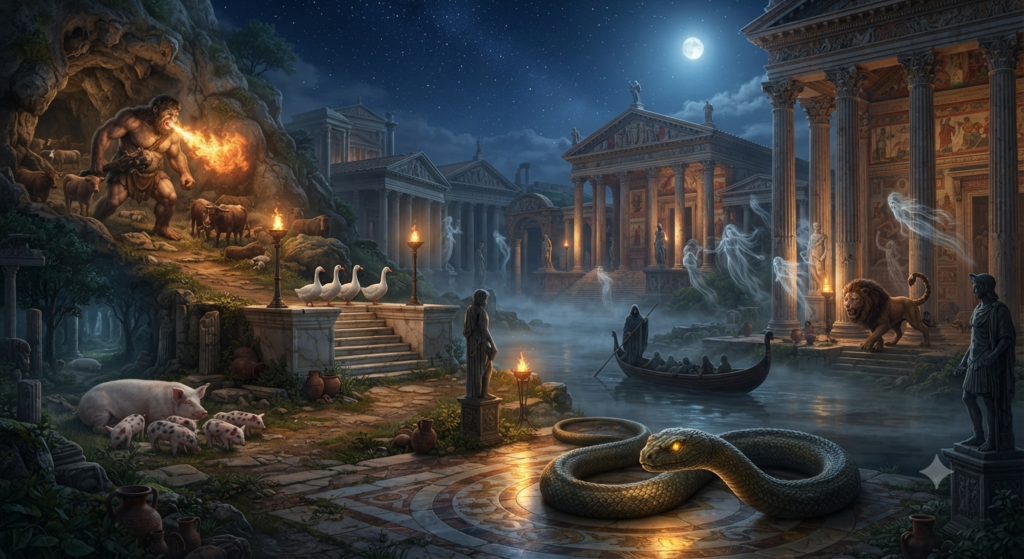
While Roman mythology absorbed many Greek monsters wholesale, it also developed its own distinct bestiary of household spirits, folk demons, prophetic animals, and creatures drawn from Roman natural history. This guide brings together the essential creatures of Roman mythology, from the fire-breathing Cacus to the restless spirits of the Roman dead.
Legendary Foes of Rome’s Founding Heroes
Cacus
Cacus was a monstrous, fire-breathing giant who stole cattle from Hercules and hid them in his lair on the future site of Rome, only to be discovered and killed, an early legendary episode tied to the land where Rome would rise.
Geryon
The three-bodied giant Geryon guarded a herd of magnificent red cattle that Hercules was tasked with stealing, driving the cattle back through Italy in a journey that later Roman tradition linked to Cacus and the founding of Rome.
Serpents of Laocoön
Sent by the gods to punish Laocoön for warning Troy against the wooden horse, these great sea serpents crushed him and his sons, a scene immortalized in Virgil’s Aeneid and later in one of the most celebrated sculptures of the ancient world.
Spirits of the Roman Dead
Lemures
The Lemures were restless, potentially malevolent spirits of the dead believed to haunt Roman households, ritually driven away each year during the nighttime festival of Lemuria through offerings of black beans.
Larvae
Unlike the ancestral Lares, the Larvae were the malevolent ghosts of those who had died wickedly or violently, believed to torment the living and requiring careful ritual precaution to avoid.
Manes
The Manes were the collective spirits of deceased ancestors, generally regarded as benevolent when properly honored through funerary rites and the annual festival of Parentalia.
Charon
Charon ferried the shades of the dead across the underworld river in exchange for a coin, a belief so deeply embedded in Roman burial custom that coins were commonly placed with the deceased to pay his fare.
Furies (Furiae/Dirae)
Known as the Furiae or Dirae, the Furies were terrifying spirits of vengeance who relentlessly pursued and tormented those guilty of grave crimes, particularly the murder of family members.
Omens and Sacred Animals of Rome
Sow of Lavinium
A white sow that gave birth to thirty piglets served as a prophetic sign guiding Aeneas to the future site of Lavinium, later interpreted as an omen of the thirty Latin cities that would one day be founded.
Capitoline Geese
According to Roman legend, sacred geese kept on the Capitoline Hill raised the alarm when Gallic invaders attempted a surprise night assault, saving Rome from conquest and earning lasting honor in Roman memory.
Creatures of Roman Natural History
Roman Basilisk
Described by the Roman naturalist Pliny the Elder, the basilisk was said to be a small but supremely deadly serpent whose gaze or breath alone could kill, a legendary creature that later spread widely through medieval bestiaries.
Roman Manticore
Transmitted to Roman audiences through Pliny the Elder’s Natural History, the manticore was described as a fearsome creature with a human face, lion’s body, and scorpion’s tail, said to originate in distant Persia or India.
Roman Phoenix
Roman writers such as Pliny the Elder, Ovid, and Tacitus elaborated extensively on the phoenix, a bird said to consume itself in flame and rise reborn from its own ashes, later adopted as a powerful symbol of imperial renewal.
Folk Spirits of the Roman Countryside and Night
Fauns
Fauns were goat-legged nature spirits associated with the god Faunus, dwelling in the Roman countryside and sometimes blamed for nightmares and unexplained sounds heard in the wild at night.
Incubus
The incubus was a nocturnal spirit of Roman folk belief thought to visit sleepers and cause nightmares or paralysis, a concept whose name and core idea passed directly into later European folklore.
Strix (Striges)
The strix was a bird-like monster of Roman folklore believed to prey on infants at night, blending the imagery of an owl with witchcraft and serving as a cautionary figure invoked to keep households vigilant after dark.
Clarifications and Distinctions
Difference Between Greek and Roman Monster Traditions
While Roman mythology adapted many Greek monsters directly, it also developed its own distinct tradition of household spirits, folk demons, and natural-historical creatures documented by Roman writers like Pliny the Elder, giving Roman monster lore its own separate character.
Are the Furies the Same as the Erinyes?
The Roman Furies, or Furiae, are essentially the same figures as the Greek Erinyes, adopted directly into Roman literature and religion with a somewhat greater emphasis on relentless, personal vengeance in works like Virgil’s Aeneid.
Fauns vs. Satyrs
Though closely related and often visually similar, Roman fauns were generally depicted as somewhat gentler and more pastoral than their wilder, more overtly lustful Greek satyr counterparts.
Difference Between Lemures, Larvae, and Manes
Roman belief distinguished between the Manes, generally benevolent ancestral spirits; the Lemures, restless and potentially troublesome wandering dead; and the Larvae, specifically malevolent ghosts of those who died wickedly — three related but distinct categories often blurred together in casual use.
Frequently Asked Questions
What is the most famous monster in Roman mythology?
Cacus is often considered the most distinctly Roman monster, given his direct connection to Hercules’s legendary journey through Italy and the future site of Rome itself.
Did the Romans believe in ghosts?
Yes — Roman religion recognized several distinct categories of the dead, including the ancestral Manes, the restless Lemures, and the malevolent Larvae, each requiring different ritual treatment.
Are Roman monsters mostly borrowed from Greek mythology?
Many are, but Roman mythology also preserved a genuinely distinct body of folk creatures and natural-historical monsters, particularly through the writings of Pliny the Elder and Roman household religious practice.
What was the purpose of the Lemuria festival?
The Lemuria festival was held to ritually appease and drive away the restless Lemures spirits from Roman households, ensuring the family’s safety for the coming year.
Why did Pliny the Elder describe creatures like the basilisk and manticore as real?
Ancient natural history often blended firsthand observation, secondhand traveler reports, and inherited legend, and Pliny’s Natural History reflects the genuine uncertainty of the ancient world regarding distant, unfamiliar regions.
What is the significance of the Capitoline Geese?
The Capitoline Geese symbolized divine protection and vigilance over Rome, their alarm during a Gallic siege becoming a lasting symbol of the city’s providential survival.
How did Roman household spirits differ from state-level monsters?
Household spirits like the Lemures and Larvae concerned personal and family safety within the home, while creatures like Cacus and the Capitoline Geese were tied to Rome’s broader founding and civic mythology.
Do Roman monsters appear in later European folklore?
Yes — concepts like the incubus and strix passed directly into medieval and later European folklore, demonstrating the lasting influence of Roman monster traditions well beyond antiquity.

Orin Vale has spent the better part of two decades tracing the threads that connect the world’s oldest stories — from the halls of Asgard to the banks of the Nile, from Olympus to the jungles of the Maya. What began as a childhood fascination with flood myths and trickster gods grew into years of independent study across comparative mythology and ancient religion, always chasing the same question: what did these stories mean to the people who first told them? Orin writes for readers who want more than trivia — the ones looking for the beliefs, fears, and truths that myths were built to carry.