Celtic Knotwork
Introduction
Celtic knotwork refers to the interlaced decorative patterns strongly associated with the art of Insular Christianity and later Celtic revival traditions. These designs, made of continuous looping lines that appear to weave over and under themselves, are among the most recognizable forms of historic European ornament. They appear in illuminated manuscripts, stone carvings, metalwork, jewelry, and later in modern graphic design, tattoo art, and popular media.
Although the term is widely used today, “Celtic knotwork” is partly a modern label. The patterns most commonly linked to it were not created by a single “Celtic” people in one moment of history, but developed across several centuries in Ireland, Britain, and neighboring regions. Their importance lies in their artistic sophistication, their role in medieval Christian manuscript illumination, and their powerful afterlife as a symbol of Celtic identity.
Origin and Meaning
The phrase Celtic knotwork is a modern descriptive term rather than an ancient technical category. “Celtic” refers broadly to the languages, peoples, and cultures historically associated with Celtic-speaking regions of Europe, especially Ireland, Scotland, Wales, Cornwall, and Brittany. “Knotwork” describes the characteristic interlaced pattern formed by ribbons or strands that loop continuously.
Historically, the design tradition is most closely associated with:
- Insular art: the distinctive art of early medieval Ireland and Britain
- Interlace ornament: woven linear patterns used in manuscripts, sculpture, and metalwork
- Zoomorphic interlace: knotwork combined with stylized animal forms
The exact origin of interlace is complex. Similar woven motifs existed in earlier Mediterranean, Germanic, Roman, and late antique art. Scholars generally agree that Insular knotwork did not arise in isolation. Rather, artists in Ireland and Britain adapted and transformed existing ornamental traditions into highly original forms.
The meaning of knotwork varies by context. In modern usage, it may symbolize:
- eternity or continuity
- interconnectedness
- spiritual unity
- heritage and identity
- protection or sacred order
These symbolic meanings are largely interpretive and often modern, though continuous loops and interwoven forms naturally invited theological and philosophical readings in medieval Christian settings.
Historical Context
Early roots and artistic background
The earliest forms of interlace in the British Isles appeared during the late Roman and post-Roman period, especially from the 5th to 7th centuries CE. Artistic exchange across Europe, together with movement of people and objects, helped shape the visual vocabulary that later became distinctively Insular.
Important influences included:
- late Roman decorative patterns
- Germanic animal art
- Mediterranean manuscript ornament
- metalwork traditions of the British Isles
The Insular style
By the 7th to 9th centuries, a highly developed Insular style emerged. This style combined:
- intricate knotwork
- stylized animals
- spirals and trumpet motifs
- Christian iconography
- ornamental initials and carpet pages in manuscripts
The most famous surviving examples come from illuminated manuscripts such as the Book of Kells, the Lindisfarne Gospels, and the Book of Durrow. These works show that knotwork was not merely decorative. It was an integral part of sacred art and manuscript design.
Religious context
Knotwork flourished in a Christian environment. Monastic communities in Ireland and Northumbria became centers of learning, book production, and artistic innovation. In these settings, interlace ornament may have carried theological resonance. Continuous lines without obvious beginning or end could suggest divine eternity, the interconnectedness of creation, or the ordered beauty of God’s world.
That said, such interpretations should be treated carefully. Medieval artists did not always leave explicit explanations of symbolism, and meanings could differ from one manuscript or object to another.
Later revival
Interest in Celtic knotwork revived strongly in the 19th century, especially during:
- the Celtic Revival
- the Arts and Crafts movement
- nationalist cultural movements in Ireland and Scotland
At this stage, knotwork became an emblem of historical continuity and cultural identity. It also entered mass-produced decorative arts and later global popular culture.
Main Characteristics
Celtic knotwork is defined by a set of visual and structural features.
Key features
- Interlacing lines: strands cross over and under one another in a repeated pattern.
- Continuous movement: many designs form endless loops with no obvious start or end.
- Symmetry: patterns are often balanced, rotational, or mirrored.
- Geometric order: knotwork may be based on grids, circles, squares, or triangles.
- Modular structure: repeating units can be extended into borders or panels.
- Integration with other motifs: knotwork may include animals, initials, spirals, or crosses.
Common types
| Type of knotwork | Description | Typical use |
|---|---|---|
| Simple interlace | Basic woven bands crossing over and under | Borders, initials, small ornaments |
| Endless knots | Closed loops with no clear beginning or end | Jewelry, manuscript decoration |
| Zoomorphic interlace | Knotwork shaped into animal forms | Manuscripts, metalwork, sculpture |
| Key patterns | Repeating stepped geometric designs | Borders, textiles, carved stone |
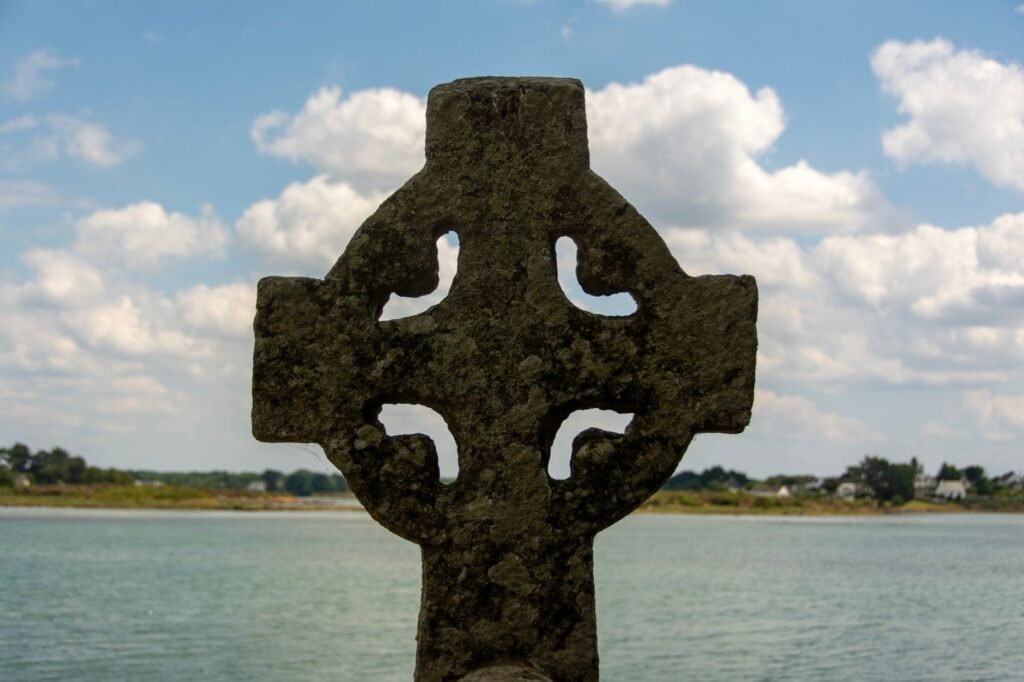
| Knot-cross designs | Interlace combined with Christian crosses | High crosses, memorial art, modern symbolism |
Artistic principles
Craftsmen likely planned knotwork carefully before execution. Designs often follow strict rules of line continuity and crossing sequence. Despite this mathematical structure, the finished work can appear lively, organic, and visually complex.
The aesthetic appeal of knotwork lies in tension between:
- order and complexity
- repetition and variation
- surface pattern and spatial illusion
Family and Genealogy
Unlike a mythological figure, Celtic knotwork does not have a family tree, genealogy, or literal relatives. However, it belongs to a family of related artistic traditions.
Related artistic “relatives”
Knotwork is connected to:
- Insular art
- La Tène art: earlier Iron Age Celtic-style decoration with curvilinear forms
- Pictish stone carving
- Germanic interlace and animal ornament
- Roman and late antique decorative art
Cultural lineage
Its “ancestry” is best understood as a sequence of artistic influences rather than a biological genealogy. The style evolved through contact, adaptation, and local innovation across centuries.
In this sense, Celtic knotwork is part of a wider network of European ornamental traditions rather than the property of a single people or period.
Symbols
Celtic knotwork is frequently associated with symbolic meanings, though these vary by era and context.
Common symbolic interpretations
- Eternity: continuous loops suggest endlessness
- Interconnection: lines weaving together imply unity
- Protection: complex patterns were sometimes believed to ward off harm
- Spiritual journey: unbroken paths may symbolize life, death, and renewal
- Divine order: the precision of the design can reflect sacred harmony
Associated forms
| Symbolic form | Meaning often attributed to it |
|---|---|
| Endless knot | Eternity, continuity |
| Trinity knot (triquetra) | Christian Trinity in later usage; earlier meanings are less certain |
| Knot-cross | Christian faith, sacred protection |
| Spiral-interlace combinations | Growth, movement, transformation |
| Animal interlace | Strength, vigilance, guardianship |
Caution on symbolism
It is important to distinguish between historical evidence and modern interpretation. Some knot symbols are ancient, but many popular meanings are later developments. For example, the triquetra appears in various contexts, and its association with the Christian Trinity is clear in some later medieval and modern usage, but not necessarily in every early example.
Sacred Animals
Knotwork itself is not a deity and does not have sacred animals in the way mythological figures do. However, animal motifs are central to many knotwork traditions, especially in Insular art.
Common animal forms in interlace
- birds
- serpents
- dogs
- cats
- wolves
- dragons
- fish
- deer
Symbolic significance
The meanings of these animals vary by context and source, but they often suggest:
- Birds: soul, transcendence, divine message
- Serpents: wisdom, danger, regeneration, or guardianship
- Dogs: loyalty and protection
- Dragons: power, challenge, and spiritual struggle
- Fish: Christian symbolism and abundance
In some manuscripts and carvings, animals are fully stylized and so interwoven that the figure becomes part of the ornamental pattern itself. This blending of creature and design is one of the most distinctive achievements of Celtic-style interlace.
Sacred Plants
Celtic knotwork does not have a fixed set of sacred plants. Nevertheless, plant forms often appear alongside interlace in Celtic and Insular art.
Plant motifs in related traditions
- vine scrolls
- leaf patterns
- tendrils
- stylized stems
- floral rosettes
Symbolic associations
Plant imagery may represent:
- growth and renewal
- the Garden of Eden in Christian art
- abundance and life
- the cycle of seasons
- the fertility of the natural world
In later Celtic revival art, knotwork is often paired with shamrocks, thistles, ivy, or other regionally meaningful plants. These associations are mostly modern or post-medieval rather than securely ancient.
Sacred Places
Celtic knotwork is connected not to one sacred place but to several important artistic and religious centers.
Major historical locations
- Iona: monastic center traditionally associated with early Insular Christianity
- Lindisfarne: site of an important Northumbrian monastery and the Lindisfarne Gospels
- Kells: associated with the Book of Kells and monastic scholarship
- Clonmacnoise: major Irish ecclesiastical center with high crosses and carved stonework
- Monasterboice: famous for high crosses decorated with interlace
- Durrow: associated with the Book of Durrow
Broader geographical context
Knotwork is found across:
- Ireland
- Scotland
- Wales
- northern England
- parts of Brittany
- later, diaspora communities worldwide
These sites mattered because monasteries were centers of writing, devotion, and artistic production. Stone crosses, manuscript pages, and metalwork objects from these places preserved and transmitted the style.
Powers and Attributes
Since Celtic knotwork is a visual tradition rather than a supernatural being, “powers” should be understood metaphorically.
Artistic and cultural functions
- Decorative power: adds visual richness and complexity
- Symbolic power: conveys ideas of eternity, faith, and unity
- Identity power: serves as a marker of Celtic heritage
- Narrative power: frames sacred texts or commemorative monuments
- Protective power: sometimes believed to repel evil in popular or later tradition
Formal attributes
- strong line control
- ornamental precision
- adaptability to many media
- ability to fill both small and large spaces
- endurance across centuries of use
In modern design, knotwork’s power lies in its versatility. It can appear traditional, spiritual, formal, or contemporary depending on context.
Main Myths
Celtic knotwork is not associated with a single body of myths in the way a deity or hero would be. However, it appears within mythic and religious storytelling traditions, especially in medieval Christian manuscripts and later Celtic-inspired folklore.
Mythic and legendary associations
- Christian cosmic symbolism: endless patterns can evoke divine eternity
- Sacred text illumination: knotwork often frames gospel texts, giving visual majesty to scripture
- Heroic and legendary art: later Celtic revival culture connected knotwork to ancient heroes, saints, and kings
- Folkloric protection: some modern traditions treat knotwork as a charm against misfortune
Storytelling role
In illuminated manuscripts, knotwork often surrounds important passages or initials. Its role is less narrative than ritual and aesthetic: it elevates the text, marks sacred space, and invites contemplation.
Relationship with Other Mythological Figures
Because knotwork is an artistic form, it does not have direct relationships with mythological figures. Still, it interacts strongly with religious and legendary traditions.
Christian associations
Knotwork appears with:
- the cross
- gospel writers’ symbols
- saints
- biblical scenes
- monastic iconography
Its relation to Christianity is especially strong in early medieval Insular art. It served as an ornament that could deepen the sacred atmosphere of scripture and devotion.
Pagan and pre-Christian associations
Modern popular culture often treats knotwork as an ancient pagan symbol. Historically, however, the evidence is more nuanced. Some patterns may have pre-Christian roots in broader Celtic art, but many of the surviving masterpieces are firmly Christian in context.
Relationship to legendary Celtic material
Later imaginative traditions link knotwork to:
- Arthurian legend
- Celtic gods and goddesses
- druids
- sacred kingship
These associations are culturally influential but not always supported by direct historical evidence.
Worship and Cult
Celtic knotwork was not itself worshipped. Still, it was used in religious settings and may have functioned within devotional life.
Historical use in Christian worship
Knotwork decorated:
- gospel books used in liturgy
- processional crosses
- shrines and reliquaries
- tombstones and memorial crosses
- church architecture and carved stones
Ritual and devotional significance
In monastic settings, such art likely supported meditation and reverence. The careful construction of ornamental pages and stone carvings reflected disciplined labor and sacred purpose.
Offerings and festivals
There is no historical evidence of offerings or festivals directed specifically to knotwork. However, the style appears in contexts linked to Christian feasts, monastic commemoration, and later cultural celebrations of Celtic identity such as St Patrick’s Day or national heritage events.
Ancient Sources
Because Celtic knotwork is an art tradition rather than a deity or character, it does not appear in the classical literary canon in the way Homeric or mythological subjects do. Instead, evidence comes from surviving objects and manuscript sources.
Important primary sources and artifacts
- Book of Kells
- Lindisfarne Gospels
- Book of Durrow
- Book of Armagh
- St Chad Gospels
- High crosses at Monasterboice, Clonmacnoise, and similar sites
- Pictish stones
- metalwork such as brooches, book shrines, and reliquaries
Classical authors
Classical writers such as Julius Caesar, Strabo, and Tacitus mention Celtic peoples, but they do not describe knotwork in the detailed artistic sense used today. Their writings are important for the broader historical context of Celtic societies, yet they are not direct sources for the interlace tradition.
Scholarly caution
The best evidence for knotwork comes from archaeology, art history, and manuscript studies rather than literary myth. Claims about ancient symbolic meanings should be grounded in specific objects and dating, not generalized assumptions.
Roman Equivalent
There is no direct Roman equivalent to Celtic knotwork in a strict mythological sense. However, Roman and late antique art did include related ornamental forms.
Comparable Roman decorative traditions
- mosaic borders
- braided guilloche patterns
- vine scrolls
- geometric interlace
- stylized animal ornament in later provincial contexts
The closest Roman analogues are decorative rather than mythological. The Roman world influenced Insular art through trade, administration, Christianity, and the transmission of visual forms. Yet Celtic knotwork developed into a distinct style with its own identity.
Influence on Modern Culture
Celtic knotwork has had a major modern afterlife. Its visual appeal and symbolic flexibility made it one of the most widely reproduced forms of traditional ornament.
Areas of influence
Literature and publishing
- book covers
- fantasy novels
- historical fiction
- poetry editions inspired by Celtic heritage
Film and television
- titles, logos, and costume design
- fantasy worlds drawing on “Celtic” visual language
- period dramas using interlace motifs for atmosphere
Games
- video game user interfaces
- fantasy maps and emblems
- tabletop game art and faction symbols
Art and design
- jewelry
- tattoos
- logos
- textile patterns
- home décor
- wedding and memorial designs
Cultural significance today
For many people, knotwork represents:
- Irish or Scottish identity
- ancestry and heritage
- spiritual continuity
- elegance and craftsmanship
At the same time, commercial use has sometimes simplified or generalized the tradition. Modern designers often borrow the style without distinguishing between early medieval Insular knotwork and later “Celtic” revival ornament.
Curiosities
- The most famous historic knotwork survives in manuscripts, not only in stone or jewelry.
- Some knot designs are so intricate that they are still studied for their geometry and construction methods.
- The repeated over-under pattern can create the illusion of endless movement even in a small space.
- Modern “Celtic knot” products often combine medieval Insular motifs with much later romantic designs.
- The word Celtic in modern marketing is sometimes used broadly, even when the design may be closer to Insular, Gaelic, or revival styles than to any ancient continental Celtic art.
- Knotwork is one of the most influential examples of how medieval ornament has been reimagined in contemporary visual culture.
- Many surviving examples were produced by skilled monastic artists whose names are now lost.
Frequently Asked Questions
What is Celtic knotwork?
Celtic knotwork is a style of interlaced decorative pattern associated especially with early medieval Irish and British art, later revived as a symbol of Celtic identity.
Is Celtic knotwork ancient?
Parts of the tradition are ancient or early medieval, but many modern uses and symbolic interpretations are much later. The most famous historic examples date from the early Middle Ages.
Was Celtic knotwork used by pagan Celts?
Some decorative roots may predate Christianity, but the best-preserved and most elaborate knotwork comes from Christian Insular art. It should not be assumed to be exclusively pagan.
What does Celtic knotwork symbolize?
Common modern meanings include eternity, unity, interconnection, and spiritual continuity. Historical meanings may vary by context and are not always explicitly stated in ancient sources.
Where can the best examples be seen?
Major examples survive in the Book of Kells, the Lindisfarne Gospels, and carved high crosses in Ireland and Britain.
Is the triquetra the same as Celtic knotwork?
The triquetra is a related interlaced symbol often grouped with Celtic knotwork, but it is only one type of knot pattern, not the whole tradition.
Why is Celtic knotwork so popular today?
Its popularity comes from a combination of visual beauty, historical depth, and strong associations with heritage, spirituality, and craftsmanship.
Conclusion
Celtic knotwork is one of the most enduring and recognizable forms of European ornamental art. Emerging from the artistic world of early medieval Ireland and Britain, it developed through a mixture of local innovation and broader artistic exchange. In manuscripts, carvings, and metalwork, knotwork became a hallmark of Insular art and a major achievement of medieval design.
Its legacy is both historical and modern. In the past, it enriched sacred texts, monuments, and devotional objects. Today, it continues to shape ideas of Celtic heritage and inspire artists, designers, and audiences around the world. Although many popular claims about its meanings are modern or simplified, the artistry itself remains unmistakable: precise, elegant, and endlessly interwoven.

Orin Vale has spent the better part of two decades tracing the threads that connect the world’s oldest stories — from the halls of Asgard to the banks of the Nile, from Olympus to the jungles of the Maya. What began as a childhood fascination with flood myths and trickster gods grew into years of independent study across comparative mythology and ancient religion, always chasing the same question: what did these stories mean to the people who first told them? Orin writes for readers who want more than trivia — the ones looking for the beliefs, fears, and truths that myths were built to carry.