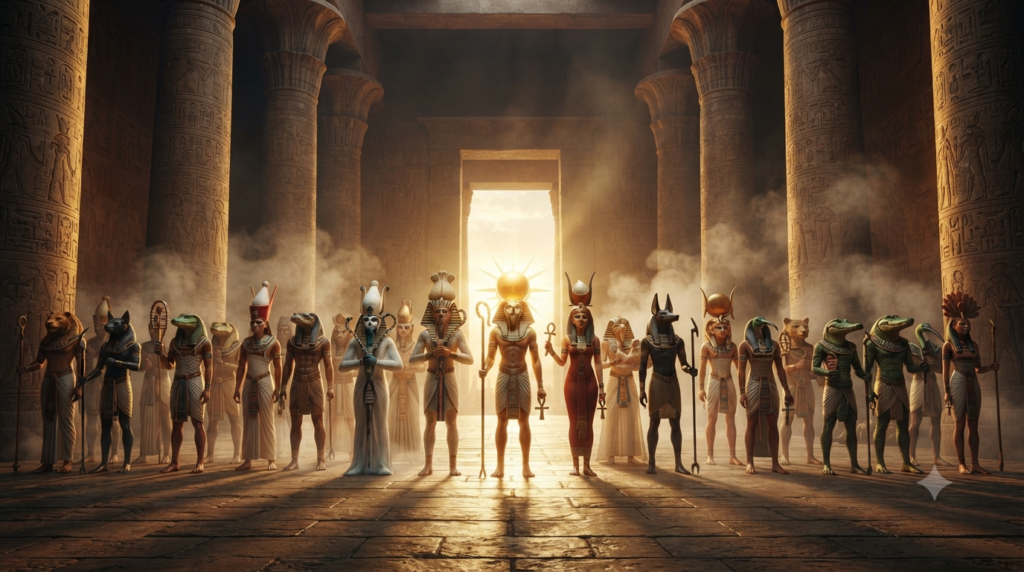
Few belief systems in human history rival the scale and endurance of Egyptian mythology. For more than three thousand years, the Egyptian gods governed every part of life along the Nile: the flood that fed the fields, the sun that crossed the sky, the justice weighed in the afterlife, and the fragile boundary between order and chaos. To understand ancient Egypt is to understand its gods, because in the Egyptian worldview, there was no clear line between religion, government, and the natural world. Pharaohs ruled as living gods, temples functioned as the literal homes of divine statues, and the Nile itself was treated as a god’s bloodstream.
This guide brings together the entire pantheon of Egyptian gods and goddesses in one place, organized the way the Egyptians themselves tended to group their divine world: by the roles each deity played, from the primeval forces that shaped the universe to the household gods who protected everyday Egyptian families. Each entry below introduces a member of the Egyptian pantheon and sets up a deeper profile you can explore for that individual god or goddess.
What Is the Egyptian Pantheon?
The Egyptian pantheon was never a fixed, single list. Ancient Egypt was a civilization of many regions, and nearly every major city had its own local god who eventually merged, competed, or coexisted with the gods of other cities. This is one of the defining features of Egyptian mythology: it absorbed rather than replaced. When a new political center rose to power, its local god typically did not erase the gods that came before. Instead, the Egyptian gods were merged, paired, or given shared titles. This habit of combination is the reason the pantheon can look confusing at first glance, and it is also what makes it one of the richest mythological systems ever recorded.
How the Egyptian Pantheon Is Organized
How Many Gods and Goddesses Did the Ancient Egyptians Worship?
Modern Egyptologists estimate that ancient Egyptians recognized somewhere between 1,500 and 2,000 named deities across three thousand years of history, drawn from local cults, household spirits, and regional variations that never appear in a single unified source. Only a few dozen of these gods, however, appear consistently across temples, royal inscriptions, and papyri from every major period of Egyptian history, making them the truly national figures most people mean when they refer to the Egyptian gods today. The sheer scale of this pantheon, far larger than better-known mythologies like the Greek or Norse systems, reflects just how deeply religion was woven into every region and profession of ancient Egyptian life.
The Great Ennead of Heliopolis
The most influential framework for organizing the Egyptian gods came from the city of Heliopolis, home to one of Egypt’s oldest and most powerful priesthoods. The Ennead (“group of nine”) described a divine family tree beginning with a single self-created god and ending with the deities most closely tied to kingship and the afterlife.
In the Heliopolitan Ennead, Atum creates Shu and Tefnut, who in turn produce Geb and Nut. Geb and Nut then become the parents of Osiris, Isis, Set, and Nephthys. This genealogy is the backbone of the entire Osiris myth cycle and explains why so many of Egypt’s most important gods are described as siblings, spouses, or cousins within a single royal-style family. The Ennead was not just theology; it was propaganda, giving Egyptian kings a divine bloodline to claim descent from.
The Ogdoad of Hermopolis
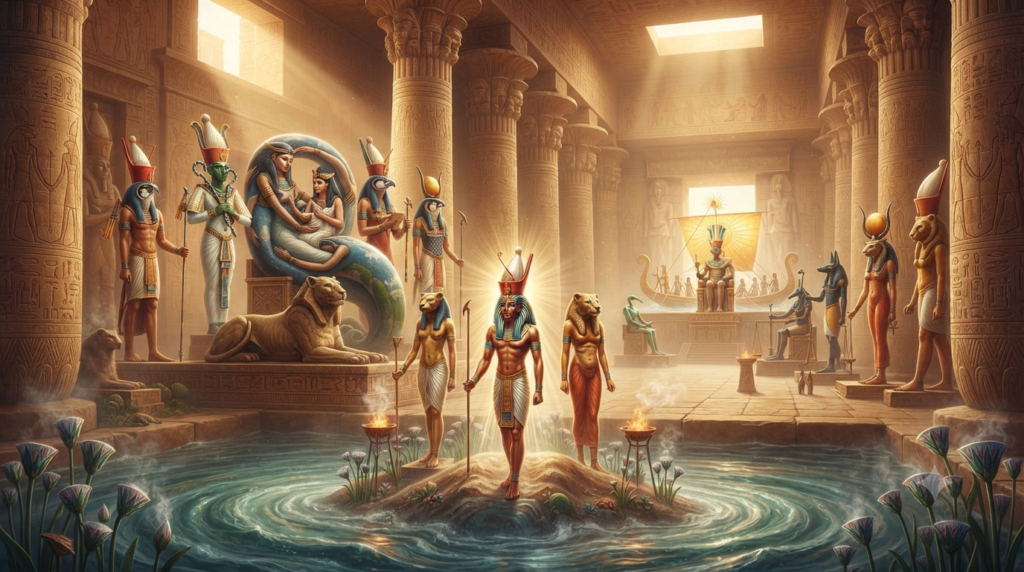
While Heliopolis organized its gods into a family of nine, the city of Hermopolis proposed an older, stranger group of eight primeval deities known as the Ogdoad. These were four male-female pairs representing the raw properties of the universe before creation: formlessness, endlessness, darkness, and hiddenness. Unlike the more human-shaped gods of the Ennead, the Ogdoad were frequently shown with frog heads for the male gods and snake heads for the female gods, emphasizing that they belonged to a watery, pre-human world.
The Ogdoad were said to have combined their forces to raise the first mound of dry land out of the waters of chaos, upon which the sun god could finally appear. Hermopolis positioned itself as the true birthplace of creation, a direct theological rival to Heliopolis, and this competition between creation stories is one of the clearest signs that Egyptian mythology was never a single, centrally authored text but a living conversation between regional priesthoods.
Who Was Considered King of the Egyptian Gods
Unlike Zeus in Greek mythology or Odin in Norse mythology, Egypt did not have one permanent king of the gods. The title shifted with Egypt’s political history. In the Old Kingdom, Ra held the position as supreme solar ruler. As the city of Thebes rose to national power in the Middle and New Kingdoms, its local god Amun absorbed Ra’s authority, becoming the composite king Amun-Ra. Osiris, meanwhile, held a different kind of kingship: ruler of the dead and the underworld rather than the living cosmos, a role that made him just as central to Egyptian religion as any sky god.
This rotating kingship is a defining trait of Egyptian mythology. Divine authority followed political power, and whichever city controlled Egypt tended to see its patron god rise toward the top of the pantheon.
Why Egyptian Gods Are Shown with Animal Heads
One of the most recognizable features of Egyptian gods is the combination of a human body with the head of a falcon, jackal, ibis, cow, or crocodile. This was not meant to depict the gods as literal hybrid creatures. Egyptian art used animal heads as a visual shorthand, instantly communicating a deity’s role through an animal’s known behavior or symbolism: the falcon’s high, sharp vision for the sky god Horus, the jackal’s association with cemeteries for the embalming god Anubis, the cow’s nurturing calm for the mother goddess Hathor.
Egyptian gods could also appear in fully human form, fully animal form, or as a sacred animal kept alive in a temple, believed to house the god’s spirit. The animal head was simply the most efficient way to identify a specific power at a glance, a kind of religious iconography rather than a literal description of what the god looked like.
The Primeval Gods of Creation
Atum
Atum is the self-created god at the very root of Heliopolitan theology, said to have emerged from the formless waters of Nun and brought himself into being through sheer will. Egyptian mythology describes Atum producing the first divine pair, Shu and Tefnut, either by spitting them out or through an act of self-fertilization, an origin story that made him the ultimate ancestor of every other major Egyptian god. Atum was closely linked with Ra as the setting, aging sun, often shown as an old man leaning on a staff, representing the completion of the daily solar cycle.
Ra
Ra is the sun god who sails across the sky by day in his solar barque and descends into the underworld by night to battle the serpent of chaos before rising again at dawn. As the dominant national god for much of the Old Kingdom, Ra’s cult shaped the design of the pyramids, the title of the pharaoh as “Son of Ra,” and the daily temple rituals meant to keep the sun’s journey safe. Ra’s fusion with other gods, especially Amun, shows how central solar worship remained throughout the history of Egyptian mythology.
Amun
Amun began as a relatively minor local god of Thebes before becoming, through the political rise of his city, one of the most powerful gods in Egypt. Once merged with the older sun god to form Amun-Ra, he was worshipped as an invisible, hidden force behind all creation, king of the gods and patron of the enormous temple complex at Karnak. Amun’s rise from local deity to national god is one of the clearest examples in Egyptian mythology of religion following political fortune.
Shu
Shu is the god of air and dry space, born directly from Atum and paired with his twin sister Tefnut. His defining mythological role is physical rather than narrative: Shu is shown holding up his daughter Nut, the sky, keeping her separated from his son Geb, the earth, so that the ordered world can exist between them. Without Shu’s constant effort, Egyptian cosmology held that sky and earth would collapse back into a single undivided mass.
Tefnut
Tefnut is the goddess of moisture and, in some traditions, of the corrosive dryness that precedes rain, the sister and consort of Shu and mother of Geb and Nut. She appears in one of Egyptian mythology’s most vivid stories, the myth of the Wandering Goddess, in which she leaves Egypt for Nubia in a rage and must be coaxed home by Thoth before her absence dries out the land entirely. Tefnut is often depicted with a lioness head, linking her to the same fierce feminine power found in goddesses like Sekhmet.
Geb
Geb is the earth god, husband and brother of Nut, whose body was imagined as the physical ground the Egyptians walked on. Egyptian art frequently shows Geb lying beneath the arched figure of Nut, permanently separated by their father Shu. As the ground itself, Geb was associated with earthquakes, described as his laughter, and with fertility and crops, and he was honored as an early divine king in the mythological succession that eventually passed kingship down to Osiris.
Nut
Nut is the sky goddess, stretched across the heavens as a star-covered arch above her brother-husband Geb, swallowing the sun each evening and giving birth to it again each morning. This daily act of swallowing and rebirthing the sun made Nut central to Egyptian funerary belief, since the same cycle promised that the dead, like the sun, could be reborn. Nut is also remembered as the mother of the five children born during the five extra days of the Egyptian calendar: Osiris, Isis, Set, Nephthys, and in some versions Horus the Elder.
The Osiris Myth Family
Osiris
Osiris is the murdered and resurrected king whose story forms the emotional core of Egyptian mythology. Killed by his jealous brother Set, dismembered, and reassembled through the magic of his wife Isis, Osiris does not return to rule the living but instead becomes king of the dead, the god who judges every soul in the afterlife. His myth gave ordinary Egyptians a model for their own hoped-for resurrection, and his cult, centered at Abydos, became one of the most widely practiced religions in Egyptian history.
Isis
Isis is the devoted wife and powerful magician who reassembles Osiris’s body, conceives their son Horus through her magic, and raises him in secret to reclaim his father’s throne. Her reputation for protective, healing magic made her one of the most beloved goddesses in Egyptian mythology, eventually spreading her worship across the Roman world. Isis is also honored as the ideal mother, frequently shown nursing the infant Horus in an image that would later influence religious art far beyond Egypt.
Set
Set is the god most associated with chaos, violence, and the harsh desert beyond the fertile Nile valley, remembered chiefly as the brother who murders Osiris to seize the throne. Yet Egyptian mythology does not treat Set as pure evil in every period; for centuries he was also honored as a powerful protector of Ra, using his strength each night to fight off the chaos serpent Apep during the sun god’s underworld journey. Set’s reputation darkened over time, particularly after foreign invasions were associated with his desert domain, but his early role shows a more complicated god than later tradition remembers.
Nephthys
Nephthys is the quieter sister of Isis, wife of Set, who nonetheless sides with Isis and Osiris rather than her own husband when the murder takes place. She is remembered as a devoted mourner, standing with Isis at the head and foot of the dead in funerary art, and as a guardian of embalming and the canopic jars that preserved a mummy’s organs. Nephthys represents the boundary between life’s edge and the beginning of death, a liminal goddess who protects the transition rather than ruling either side of it outright.
Horus
Horus is the falcon-headed sky god whose identity in Egyptian mythology splits across several overlapping traditions: the son of Osiris and Isis who avenges his father and battles Set for the throne, and the older, cosmic Horus the Elder, a sky god in his own right whose eyes were the sun and moon. Every living pharaoh was considered an embodiment of Horus, making this god’s myth directly tied to Egyptian kingship itself. The long conflict between Horus and Set, eventually settled by a divine tribunal in Horus’s favor, mirrors Egypt’s own historical struggles between order and disruption.
Anubis
Anubis is the jackal-headed god of embalming and the protector of the dead, credited in myth with performing the first mummification on the body of Osiris. Long before Osiris took over as ruler of the underworld, Anubis held that role himself, and he remained essential to Egyptian funerary religion as the god who guided souls to judgment and weighed the heart against the feather of Ma’at. Anubis’s jackal form reflects a very practical origin: jackals were commonly seen scavenging near desert cemeteries, and the Egyptians transformed that unsettling association into a guardian god instead.
Gods of Wisdom, Order, and Magic
Thoth
Thoth is the ibis-headed god of writing, knowledge, and the moon, credited by the Egyptians with inventing hieroglyphs and serving as the scribe of the gods. In the judgment of the dead, Thoth records the verdict when the heart is weighed against Ma’at, making him essential to Egyptian ideas about truth and the afterlife. He also plays a diplomatic role throughout Egyptian mythology, mediating conflicts between other gods, including the long feud between Horus and Set and the myth of the Wandering Goddess Tefnut.
Ma’at
Ma’at is both a goddess and a concept, the personification of truth, balance, and cosmic order that every pharaoh swore to uphold. She is shown as a woman wearing a single ostrich feather, the same feather placed on the scale against a deceased person’s heart in the underworld’s final judgment. Ma’at represents the opposite of chaos, and maintaining her order was considered the central duty of Egyptian kingship, temple ritual, and daily ethical life.
Heka
Heka is the god who personifies magic itself, the divine force believed to have existed even before creation and to have powered every act performed by every other god. Egyptian priests who practiced ritual magic considered themselves servants of Heka, and his name became the standard Egyptian word for magic in general. Unlike gods tied to a single myth or family drama, Heka represents an abstract but foundational power running underneath the entire Egyptian mythological system.
Seshat
Seshat is the goddess of writing, measurement, and record-keeping, often shown alongside Thoth but distinct in her specialty: architecture, census counts, and the ceremonial marking out of temple foundations. Pharaohs were depicted performing the “stretching of the cord” ritual with Seshat before laying a new temple’s foundation, linking her directly to the physical construction of sacred space. Seshat’s precise, measuring role made her the patron of scribes, librarians, and anyone whose work depended on accuracy.
Goddesses and Gods of War and Protection
Sekhmet
Sekhmet is the lioness-headed goddess of war, plague, and destructive fury, born from the fire in Ra’s eye and sent to punish humanity for its disobedience. In one of Egyptian mythology’s most dramatic tales, Sekhmet’s rampage grows so uncontrollable that Ra must trick her into drinking beer dyed red to resemble blood, calming her into a gentler, healing form. This dual nature, a goddess who could bring plague or cure it, made Sekhmet both feared and urgently appeased through temple ritual.
Wadjet
Wadjet is the cobra goddess of Lower Egypt, shown coiled on the pharaoh’s crown as the uraeus, ready to spit fire at any enemy who threatened the king. As one of Egypt’s oldest protective deities, Wadjet symbolized the king’s authority over the northern half of the country and was paired with the vulture goddess Nekhbet to represent the unified Two Lands. Wadjet’s venomous defense made her a natural protector, invoked in royal inscriptions to guard both the pharaoh and the land itself.
Nekhbet
Nekhbet is the vulture goddess of Upper Egypt, Wadjet’s southern counterpart, associated with protective, maternal watchfulness over the king. Together, Wadjet and Nekhbet appear on royal regalia as the “Two Ladies,” a title carried by every pharaoh to symbolize rule over both halves of a unified Egypt. Nekhbet’s vulture form, often shown with wings spread protectively above the king’s head, reinforced her role as a guardian mother figure within Egyptian mythology.
Neith
Neith is an ancient warrior goddess of hunting and weaving, worshipped from Egypt’s earliest dynasties as a creator figure in her own right at her cult center of Sais. Egyptian mythology sometimes credits Neith with weaving the world into existence on her loom and with judging the dispute between Horus and Set when the other gods could not agree. Neith’s combination of martial and domestic symbols, the bow and arrows alongside the weaver’s shuttle, reflects her unusually broad authority compared to most Egyptian goddesses.
Anhur
Anhur is a warrior god associated with hunting and the protection of Egypt’s borders, often linked with the sun god as the mythical figure who traveled to Nubia to retrieve the raging lioness goddess and bring her home in a calmer form. His name is sometimes translated as “he who leads back the distant one,” tying him closely to the same Wandering Goddess myth associated with Tefnut and Sekhmet. Anhur’s soldiers considered him a patron of the army, and he was frequently invoked in royal military inscriptions.
Montu
Montu is a falcon-headed war god centered at Thebes, closely associated with the pharaoh’s military strength and often invoked before and during battle. Before Amun rose to dominate Theban religion, Montu was the city’s chief god, and even after Amun’s ascendancy, Montu retained his role as the divine force behind Egypt’s armies. New Kingdom pharaohs frequently praised their own battlefield courage by comparing themselves directly to Montu.
Serqet
Serqet is the scorpion goddess who both causes and cures venomous stings and bites, called upon by healers treating scorpion and snake attacks. She is also one of the four goddesses depicted guarding the canopic jars in royal burials, protecting the internal organs of the deceased alongside Isis, Nephthys, and Neith. Serqet’s dual power over poison, to inflict it and to heal it, placed her among the most practically important goddesses in everyday Egyptian medical magic.
Bastet
Bastet is the cat goddess of protection, the home, and joyful celebration, worshipped with particular devotion at her cult center of Bubastis. Originally shown as a fiercer lioness goddess closer in spirit to Sekhmet, Bastet’s image softened over time into the domestic cat familiar from Egyptian art, reflecting her role guarding households from evil spirits and venomous creatures like snakes. Her festivals were famous throughout the ancient world for their music, dancing, and large public gatherings.
Gods of Love, Fertility, and the Household
Hathor
Hathor is one of the most widely worshipped goddesses in Egyptian mythology, associated with love, music, motherhood, and joy, often shown as a cow or as a woman wearing cow horns cradling the sun disk. As a solar goddess she was sometimes described as Ra’s daughter and considered a gentler counterpart to Sekhmet’s destructive fire. Hathor’s temple at Dendera was one of the great centers of Egyptian religious life, and she was invoked at births, in marriage, and as a comforting presence for the dead entering the afterlife.
Bes
Bes is a dwarf god with a lion-like face, unusual among Egyptian gods for being shown fully frontal rather than in profile, a household protector against evil spirits, nightmares, and dangers during childbirth. Despite his fierce, almost comic appearance, Bes was one of the most beloved figures in ordinary Egyptian homes, painted on bedroom walls and carved into furniture to ward off harm from sleeping children and mothers in labor. His popularity crossed every level of Egyptian society, appearing in royal palaces and modest houses alike.
Taweret
Taweret is a hippopotamus goddess with crocodile and lion features, another fierce-looking protector specifically devoted to guarding pregnant women and children during childbirth. Frequently paired with Bes in household shrines and amulets, Taweret’s exaggerated, intimidating form was meant to frighten away the demons and dangers believed to threaten mothers during delivery. She represents the very common Egyptian pattern of using a monstrous appearance for protective rather than harmful purposes.
Min
Min is an ancient fertility god associated with the eastern desert, male potency, and successful harvests, typically shown in a rigid standing pose holding a flail. His festivals, particularly at harvest time, involved public celebrations of agricultural abundance, and pharaohs performed ceremonial rituals linking royal virility to the fertility of the land itself. Min’s cult, one of the oldest in Egypt, shows how closely Egyptian mythology tied human fertility to the fertility of the fields along the Nile.
Renenutet
Renenutet is a cobra goddess of the harvest and of nursing, believed to determine the fortune, or “renenet,” of every newborn child and every field of grain. She was especially honored at harvest festivals, where offerings were made to secure her blessing over the year’s crop yield, and she was sometimes merged with other protective cobra goddesses like Wadjet. Renenutet’s dual role over both children’s destinies and agricultural abundance reflects the Egyptian instinct to link human fate directly to the health of the land.
Mut
Mut is the mother goddess and consort of Amun, worshipped alongside her husband and their son Khonsu as part of the powerful Theban divine family. Her name itself means “mother” in the Egyptian language, and she absorbed traits from older goddesses as her cult grew alongside Amun’s rise to national prominence. Mut’s great temple complex at Karnak, connected to Amun’s by a sacred lake, marked her as one of the most politically significant goddesses of the New Kingdom.
Gods of the Nile and Water
Hapi
Hapi is the god of the Nile’s annual flood, shown with a swollen belly and pendulous breasts symbolizing abundance regardless of gender, since the flood itself nourished all of Egypt without distinction. Unlike most Egyptian gods, Hapi had no major dedicated temple of his own, worshipped instead through offerings thrown directly into the river at the start of the flood season. Egyptian mythology treated the flood’s arrival as a matter of vital importance, and hymns to Hapi are among the most heartfelt religious poetry to survive from ancient Egypt.
Sobek
Sobek is the crocodile god associated with the Nile’s power and danger, worshipped both as a fearsome force to be appeased and as a protector who could guard against the very crocodiles he embodied. His major cult center at Crocodilopolis kept live sacred crocodiles believed to house the god’s spirit, and Sobek was closely linked with royal power and military strength, sometimes merged with Ra as Sobek-Ra. Sobek represents the Egyptian pattern of honoring a dangerous natural force by making it a protective deity rather than simply an enemy.
Satet
Satet is a goddess associated with the Nile’s source near the first cataract at Aswan, worshipped as a guardian of Egypt’s southern border and a deity connected to the flood’s life-giving waters. She was often paired with Khnum and their daughter Anuket as a divine triad overseeing the region where the Nile entered Egypt. Satet’s arrows were said to purify the pharaoh, and her cult reflects how seriously the Egyptians treated the geographic origin point of their most essential river.
Anuket
Anuket is a gazelle-associated goddess of the Nile’s cataract region, completing the divine family alongside her parents Khnum and Satet at Egypt’s southern frontier. She was honored as a nurturing goddess of the river’s waters, particularly celebrated at Elephantine and Sehel Island, close to the natural granite barriers that Egyptian mythology treated as the mysterious birthplace of the Nile flood. Anuket’s worship highlights how Egyptian religion assigned specific gods to specific, concrete stretches of geography rather than treating the Nile as a single undifferentiated force.
Gods of the Moon, Time, and Healing
Khonsu
Khonsu is the moon god, son of Amun and Mut, completing the great Theban family triad worshipped at Karnak. Associated with time, healing, and the phases of the moon, Khonsu’s name means “traveler,” referring to the moon’s nightly journey across the sky. Some Egyptian myths credit Khonsu with gambling moonlight away in a game against Thoth, an origin story explaining the moon’s changing phases and its dimmer light compared to the sun.
Nefertem
Nefertem is the god of the lotus flower and of pleasant fragrance, sometimes described as a son of Ptah and Sekhmet, representing healing, beauty, and the first sunrise. In one Egyptian creation account, the sun god himself is said to have emerged from a lotus blossom associated with Nefertem, tying this gentler god to the very beginning of the cosmos. Nefertem’s lotus imagery made him a popular figure in perfume and healing rituals throughout Egyptian religious life.
The Aten and the Amarna Revolution
Aten
Aten is the god of the visible solar disk itself, elevated during the reign of Akhenaten to a position unlike any other god in Egyptian mythology: the sole object of official worship. Rather than depicting Aten in human or animal form like other Egyptian gods, Akhenaten’s artists showed him as a plain sun disk with rays ending in small hands, reaching down to touch the royal family directly. This radical shift briefly suppressed the worship of Amun and the rest of the traditional pantheon in favor of a single, largely abstract solar power.
How Did the Egyptian Gods Change During the Amarna Period?
The Amarna period, named after Akhenaten’s new capital city, marks the one true monotheistic experiment in a religion otherwise defined by constant divine combination rather than substitution. Temples to Amun and the rest of the traditional Egyptian gods were closed, their names were chiseled out of inscriptions, and state resources shifted entirely toward the worship of Aten alone. The change did not last. Within a generation of Akhenaten’s death, his successors, including the young Tutankhamun, restored the traditional Egyptian gods and reopened the temples of Amun that had been closed, treating the entire episode afterward as a dangerous heresy to be erased from official memory.
What Is the Difference Between Amun and Amun-Ra?
Amun, Amun-Ra, and Aten are three distinct stages in Egyptian solar theology often confused with one another. Amun was Thebes’s original hidden god of the air and mystery, worshipped locally long before his city rose to national power. Amun-Ra was his fused form as supreme solar king, created once Amun absorbed the older sun god Ra’s authority and iconography. Aten, by contrast, represented a separate and short-lived attempt under Akhenaten to replace that entire fused tradition with a single, undivided sun disk, stripped of Amun’s name and mystery altogether.
Forces of Chaos and Guardians of the Dead
Apep
Apep, also known as Apophis, is the great serpent of chaos who threatens to devour the sun god Ra every single night as his barque crosses the underworld. Apep represents pure disorder in Egyptian mythology, the opposite of Ma’at’s balance, and temple priests performed daily rituals, including the symbolic destruction of wax serpent figures, to help Ra defeat this eternal enemy. Unlike most figures in the Egyptian pantheon, Apep received no worship of his own; he was cursed and ritually attacked rather than appeased.
Wepwawet
Wepwawet is a wolf-headed god whose name means “opener of the ways,” associated with leading both armies into battle and the dead into the afterlife. Often confused with Anubis because of their similar canine appearance, Wepwawet had his own distinct cult center at Asyut and played a ceremonial role at the front of royal and funeral processions, symbolically clearing the path ahead. His military symbolism made him a favored god among Egyptian soldiers marching to war.
Meretseger
Meretseger is a cobra goddess whose name means “she who loves silence,” worshipped specifically by the workers who built the royal tombs in the Valley of the Kings. Believed to inhabit the mountain peak overlooking Thebes’s necropolis, Meretseger was thought to punish tomb robbers and wrongdoers with snakebite while protecting honest workers who respected her sacred silence. Her worship, concentrated almost entirely among the artisan community at Deir el-Medina, offers a rare glimpse into the personal religious life of ordinary Egyptian laborers rather than official state religion.
The Four Sons of Horus
The Four Sons of Horus, Imsety, Hapy, Duamutef, and Qebehsenuef, are a group of minor funerary gods responsible for protecting the four canopic jars holding a mummy’s preserved organs. Each son guarded a specific organ and was in turn protected by one of the four goddesses Isis, Nephthys, Neith, and Serqet, linking this quartet directly into the broader network of Egyptian funerary religion. Though rarely worshipped individually outside of burial ritual, the Four Sons of Horus appear on nearly every well-preserved set of Egyptian canopic equipment, making them essential background figures in any discussion of Egyptian mythology’s approach to death and preservation.
Frequently Asked Questions About the Egyptian Gods
Which Egyptian god is considered the oldest?
Atum and the members of the Ogdoad are generally treated as the oldest gods in Egyptian mythology, representing the state of the universe before organized creation. Because different cult centers told competing origin stories, no single god is universally agreed upon as the very first across all of ancient Egypt.
Are the Egyptian gods still worshipped today?
Organized worship of the Egyptian gods largely ended by the early centuries CE as Christianity and later Islam spread through Egypt, and the last known active temple, dedicated to Isis at Philae, closed in the sixth century CE. Small modern revival movements do exist, though they represent a tiny fraction of the devotion these gods once commanded.
Which Egyptian god represents death?
Osiris is the primary ruler of the dead and the underworld in Egyptian mythology, though Anubis, as god of embalming and the guide of souls, is equally central to Egyptian ideas about death and the afterlife journey.
How many Egyptian gods and goddesses are there in total?
Egyptologists estimate that ancient Egyptians recognized between 1,500 and 2,000 named deities across their history, though most of these were minor local gods; only a few dozen appear consistently as major national figures.
Why do so many Egyptian gods share overlapping roles?
Egyptian mythology grew from many separate regional traditions that merged as political power shifted between cities. Rather than eliminating older gods, Egyptian religion typically combined them, which is why solar, war, and protective roles are often shared by several different deities.
What is the difference between an Egyptian god and an Egyptian goddess’s cult center?
Nearly every major Egyptian god or goddess had a primary cult center, a city where their main temple stood and their priesthood held the greatest local influence, such as Ra at Heliopolis, Amun at Thebes, or Ptah at Memphis. A deity’s national importance often depended directly on the political power of their home city.
Did Egyptian gods change appearance over time?
Yes. Many Egyptian gods shifted in both appearance and status across dynasties, most dramatically Bastet’s transformation from a fierce lioness into a gentler domestic cat, and Amun’s evolution from a minor local god into the fused solar king Amun-Ra.
How were the Egyptian gods connected to the pharaoh?
Egyptian kingship was itself a religious office. The living pharaoh was considered an embodiment of Horus, and upon death was believed to become one with Osiris, meaning the entire Osiris myth cycle functioned as a direct model for Egyptian royal succession and the promise of the king’s own resurrection.

Orin Vale has spent the better part of two decades tracing the threads that connect the world’s oldest stories — from the halls of Asgard to the banks of the Nile, from Olympus to the jungles of the Maya. What began as a childhood fascination with flood myths and trickster gods grew into years of independent study across comparative mythology and ancient religion, always chasing the same question: what did these stories mean to the people who first told them? Orin writes for readers who want more than trivia — the ones looking for the beliefs, fears, and truths that myths were built to carry.