What Is the Difference Between Amun and Amun-Ra?
The difference between Amun and Amun-Ra lies mainly in historical development and religious fusion. Amun was originally a major Egyptian god associated with hiddenness, air, and later kingship, especially prominent in Thebes. Amun-Ra, by contrast, is a syncretic form that combines Amun with Ra, the ancient sun god of Heliopolis. In Egyptian religion, this was not merely a name change but a theological merging of two powerful deities into one supreme divine figure.
Understanding the distinction is important because it reveals how ancient Egyptian religion evolved over time. It also shows how the Egyptians could combine gods rather than replacing one with another. In this way, Amun and Amun-Ra reflect both continuity and adaptability in Egyptian belief.
Origin and Meaning
The name Amun
The name Amun is usually translated as “the Hidden One” or “the Hidden”. This meaning fits his early nature as a god connected with invisibility, air, and what cannot be directly seen. Because the wind is present yet unseen, Amun’s hidden quality may have helped shape his identity.
Amun was originally a local deity of Thebes in Upper Egypt. His rise to national prominence happened gradually, especially during the Middle Kingdom and dramatically in the New Kingdom.
The name Amun-Ra
Amun-Ra (also written Amun-Re or Amon-Re) combines Amun with Ra, the sun god. Ra was one of the most ancient and important Egyptian deities, associated with the sun, creation, and kingship. By merging Amun with Ra, Egyptian theology united:
- Amun’s hidden, transcendent aspect
- Ra’s visible solar power
- Kingship and cosmic order
This fusion made Amun-Ra one of the most powerful divine forms in Egyptian religion.
Why the fusion happened
The combination was not random. It reflects the Egyptian tendency to merge deities with complementary roles. Since both Amun and Ra were associated with kingship and supreme divine authority, their union made theological and political sense, especially as Thebes became the center of state power.
Historical Context
Amun in early Egyptian religion
Amun began as a local god in the Theban region. During the Middle Kingdom (roughly 2055–1650 BCE), Thebes grew in political importance, and Amun’s cult expanded with it. By the New Kingdom (c. 1550–1070 BCE), Amun had become one of the chief gods of Egypt.
The rise of Amun-Ra
The elevation of Amun to national importance was closely tied to Theban royal power. As Theban dynasties unified Egypt and expanded Egyptian influence abroad, Amun’s prestige increased. The fusion with Ra helped integrate Amun into the broader Egyptian religious system, since Ra had long been a central solar deity.
In many texts, Amun-Ra became the king of the gods, a supreme creator figure who was both hidden and manifest.
Political and religious significance
The rise of Amun-Ra was not only theological. It also had strong political implications. The priesthood of Amun became extremely wealthy and influential, especially at Karnak, where the god’s principal temple stood. In some periods, the priests of Amun wielded enormous power, rivaling that of the pharaohs.
This means that the difference between Amun and Amun-Ra is partly a matter of historical development, cultic expansion, and state ideology.
Main Characteristics
Amun
Amun’s core features included:
- Hiddenness
- Air and invisibility
- Kingship and divine authority
- Protection
- Fertility in some contexts
- Thebes as his main cult center
He was often depicted as a man wearing a crown with two tall plumes, though his iconography varied.
Amun-Ra
Amun-Ra retains Amun’s hidden nature but adds the solar and creative power of Ra. As a result, he represents:
- The hidden force behind creation
- The sun as a life-giving power
- Universal kingship
- Cosmic order
- Supreme divine authority
In hymns and temple inscriptions, Amun-Ra is often praised as a transcendent creator who cannot be fully known.
Key difference in function
A simple way to distinguish them is:
- Amun = the original Theban god, hidden and atmospheric, later associated with kingship
- Amun-Ra = the combined deity, uniting Amun with the solar creator Ra
Family and Genealogy
Amun’s family in Egyptian tradition
Egyptian myths do not provide a single fixed family tree for Amun. Different traditions describe him in different ways. He was sometimes grouped with a Theban triad:
- Amun
- Mut (his consort)
- Khonsu (their son)
In some traditions, Amun was paired with Mut as a divine couple and Khonsu as their child.
Amun-Ra’s family role
Amun-Ra is not usually treated as a separate family line from Amun; rather, he is a theological form of Amun. However, because he absorbed Ra’s attributes, he can also participate in cosmic family structures associated with solar theology.
Relationships vary by source
Ancient Egyptian religion was not centralized in the way later monotheistic traditions are. Different temples and regions emphasized different divine relationships. Therefore:
- Some traditions stress Amun’s role in the Theban triad
- Others focus on his fusion with Ra as a universal creator
- Still others connect him to broader solar and royal mythologies
Symbols
Symbols of Amun
Amun is commonly associated with:
- Double plume crown
- Ram
- Goose
- Blue skin in some artistic depictions of divine or royal forms
- Staff or scepter
The double plume is one of his most recognizable symbols in Egyptian art.
Symbols of Amun-Ra
Amun-Ra often combines symbols from both deities. These may include:
- Solar disk
- Crown with plumes
- Ram-headed imagery
- Uraeus (the protective serpent)
- Scepters and royal emblems
Meaning of the symbols
| Symbol | Associated deity | Meaning |
|---|---|---|
| Double plume crown | Amun / Amun-Ra | Divine authority and elevated status |
| Solar disk | Ra / Amun-Ra | Sun, creation, life, cosmic order |
| Ram | Amun / Amun-Ra | Fertility, strength, generative power |
| Goose | Amun in some traditions | Early cult associations and sacred presence |
| Uraeus | Amun-Ra and royal theology | Protection and kingship |
Sacred Animals
Ram
The ram is the best-known sacred animal linked with Amun and Amun-Ra. It symbolizes:
- Fertility
- Creative energy
- Masculine power
- Protective force
Ram-headed sphinxes or ram imagery appear in Egyptian temple contexts, especially at Thebes.
Goose
The goose is also associated with Amun in some traditions, though it is less prominent than the ram. The significance of the goose likely relates to early cult symbolism and local religious associations.
Sacred animal interpretation
The animal symbolism of Amun and Amun-Ra should not be over-simplified. Egyptian divine animal associations often had multiple layers of meaning, and their importance could vary across time and region.
Sacred Plants
Limited evidence
Compared with some other deities, Amun and Amun-Ra are not strongly associated with a single sacred plant in the way that other gods are linked to specific flora. However, Egyptian temple religion often used plants symbolically in offerings and ritual decoration.
Lotus and papyrus in broader Egyptian symbolism
Although not uniquely sacred to Amun, plants such as:
- Lotus
- Papyrus
- Persea tree
appear widely in Egyptian religious symbolism and temple art. They are connected with life, renewal, Lower and Upper Egypt, and divine order.
Caution about attribution
Because sacred plant associations can vary by temple and period, it is best to say that Amun and Amun-Ra were not primarily defined by a specific sacred plant, even though they were worshipped in a broader plant-rich ritual environment.
Sacred Places
Thebes
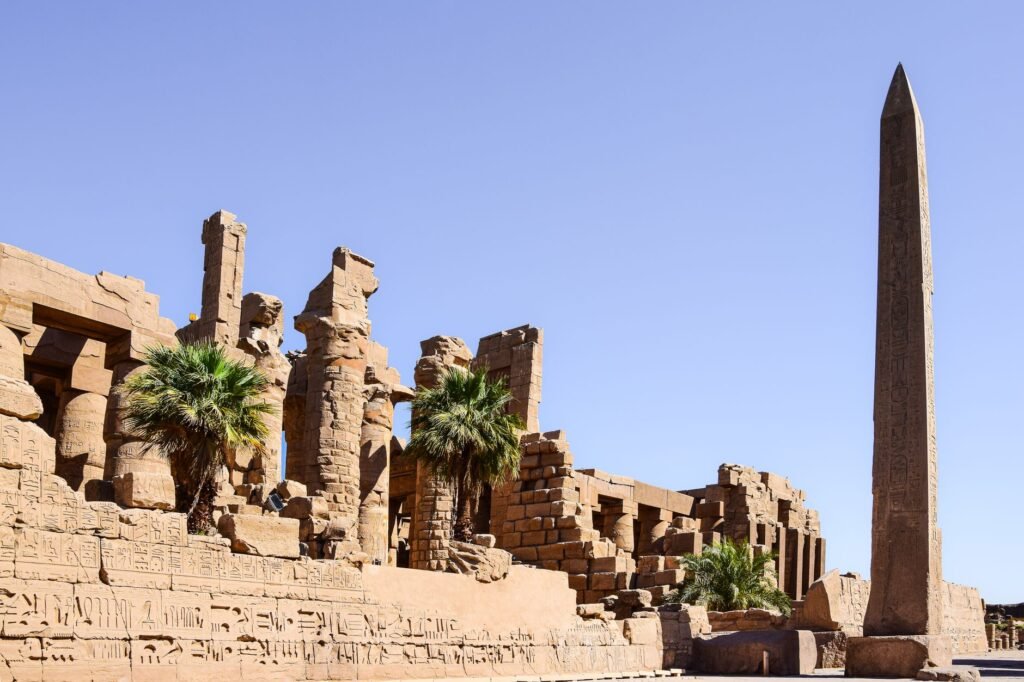
The most important sacred center of Amun was Thebes (modern Luxor). As Thebes rose to political power, Amun’s cult became dominant.
Karnak
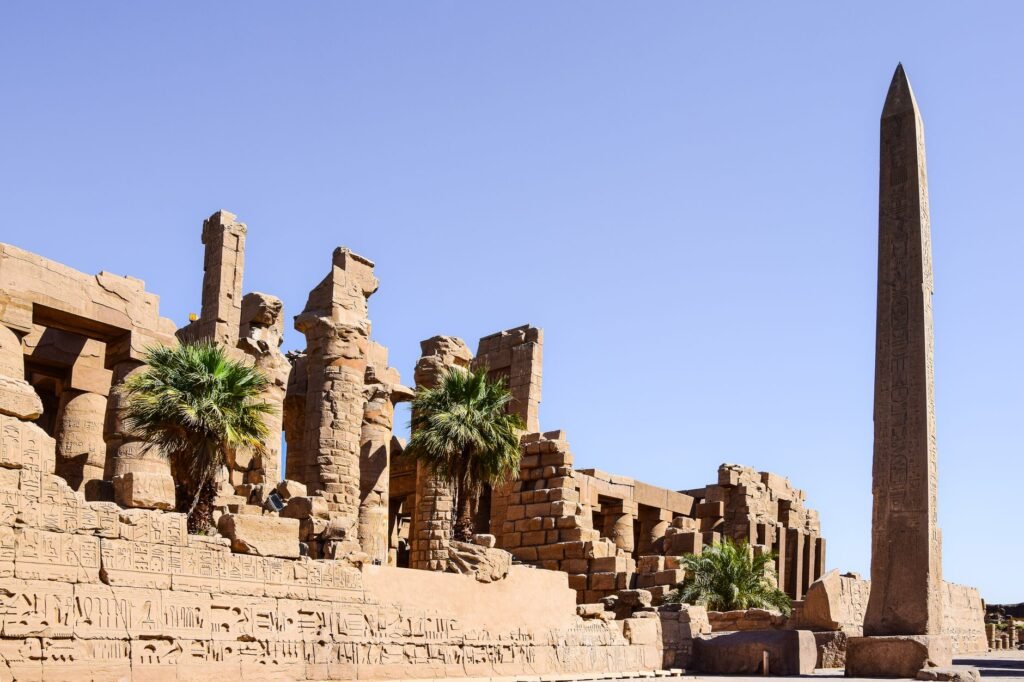
The great temple complex at Karnak was the principal center of Amun worship. It became one of the largest religious complexes in the ancient world. Karnak was especially important for the worship of Amun-Ra, whose cult there grew in immense prestige.
Luxor
The nearby temple at Luxor was also linked to the god, especially in relation to royal festivals and ceremonial processions.
Other important sites
Amun and Amun-Ra were worshipped across Egypt, and their cult spread to Nubia and other regions under Egyptian influence. In some places, local forms of the god developed unique features.
Powers and Attributes
Powers of Amun
Amun was associated with:
- Hidden divine presence
- Air and invisible force
- Protection
- Royal legitimacy
- Fertility
- Oracular authority in later periods
Powers of Amun-Ra
Amun-Ra inherited Amun’s hiddenness and combined it with Ra’s solar powers. As a result, he was viewed as:
- Creator of the world
- Sustainer of cosmic order
- Source of light and life
- Legitimizer of pharaonic rule
- Universal god beyond complete human understanding
Theological significance
Amun-Ra could be described in hymns as both immanent and transcendent: present in the world, yet beyond full human sight. This made him especially suitable for grand theological reflection in temple texts.
Main Myths
Amun’s mythic profile
Amun does not have a single, tightly defined myth cycle like some gods in Greek or Norse mythology. Instead, his importance appears in hymns, temple inscriptions, and royal theology.
He is often portrayed as:
- A hidden divine power
- A protector of kings
- A god who grants victory and legitimacy
Amun-Ra in creation theology
Amun-Ra appears in many Egyptian hymns as a creator god. Some texts describe him as self-created or as the hidden source behind all existence. These are theological expressions rather than narrative myths in the modern sense.
Theban and royal myths
In royal ideology, Amun-Ra could be said to support the king in battle, to authorize his reign, and to ensure the order of the universe. Pharaohs frequently claimed special relationship with him.
Important caution
There is no single “Amun-Ra myth” equivalent to a continuous epic story. His role is mainly visible in hymns, temple liturgy, royal inscriptions, and theological compositions.
Relationship with Other Mythological Figures
Relationship with Ra
The most important relationship is between Amun and Ra. Their merger created Amun-Ra. This was a theological combination of two great gods:
- Amun: hidden, local, Theban
- Ra: solar, ancient, widely revered
Relationship with Mut and Khonsu
Amun was part of the Theban triad with:
- Mut, his consort
- Khonsu, the moon god often regarded as their son
This family grouping became highly important in Theban religion.
Relationship with other gods
Amun-Ra was sometimes linked to broader creator theology and could be elevated above many other gods in temple hymns. At the same time, Egyptian religion was flexible, and other great gods such as Ptah, Osiris, and Horus retained important roles.
Rivalry and complementarity
It is more accurate to speak of complementarity than rivalry between Amun and Ra. The fusion honored both deities and created a more comprehensive divine figure.
Worship and Cult
Temple worship
Worship of Amun and Amun-Ra centered on major temples, especially at Karnak. Temple rituals could include:
- Daily offerings
- Incense burning
- Hymns and prayers
- Processions
- Festival rituals
- Oracle consultations in later periods
Priesthood
The priesthood of Amun became exceptionally powerful. In some periods, especially in the New Kingdom and Third Intermediate Period, the Priests of Amun were major political and economic actors.
Festivals
The Opet Festival was one of the most important celebrations connected with Amun at Thebes. It involved processions between Karnak and Luxor and reinforced the divine kingship of the pharaoh.
Offerings
Offerings to Amun and Amun-Ra could include:
- Food and drink
- Incense
- Linen
- Statues and votive gifts
- Animals in some ritual contexts
Cultic distinction
When people speak of “Amun” versus “Amun-Ra,” they are often referring to different theological emphases within worship rather than to two entirely separate cults.
Ancient Sources
Egyptian sources
Much of what is known about Amun and Amun-Ra comes from:
- Temple inscriptions
- Hymns
- Royal stelae
- Funerary texts
- Papyri
- Reliefs and statues
Notable texts include hymns praising Amun as a hidden creator and royal supporter.
Classical authors
Greek and Roman authors mention Egyptian religion, but they often interpret it through their own frameworks. Their accounts can be useful, though they are not always precise by modern standards.
Classical writers relevant to Egyptian religion include:
- Herodotus
- Diodorus Siculus
- Plutarch
- Strabo
They do not provide a complete theology of Amun or Amun-Ra, but they offer valuable external perspectives.
Egyptian caution
Because Egyptian religion is primarily preserved in Egyptian language and temple contexts, modern understanding depends more on archaeological and epigraphic evidence than on later classical summaries.
Roman Equivalent
No direct Roman equivalent
Amun and Amun-Ra do not have a single exact Roman equivalent. Romans often interpreted foreign gods through interpretatio Romana, comparing them to their own deities.
Possible partial comparisons
Amun-Ra was sometimes compared loosely with:
- Jupiter for supreme kingship and sky authority
- Sol or solar deities for the sun aspect
However, these are only approximate parallels. The Egyptian theology of Amun-Ra is distinct and should not be reduced to a Roman counterpart.
Influence on Modern Culture
Egyptology and scholarship
Amun and Amun-Ra remain central to Egyptology because they illuminate:
- Egyptian kingship
- Temple religion
- Religious syncretism
- The rise of Thebes
- The theology of hiddenness and creation
Popular culture
Modern literature, film, games, and art sometimes use Amun or Amun-Ra as symbols of ancient mystery, divine kingship, or solar power. However, popular portrayals often simplify or combine their identities.
Common modern misconceptions
Modern culture sometimes treats Amun-Ra as if he were simply “the sun god,” but this misses the theological meaning of the fusion. The distinction matters:
- Amun was not originally the sun god
- Ra was the older and more directly solar deity
- Amun-Ra is the combined form
Curiosities
- Amun became so influential that at times his priesthood rivaled royal power.
- The name Amun means “the Hidden One,” which is unusual for a god so publicly monumental in temple art.
- Amun-Ra could be described as both hidden and visible, a paradox that fascinated Egyptian theologians.
- The fusion of gods was common in Egyptian religion and was a sophisticated theological practice, not a sign of confusion.
- Karnak’s temple complex reflects the scale of Amun’s cult better than almost any other ancient religious site.
- The ram became one of the clearest visual markers of Amun’s sacred presence.
- Different periods of Egyptian history emphasized Amun, Ra, or Amun-Ra differently, so the god’s profile changed over time.
Frequently Asked Questions
1. What is the difference between Amun and Amun-Ra?
Amun is the original Egyptian god of hiddenness, air, and later kingship, especially associated with Thebes. Amun-Ra is the combined form of Amun and Ra, the solar god, creating a more universal deity of hidden creative power and sunlight.
2. Are Amun and Ra the same god?
No. They began as distinct deities. Amun-Ra is a syncretic fusion of the two, not proof that they were always the same.
3. Why did the Egyptians combine Amun with Ra?
They combined them because both were major gods connected with creation and kingship. The fusion united Amun’s hidden power with Ra’s solar authority.
4. Was Amun more important than Ra?
At some points in Egyptian history, especially during the New Kingdom, Amun became extremely prominent. Ra, however, remained one of Egypt’s oldest and most important gods. Their importance varied by period and region.
5. What did Amun symbolize?
Amun symbolized hidden divine presence, air, protection, fertility in some contexts, and royal legitimacy.
6. What did Amun-Ra symbolize?
Amun-Ra symbolized a supreme creator god who was both hidden and manifest, as well as the life-giving power of the sun and divine kingship.
7. Where was Amun mainly worshipped?
Amun was mainly worshipped in Thebes, especially at the great temple of Karnak.
8. Is Amun-Ra a separate god?
He is best understood as a combined theological form rather than a completely separate deity.
Conclusion
The difference between Amun and Amun-Ra is rooted in the development of ancient Egyptian religion. Amun began as a local Theban god of hiddenness and atmospheric power, while Amun-Ra emerged as a fusion of Amun with Ra, the ancient solar creator. This combination created one of the most important divine figures in Egyptian history.
Amun-Ra reflects the Egyptian ability to unite different religious traditions into a single, more comprehensive theology. He became a symbol of creation, kingship, cosmic order, and divine mystery. For that reason, studying Amun and Amun-Ra offers valuable insight into how ancient Egyptians understood the gods, the pharaoh, and the universe itself.

Orin Vale has spent the better part of two decades tracing the threads that connect the world’s oldest stories — from the halls of Asgard to the banks of the Nile, from Olympus to the jungles of the Maya. What began as a childhood fascination with flood myths and trickster gods grew into years of independent study across comparative mythology and ancient religion, always chasing the same question: what did these stories mean to the people who first told them? Orin writes for readers who want more than trivia — the ones looking for the beliefs, fears, and truths that myths were built to carry.