Who Is Demeter in Greek Mythology?

Demeter is one of the most important goddesses in ancient Greek religion and myth. She is best known as the goddess of agriculture, grain, fertility, and the harvest. When people ask, who is Demeter in Greek mythology, the simplest answer is that she is the divine power behind the growth of crops and the nourishment of humankind.
But Demeter is more than a goddess of farming. Her myths reveal deep ancient ideas about motherhood, loss, renewal, and the changing seasons. She was honored throughout the Greek world because her gifts were essential to survival: fertile soil, ripened grain, and the promise that life would return after winter.
Demeter’s Role Among the Greek Gods
Demeter was one of the twelve Olympian deities, though she was not always shown living permanently on Mount Olympus. She was the daughter of the Titans Cronus and Rhea, making her the sister of Zeus, Hera, Poseidon, Hades, and Hestia.
Like her siblings, Demeter belonged to the generation of gods who came to power after Zeus overthrew Cronus. While Zeus ruled the sky, Poseidon ruled the sea, and Hades ruled the underworld, Demeter’s domain was the earth’s fertility.
Her influence touched everyday life more directly than many other gods. Ancient Greeks depended on successful harvests, especially grain crops such as wheat and barley. Because of this, Demeter was worshipped as a generous but powerful goddess who could bless the fields—or withhold abundance when angered.
The Meaning of Demeter’s Name and Symbols
Demeter’s name is often connected to the idea of “mother,” and she was frequently seen as a maternal figure. She was not only the mother of her daughter Persephone but also a kind of mother to the earth’s crops and to human civilization itself.
Common symbols associated with Demeter include:
- Wheat and grain
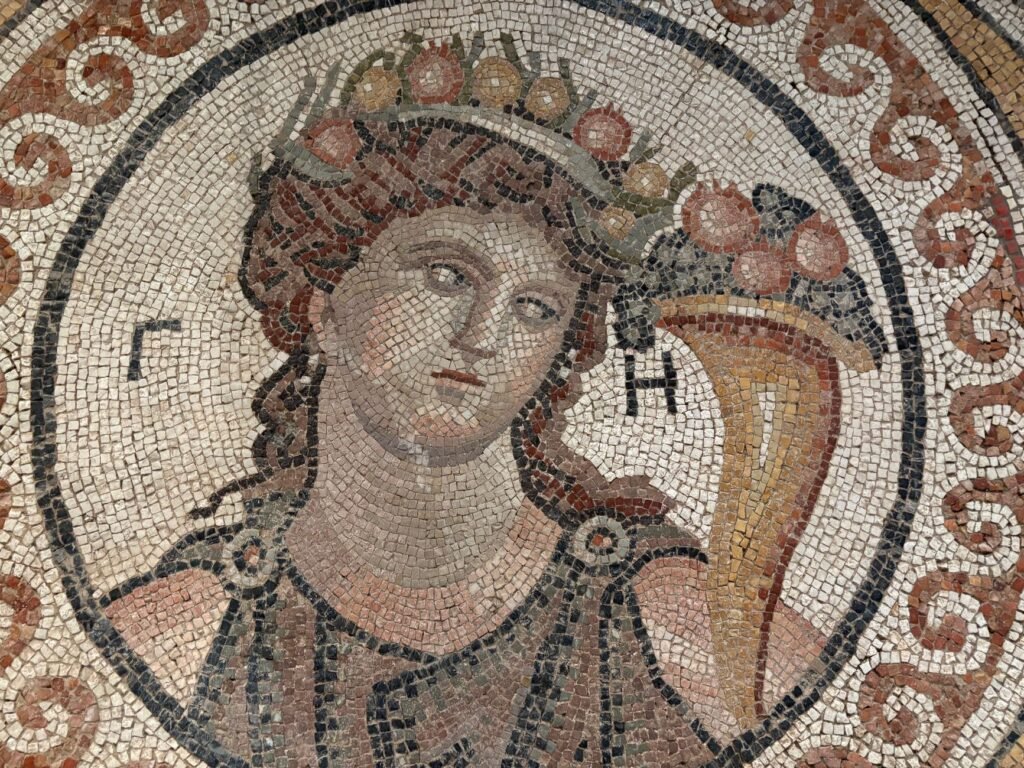
- A cornucopia, representing abundance
- A torch, linked to her search for Persephone
- A sheaf of wheat
- Poppies, which grew among grain fields
- A scepter, showing her divine authority
In ancient art, Demeter is often shown as a mature, dignified woman holding grain or a torch. Her image reflects both warmth and seriousness, fitting a goddess who gives life but also experiences profound grief.
Demeter and Persephone
The most famous myth about Demeter is the story of her daughter, Persephone. This myth explains the changing seasons and became one of the central stories in Greek mythology.
According to the myth, Persephone was gathering flowers when Hades, god of the underworld, abducted her and took her to his realm to be his queen. In many versions, Zeus had allowed or arranged the marriage, but Demeter had not consented to losing her daughter.
When Demeter discovered Persephone was missing, she was devastated. She searched the earth with torches, refusing to rest. During her grief, she neglected her duties as goddess of the harvest. Crops stopped growing, fields became barren, and famine threatened humanity.
Eventually, Zeus intervened. If humans starved, they could no longer offer sacrifices to the gods. A compromise was reached: Persephone would spend part of the year with Hades in the underworld and part of the year above ground with Demeter.
How Demeter Explains the Seasons
The myth of Demeter and Persephone was used to explain why the earth changes throughout the year. When Persephone returns to her mother, Demeter rejoices, and the earth becomes fertile again. Plants grow, flowers bloom, and crops ripen.
When Persephone goes back to the underworld, Demeter mourns. The land becomes cold and unproductive, symbolizing autumn and winter.
This myth gave emotional meaning to the agricultural cycle. The seasons were not just natural changes; they reflected the bond between mother and daughter. Spring and summer represented reunion and life, while fall and winter represented separation and sorrow.
Demeter as a Goddess of Agriculture and Civilization
Demeter was deeply connected with farming, but her importance went beyond crops. In Greek thought, agriculture was tied to civilization. Before farming, people were imagined as living in a wilder, less organized state. Through grain cultivation, communities could settle, grow, and develop laws, rituals, and cities.
In some myths, Demeter taught humans how to cultivate wheat and make bread. This made her a goddess of nourishment and human progress. She was especially associated with the idea that divine knowledge allowed people to live in an orderly society.
Because of this, Demeter was worshipped by farmers, families, and city-states alike. Her blessings were practical and sacred at the same time.
The Eleusinian Mysteries
One of the most important religious traditions connected to Demeter was the Eleusinian Mysteries, held at Eleusis near Athens. These secret rites honored Demeter and Persephone and were among the most famous religious ceremonies in the ancient Greek world.
Initiates into the Mysteries were promised special knowledge or hope concerning life, death, and the afterlife. Although the exact details were kept secret, the rituals seem to have focused on themes of loss, return, rebirth, and divine blessing.
The story of Persephone’s descent into the underworld and return to the earth made Demeter central to ancient Greek ideas about mortality and renewal. Her myth suggested that death was not simply an end, but part of a larger cycle.
Demeter’s Personality in Myth
Demeter is often portrayed as loving, protective, and nurturing. She cares deeply for her daughter and for the fertility of the earth. However, she is not a passive figure. Her grief becomes a force powerful enough to challenge Zeus and threaten the survival of gods and humans alike.
This makes Demeter one of the most emotionally complex figures in Greek mythology. She represents motherhood, but not only in a gentle sense. She also shows the fierce determination of a mother who refuses to accept injustice.
Her myth reminds us that the natural world is both generous and fragile. When balance is broken, life itself suffers.
Why Demeter Still Matters
Demeter remains an enduring figure because her story speaks to universal human experiences. People still understand the pain of separation, the comfort of reunion, and the hope that life returns after hardship.
So, who is Demeter in Greek mythology? She is the goddess of grain, harvest, fertility, and sacred motherhood. She is the grieving mother of Persephone, the giver of agriculture, and the divine force behind the earth’s cycles of growth and rest.
Through Demeter, the ancient Greeks expressed their dependence on nature and their belief that life, death, and renewal are deeply connected.

Orin Vale has spent the better part of two decades tracing the threads that connect the world’s oldest stories — from the halls of Asgard to the banks of the Nile, from Olympus to the jungles of the Maya. What began as a childhood fascination with flood myths and trickster gods grew into years of independent study across comparative mythology and ancient religion, always chasing the same question: what did these stories mean to the people who first told them? Orin writes for readers who want more than trivia — the ones looking for the beliefs, fears, and truths that myths were built to carry.