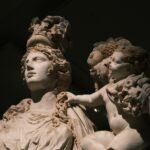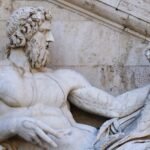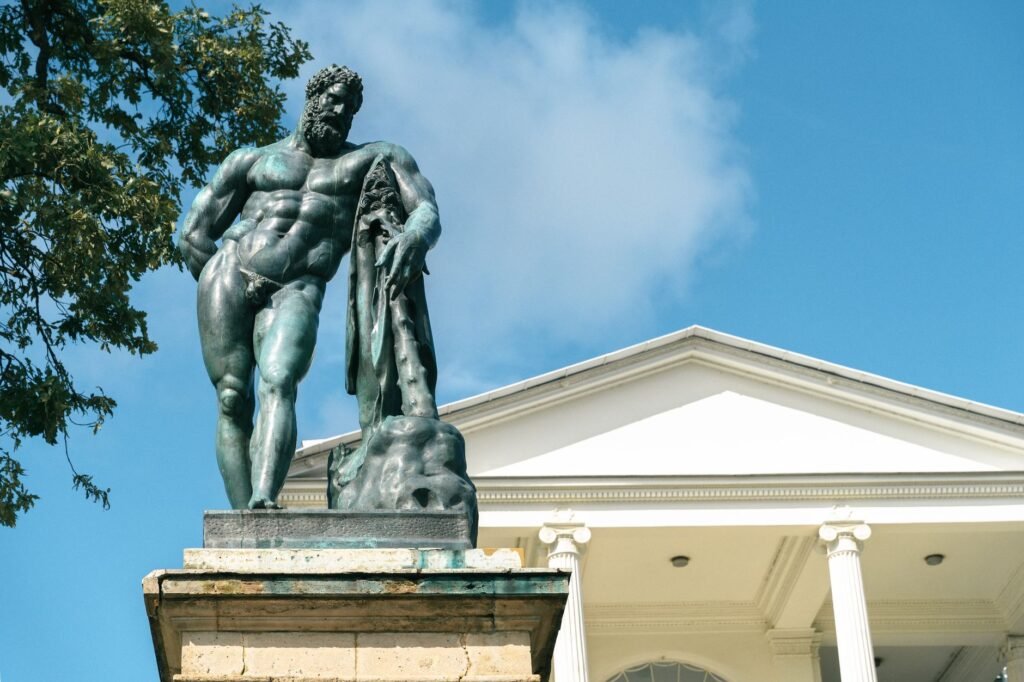
Gigantomachy
Introduction
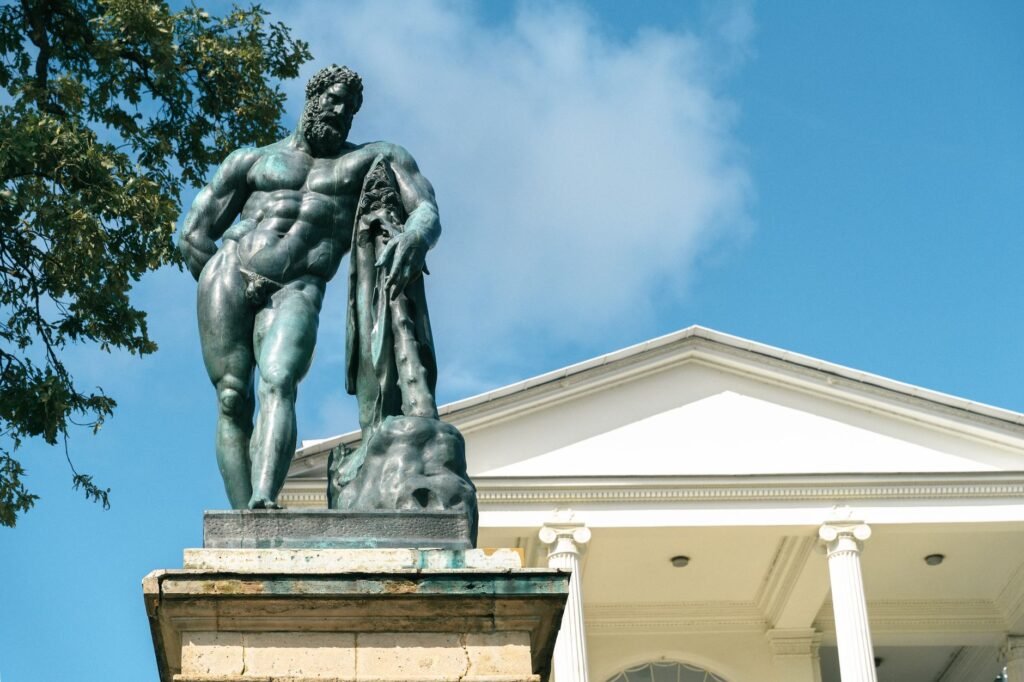
The Gigantomachy is one of the best-known mythic conflicts in ancient Greek tradition: the war between the Olympian gods and the Giants. In Greek mythology, it represents a cosmic struggle for order against chaos, a theme that resonated deeply in religion, literature, and art. The story appears in several ancient sources and was especially important in Athenian visual culture, where it was often used to symbolize the triumph of civilization, divine authority, and cosmic order.
The Gigantomachy should not be confused with the Titanomachy, the war between the Olympians and the Titans. Ancient authors and artists distinguished these narratives, though later traditions sometimes blurred them. The Giants of the Gigantomachy were not simply large beings in a modern fantasy sense; they were mythic opponents born from divine genealogy and marked by extraordinary strength and hostility to the gods.
Origin and Meaning
The word Gigantomachy comes from Greek Gigantomakhia (Γιγαντομαχία), meaning “battle of the Giants.”
It is formed from:
- gigantes (Giants)
- machē (battle, fight)
The name denotes the specific mythic war against the Giants, though ancient authors did not always use the term in exactly the same way. In modern scholarship, it refers both to the myth itself and to artistic depictions of the battle.
The term reflects the ancient Greek tendency to frame major mythical conflicts as cosmic wars, in which the gods defend the established order against threatening forces.
Historical Context
The Gigantomachy belongs to the larger world of Greek myth and religion, but it gained special significance in particular historical settings.
Archaic and Classical Greece
The story was known by the Archaic period and became especially prominent in Classical Athens. There, the Gigantomachy was often presented as a paradigm of:
- divine victory over disorder
- Greek triumph over barbarism
- civic order over lawlessness
Athenians frequently used myth in public art to express political and cultural identity. The Gigantomachy was especially suited to this purpose because it featured:
- a collective divine response to violent rebellion
- a clear moral opposition
- a dramatic struggle with broad symbolic meaning
Religious and Cultural Significance
In Greek thought, the myth could express several ideas at once:
- the establishment of cosmic hierarchy
- the legitimacy of Olympian rule
- the defeat of hostile, earth-born forces
- the boundary between mortal and divine spheres
The story also participated in a wider ancient pattern in which one generation of powers overcomes another in order to secure the world’s order.
Artistic Importance
Gigantomachy scenes appear on:
- vase paintings
- temple sculpture
- reliefs
- monumental friezes
The most famous example is the Gigantomachy frieze of the Altar of Zeus at Pergamon in Hellenistic Asia Minor, although the theme was already important much earlier in Greek art.
Main Characteristics
The Gigantomachy has several defining features.
A War of Gods and Giants
At its core, the myth is a battle between the Olympian gods and the Giants. The gods are usually victorious, but the struggle is fierce and often portrayed as requiring the combined force of several deities.
The Giants as Mythic Opponents
Ancient sources do not give one uniform account of the Giants. In many traditions, they are:
- huge and powerful
- violent and rebellious
- born from the earth or connected to it
- enemies of heaven and order
Some sources describe them as having serpent-like features, especially in art, where they may be shown with lower bodies ending in snakes.
A Cosmic and Political Symbol
The Gigantomachy functions on more than one level:
- cosmic: the triumph of order over chaos
- religious: the authority of the Olympian gods
- political: the defense of a city or civilization against destruction
- artistic: a dramatic theme ideal for large-scale representation
Distinction from the Titanomachy
A common point of confusion is the difference between the Gigantomachy and the Titanomachy:
| Myth | Opponents | Main Theme |
|---|---|---|
| Titanomachy | Olympian gods vs. Titans | War for supremacy among divine generations |
| Gigantomachy | Olympian gods vs. Giants | Defense of cosmic order against earth-born rebels |
Although both myths involve divine warfare, they are distinct in Greek tradition.
Family and Genealogy
The genealogy of the Giants varies across sources.
Parentage
The most common ancient tradition, especially in Hesiod, makes the Giants descendants of Gaia (Earth). In one famous account, they are born from the blood of Ouranos that fell upon Gaia after his castration by Cronus.
Other traditions present different origins or emphasize their earth-born nature rather than a precise genealogy.
Relatives and Associations
Because the Giants are linked to Gaia, they are often connected conceptually with other earth-born hostile beings, including:
- Titans
- Typhon
- various monstrous adversaries of the gods
However, these figures are not always related in the same way from source to source.
Spouses and Descendants
Ancient sources do not provide a consistent, widely accepted family structure for the Giants. Some later interpretations and artistic traditions give individual Giants names and occasionally specific parentage or offspring, but there is no single canonical family tree comparable to that of the Olympian gods.
Symbols
The Gigantomachy itself is associated with a number of recurring symbols, especially in art.
Common Symbolic Motifs
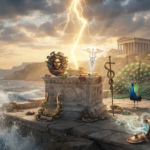
- Thunderbolt: the weapon of Zeus, symbolizing divine supremacy
- Lightning: associated with Zeus’s power over the sky
- Spear and sword: weapons of gods and heroes in combat
- Serpents: often linked to the Giants in iconography
- Armor and shield: symbols of organized divine warfare
Symbolic Meaning
These symbols reinforce the myth’s central message:
- rightful order defeats violent rebellion
- divine authority is active, armed, and protective
- chaos can be contained only through force and cooperation
Colors in Art
Ancient sources do not assign fixed sacred colors to the Gigantomachy in the way later traditions sometimes do with gods or cult figures. In art, however, the scene is often visually coded through contrast: radiant Olympian figures against darker, more chaotic opponents.
Sacred Animals
The Gigantomachy is not centered on a single sacred animal, but several creatures appear in the myth and its imagery.
Serpents
Serpents are among the most important animal forms associated with the Giants. In artistic depictions, Giants may have:
- serpent legs
- snake-like lower bodies
- serpentine companions or attributes
The serpent imagery likely underscores their connection to the earth and to chthonic, underworld-like powers.
Eagles
The eagle, an animal associated with Zeus, symbolizes:
- royal authority
- sky and storm
- divine sovereignty
Horses and Chariots
In some mythic and artistic settings, horses and chariots appear as part of the wider martial setting. They do not define the Gigantomachy itself, but they contribute to its heroic and military atmosphere.
Sacred Plants
There are no universally attested sacred plants specific to the Gigantomachy. However, in Greek religion and myth, certain plants may appear in broader symbolic contexts.
Olive
In Athenian cultural symbolism, the olive can be associated indirectly with civic order and Athena, who often appears in Gigantomachy scenes.
Laurel
The laurel is often associated with Apollo and divine triumph, though it is not uniquely tied to the Gigantomachy.
Vine and Agricultural Imagery
Because the Giants are earth-born, later interpretations sometimes contrast them with the cultivated order represented by civilized agriculture. This is more symbolic than cultic and should not be treated as a fixed ancient doctrine.
Sacred Places
The Gigantomachy is linked to several important mythic and artistic places.
Mount Olympus
Olympus is the home of the gods and the central seat of divine authority. It is the natural symbolic setting for a battle defending the Olympian order.
Phlegra
A place called Phlegra is often associated with the battle. Ancient authors vary as to its exact location; some place it in Thrace, others in Pallene in the Chalcidic peninsula, and later traditions sometimes connect it with other regions. Because of this variation, Phlegra should be understood as a mythic battlefield rather than a fixed historical site.
Athens
Athens became one of the most important cultural centers for Gigantomachy imagery. The theme appears in major public monuments and helped express Athenian identity.
Pergamon
The Great Altar of Zeus at Pergamon is famous for its monumental Gigantomachy frieze. Although later than the Classical Athenian examples, it is one of the most important artistic treatments of the myth in the ancient world.
Powers and Attributes
Since the Gigantomachy is not a deity or single figure but a mythic event, it does not have powers in the same sense as a god. Still, the battle is associated with several functional domains.
Divine Attributes in the Myth
The gods involved in the Gigantomachy represent:
- sovereignty
- protection of order
- mastery over sky, sea, and earth
- punishment of rebellion
The Giants’ Characteristics
The Giants embody:
- brute force
- rebellion
- resistance to divine hierarchy
- violent earth power
In many artistic depictions, the battle visualizes these opposing attributes through posture, weaponry, and gesture.
Main Myths
The Gigantomachy appears in several versions and related episodes.
The Birth of the Giants
A key prelude is the violent origin of the Giants from Gaia. In some traditions, they arise from the blood of Ouranos, making them children of Earth and remnants of primordial violence.
The War Against the Gods
The central myth tells how the Giants attacked the gods, often attempting to overthrow Olympian rule. The gods fought back with the help of heroes in some versions.
Heracles’ Participation
In several ancient traditions, Heracles is essential to the victory. Some accounts state that a prophecy required mortal aid for the gods to triumph. Heracles, as the greatest hero, fulfills this role.
The Role of Specific Gods
Ancient sources and artworks often assign major roles to:
- Zeus, who strikes with thunderbolts
- Athena, who opposes or defeats specific Giants
- Apollo, who uses his arrows
- Heracles, who fights beside the gods
- Dionysus, who appears in some artistic traditions as a combatant
The Buried Giant Motif
In later myths and literary imagery, defeated Giants may be buried beneath islands or mountains, explaining seismic activity or volcanic power. These stories vary by region and author.
Relationship with Other Mythological Figures
The Gigantomachy is deeply connected to the broader mythological world.
Zeus
Zeus is the leader of the Olympian defense. The Gigantomachy highlights his role as king of the gods and master of thunder and law.
Athena
Athena often appears as one of the most effective divine combatants. In Athenian tradition, she is especially prominent and symbolically central.
Heracles
Heracles bridges gods and humans. His involvement emphasizes the idea that divine order can require heroic mediation.
Gaia
As the Giants’ mother or source, Gaia stands at the beginning of the conflict. In some traditions, she reacts against Zeus and the Olympians because of the treatment of her offspring or earlier primordial powers.
Typhon and Other Monsters
The Gigantomachy belongs to a broader mythic pattern of divine combat against monstrous forces, including Typhon. These stories are related in theme, though not identical in narrative structure.
Worship and Cult
The Gigantomachy was not itself a cult object in the way a god or local hero could be worshipped. However, it had religious importance.
Ritual and Festival Context
There is no single pan-Hellenic festival dedicated specifically to the Gigantomachy. Its importance emerged through:
- temple decoration
- civic mythology
- religious art
- poetic retelling
Civic and Religious Meaning
In Athens and other cities, depictions of the myth could reinforce the idea that the gods protect the community. Public art was therefore a form of religious and ideological communication.
Offerings and Dedications
Dedications to gods such as Zeus, Athena, and Apollo could indirectly invoke the themes of the Gigantomachy, but these were not exclusive rituals for the battle itself.
Ancient Sources
Several ancient authors mention or allude to the Gigantomachy.
Major Sources
| Author | Work | Relevance |
|---|---|---|
| Hesiod | Theogony | Early account of divine generations and Giants |
| Homer | Iliad, Odyssey | Indirect allusions to divine conflict and heroic combat |
| Apollodorus | Bibliotheca | Systematic mythographic summary of the Gigantomachy |
| Pausanias | Description of Greece | Descriptions of monuments and mythic imagery |
| Ovid | Metamorphoses | Later Roman retelling and related mythic material |
| Pindar | Odes | Mythic references in poetic context |
Hesiod
Hesiod is especially important because he provides one of the earliest genealogical frameworks for the Giants and the divine order they threaten.
Apollodorus
The Bibliotheca offers a compact narrative of the gods’ battle against the Giants, making it valuable for reconstructing the mythic sequence.
Pausanias
Pausanias is crucial for understanding how the Gigantomachy appeared in Greek art and public monuments.
Ovid
Although Roman and later, Ovid preserves classical myth in literary form and contributes to the afterlife of the story.
Roman Equivalent
There is no exact Roman equivalent to the Gigantomachy, but the Romans adopted and adapted the myth extensively.
Roman Adaptation
Roman literature and art frequently used Greek mythological material. The Gigantomachy was especially visible in:
- elite decorative programs
- poetry
- sculpture
- imperial symbolism
Related Roman Concepts
Romans often interpreted such myths through their own cultural values, emphasizing:
- order over rebellion
- imperial stability
- divine sanction of rule
In this sense, the Gigantomachy could function as a visual and ideological ancestor to Roman ideas of victory and dominion.
Influence on Modern Culture
The Gigantomachy remains influential in modern culture, particularly in scholarship, art history, and fantasy-inspired media.
Literature and Scholarship
The myth is regularly discussed in studies of:
- Greek religion
- comparative mythology
- political symbolism in ancient art
- the evolution of cosmic battle narratives
Art and Museums
The Great Altar of Zeus at Pergamon and related imagery remain central subjects in museums and classical art history.
Popular Culture
Modern fiction, graphic novels, games, and films sometimes draw on the Gigantomachy’s visual language:
- gods battling enormous enemies
- earth-born monsters
- epic warfare between order and chaos
Even when the term is not used directly, the myth’s structure is familiar in fantasy storytelling.
Curiosities
- The Gigantomachy was often treated as a different myth from the Titanomachy, even though both describe wars against earlier or hostile powers.
- In some artistic scenes, individual Giants are named and matched against specific gods, creating a highly organized visual battle.
- The Giants are sometimes shown with snake legs in vase painting and relief sculpture, a feature that makes them instantly recognizable.
- The myth was particularly useful in civic art because it could symbolize the victory of a city’s patron gods and, by extension, the city itself.
- The Pergamon frieze is one of the largest and most dramatic ancient representations of the Gigantomachy, but it is a late example rather than an early one.
- Ancient authors did not fully agree on where the battle took place; Phlegra is a recurring name, but its location varies.
- The theme of gods needing a mortal helper, often Heracles, is one reason the Gigantomachy is so important in the intersection of divine and heroic myth.
Frequently Asked Questions
What is the Gigantomachy?
The Gigantomachy is the mythic battle between the Olympian gods and the Giants in Greek mythology.
How is the Gigantomachy different from the Titanomachy?
The Titanomachy is the war between the Olympians and the Titans. The Gigantomachy is the later battle between the gods and the Giants. They are separate myths, though both concern divine struggles for order and power.
Who were the Giants in Greek mythology?
The Giants were monstrous or semi-divine beings, often said to be born from Gaia or from the blood of Ouranos. They were enemies of the Olympian gods.
Did Heracles fight in the Gigantomachy?
In many ancient traditions, yes. Heracles is often said to have helped the gods defeat the Giants, sometimes because prophecy required a mortal’s aid.
Where did the Gigantomachy take place?
Ancient sources often mention Phlegra, but its location is not fixed and varies between traditions. The battle is primarily mythic rather than historical.
Why was the Gigantomachy important in ancient art?
It provided a dramatic image of order defeating chaos and was especially useful for public monuments, temple sculpture, and political symbolism.
Is the Gigantomachy a religious story?
Yes, in the sense that it concerns the gods and divine order. However, it was not usually an object of direct worship. Its religious value lay in myth, art, and symbolic meaning.
Conclusion
The Gigantomachy is one of the most powerful and enduring myths of ancient Greece. More than a simple battle narrative, it expresses central Greek ideas about divine authority, cosmic order, rebellion, and the victory of civilization over chaos. Its importance is visible in literature, religion, and especially art, where the battle of gods and Giants became a favored subject for monumental representation.
Because ancient sources preserve different versions of the story, the Gigantomachy should be understood as a mythic tradition with multiple forms, not as a single fixed tale. Its lasting appeal lies in that flexibility: it could speak to theology, politics, aesthetics, and cultural identity at the same time. For this reason, the Gigantomachy remains one of the most significant and recognizable episodes in the mythological heritage of the ancient Mediterranean world.

Orin Vale has spent the better part of two decades tracing the threads that connect the world’s oldest stories — from the halls of Asgard to the banks of the Nile, from Olympus to the jungles of the Maya. What began as a childhood fascination with flood myths and trickster gods grew into years of independent study across comparative mythology and ancient religion, always chasing the same question: what did these stories mean to the people who first told them? Orin writes for readers who want more than trivia — the ones looking for the beliefs, fears, and truths that myths were built to carry.