The planets visible to the naked eye were never only points of light in the ancient world. For Greek and Roman observers, they were wandering stars with character, memory, and divine association, each one understood through the language of myth. Their names and symbols came to reflect the gods, their spheres of power, and the qualities later generations believed those gods embodied.
The connection between planets and Greek mythology is strongest in the classical tradition of naming and interpretation. What modern astronomy calls Mercury, Venus, Mars, Jupiter, and Saturn preserves a much older worldview in which celestial motion and divine personality were closely linked. Even Uranus, named later in the Roman scholarly tradition, reaches back to Greek myth through Ouranos, the personification of the sky.
Greek planets and the gods behind their names
The ancient Greeks did not treat the planets as mere astronomical objects. They recognized them as moving lights that differed from the fixed stars, and they associated these “wandering” bodies with powerful deities whose influence seemed broad, vivid, and sometimes unpredictable. In time, Greek and later Roman writers and astronomers gave the visible planets divine names that helped explain their apparent behavior and place them within a meaningful cosmos.
This naming was not arbitrary. The brightest and most distinctive planets were linked to gods whose mythic roles seemed to match their visible qualities, such as speed, brilliance, authority, or redness. The result was a layered tradition in which observation, religion, and poetic imagination worked together. That tradition still shapes planetary names today, especially in European languages and in the broader history of astronomy.
Why classical astronomers named the planets
Greek astronomy developed in a world where myth and measurement were not opposed. Philosophers and sky-watchers studied the heavens with mathematical care, but they also inherited a cultural habit of reading meaning into celestial signs. The planets were unusual because they moved against the fixed pattern of the stars, and this made them especially worthy of attention. Their motion invited interpretation, and divine naming became one way to order that experience.
The Greek-speaking world also absorbed older Mesopotamian astronomical traditions, where planets were already linked with gods. By the Hellenistic period, especially in scholarly centers such as Alexandria, celestial observation and divine association were increasingly systematized. Greek writers often translated foreign planetary gods into their own pantheon, so that the heavens became a shared field of knowledge in which local myth and inherited astronomy met.
Zeus, Jupiter, and the kingly bright wanderer
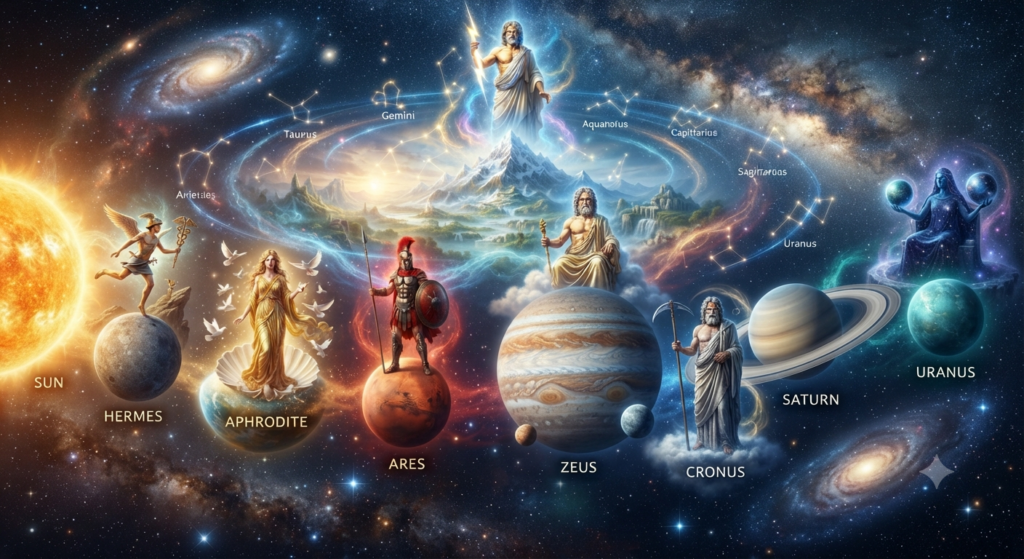
Among the visible planets, the one associated with Zeus in Greek tradition and Jupiter in Roman tradition became the planetary emblem of kingship. Jupiter is the largest and brightest of the planets when it is prominent in the night sky, and this grandeur made it an apt celestial counterpart to Zeus, the ruler of Olympus. The connection reflects a broad ancient tendency to match visible magnitude with divine rank.
Zeus in myth is the sovereign who rules by force, law, oath, and thunder, and those themes fit the planet’s stately presence in later symbolic thought. Greek sources do not preserve a single formal “planet of Zeus” doctrine in the way modern readers might expect, but the identification of the brightest kingly planet with the chief god became durable in Greco-Roman tradition. In Roman usage, Jupiter carried this association most fully, and the name survived into modern astronomy.
Ares and Mars in mythic and Roman tradition
Mars is the planet most strongly linked to war, and in the Greek framework this connection belongs to Ares. Ares in Homer and later myth is the turbulent force of battle, less the noble strategist than the raw violence of conflict. The planet’s reddish appearance naturally encouraged comparison with blood and warfare, making Ares a fitting mythic counterpart before Roman tradition fixed the Latin name Mars in common use.
The Roman Mars was not identical to Ares. In Roman religion, Mars could be more honored and more central to civic identity, linked with agriculture, ancestry, and the protection of the state. Yet the planetary image in later tradition often blended the Greek and Roman figures together. Thus the planet became a bridge between Greek mythic language and Roman religious imagination, retaining the martial symbolism that still defines it today.
Hermes, Mercury, and the swift-moving planet
Mercury, the fastest-moving of the visible planets, was associated with Hermes in Greek tradition. This match is one of the most elegant in classical astronomy, because Hermes is the swift messenger, guide of travelers, patron of crossings, and god of movement between realms. His speed and liminal nature make him a natural counterpart to a planet that darts quickly across the sky and changes position more rapidly than the others.
Ancient observers likely found in this motion an image of Hermes’ own restless mobility. The Roman name Mercury preserved the same core association, since Mercury also served as a divine messenger and patron of commerce, communication, and exchange. The planetary link therefore fused Greek myth with Roman religious continuity, allowing the figure of Hermes to remain present in the sky through a Latin name.
Aphrodite, Venus, and celestial beauty
The brilliant evening and morning star was associated with Aphrodite in Greek tradition and Venus in Roman tradition. Of all the planets visible to the naked eye, Venus is the most striking in brightness, and its radiant beauty made it an obvious emblem for a goddess of desire, attraction, and generative force. Greek myth presents Aphrodite as a power whose beauty can stir gods and mortals alike, and the planet’s splendor matched that enduring image.
Classical sources and later astronomical practice often treated Venus as the planet of the goddess of love, though the Greek and Roman emphases could differ in detail. Aphrodite in Greek myth is older than the Roman Venus in literary form, but the two were early identified with one another in Greco-Roman culture. The result is a planetary name that carries both mythic elegance and a long history of cultural blending.
Cronus, Saturn, and the oldest planetary link
Saturn was linked to Cronus in Greek tradition, the Titan associated with an earlier divine generation. Cronus is a complex figure in Hesiod and later authors: son of Uranus and Gaia, overthrower of his father, and later father to Zeus and the Olympian gods. Because Saturn is slow-moving across the sky, its name was suited to a primordial god whose myth belongs to the deep past of cosmic history.
The Roman Saturn was not simply a Greek copy of Cronus, though the two became closely identified. Roman religion connected Saturn with agriculture and the Saturnalia festival, while Greek myth emphasized Cronus’ place in the succession of divine rulers. In planetary symbolism, however, the two traditions merged. The slow and distant planet thus came to suggest antiquity, endurance, and the weight of an older cosmic order.
Poseidon, Uranus, and the outer sky in lore
Poseidon is not one of the classical names of the seven ancient planets, but Greek sky-lore does appear in the naming of Uranus, a much later astronomical discovery. The planet Uranus was named in the eighteenth century after Ouranos, the primordial personification of the sky in Greek myth, father of Cronus and the Titans in Hesiod’s Theogony. This choice deliberately extended the older mythic pattern of associating heavenly bodies with divine figures.
Poseidon belongs to the mythic realm surrounding the sea, earthquakes, and horses rather than planetary naming, yet his presence is relevant to Greek cosmology more broadly. The Greek imagination divided divine power across sky, sea, and underworld, and those domains shaped later symbolic interpretations of the heavens. Uranus, in particular, shows how deeply Greek mythology continued to influence astronomy even after the classical planet names had already been fixed.
Mythic traits reflected in planetary symbolism
The planets were mapped onto gods partly because the gods embodied traits that seemed visible in the sky itself. Brightness suggested radiance and beauty, swift motion suggested speed and mediation, red color suggested conflict, great size suggested rulership, and slow movement suggested age and gravity. This was not science in the modern sense, but it was a coherent symbolic reading of the cosmos shaped by myth and repeated observation.
Those associations endured because they were memorable and flexible. They could be used in poetry, divination, astrology, and later in the language of education and science. Even when astronomy moved away from mythic explanation, the old symbolic framework remained available. In that sense, the planets became not only objects in space but carriers of cultural memory, each one preserving a fragment of divine personality.
Greek mythology’s lasting imprint on astronomy
Greek mythology helped give the planets their enduring identities. Through the Roman adoption of Greek gods, the visible planets entered a naming system that joined celestial motion to divine story, and that system remained influential for centuries. Modern astronomy may describe planets by physical composition, orbital period, and atmospheric conditions, but the names themselves still echo the ancient world.
This is one of the clearest places where mythology remains embedded in everyday language. To say Jupiter, Mars, Venus, Mercury, Saturn, or Uranus is to repeat a chain of inheritance that began with ancient sky-watchers and mythmakers. The planets are not gods, yet their names still carry the memory of Greek mythology, a reminder that human beings have long looked upward and found both wonder and meaning in the night sky.
The planets are connected to Greek mythology through naming, symbolism, and the ancient habit of reading the heavens as a realm of divine presence. Each planet became a kind of mythic portrait, shaped by brightness, motion, color, or antiquity, and matched with a god whose qualities seemed to fit. That connection has survived far beyond the age that created it, leaving Greek myth written into the modern sky.

Orin Vale has spent the better part of two decades tracing the threads that connect the world’s oldest stories — from the halls of Asgard to the banks of the Nile, from Olympus to the jungles of the Maya. What began as a childhood fascination with flood myths and trickster gods grew into years of independent study across comparative mythology and ancient religion, always chasing the same question: what did these stories mean to the people who first told them? Orin writes for readers who want more than trivia — the ones looking for the beliefs, fears, and truths that myths were built to carry.