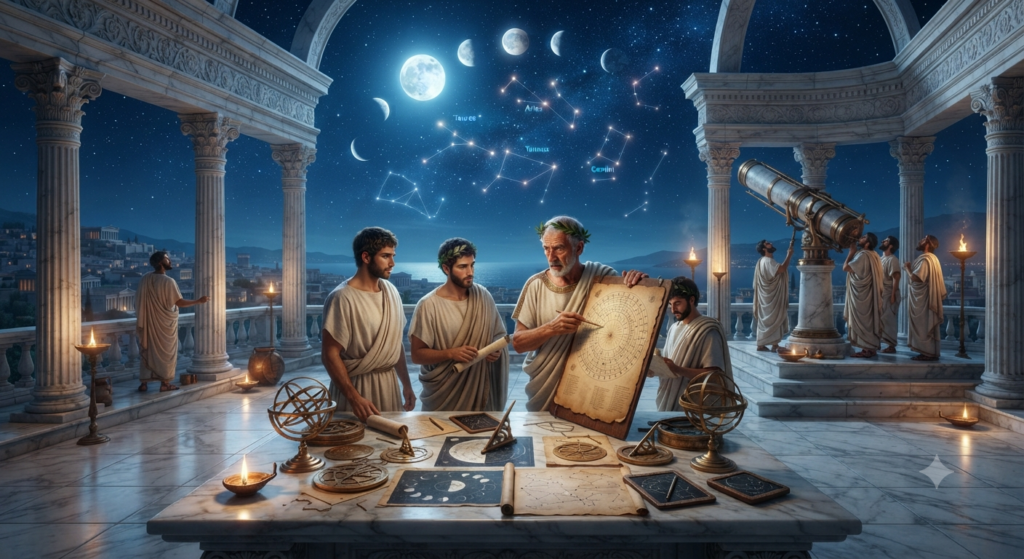
The ancient Greek, or Hellenic, calendar was not a single fixed system but a family of local lunisolar calendars, each tied to a city-state’s religious life and civic rhythm. In Athens, the best documented example, time was measured by the moon, adjusted to the sun, and organized around sacrifices, festivals, assemblies, and magistracies rather than by an abstract mathematical year alone. Its logic was practical and sacred at once: the heavens marked the passage of time, but the calendar gave that passage meaning through ritual and public order.
The Greek lunar year and lunar months
The Greek year was fundamentally lunar. A month began and ended with the cycle of the moon, so the calendar followed roughly twelve lunations rather than the solar year alone. Since a lunar month is about twenty-nine and a half days, the Greek year was shorter than the seasons if left uncorrected, which meant the calendar had to be managed carefully over time.
This gave Greek timekeeping a living, visible character. The sky was not merely a backdrop; it was the measure itself. Month names, sacrifices, and civic business all moved within this lunar framework, and ancient writers from Aristophanes to later scholars assume that Athenians understood the month as a religious and administrative unit, not simply a numerical count of days.
New moon begins each month in Athens
In Athens, the month was reckoned from the new moon, or more precisely from the first visible crescent after conjunction. That first sighting marked the opening of a month and set the rhythm for many public and sacred events. The opening day was called noumēnia, a day of offerings and recognition of the new cycle.
Because the moon was visibly observed, the calendar was rooted in experience rather than in a purely theoretical table. Ancient sources and later scholarly reconstructions indicate that this practice could create small variations from year to year, depending on weather and observation. The result was a calendar that was stable in principle but flexible in practice, reflecting the Greek habit of trusting ritual observation.
Intercalary months kept seasons aligned
A purely lunar calendar would drift away from the agricultural seasons, so Greek communities inserted extra months when needed. In Athens, an intercalary month was added to restore alignment between lunar months and the solar year. This prevented festivals associated with harvest, sailing, or seasonal gods from sliding into the wrong part of the year.
The method was not identical in every polis, and ancient evidence suggests periodic correction rather than a single universal rule. Later Greek calendrical systems could use cycles such as the Metonic cycle, but classical Athens did not rely on one rigid mathematical scheme in the way modern calendars do. Instead, magistrates and civic authorities adjusted the year to preserve the relationship between moon, season, and festival.
Polis calendars and local civic variation
There was no single pan-Hellenic calendar in the classical period. Each polis maintained its own month names, year count, and local conventions. Athens, Sparta, Delphi, Boeotia, and many other communities all tracked time in ways that reflected their own cults and political institutions.
This variation mattered because Greek civic life was local by nature. A festival, assembly, or treaty might be dated by one city’s month while another city used different names entirely. The diversity of calendars is one reason Greek chronology can be difficult to reconstruct, but it also shows how deeply time was embedded in the identity of each community.
Prytany cycles in Athenian administration
Athens also used prytanies, administrative divisions of the year connected to the Council of 500. These cycles did not replace the lunar months but ran alongside them, helping organize civic business. Since the prytanies were tied to political procedure, they offered a practical framework for recording decrees, payments, and public responsibilities.
The relationship between prytanies and calendar months could be uneven, especially because the length of the Athenian year and the number of prytanies changed over time. Still, the system shows a distinctly Greek solution to timekeeping: sacred lunar months governed ritual life, while civic cycles provided the machinery of government. Calendar and constitution worked together.
Sacred festival dates shaped the calendar
Festivals were not added onto the calendar as decorative events; they were one of its main purposes. In Athens, major celebrations such as the Panathenaia, Dionysia, and Thargelia gave structure to the year. The dates of these observances were tied to particular months and often to specific days within those months.
Because ritual obligation was central, the calendar preserved memory through repetition. Each return of a month called back the same sacrifices, processions, and offerings, though some festivals were local and others had broader religious importance. The calendar therefore served as a map of communal devotion, aligning the city with its gods through recurring observance.
Month names reflect cults and ritual life
Greek month names often derived from festivals, deities, or sacred practices associated with that time of year. In Athens, for example, names such as Hecatombaeon, Boedromion, and Poseideon preserve echoes of ritual life, sacrifice, and divine power. The names are themselves evidence that the calendar was shaped by cult rather than by neutral chronology.
This pattern is widely attested across the Greek world, though the exact meanings of some names remain debated. Even when a month’s origin is uncertain, its association with a festival or god reveals how Greeks perceived time. A month was not only a span of days; it was a sacred season with its own character and obligations.
Days within each month and lunar divisions
Greek months were divided into three parts: the first ten days, the middle ten, and the final days leading to the next new moon. The early days counted upward from the beginning of the month, while the ending days were often counted backward from the month’s close. This created a dual logic of time, forward in the first half, reverse in the second.
Athenian day names reflect that structure, with the 10th day often serving as a midpoint and the waning days counted with reference to the end of the month. This system may feel unusual to modern readers, but it matched the visible lunar cycle. The moon’s waxing, fullness, and waning gave the month a natural sequence that Greeks translated into civic and ritual order.
From Hecatombaeon to Poseideon in use
The Athenian year began with Hecatombaeon, followed by months such as Metageitnion, Boedromion, Pyanopsion, Maimakterion, and Poseideon, among others. These names survive in inscriptions, decrees, and later antiquarian accounts, allowing historians to reconstruct the calendar with considerable confidence. Their sequence reflects the religious and seasonal pattern of the Attic year.
Yet these names were not used everywhere in the Greek world, and even within Athens the calendar could vary in detail across periods. Some months were later aligned differently, and intercalations altered the sequence when a second Poseideon or similar correction was inserted. The surviving evidence shows a calendar that was practical, adaptable, and deeply local rather than rigidly uniform.
Observing time through sun, moon, and rites
The Hellenic calendar worked by holding several kinds of time together at once: the moon’s visible cycle, the sun’s seasonal course, and the repeated demands of worship and civic administration. It was not designed to isolate time from religion but to fuse them. In that sense, Greek calendrical practice belonged to the same cultural world as the myths and cults that filled the polis with memory and meaning.
To understand the ancient Greek calendar is to see that time itself was a sacred civic art. The moon marked the month, the sun corrected the year, and the city filled both with sacrifice, assembly, and festival. What survives in inscriptions and literary sources is not a single universal machine of chronology, but a family of living calendars that bound each community to its gods, its seasons, and its own remembered order.

Orin Vale has spent the better part of two decades tracing the threads that connect the world’s oldest stories — from the halls of Asgard to the banks of the Nile, from Olympus to the jungles of the Maya. What began as a childhood fascination with flood myths and trickster gods grew into years of independent study across comparative mythology and ancient religion, always chasing the same question: what did these stories mean to the people who first told them? Orin writes for readers who want more than trivia — the ones looking for the beliefs, fears, and truths that myths were built to carry.