In Homer’s Odyssey, hubris is not a decorative vice or a passing flaw; it is one of the forces that shapes the entire poem’s moral world. The Greek term itself is broader than simple pride. It suggests overstepping, insolence, and the refusal to accept the boundaries that define human life before the gods, before kingship, and before custom. Again and again, Homer shows that when mortals act as though they can ignore those limits, disorder follows. That pattern affects heroes and villains alike, and it helps explain why so many moments in the epic turn from triumph to ruin.
Hubris in the Odyssey as a fatal human flaw
In the Odyssey, hubris appears most clearly as a failure of measure. Mortal beings may be brave, clever, or powerful, but they remain mortal; to behave otherwise is to invite disaster. Homer’s world is one in which status, ritual, hospitality, and reverence are not abstract ideals but practical boundaries. Characters who cross them often do so with full awareness, and that is what makes their fall so severe. Hubris is not merely an emotion in the poem; it is an action that breaks the proper order between gods and men.
This is why the Odyssey repeatedly contrasts restraint with overreach. Odysseus survives because he adapts, conceals, waits, and calculates, yet even he is vulnerable when cleverness hardens into self-assertion. The suitors, by contrast, embody open insolence: they consume another man’s house, mock the absent king, and trust that power without justice will protect them. Homer presents hubris as fatal because it blinds people to consequences that remain visible to everyone else, especially the gods.
Odysseus, pride, and the limits of cunning
Odysseus is not a simple example of hubris, but he is not free from it either. Homer calls him “much-enduring” and “of many wiles,” and those qualities save him more than once. Yet the poem also shows how cunning can shade into self-regard. Odysseus often wants not only to survive but to be recognized as the man who outwitted others. That desire for reputation is part of heroic culture, but in the Odyssey it becomes dangerous when it leads him to expose himself unnecessarily.
The poem repeatedly tests whether intelligence can remain disciplined. When Odysseus acts with patience, he is effective; when he speaks too proudly or seeks glory at the wrong moment, trouble follows. Homer does not condemn intelligence itself. Rather, he suggests that even the best human capacity must stay within limits. Odysseus’s greatness depends on knowing when to remain hidden, and his suffering deepens whenever he forgets that wisdom also requires restraint.
The Cyclops episode and reckless self-naming
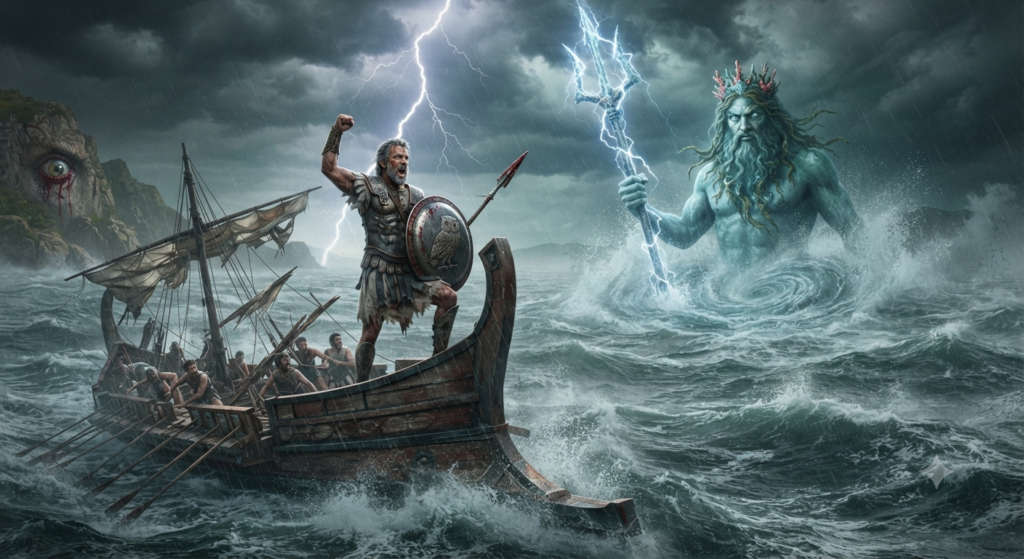
The encounter with Polyphemus is the clearest early example of hubris in the Odyssey. Odysseus and his men enter the Cyclops’s cave and act as guests, but the giant refuses civilized norms and devours them. Odysseus then blinds Polyphemus through a brilliant deception, yet victory does not end there. As he sails away, he cannot resist naming himself and claiming the deed. In doing so, he turns a successful escape into a prolonged danger.
That self-naming matters because it reveals the double edge of heroic pride. Odysseus wants credit, but in Homer’s world that demand for recognition is costly when the opponent is still able to retaliate. Polyphemus calls upon his father Poseidon, and the curse becomes one of the major engines of the hero’s long return. The scene shows that hubris can arise not only in brute violence but also in the urge to speak one’s glory aloud at the wrong moment.
Why divine power punishes mortal arrogance
The gods in the Odyssey are not indifferent to human behavior. They intervene in response to loyalty, piety, and violation, though not always in ways that seem fair by human standards. Divine punishment in the poem often follows arrogance because hubris denies the hierarchy that structures the cosmos. Mortals who act as if they owe nothing to the gods challenge an order that cannot be safely ignored. Homer’s audience would have recognized this as more than a moral lesson; it is a statement about the way the world functions.
Poseidon’s anger after the Cyclops episode is a strong example. Odysseus is not punished merely for ingenuity, but for the pride that accompanies it and for the insult to a divine family member. Elsewhere in the poem, the gods respond to violations of hospitality, sacrilege, and waste with equal severity. Their role is not always to reward virtue in a straightforward sense. Instead, they restore balance when human arrogance has made the world out of joint.
Telemachus and the testing of youthful restraint
Telemachus offers a quieter but important study in restraint. At the start of the poem he is young, uncertain, and surrounded by men who treat his household as their own. The pressure on him is not to dominate by force, since he cannot yet do that, but to learn how a legitimate son and heir should act. His growth involves becoming firm without becoming reckless. In that sense, his story is a schooling in the opposite of hubris.
Athena’s guidance helps him move from passivity to measured action. He must speak in assembly, travel abroad, and identify himself publicly, yet the poem never lets him become inflated by sudden authority. The contrast with the suitors is sharp. They assume entitlement without right; Telemachus must earn authority by learning self-command. Homer presents youthful restraint as a necessary balance to inherited status, showing that rank alone does not make a man fit to lead.
Suitors in Ithaca: excess, insolence, and waste
The suitors are the poem’s most obvious embodiment of hubris. They consume Odysseus’s estate, court Penelope while presuming he is dead, and act as if Ithaca belongs to them already. Their behavior is not merely impolite; it is a steady dismantling of order through entitlement. They feast without earning, boast without risk, and ridicule anyone who challenges them. Homer makes their arrogance visible through their appetite, which becomes a sign of moral emptiness.
Their downfall is prepared by their refusal to recognize limits. Again and again they are warned, but warnings only sharpen their contempt. They mistake temporary power for legitimate rule, and they mistake the absence of the king for permission. In Greek heroic culture, the house is the center of identity and continuity, so their waste is more than economic abuse. It is a kind of civic and moral sacrilege, one that invites violent correction.
Sacred hospitality and the violation of xenia
Xenia, the sacred code of hospitality, is one of the poem’s most important measures of civilized conduct. A guest should be received with food, shelter, and courtesy; a host should protect the guest and honor Zeus, who oversees strangers and suppliants. The Odyssey repeatedly shows that hubris often appears as the abuse of this sacred bond. The suitors are guilty of it in Ithaca, and the Cyclops is guilty of it in its most savage form, because he does not merely neglect hospitality but devours the guests who enter his cave.
Homer’s treatment of xenia makes arrogance socially destructive. Hospitality is not a private favor but a sacred exchange that keeps communities connected across distance and danger. When characters violate it, they reject the shared structure that makes civilization possible. That is why the poem treats these breaches so seriously. Hubris here is not just personal vanity; it is an assault on the rules that allow human life to remain human.
Helios, cattle, and the cost of defiance
The episode of Helios’s cattle in Book 12 shows how deliberate defiance can become collective ruin. Odysseus’s men know the warning not to touch the sacred herd, yet hunger, impatience, and disregard for the divine command lead them to slaughter the cattle anyway. In Homer, the offense is not ordinary theft. It is an act of knowing transgression against a god’s property, and that knowledge makes the act far worse.
The result is total catastrophe. Zeus destroys the ship, and Odysseus alone survives. This scene is especially revealing because it strips away heroic excuses. The men are not ignorant; they are not tricked; they choose to override a boundary. Hubris here is the temptation to treat necessity as a permission slip. Homer’s answer is uncompromising: mortal need does not erase sacred limits.
Athena’s guidance against proud misjudgment
Athena is often associated with Odysseus because both value intelligence, strategy, and timing. Yet her presence in the poem also highlights the difference between wise action and proud misjudgment. She does not simply empower human cleverness; she disciplines it. She advises concealment, timing, and patience, all of which resist the impulsive self-display that characterizes hubris. Under her guidance, Odysseus is most effective when he is least grandiose.
Her relationship with Odysseus is therefore instructive rather than flattering. She supports him, but she does not erase the consequences of his overconfidence. In the Odyssey, divine favor does not license arrogance. Athena’s role suggests that true intelligence is collaborative and measured, not self-exalting. The hero who listens can be restored; the one who insists on his own brilliance without restraint becomes vulnerable.
Hubris, fate, and the return to rightful order
By the end of the Odyssey, hubris has been exposed as one of the principal reasons the world falls into disorder. The suitors are destroyed, Odysseus returns, and the household is restored, but the journey reveals that victory depends on more than force. It requires the reestablishment of proper limits: king and household, guest and host, mortal and god, son and father. When those lines are ignored, the result is violence; when they are respected, peace becomes possible.
Homer does not present hubris as a problem only for villains. Odysseus himself must learn, through suffering, when cleverness becomes dangerous and when self-assertion invites divine anger. That is why the poem feels so enduring. It understands that pride is not always loud or crude; sometimes it is brilliant, persuasive, and almost justified. Yet in the world of the Odyssey, any mortal who forgets the boundaries of human life moves closer to ruin, and the road home becomes longer than it should have been.

Orin Vale has spent the better part of two decades tracing the threads that connect the world’s oldest stories — from the halls of Asgard to the banks of the Nile, from Olympus to the jungles of the Maya. What began as a childhood fascination with flood myths and trickster gods grew into years of independent study across comparative mythology and ancient religion, always chasing the same question: what did these stories mean to the people who first told them? Orin writes for readers who want more than trivia — the ones looking for the beliefs, fears, and truths that myths were built to carry.