Apollo is most often associated with the lyre, the small stringed instrument that came to embody harmony, poetic inspiration, and divine skill in Greek myth. In the classical tradition, this is the Apollo of Olympus, son of Zeus and Leto, not any later historical or local figure using the same name. Across Homer, the Homeric Hymns, and later authors such as Apollodorus and Pausanias, the lyre appears again and again as the sign of his musical authority, even when other instruments, such as the kithara, are linked with his broader cult and artistic role.
Apollo and the Lyre in Greek Myth
Apollo’s connection to the lyre is one of the most familiar images in Greek mythology. In mythic language, the god is not merely a musician but the divine source of measured sound, the figure whose playing brings order where there is tension. The lyre is therefore more than an accessory; it belongs to his identity as a god of music, prophecy, and civilized form. When Greek poets invoke Apollo, they often place strings and song close to his presence, as though the instrument itself were an extension of his authority.
The association is especially clear in stories where Apollo appears as a rival or judge in musical contests. His playing is described as refined, disciplined, and overwhelming in its precision, a contrast to more unruly or rustic forms of performance. The mythic record does not present him as limited to one instrument alone, but the lyre is the object most consistently attached to him, and later Greek art makes that association immediately visible.
Why the Lyre Became His Symbol
The lyre suited Apollo because Greek religion and poetry saw him as a god of proportion, restraint, and luminous intelligence. Unlike the pipe, which could suggest wild ecstasy or Dionysian abandon, the lyre implied measured harmony and formal beauty. It fit a deity linked with order in the cosmos, clarity in speech, and disciplined excellence in performance. The instrument’s shape and sound made it a natural emblem for a god whose gifts included music, healing, and prophecy.
Classical sources also place Apollo within a mythic genealogy of invention and transmission. The lyre itself is often connected with Hermes in the story of the stolen cattle and the first crafting of the instrument, as told in the Homeric Hymn to Hermes. Apollo then receives it and becomes its supreme player. That exchange matters: it explains why the lyre can stand both for invention and for perfected use, with Apollo representing the instrument’s highest cultural meaning.
Apollo as Patron of Music and Poetry
Apollo’s musical identity is inseparable from his patronage of poetry. In archaic and classical Greek culture, song, verse, and instrumental accompaniment were closely related, and Apollo presided over that whole domain. He was not only the god who played; he was the divine model behind inspired composition, the figure to whom poets looked for clarity of expression and grace of form. This is one reason later tradition links him so closely with the Muses.
As patron of music and poetry, Apollo also stands for the ideal of art governed by measure. Greek writers often present him as the opposite of disorderly noise, not because music itself is suspect, but because true musical excellence requires control. The lyre becomes the perfect instrument for this role: portable, refined, and capable of accompanying song in ways that mirror the balance Apollo embodies.
The Kithara in Ancient Greek Culture
While the lyre is Apollo’s best-known instrument, the kithara also belongs to his cultural world. The kithara was a more elaborate stringed instrument, associated with professional performance and formal song. In Greek art and literature, Apollo may be shown with a lyre or a kithara depending on the context, and both reinforce his standing as a master of strings. The distinction matters historically, even if later imaginations often merge the two.
In the broader culture of ancient Greece, the kithara carried prestige in competitions and ceremonial performance. Its association with skilled musicians made it especially fitting for a god who represented excellence rather than improvisation. Apollo’s image with the kithara therefore reflects not a different divine identity, but an expanded one: he is the god of stringed music in its fullest and most elevated form.
Musical Skills Attributed to Apollo
Apollo’s musical skill is portrayed as complete and authoritative. He does not simply accompany song; he sets the standard for it. In mythic contests, his performance is marked by control, beauty, and a power that commands recognition from gods and mortals alike. The sources present him as a musician whose art is so perfected that it becomes an expression of divine legitimacy.
This skill extends beyond entertainment. Music in Apollo’s hands can order emotion, honor the gods, and embody cosmic balance. That is why the lyre is so appropriate to him: its clear, resonant strings suggest both precision and harmony. In Greek myth, Apollo’s musicianship is not decorative; it is one of the ways his divinity becomes audible.
Lyre Imagery in Homeric Hymns
The Homeric Hymns preserve some of the most important early literary evidence for Apollo’s association with stringed instruments. In the Hymn to Hermes, Hermes invents the lyre from a tortoise shell and later gives it to Apollo, who becomes its rightful master. The hymn is important because it explains, in mythic terms, how Apollo comes to possess the instrument most associated with him. The exchange also highlights Apollo’s status as the one who transforms raw invention into elevated art.
Other hymnic passages reinforce the god’s musical aura through repeated references to song, dance, and the orderly pleasures of divine performance. Apollo is often imagined in the company of choruses and ritual music, where the lyre serves as a bridge between mortal worship and divine presence. The hymnic tradition does not always linger on technical detail, but it firmly places the instrument at the center of Apollo’s sacred identity.
Apollo, Muses, and Sacred Harmony
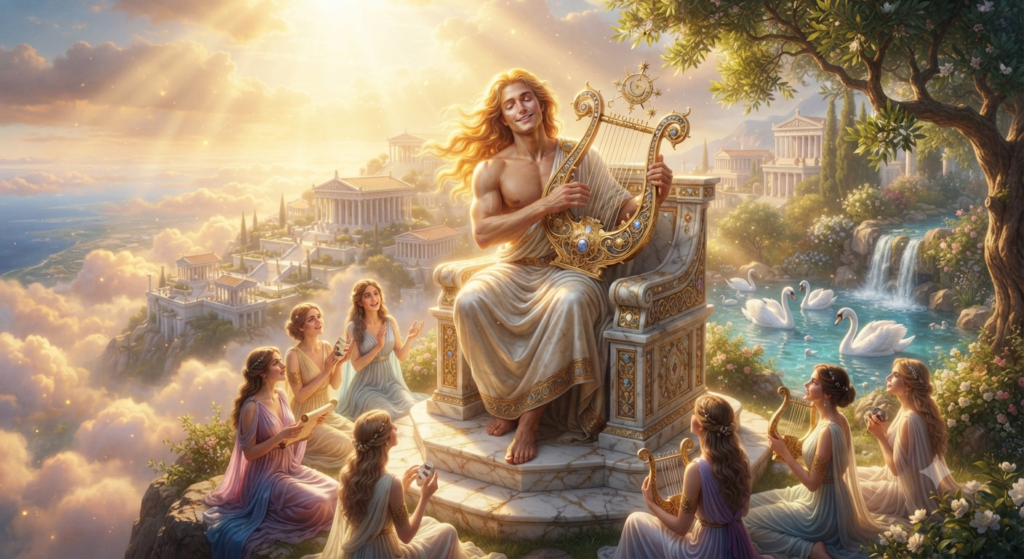
Apollo’s connection with the Muses strengthens the meaning of the lyre in Greek thought. The Muses govern poetic memory, song, and intellectual inspiration, while Apollo often appears as their leader or companion in artistic settings. Together they represent the disciplined and sacred dimensions of performance. The lyre, in this company, becomes more than a tool; it becomes a symbol of harmony among voice, memory, and divine order.
This association is visible in later literary and artistic tradition, where Apollo stands among the Muses as a figure of serene musical authority. The relationship also explains why his music is so often described as balanced and elevating rather than merely pleasing. In mythic terms, Apollo and the Muses do not produce noise; they produce μορφή, form made audible. The lyre is the instrument through which that harmony is heard.
Temple Reliefs Showing Apollo with Strings
Greek and Roman visual art repeatedly shows Apollo with stringed instruments, especially in sculpture, vase painting, and relief. These images are not casual decoration. They communicate the god’s identity at a glance: youthful, idealized, and associated with music, prophecy, and ritual purity. In temple and sanctuary contexts, Apollo with a lyre or kithara could signal his presence as a deity whose favor was sought through ordered worship.
Reliefs and other artistic representations also show how firmly established the image had become by the classical period. Even when the literary sources are sparse on visual detail, the art confirms what the myths imply: Apollo’s instrument is part of his public religious identity. For ancient viewers, the sight of Apollo with strings would have evoked not only beauty but authority, reminding them that music under his patronage belonged to the sacred sphere.
Rivalry, Contest, and Divine Performance
Apollo’s most famous musical rivalries reinforce his link to the lyre. In myth, he competes with Marsyas and, in some traditions, with Pan, each contest serving as a test of musical order against a different kind of performance. The outcome usually favors Apollo, whose stringed instrument and controlled style are judged superior to the more chaotic or rustic alternatives. These stories are severe in tone, especially the one involving Marsyas, and they reveal how seriously the Greeks imagined musical hierarchy.
Such contests are not merely tales of vanity. They dramatize a cultural judgment about what counts as true art. Apollo wins because his music reflects the values Greeks associated with civilization: measure, clarity, and mastery. The lyre is crucial to that message, since its sound and form embody the disciplined excellence Apollo represents.
The Lyre in Later Classical Tradition
In later classical and post-classical tradition, the lyre remains Apollo’s defining instrument even as authors and artists continue to use kithara imagery alongside it. Roman poets, mythographers, and visual artists inherited the Greek association and strengthened it through repetition. By then, Apollo with the lyre had become a stable cultural symbol, recognizable beyond the details of any single myth.
That enduring image explains why Apollo still seems inseparable from stringed music in modern retellings. The instrument carries layers of meaning: divine invention, poetic inspiration, ritual order, and artistic mastery. If one asks what instrument Apollo is associated with, the clearest answer is the lyre, with the kithara as its closely related counterpart in the ancient tradition. Apollo’s lyre is one of the most enduring symbols in Greek mythology because it captures so much of what the god represents. It is an instrument of harmony, but also of authority; an object of beauty, but also of discipline. Through myth, hymn, and image, the lyre became the most recognizable sign of Apollo’s place among the gods.

Orin Vale has spent the better part of two decades tracing the threads that connect the world’s oldest stories — from the halls of Asgard to the banks of the Nile, from Olympus to the jungles of the Maya. What began as a childhood fascination with flood myths and trickster gods grew into years of independent study across comparative mythology and ancient religion, always chasing the same question: what did these stories mean to the people who first told them? Orin writes for readers who want more than trivia — the ones looking for the beliefs, fears, and truths that myths were built to carry.