Labyrinth
Introduction
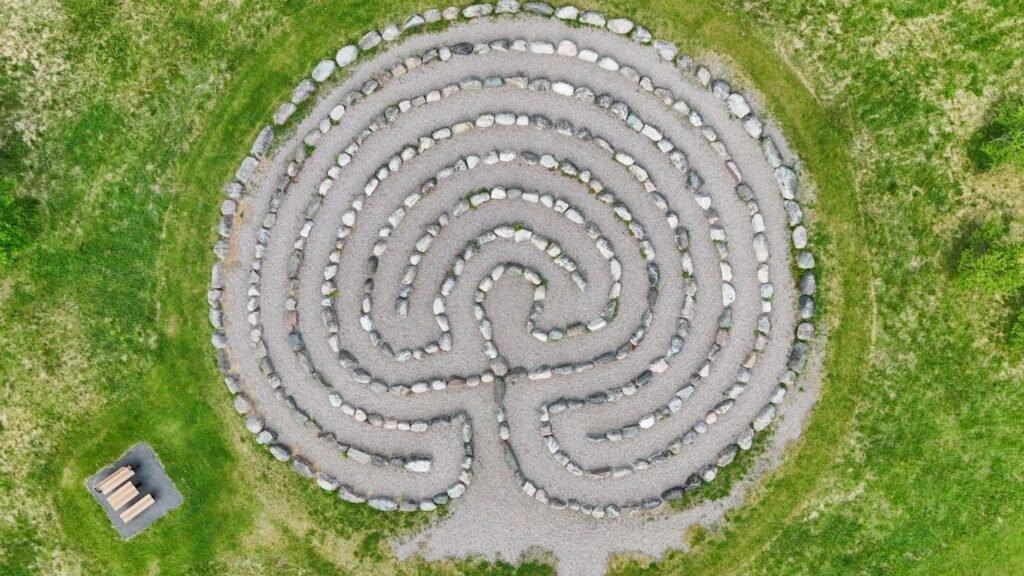
A labyrinth is a complex, often intricate structure of winding passages designed to confuse, challenge, or guide those who enter it. In modern usage, the term can refer either to a maze with branching choices and dead ends or to a single-path winding design that leads to a center. In mythology, architecture, literature, and psychology, the labyrinth has become one of the most enduring symbols of mystery, trial, transformation, and hidden knowledge.
The labyrinth is especially famous in Greek mythology through the story of the Minotaur and the labyrinth built by Daedalus for King Minos of Crete. Beyond this myth, labyrinthine patterns appear in many cultures and historical periods, from ancient temple layouts and ritual designs to medieval church pavements and modern art. The concept has remained powerful because it represents both physical complexity and the human experience of uncertainty, search, and discovery.
Origin and Meaning
The word labyrinth entered English through Latin labyrinthus, which came from Greek labyrinthos (λαβύρινθος). The exact origin of the Greek term is uncertain and has long been debated by scholars.
Several proposals exist:
- A possible connection with the double axe or labrys, a ritual object associated with Minoan Crete.
- A link to pre-Greek or non-Indo-European language forms used in the eastern Mediterranean.
- A folk etymology later developed in antiquity to associate the labyrinth with Cretan religious symbolism.
Although the derivation remains uncertain, the word became firmly associated in classical antiquity with a large, confusing building or network of passages. Over time, the term also acquired a broader metaphorical meaning, referring to anything difficult to navigate mentally or physically.
Historical Context
Labyrinths are found in both mythological tradition and historical architecture. Their significance varies according to cultural context.
Ancient Greece and Crete
The most influential ancient tradition places the labyrinth in Crete, linked with the palace culture of Knossos and the mythic reign of Minos. Greek authors described the labyrinth as an extraordinary construction made to imprison the Minotaur, a creature born from the union of Pasiphaë and a bull sent by Poseidon.
Some modern scholars have connected the myth to the complex architectural layout of the Minoan palace at Knossos, though this remains interpretive rather than proven fact. The palace was indeed large and intricate, which may have inspired later ideas of a labyrinth.
Egypt and the Ancient Near East
Ancient Greek writers also described a great Egyptian labyrinth, especially one near the Lake of Moeris in the Fayum region. Herodotus, among others, claimed it surpassed even the pyramids in grandeur. Later authors gave differing accounts of its size, purpose, and fate. Archaeology has not fully confirmed the precise structure described in these texts, but the tradition shows that labyrinthine monuments were associated with royal power, sacred space, and wonder.
Roman and Medieval Europe
In Roman culture, labyrinth designs appeared in mosaics and decorative art. During the medieval period, labyrinths became important in Christian contexts, especially as pavement labyrinths in cathedrals. These were not usually intended as confusing structures but as symbolic paths for contemplation, pilgrimage, or spiritual reflection.
Global Traditions
Similar winding designs or maze-like symbolic structures appear in other parts of the world as well, though they are not all historically connected. These include Native American, Indian, and Nordic traditions, each with distinct meanings. The widespread presence of labyrinth imagery suggests a deep human fascination with orientation, threshold, and the journey toward a center.
Main Characteristics
A labyrinth is defined by several characteristic features:
- Complexity of path: It presents a winding or confusing route.
- Central goal: Many labyrinths lead toward a center or symbolic destination.
- Transformation through movement: Entry and passage often represent a journey of testing or insight.
- Symbolic ambiguity: A labyrinth may be physical, mental, spiritual, or literary.
- Controlled disorientation: It challenges ordinary navigation and imposes uncertainty.
Labyrinth versus Maze
Although the terms are often used interchangeably, there is a useful distinction:
| Feature | Labyrinth | Maze |
|---|---|---|
| Structure | Usually a single path or highly structured route | Multiple paths, branches, and dead ends |
| Purpose | Meditative, symbolic, ritual, or decorative | Often designed as a puzzle or challenge |
| Experience | Progression toward a center | Problem-solving and choice |
| Cultural use | Ancient, religious, symbolic | More common in modern recreational contexts |
In mythology and historical symbolism, the labyrinth is usually less about puzzle-solving than about initiation, danger, and revelation.
Family and Genealogy
The labyrinth itself is not a divine being and therefore does not have a genealogy in the strict mythological sense. However, its mythological associations are closely tied to a family network centered on the royal house of Crete.
Key Figures in the Cretan Myth
- Minos: King of Crete; the labyrinth is commissioned in his reign.
- Pasiphaë: Minos’s wife; mother of the Minotaur.
- The Minotaur: The monster confined in the labyrinth.
- Daedalus: Master craftsman who built the labyrinth.
- Icarus: Daedalus’s son, connected indirectly through the later escape from Crete.
- Ariadne: Daughter of Minos who helps Theseus navigate the labyrinth.
- Theseus: Athenian hero who kills the Minotaur and escapes the labyrinth.
In mythic tradition, these relationships give the labyrinth its narrative force. It is the setting in which dynastic conflict, human ingenuity, divine punishment, and heroic action converge.
Symbols
The labyrinth is itself a symbol, and its meaning changes according to context. Common symbolic associations include:
- The center: spiritual insight, hidden truth, or the goal of a journey.
- The path: life, pilgrimage, fate, or self-discovery.
- Twisting walls or lines: confusion, challenge, complexity, or secrecy.
- The enclosure: the boundary between the known world and the unknown.
Common Symbolic Meanings
| Symbolic element | Meaning |
|---|---|
| Center | Fulfillment, revelation, or the divine |
| Winding path | Life’s journey or a spiritual trial |
| Enclosed structure | Mystery, protection, or entrapment |
| Repeated turns | Cycles, return, or contemplation |
In Christian and medieval traditions, labyrinths often symbolized the pilgrimage of the soul. In psychological and literary interpretations, they can represent the unconscious mind, moral complexity, or the search for identity.
Sacred Animals
Labyrinth traditions are not usually associated with a fixed pantheon of sacred animals in the way that gods are. However, specific animals appear prominently in the myths connected with the labyrinth.
The Bull
The bull is the most important animal associated with the Cretan labyrinth tradition. It is central to the story of the Minotaur’s birth and reflects broader Aegean symbolic traditions in which bulls were linked with power, fertility, and ritual significance.
The Minotaur
The Minotaur itself is a hybrid creature, combining human and bovine traits. As such, it is not a sacred animal in a devotional sense, but it is one of the most enduring symbolic beings in Western mythology.
The Thread and the Path
Although not an animal, Ariadne’s thread is inseparable from the labyrinth myth. It is the tool that makes escape possible and has become a lasting symbol of guidance through complexity.
Sacred Plants
No plant is universally or originally sacred to the labyrinth itself. However, some plant associations appear in later symbolic traditions and artistic interpretations.
Ivy and Laurel in Classical Symbolism
- Ivy: often associated with Dionysus, and in broader classical art with endurance and ritual celebration.
- Laurel: linked with victory and divine favor, especially in Greek and Roman contexts.
These plants are not uniquely tied to the labyrinth, but they may appear in artistic depictions of Greek mythological settings. In Christian labyrinth symbolism, plants are less central than the architectural form itself.
Sacred Places
The labyrinth is associated with several important places in mythology, history, and archaeology.
Crete
Crete is the primary mythological location of the famous labyrinth. The palace complex at Knossos is often discussed in connection with the story, though the mythic labyrinth should not be reduced to a single archaeological site.
Knossos
Knossos is the best-known Minoan center on Crete. Its large, interconnected rooms and corridors have inspired comparisons to a labyrinth, especially in popular retellings. While the site is historically real, its direct identification with the mythological labyrinth remains speculative.
Egypt
Ancient authors such as Herodotus described an Egyptian labyrinth near the Faiyum region. This structure was said to be astonishing in scale and complexity. Different classical writers varied in their descriptions, and the exact historical reality of the building remains debated.
Cathedrals and Churches
In medieval Europe, labyrinths were incorporated into the floors of cathedrals, notably in France. These were not sacred sites in the same sense as temples dedicated to a god, but they served devotional and symbolic functions.
Powers and Attributes
Since the labyrinth is not a deity, it does not possess powers in a literal mythological sense. Its “attributes” are symbolic and functional.
Core Attributes
- Disorientation: it confuses the traveler.
- Concealment: it hides what lies at the center.
- Transformation: the journey through it changes the participant.
- Testing: it measures courage, intelligence, and perseverance.
- Boundary-crossing: it marks the movement from one state to another.
Symbolic Domains
The labyrinth is often understood as governing:
- Initiation
- Mystery
- Trial
- Self-knowledge
- Escape and revelation
In modern interpretation, it is sometimes treated as a metaphor for psychological depth, social complexity, or institutional bureaucracy.
Main Myths
The labyrinth is most famous for one myth, but related traditions enrich its meaning.
The Minotaur and the Labyrinth
According to the best-known Greek myth, King Minos offended Poseidon, who caused his wife Pasiphaë to develop an unnatural desire for a bull. From this union came the Minotaur. To conceal the creature, Minos ordered Daedalus to build the labyrinth.
Athens was later required to send youths and maidens as tribute to be devoured by the monster. The hero Theseus, with the help of Ariadne’s thread, entered the labyrinth, killed the Minotaur, and found his way out.
This myth combines several themes:
- royal guilt
- divine punishment
- monstrous birth
- architectural ingenuity
- heroic conquest
- rescue through strategy rather than force alone
The Egyptian Labyrinth
Herodotus and later writers described a vast labyrinth in Egypt connected with tombs, temples, or royal functions. The accounts differ significantly. Some sources emphasize its grandeur, while others stress its architectural complexity. Because the surviving ancient descriptions are not fully consistent, the Egyptian labyrinth remains partly historical and partly literary.
Labyrinth as a Pattern of the World
In later interpretation, the labyrinth became a metaphor for the world as a place of confusion that can nonetheless be navigated with wisdom. This symbolic use is especially prominent in medieval and Renaissance thought.
Relationship with Other Mythological Figures
The labyrinth’s primary relationships are with the figures surrounding the Cretan myth.
Daedalus
Daedalus is the master builder of the labyrinth. He represents technical genius, invention, and the ambiguous morality of craftsmanship. His work creates both protection and imprisonment.
Minos
Minos commissions or possesses the labyrinth as an instrument of control. His authority depends partly on the structure’s ability to contain the Minotaur and hide the shame of the royal household.
Pasiphaë
Pasiphaë is linked to the origin of the Minotaur. Her role is central to the mythic chain of events that leads to the construction of the labyrinth.
Theseus
Theseus embodies the heroic challenger who enters the labyrinth and defeats the monster. His success depends not only on strength but also on assistance from Ariadne and, by extension, Daedalus’s clever design.
Ariadne
Ariadne is one of the most important figures in the labyrinth narrative. Her thread gives Theseus a route out. In later mythology, she is also associated with abandonment, romance, and eventual divine or semi-divine honor in some traditions.
Worship and Cult
The labyrinth itself was not usually worshipped as a god, but it participated in religious and ritual life.
Ancient Ritual Associations
In Minoan and Greek contexts, bulls, palaces, and sacred spaces were deeply connected to ritual culture. Some scholars have suggested that labyrinth mythology may preserve memories of ceremonial architecture or initiation practices, but such interpretations should be treated cautiously.
Christian Labyrinths
In medieval Christianity, labyrinths often appeared in church floors. These were used for:
- symbolic pilgrimage
- meditation
- penitential reflection
- ritual walking on sacred days
They were especially associated with Easter or devotional use in some places, although practices varied by region and period.
Modern Ritual and Therapeutic Use
In modern settings, labyrinths are sometimes used for:
- contemplative walking
- stress reduction
- spiritual reflection
- community ceremonies
These uses are not ancient worship in a strict sense, but they show the continuing ritual appeal of the form.
Ancient Sources
Several classical and later authors mention labyrinths or labyrinth-like structures.
Important Ancient Authors
| Author | Contribution |
|---|---|
| Homer | Does not provide a major labyrinth narrative, but forms part of the broader early Greek tradition |
| Herodotus | Describes the Egyptian labyrinth in Histories |
| Diodorus Siculus | Gives accounts related to Crete and the Minotaur tradition |
| Apollodorus | Summarizes the Theseus and Minotaur myth in the Bibliotheca |
| Pausanias | Refers to monuments and local traditions in Greece |
| Ovid | Retells the Minotaur and Daedalus traditions in Metamorphoses |
| Pliny the Elder | Mentions labyrinths in his encyclopedic writings |
Different ancient sources do not always agree. This is especially true for the Egyptian labyrinth and for details of the Cretan myth. Modern understanding depends on comparing literary testimony with archaeology and later reception.
Roman Equivalent
There is no single Roman god or figure that functions as a direct equivalent to the labyrinth. However, Roman culture adopted and adapted the concept in several ways:
- Latin literature preserved and expanded the Greek myth.
- Roman mosaics often used labyrinth patterns as decorative motifs.
- Architectural and symbolic use continued in domestic, funerary, and public contexts.
If a “Roman equivalent” is meant in terms of cultural adaptation, the labyrinth became part of the broader Roman artistic and literary vocabulary rather than a distinct deity or cult object.
Influence on Modern Culture
The labyrinth has had an enormous influence on modern culture, far beyond its ancient origins.
Literature
Writers have used the labyrinth as a metaphor for:
- memory
- identity
- history
- language
- political systems
- existential uncertainty
It appears frequently in modernist and postmodern literature, where complexity and uncertainty are central themes.
Cinema and Television
Labyrinth imagery appears in films and series as a symbol of:
- hidden truth
- danger
- psychological entrapment
- fantasy or adventure
The name itself became especially familiar through the 1986 film Labyrinth, which helped reinforce the word’s association with fantasy and wonder in popular culture.
Games
Labyrinths and mazes are staples of board games, video games, and puzzle design. They often function as spaces of exploration, survival, or strategic navigation.
Art and Architecture
Contemporary artists and architects continue to use labyrinth forms in:
- installations
- gardens
- public spaces
- meditative design
The form remains attractive because it is visually striking and conceptually rich.
Psychology and Popular Thought
In psychological and popular discourse, labyrinths are often used metaphorically to describe:
- the unconscious
- trauma
- decision-making
- institutional complexity
This makes the labyrinth one of the most adaptable symbols in modern thought.
Curiosities
- The word labyrinth is often used loosely for a maze, but historically the two can mean different things.
- The Ariadne’s thread image has become a common metaphor for a clue or guiding principle that helps solve a difficult problem.
- In some medieval traditions, walking a labyrinth was considered a substitute for pilgrimage when travel to holy sites was impossible.
- The labyrinth is one of the few mythic symbols that survives equally well in religion, literature, architecture, and psychology.
- The Egyptian labyrinth described by ancient authors was said to be so remarkable that some writers ranked it alongside the pyramids.
- Labyrinth patterns can be found in floor mosaics, manuscripts, garden designs, and contemporary therapy spaces.
- The labyrinth is often interpreted as a symbol of return rather than escape, because its path leads inward and outward through a single route.
Frequently Asked Questions
What is the difference between a labyrinth and a maze?
A labyrinth usually has a single winding path to the center, while a maze has branches, choices, and dead ends. In everyday speech, the terms are often used interchangeably.
Why is the labyrinth important in Greek mythology?
It is central to the myth of the Minotaur and Theseus. The labyrinth represents danger, concealment, and the need for intelligence and divine or human assistance to achieve escape.
Who built the labyrinth in mythology?
The myth usually credits Daedalus, the legendary inventor and craftsman, with building the labyrinth for King Minos of Crete.
What does the labyrinth symbolize?
It can symbolize a journey, spiritual trial, confusion, hidden knowledge, self-discovery, or the movement toward a center of truth.
Was the labyrinth a real building?
The mythological Cretan labyrinth is not archaeologically confirmed as a specific building. However, ancient authors also described real structures, especially in Egypt, that they called labyrinths.
Why is Ariadne’s thread famous?
It is the tool that allowed Theseus to find his way back out of the labyrinth after defeating the Minotaur. Today it means a clue, guide, or method for solving a complex problem.
Are there Christian labyrinths?
Yes. Medieval churches and cathedrals sometimes contained labyrinth designs in their floors, used for symbolic walking and devotional reflection.
Does the labyrinth appear in cultures outside Greece?
Yes. Similar winding or symbolic path structures appear in many cultures, though their meanings and origins differ widely.
Conclusion
The labyrinth is one of the most enduring symbols in world culture. Rooted most famously in Greek mythology, it has also appeared in ancient Egyptian descriptions, Roman art, medieval Christian practice, and modern literature and media. Whether understood as a mythic prison, a ritual path, or a metaphor for life’s complexity, the labyrinth continues to represent the human encounter with mystery, difficulty, and the search for meaning.
Its lasting power lies in its versatility. The labyrinth can be architectural, symbolic, spiritual, or psychological. It can imprison a monster, guide a pilgrim, or express the complexity of thought itself. Across centuries and cultures, it remains a compelling image of the journey inward and the possibility of finding one’s way out.

Orin Vale has spent the better part of two decades tracing the threads that connect the world’s oldest stories — from the halls of Asgard to the banks of the Nile, from Olympus to the jungles of the Maya. What began as a childhood fascination with flood myths and trickster gods grew into years of independent study across comparative mythology and ancient religion, always chasing the same question: what did these stories mean to the people who first told them? Orin writes for readers who want more than trivia — the ones looking for the beliefs, fears, and truths that myths were built to carry.