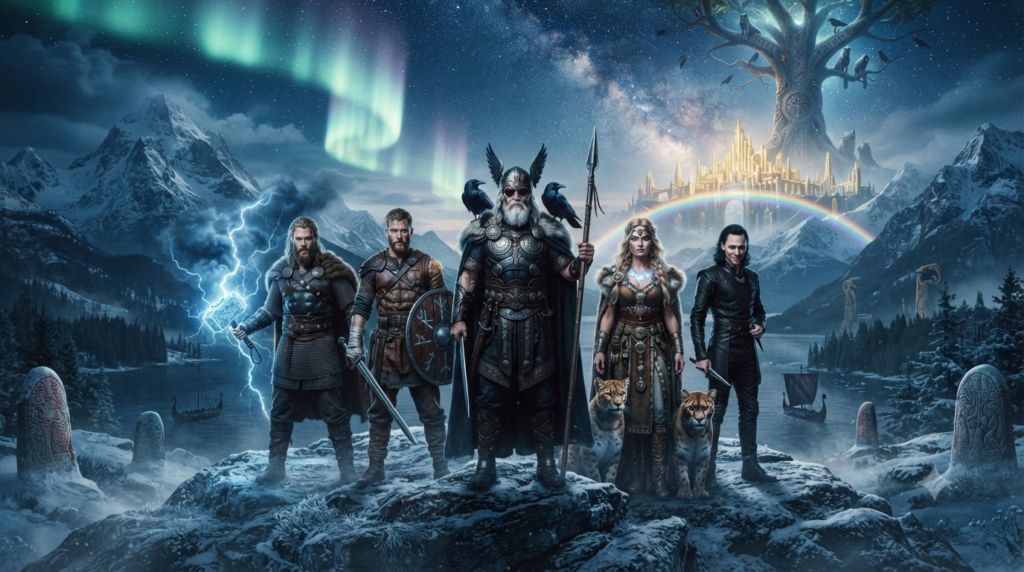
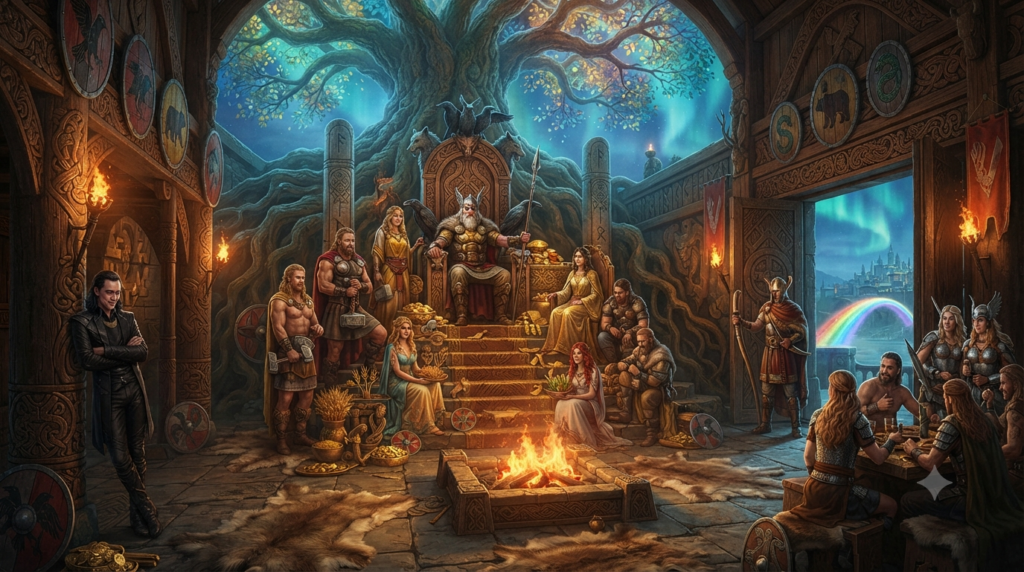
Norse mythology grew out of the harsh landscapes and long winters of Scandinavia, producing a pantheon defined less by effortless immortality than by gods who fight, scheme, age, and ultimately march toward a foretold destruction at Ragnarok. The Norse gods were divided into two distinct tribes, the Aesir and the Vanir, who once fought a war against one another before settling into an uneasy alliance, a conflict that shaped much of how Norse mythology explains the different powers each god holds. Preserved mainly through medieval Icelandic texts written centuries after Christianity replaced the old religion, Norse mythology survives as one of the most vivid and human pantheons in world mythology.
This guide brings together the gods and goddesses of Norse mythology in one place, organized by family and function: the ruling house of Odin, the gods of war and law, the keepers of wisdom and magic, the Vanir gods of fertility, the goddesses of healing and fate, and Loki, whose complicated loyalty runs through nearly every major Norse myth. Each entry below introduces one god or goddess and sets up a deeper profile you can explore for that individual figure.
How the Norse Pantheon Is Organized
What Is the Difference Between the Aesir and the Vanir?
Norse mythology divides its gods into two distinct families, the Aesir and the Vanir, who originally lived apart and fought a long, destructive war before finally exchanging hostages and living together in Asgard. The Aesir, led by Odin, are generally associated with war, law, and the ruling order of the cosmos, while the Vanir, led by Njord, are associated with fertility, prosperity, and the natural world. By the time most surviving Norse myths were written down, the distinction had softened considerably, with major Vanir gods like Freyr and Freyja fully integrated into Aesir society in Asgard.
Who Is the King of the Norse Gods?
Odin holds the position of king of the Norse gods, ruling from his hall of Valhalla and commanding the loyalty of the other Aesir through a combination of wisdom, magic, and hard-won knowledge rather than raw physical strength alone. Unlike Zeus in Greek mythology, whose authority rests heavily on overwhelming physical power, Odin’s Norse mythology kingship is built on sacrifice, including giving up an eye for wisdom and hanging from the world tree Yggdrasil to learn the secret of the runes. This emphasis on earned knowledge over brute force is one of the clearest ways Norse mythology’s idea of leadership differs from other ancient pantheons.
How Many Gods and Goddesses Are There in Norse Mythology?
Surviving Norse mythology names several dozen individual gods and goddesses across the Aesir and Vanir tribes, though the two main medieval sources, the Poetic Edda and the Prose Edda, do not always agree on the full list or on every god’s exact role. Many minor figures appear only once or twice in the surviving texts, with only a smaller core group, generally two to three dozen deities, receiving enough detail to reconstruct a clear individual identity. This relatively limited but well-documented pantheon is part of what makes Norse mythology approachable compared to larger, more fragmented mythological systems.
Why Does Odin Have So Many Different Names?
Odin is recorded in Norse mythology under more names, or heiti, than any other god, with lists in the Prose Edda naming well over one hundred titles reflecting his many roles as war god, poetry god, wanderer, and master of magic. Names like Allfather, Grey Beard, and Raven God each highlight a different aspect of Odin’s character, and Norse mythology often has him travel in disguise under one of these secondary names when interacting with mortals or other gods. This tradition of multiple names reflects Odin’s fundamentally shifting, unpredictable nature within Norse mythology, a god who is never fully captured by any single title.
What Is the Difference Between a God and a Giant in Norse Mythology?
Norse mythology draws a formal line between the Aesir and Vanir gods and the jotnar, or giants, who represent older, more chaotic forces often associated with mountains, frost, and fire. In practice, this line blurs constantly: several major gods, including Loki and Skadi, come from giant families, and gods frequently marry giants or count them among close relatives. The distinction in Norse mythology has less to do with power or appearance and more to do with allegiance and role, with giants generally representing the disruptive forces the gods must continually manage to delay the chaos of Ragnarok.
The Ruling House of Odin
Odin
Odin is the Allfather and ruler of Asgard, a god of war, wisdom, poetry, and death who sacrificed an eye at Mimir’s well and hung himself from the world tree Yggdrasil to gain the knowledge of the runes. Norse mythology presents Odin as a restless, wandering figure, often traveling the nine realms in disguise seeking knowledge, and as the god who selects half of all warriors slain in battle to join him in Valhalla in preparation for Ragnarok. Despite his immense power, Odin is defined by his relentless pursuit of wisdom over strength, a trait that distinguishes his rule from that of nearly any other head god in world mythology.
Frigg
Frigg is Odin’s wife and the queen of Asgard, a goddess of marriage, motherhood, and foresight said to know the fate of every being in the nine realms, though Norse mythology holds that she never reveals what she knows. Her most famous myth centers on her son Baldr, whom she tries desperately to protect from harm by extracting an oath from nearly everything in existence not to hurt him, an effort ultimately undone by the one substance she overlooked. Frigg’s combination of quiet foreknowledge and fierce maternal protection makes her one of the most emotionally resonant figures in Norse mythology.
Baldr
Baldr is the beloved god of light, beauty, and joy, son of Odin and Frigg, whose death at the hands of his blind brother Hodr, manipulated by Loki, sets Norse mythology’s tragic chain of events toward Ragnarok into motion. Despite Frigg’s efforts to make him invulnerable, Loki discovers the one overlooked weakness, mistletoe, and uses it to engineer Baldr’s death, an act the other gods can never fully forgive. Baldr’s death is treated in Norse mythology as the moment the world’s fate turns irreversibly toward its foretold destruction.
Hodr
Hodr is Baldr’s blind brother, remembered in Norse mythology as the unwitting instrument of Baldr’s death after Loki tricks him into throwing a mistletoe dart at his own brother during a game the gods believed was harmless. Norse mythology treats Hodr with more sympathy than blame, since he acts without knowledge of Loki’s deception, though he is nonetheless killed in revenge by another son of Odin, Vali, born specifically to avenge Baldr. Hodr’s story highlights how thoroughly Loki’s manipulation, rather than any god’s own malice, drives the tragedy at the heart of Norse mythology’s central turning point.
Vali
Vali is a son of Odin born for a single, specific purpose within Norse mythology: to grow to adulthood within a single day and avenge Baldr’s death by killing Hodr. His rapid, unnatural growth and singular purpose mark him as one of Norse mythology’s clearest examples of a god existing almost entirely to fulfill a prophecy rather than to develop an independent mythological role. After completing his act of vengeance, Vali is also named among the small number of gods expected to survive Ragnarok and help rebuild the world afterward.
Vidar
Vidar is a son of Odin known in Norse mythology chiefly for his role at Ragnarok, where he avenges his father’s death by killing the great wolf Fenrir after Fenrir devours Odin during the final battle. Norse mythology describes Vidar as nearly as strong as Thor, quiet and reserved among the gods, wearing a specially reinforced shoe built for the sole purpose of prying open Fenrir’s jaws to deliver the killing blow. Like Vali, Vidar is named among the gods who survive Ragnarok, making him one of the key figures bridging the old world’s destruction and the new world’s beginning.
Hermod
Hermod is a son of Odin who volunteers for one of Norse mythology’s most poignant journeys, riding Odin’s own horse Sleipnir down into the underworld realm of Hel to plead for Baldr’s return to the living. Hel agrees to release Baldr only if every single thing in existence will weep for him, a condition ultimately spoiled when one giantess, widely believed in Norse mythology to secretly be Loki in disguise, refuses to cry. Hermod’s failed but courageous mission underscores how deeply Baldr’s death affected the entire Norse pantheon, driving even a direct journey into the land of the dead.
Gods of War, Law, and Order
Thor
Thor is the thunder god and Norse mythology’s foremost defender of Asgard and Midgard, wielding the hammer Mjolnir to battle giants and hold back the forces of chaos threatening the ordered world. Son of Odin and the earth goddess Jord, Thor is characterized by immense physical strength paired with a straightforward, honest temperament that contrasts sharply with Odin’s calculating wisdom and Loki’s constant scheming. Norse mythology’s most famous confrontation awaits Thor at Ragnarok, where he is fated to kill the world serpent Jormungand before succumbing to its venom himself.
Tyr
Tyr is the Norse god of law, justice, and formalized warfare, remembered above all for the myth in which he sacrifices his own hand to bind the monstrous wolf Fenrir, allowing the other gods to trick the wolf into a magical restraint. Norse mythology treats this sacrifice as an act of genuine honor rather than simple loss, since Tyr willingly places his hand in Fenrir’s mouth as a show of good faith, fully expecting to lose it once the trick is revealed. As a god closely tied to oaths and legal contracts, Tyr’s willingness to honor his word even at great personal cost made him a model of integrity within Norse mythology.
Heimdall
Heimdall is the ever-watchful guardian of Asgard, stationed at the Bifrost rainbow bridge with senses so sharp that Norse mythology credits him with hearing grass grow and seeing for hundreds of miles in every direction. He is fated to sound the Gjallarhorn to warn the gods of Ragnarok’s approach and to face Loki in single combat during the final battle, a confrontation in which the two are destined to kill one another. Heimdall’s origin is unusually mysterious even by Norse mythology’s standards, described as the son of nine different mothers, a detail Norse sources never fully explain.
Ullr
Ullr is a god associated with archery, skiing, and winter hunting, mentioned only briefly in surviving Norse mythology despite apparent evidence, including numerous place names across Scandinavia, that his cult was once far more widespread than the written sources suggest. Some fragments describe Ullr as skilled enough with a bow and on skis to be called upon in duels and formal challenges, and he is occasionally named as a temporary ruler of Asgard during one of Odin’s long absences. Ullr’s near-total absence from the major surviving myths, despite this apparent early importance, stands as one of the clearest examples of how much of Norse mythology has likely been lost to history.
Forseti
Forseti is the god of justice and reconciliation, son of Baldr, said in Norse mythology to preside over a golden hall called Glitnir where disputes among both gods and mortals could be settled fairly. Unlike Tyr’s association with war-oaths and combat-related justice, Forseti’s role centers specifically on peaceful mediation, making him one of the gentler figures within the Norse pantheon. His limited appearances in the surviving sources suggest a genuinely important but poorly documented role, inherited fittingly from a father whose own death caused so much conflict among the gods.
Gods of Poetry, Wisdom, and Magic
Bragi
Bragi is the god of poetry and eloquence in Norse mythology, often shown welcoming fallen warriors into Valhalla and composing verses in their honor as they arrive. Married to Idun, keeper of the gods’ apples of youth, Bragi represents the value Norse mythology placed on skilled speech and memorable verse as genuine, almost magical skills rather than simple entertainment. Some sources suggest Bragi may have originally been based on a historical skaldic poet before becoming fully absorbed into the mythological pantheon, a pattern of divine origin unusual even within Norse mythology.
Idun
Idun is the keeper of the golden apples that keep the Norse gods perpetually young, making her one of the most quietly essential figures in the entire pantheon despite her relatively few individual myths. In Norse mythology’s most famous story involving her, Idun is tricked and kidnapped by a giant, and the gods begin visibly aging the moment she and her apples disappear from Asgard, forcing Loki, who arranged the trick, to rescue her before the gods lose their immortality entirely. Idun’s myth demonstrates how central she was to the gods’ survival, even though Norse mythology rarely places her at the center of its more dramatic conflicts.
Mimir
Mimir is a being renowned in Norse mythology for unmatched wisdom, guardian of a well beneath Yggdrasil’s roots whose waters grant profound knowledge to anyone who drinks from them, a gift Odin claims only after sacrificing an eye. Following the Aesir-Vanir war, Mimir is sent to live among the Vanir as a hostage but is later beheaded; Odin preserves the head with herbs and magic, keeping it as a permanent advisor he consults on matters requiring deep wisdom. Mimir’s continued existence as a severed but still-speaking head makes him one of the strangest and most memorable figures in all of Norse mythology.
Loki: The Trickster Among the Gods
Loki
Loki occupies a uniquely unstable position in Norse mythology: blood-sworn brother to Odin, yet the son of giants, capable of clever help one moment and catastrophic betrayal the next. His trickery ranges from mischievous, like cutting off Sif’s hair, to world-altering, like engineering Baldr’s death and fathering three of Norse mythology’s most dangerous monsters, the wolf Fenrir, the serpent Jormungand, and the ruler of the dead, Hel. Bound and tortured by the gods as punishment for Baldr’s death, Loki is fated to break free at Ragnarok and lead the forces of chaos directly against his former Aesir family, making him both an insider and Norse mythology’s ultimate agent of destruction.
The Vanir: Gods of Fertility and Prosperity
Njord
Njord is the Vanir god of the sea, wind, and seafaring wealth, sent to Asgard as a hostage after the Aesir-Vanir war and eventually accepted as a full member of the ruling pantheon. Norse mythology recounts his brief, mismatched marriage to the giantess Skadi, undone by their inability to agree on whether to live by Njord’s beloved shore or Skadi’s preferred mountains, a myth often read as an explanation for the seasonal shift between calm summer seas and harsh winter storms. As father to Freyr and Freyja, Njord’s line brought fertility and prosperity firmly into the heart of Asgard’s ruling family.
Freyr
Freyr is the Vanir god of fertility, harvest, and prosperity, wielding a magic sword that fights on its own and riding the golden boar Gullinbursti across the sky and sea. Norse mythology’s most famous Freyr myth describes him falling deeply in love with the giantess Gerd, giving up his magic sword to secure a servant’s help in winning her hand, a sacrifice that leaves him without his greatest weapon when he needs it most at Ragnarok. Freyr’s association with peace and abundance made him one of the most widely worshipped gods in everyday Norse religious life, particularly among farmers.
Freyja
Freyja is the Vanir goddess of love, beauty, fertility, and also war and death, riding a chariot pulled by cats and claiming half of all warriors slain in battle to bring to her hall Folkvangr, a role that directly parallels Odin’s own selection of the fallen for Valhalla. Norse mythology credits Freyja with teaching the Aesir the magical practice of seidr, and she owns the beautiful necklace Brisingamen, obtained through a bargain that several later myths reference or dispute. As one of the most independently powerful goddesses in Norse mythology, Freyja combines beauty and romance with genuine battlefield authority in a way matched by few other figures in the pantheon.
Goddesses of Healing, Household, and Fate
Sif
Sif is Thor’s wife, best known in Norse mythology for the golden hair Loki mischievously cuts off while she sleeps, forcing him to commission magical replacement hair from the dwarves to avoid Thor’s wrath. That single act of dwarven craftsmanship, undertaken to repair Loki’s prank, ends up producing several of Norse mythology’s greatest treasures, including Thor’s hammer Mjolnir itself, made as part of the same wager. Beyond this myth, Sif is generally associated with the harvest and the golden color of ripened grain, connecting her hair symbolically to the fertility of the land.
Eir
Eir is the goddess of healing in Norse mythology, associated with medical skill and the knowledge of herbs and remedies, sometimes counted among Frigg’s attendant goddesses rather than as a fully independent deity. Later folk tradition expanded Eir’s role considerably, portraying her as a teacher of healing arts to mortal women, though the earliest surviving Norse mythology sources describe her only briefly. Her limited but consistent association with medicine marks her as the closest figure Norse mythology offers to a dedicated goddess of health.
Gefjon
Gefjon is a goddess associated with plowing, agriculture, and virginity, remembered in Norse mythology for a remarkable myth in which she transforms her sons into oxen and uses them to plow an enormous piece of land out of Sweden, dragging it into the sea to form the Danish island of Zealand. This myth functions partly as a legendary explanation for real Scandinavian geography, a pattern found elsewhere in Norse mythology connecting divine action directly to the physical landscape its worshippers inhabited. Gefjon is also associated in some sources with receiving unmarried women after death, giving her a role alongside Freyja and Odin in claiming portions of the deceased.
Nanna
Nanna is Baldr’s devoted wife, remembered in Norse mythology chiefly for dying of grief immediately after her husband’s funeral and being placed on his funeral ship to join him in death. Her brief but emotionally significant appearance reinforces the depth of loss surrounding Baldr’s death, extending the tragedy beyond Baldr himself to the wife whose grief proves fatal. Nanna’s story, though short, remains one of the most poignant individual moments within the wider Norse mythology narrative of Baldr’s death and its consequences.
Fulla
Fulla is Frigg’s close attendant and confidante, described in Norse mythology as keeping Frigg’s personal chest and shoes, trusted with the queen of Asgard’s most private matters and secrets. Depicted with flowing golden hair bound by a golden band, Fulla represents the close, personal loyalty surrounding Frigg’s household, a smaller-scale reflection of the broader loyalty and hierarchy running throughout the Norse pantheon. Though she receives little individual narrative attention, Fulla’s consistent presence beside Frigg marks her as a permanent fixture of Asgard’s inner court.
Sigyn
Sigyn is Loki’s loyal wife, remembered in Norse mythology above all for her devotion during Loki’s punishment after Baldr’s death, when the gods bind him beneath a venomous serpent whose poison drips continuously onto his face. Sigyn kneels beside her bound husband holding a bowl to catch the venom, and Norse mythology describes Loki’s violent thrashing, believed to cause earthquakes, occurring only in the moments she must turn away to empty the full bowl. Her unwavering loyalty to a husband whose actions caused so much harm to the other gods stands in stark, deliberate contrast to Loki’s own betrayals.
Skadi
Skadi is a giantess who becomes formally associated with the Aesir gods after marrying Njord as compensation for the accidental death of her father at the gods’ hands, making her one of Norse mythology’s clearest examples of the blurred line between gods and giants. Fiercely independent, Skadi is associated with winter, skiing, and mountain hunting, and her brief, incompatible marriage to the sea god Njord is often read as a myth explaining the seasonal contrast between coastal calm and mountain winter. Skadi’s continued presence among the Aesir despite her giant heritage reflects Norse mythology’s broader pattern of absorbing powerful outsiders into its divine order.
The Norns
The Norns are three powerful female beings, Urd, Verdandi, and Skuld, who dwell at the base of the world tree Yggdrasil and control the fate of every god and mortal within Norse mythology. Their names, generally translated as past, present, and future, describe their combined role in weaving destiny itself, a power so absolute that even Odin cannot override what the Norns have determined. Unlike the Aesir or Vanir, the Norns exist outside the normal divine hierarchy entirely, representing a force of fate that Norse mythology treats as more fundamental than the gods’ own authority.
The Valkyries
The Valkyries are Odin’s battlefield maidens, tasked with choosing which slain warriors are worthy of joining him in Valhalla to prepare for Ragnarok, riding armored across the sky on horseback to survey the fallen after every great battle. Norse mythology describes the Valkyries as fierce, armed figures rather than passive observers, sometimes directly influencing the outcome of battles they oversee, and later poetic sources give many of them individual names and distinct personalities. As the direct link between Odin’s hall and the mortal battlefield, the Valkyries embody Norse mythology’s deep cultural focus on a warrior’s death as the gateway to a meaningful afterlife.
Frequently Asked Questions About the Norse Gods
Which Norse god is considered the most powerful?
Odin is generally regarded as the most powerful Norse god in terms of authority and wisdom, though Thor is frequently described as the physically strongest, a distinction that reflects Norse mythology’s broader preference for separating raw strength from ultimate rulership.
Are the Norse gods immortal?
The Norse gods rely on Idun’s golden apples to remain youthful and are not naturally immortal, and Norse mythology explicitly describes several of them, including Odin, Thor, Tyr, and Freyr, dying during the events of Ragnarok.
What happens to the Norse gods at Ragnarok?
Ragnarok is the foretold final battle in which most of the major Norse gods, along with their enemies among the giants and monsters, die in a mutually destructive confrontation, though a small number of gods, including Vidar, Vali, and Baldr, are said to survive or return afterward.
Why do some Norse gods come from giant families?
Norse mythology treats the boundary between gods and giants as a matter of allegiance and household rather than a strict biological category, allowing figures like Loki and Skadi to be born among the giants yet function fully as members of Asgard.
Is Loki considered a god or a giant in Norse mythology?
Loki is typically described as a giant by birth who lives among the Aesir gods as Odin’s blood brother, making him one of the clearest examples of how fluid the line between the two categories could be in Norse mythology.
How were the Aesir and Vanir gods reconciled after their war?
Following their war, the Aesir and Vanir exchanged hostages, including Njord, Freyr, and Freyja moving to Asgard and Mimir and Hoenir moving to Vanaheim, effectively merging the two divine families into the single pantheon most surviving Norse mythology describes.
Who are the main sources for Norse mythology about the gods?
Most surviving knowledge of the Norse gods comes from the Poetic Edda and the Prose Edda, both compiled in medieval Iceland centuries after the conversion to Christianity, supplemented by sagas, place names, and earlier skaldic poetry.
Did every Norse god have a specific animal or symbol associated with them?
Many Norse gods carried a signature animal or object, such as Odin’s ravens and eight-legged horse Sleipnir, Thor’s hammer Mjolnir and goat-drawn chariot, and Freyja’s cat-drawn chariot, each reinforcing that god’s particular domain within Norse mythology.

Orin Vale has spent the better part of two decades tracing the threads that connect the world’s oldest stories — from the halls of Asgard to the banks of the Nile, from Olympus to the jungles of the Maya. What began as a childhood fascination with flood myths and trickster gods grew into years of independent study across comparative mythology and ancient religion, always chasing the same question: what did these stories mean to the people who first told them? Orin writes for readers who want more than trivia — the ones looking for the beliefs, fears, and truths that myths were built to carry.