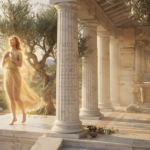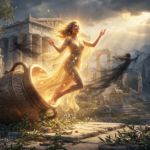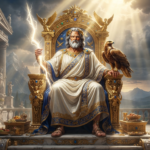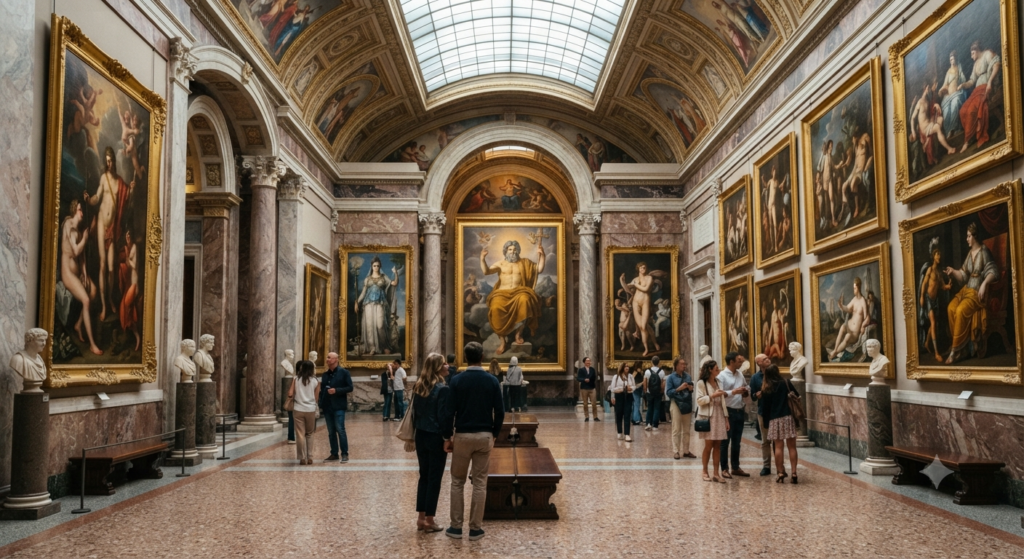
Famous paintings depicting Greek gods belong to one of the richest traditions in European art, where ancient myth was reborn through Renaissance, Baroque, and Neoclassical imagination. These works do not simply illustrate old stories; they translate the powers of Olympus into color, movement, and gesture. From Zeus with his thunderbolt to Athena in her martial wisdom, from Apollo’s light to Venus’s beauty, painters repeatedly returned to the Olympians as symbols of authority, desire, order, and transformation. Some scenes come directly from Homer, Hesiod, Ovid, or later mythographers such as Apollodorus, while others reflect the taste of patrons who wanted learned, elegant, and often politically resonant imagery for palaces and villas.
Greek Gods in Renaissance and Baroque Art
Greek gods became central subjects in Renaissance art when humanist scholars revived classical literature and artists sought noble themes beyond biblical narrative. Painters such as Botticelli, Titian, and later Rubens treated mythology not as distant superstition but as a living language of beauty and power. Their canvases often depended on Ovid’s Metamorphoses, which offered painters vivid episodes of divine pursuit, transformation, and punishment, while also giving patrons room to admire classical learning.
In the Baroque period, these myths grew more theatrical. Bodies twisted, clouds opened, and divine figures entered with dramatic force, as if the ancient gods had been staged for courts and collectors. A painting of a god or goddess could celebrate dynastic legitimacy, erotic refinement, or philosophical allegory at once. That flexibility explains why Greek deities remained so attractive to European artists for centuries: they could be moral exemplars, political symbols, or simply magnificent presences in paint.
Famous Paintings of Zeus and His Symbols
Zeus appears in art less often in solitary portrait-like form than through the stories that define his rule. Among the most famous images is Correggio’s Jupiter and Io, where Zeus, in the form of a cloud, embraces the mortal Io according to the Roman retelling preserved by Ovid. The painting captures the god’s metamorphic power rather than a fixed human face, a reminder that Zeus is often represented by transformation itself. His thunderbolt, eagle, and royal grandeur remain the most common signs of his presence.
Another major work is Titian’s The Rape of Europa, in which Zeus takes the shape of a bull to carry Europa over the sea. Though not a portrait of the god in his usual form, it is one of the clearest visual statements of his divine authority and desire. In classical literature, Zeus’s many disguises are integral to his mythic identity, and painters repeatedly exploited that motif because it allowed them to show the god indirectly, through movement, atmosphere, and the vulnerability of those he encounters.
Athena in Classical and Neoclassical Painting
Athena, goddess of wisdom, war, and craft, is usually shown armed, composed, and intelligent rather than overtly passionate. In Renaissance and Neoclassical painting she often appears as Minerva, her Roman counterpart, but the mythic identity remains the same. Artists favored her helmet, shield, spear, and the aegis, along with the owl as a symbol of watchful intelligence. These attributes made her ideal for allegories of civic order, learning, and disciplined power.
One of the most enduring Athena subjects is Pallas and the Centaur by Botticelli, where the goddess restrains brute force with calm command. Works like this reflect a broader artistic tendency to present Athena as the opposite of chaos: reason over impulse, strategy over violence. In more academic Neoclassical settings, she often appears as the patron of arts and statesmanship, linking ancient myth with modern ideals of virtue and enlightened rule.
Apollo, Artemis, and the Language of Light
Apollo and Artemis, the twin children of Zeus and Leto, embody opposed yet related forms of radiance. Apollo governs music, prophecy, healing, and the sun’s clarity, while Artemis presides over the hunt, wild places, and the moon’s cooler light. In painting, Apollo is often shown with the lyre, laurel, or radiant youthfulness, and he frequently appears in scenes of poetic competition or divine revelation. His beauty made him a favorite subject for artists interested in ideal male form.
Artemis, by contrast, tends to emerge in scenes of motion and alertness, especially in myths involving Actaeon or the punishment of arrogance toward the divine. In Titian’s Diana and Actaeon and Diana and Callisto, the goddess is rendered through a visual balance of grace and severity. Although Roman names often dominate these titles, the myths are Greek in origin or in the classical tradition. Together, Apollo and Artemis gave painters a way to explore light as both illumination and judgment.
Poseidon and the Sea in Mythological Scenes
Poseidon is less frequently the single focus of major canonical paintings than Zeus, Athena, or Venus, yet his presence saturates marine mythology. As god of the sea, earthquakes, and horses, he appears in scenes where the natural world becomes unstable and immense. Artists often associated him with waves, tridents, sea creatures, and the elemental power of the ocean, making him a useful figure in grand decorative programs for maritime courts and palaces.
When Poseidon does appear in mythological scenes, he is often part of a larger narrative, such as contests for cities or divine processions over the sea. His rivalry with Athena for Athens is a foundational myth preserved by ancient authors, and painters and designers sometimes evoked it in allegorical contexts. The sea itself often functions as Poseidon’s canvas: a storm-tossed background, a marine chariot, or a procession of nereids can communicate his authority even when he is not centrally framed.
Venus and Ares in Timeless Painted Myths
In painting, Venus and Ares are among the most recurring divine figures, though their Roman names usually stand in for the Greek Aphrodite and Ares. Their relationship appears in the ancient tradition as an illicit affair exposed in a famous episode from Homer’s Odyssey, where the gods witness their entanglement. Painters took this story and expanded it into images of beauty, secrecy, and exposed desire, often balancing sensuality with mythological decorum.
Venus also appears in countless works as the goddess of love and beauty, from Botticelli’s Birth of Venus to Titian’s more sumptuous mythological nudes. Ares, by contrast, is less often idealized alone, but his presence gives the painted myth tension and risk. Together they embody the classical idea that love and conflict are never far apart, a theme European painters used to explore both bodily beauty and the unstable politics of the gods.
Hermes, Dionysus, and the Lesser Olympians
Hermes and Dionysus occupy a different place in visual mythology: less monumental than Zeus or Athena, yet extremely rich in symbolic meaning. Hermes, the messenger, guide of souls, and patron of travelers, is often shown with winged sandals, a staff, or the caduceus. In painting he can appear as a swift intermediary, especially in scenes involving divine errands or the passage between worlds. His elegance made him a natural subject for artists who valued motion, youth, and intelligence.
Dionysus, god of wine, ecstasy, theater, and altered boundaries, offered painters an entirely different visual language. He appears in processions with satyrs, maenads, vine leaves, and ecstatic movement, or as a serene youthful god in works influenced by classical sculpture. Lesser Olympians and attendant figures such as Pan, nymphs, and satyrs often populate these scenes. Their presence allowed artists to explore the tension between order and release, a theme that runs through much of mythological painting.
The Rape of Europa in European Masterworks
The story of Europa, taken by Zeus in the form of a bull, is one of the best-known mythological subjects in European painting. Ovid’s version is the most influential for later artists, though the myth itself is older and appears in Greek tradition. In Titian’s treatment, Europa’s white garment, the bull’s deceptive calm, and the open sea create an image of beauty crossed by danger. The scene is elegant, but its force comes from the moment of irreversible departure.
Many later painters returned to the same subject because it combines landscape, movement, and divine disguise in a single image. Europa’s myth became a favorite for decorative cycles, tapestries, and palace collections, where it could signify conquest, imperial reach, or the uncertainty of human fate before divine power. The popularity of the scene also shows how Greek myth survived in European art not only as narrative, but as a repertoire of visual metaphors for crossing, loss, and transformation.
Titian, Rubens, and the Gods on Canvas
Titian stands among the greatest painters of mythological antiquity, especially in his series often called the poesie, made for Philip II of Spain. Works such as Diana and Actaeon, Diana and Callisto, and The Rape of Europa transformed Greek-derived myths into rich painterly dramas of color and flesh. Titian did not merely illustrate stories; he interpreted them through atmosphere, sensuality, and emotional ambiguity, which is why these paintings remain so influential.
Rubens later carried that tradition into the Baroque with even greater physical energy. His mythological canvases are crowded, muscular, and alive with motion, often drawing on Ovid and classical statuary alike. He was especially adept at rendering gods and nymphs in a mode that feels both ancient and exuberantly modern. Together, Titian and Rubens helped define the European visual idea of the Olympians: not remote idols, but powerful figures whose myths could be made flesh on canvas.
How Artists Recast Greek Myth for Patrons
Painters did not approach Greek gods as archaeologists; they adapted them to the needs of courts, churches, academies, and private collectors. A patron might want a Venus to celebrate beauty, an Athena to suggest wise governance, or a Jupiter to imply sovereignty. Mythological paintings could also function as learned conversation pieces, requiring viewers to recognize episodes from Homer, Ovid, or later compendia such as Apollodorus. The more erudite the reference, the more cultured the patron appeared.
At the same time, artists reshaped myth to suit local taste and moral expectations. Some works emphasize allegory over narrative; others soften violent stories into elegant scenes, while still acknowledging the source material. This is why famous paintings depicting Greek gods are never mere illustrations of ancient literature. They are reinterpretations, where the old Olympian figures survive through changing centuries, carrying memory, desire, and authority into the visual language of Europe.
Famous paintings depicting Greek gods endure because they unite myth and mastery: the timeless force of Olympus with the individual vision of a painter. Zeus, Athena, Apollo, Aphrodite, Poseidon, Hermes, and Dionysus continue to appear not as frozen relics, but as living symbols shaped by changing eras and patrons. Their stories, preserved in classical sources and reimagined on canvas, reveal how deeply Greek myth has informed Europe’s artistic imagination.

Orin Vale has spent the better part of two decades tracing the threads that connect the world’s oldest stories — from the halls of Asgard to the banks of the Nile, from Olympus to the jungles of the Maya. What began as a childhood fascination with flood myths and trickster gods grew into years of independent study across comparative mythology and ancient religion, always chasing the same question: what did these stories mean to the people who first told them? Orin writes for readers who want more than trivia — the ones looking for the beliefs, fears, and truths that myths were built to carry.