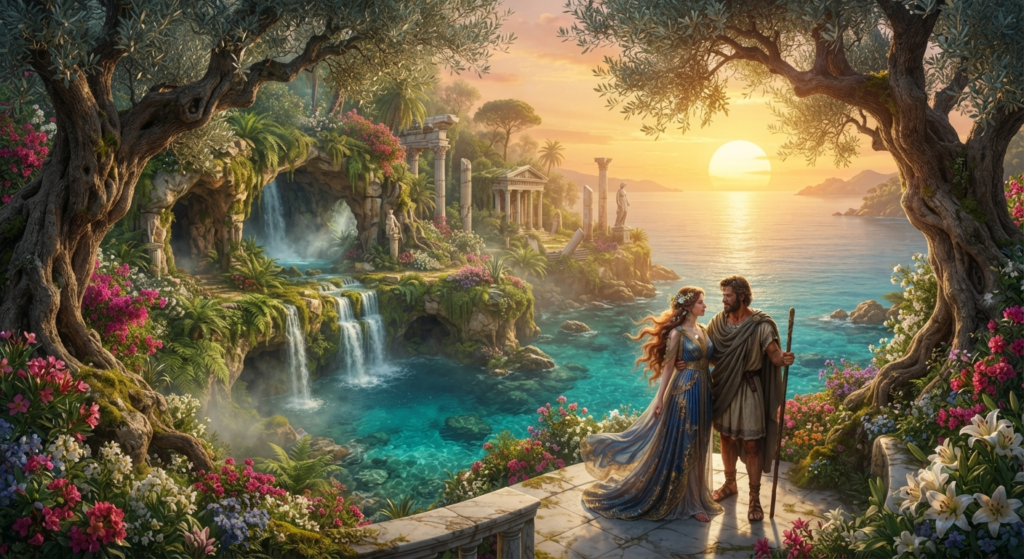
In The Odyssey, Calypso’s island is Ogygia, the remote isle where Odysseus is kept for years after the destruction of his ship and crew. Homer presents it as a place beyond ordinary geography, a hidden edge of the world where a divine nymph lives in a splendid cave amid forests, gardens, and the sea. For readers asking what Calypso’s island is, the simplest answer is that it is not a named land within the Greek world, but a mythic boundary-space: beautiful, lonely, and cut off from human society.
Calypso’s Island in the Odyssey and Its Setting
Calypso’s island appears in the opening movement of Odysseus’ long return from Troy, though the poem first hears of it through the gods’ conversation in Book 5. Zeus and Athena refer to Odysseus being detained by the nymph Calypso on Ogygia, and Hermes is sent to command her to release him. The island is therefore not merely a backdrop, but the place where the hero is suspended between one life and another, unable to resume his journey home.
Homer places the island at the farthest remove from Ithaca and the centers of human power. It is set in the open sea, yet enclosed by its own natural abundance, as if the world has folded inward on itself. That combination of remoteness and fertility makes Ogygia one of the most memorable locations in Greek epic: it is isolated, but not barren; enclosed, but not lifeless.
Ogygia: The Remote Isle of the Nymph Calypso
In Homer, the island’s name is Ogygia, a term that suggests great antiquity and deep remoteness. Ancient readers often understood the word as implying something primordial or ancient beyond measure. The setting fits that sense: Ogygia is not part of the ordinary map of the Mediterranean, and Homer gives no coordinates that would allow it to be found with certainty.
Calypso herself is described as a divine nymph who lives there alone, apart from gods and mortals alike. The island belongs to her in the poetic sense that it is shaped by her presence: the cave, the gardens, and the sea around it all frame her isolation. In the Odyssey, Ogygia becomes the stage for a paradoxical condition, because it is both a prison and a paradise.
Homer’s Description of the Sea-Girt Island
Homer describes the island as “sea-girt,” an image that emphasizes its separation by water on every side. It is ringed by the sea and difficult to reach, which suits its role as a place where the normal movement of ships and travelers comes to a halt. The sea around it is not a highway, as it often is in Greek epic, but a barrier.
At the same time, Homer gives the island lush details: thick woods, cypress, alder, and fragrant growth; birds nesting in the branches; vines and springs; and a cave that glitters with divine craftsmanship. This is not a rugged wasteland. It is an environment of beauty and abundance, yet one that remains profoundly detached from community, law, and home.
Why Odysseus Was Held on Calypso’s Island
Odysseus reaches Ogygia after Poseidon wrecks his raft in response to the death of Polyphemus, and he is saved from drowning by the sea goddess Ino before washing ashore. Calypso receives him, nurses him, and then keeps him with her for seven years in Homer’s narrative. The poem makes clear that he is not there by choice, even though he is given comfort and, at least in later reflection, the offer of immortality.
The reasons for his detention belong to divine will and mythic necessity. Calypso’s attachment to Odysseus delays the hero’s nostos, his homecoming, while also exposing a central tension in the poem: a mortal can be offered ease, safety, and even deathless life, yet still long for the fragile, harder reality of return. The island thus becomes a test of identity, since Odysseus must choose mortality, memory, and home over timeless repose.
Nymph Calypso, Daughter of Atlas, in Myth
Calypso is usually identified in Homer as a nymph, and later traditions often call her a daughter of Atlas. That genealogy appears in sources after Homer and helps place her among the divine beings associated with the margins of the world. Unlike the major Olympian gods, nymphs are often tied to particular landscapes, and Calypso is inseparable from her island dwelling.
Her name is commonly linked with concealment or hiding, a meaning that suits both her character and her island. In myth, she is neither a ruler of a city nor a fully public deity; she exists at the edge, keeping Odysseus hidden from the world that seeks him. Some later interpretations give her a more sympathetic profile, but in the Odyssey she remains a powerful immortal who resists Zeus’ command until Hermes arrives.
Ogygia as a Place of Isolation and Forgetfulness
Ogygia functions in the Odyssey as a place outside the rhythms of normal human life. Years pass there, yet the island is not measured by civic time, military time, or agricultural time. Odysseus is removed from companions, contests, feasts, and the social bonds that define his identity in Ithaca. The result is not only physical isolation but also a threat to remembrance itself.
For that reason, the island has often been understood as a realm of forgetfulness or suspension. Homer does not say that Odysseus loses his memory there in a literal sense, but the danger is implicit: a life without return could dissolve the self that depends on kinship and homeland. Calypso’s home is therefore an anti-Ithaca, a place where the usual structure of longing is interrupted rather than fulfilled.
The Cave, Grove, and Shore in the Epic Source
One of the most vivid scenes in Book 5 is Hermes’ arrival at Calypso’s dwelling. Homer describes a cave deep within the island, with a grove of trees around it and a vine heavy with fruit. The cave is not a dark prison in the narrow sense, but a richly adorned interior that reflects divine habitation. Nearby, the sea and shoreline remain close, reminding the reader that escape is both possible and delayed.
These details matter because they give Ogygia a layered geography. The cave represents enclosure and secrecy, the grove represents growth and shelter, and the shore represents passage and departure. Odysseus lives within this natural architecture while preparing, slowly and unwillingly, for the next stage of his wanderings. Homer’s landscape is symbolic without becoming abstract.
Interpretations of Calypso’s Island by Scholars
Scholars have long treated Ogygia as a literary and symbolic place rather than a straightforward location on a historical map. Some see it as an island of enchantment that reflects ancient ideas about the boundary between mortal life and divine removal. Others emphasize its narrative function: it is where the hero is paused, allowing the poem to deepen its themes of longing, identity, and endurance.
There has also been debate over whether Homer may have drawn on real seafaring knowledge or on older mythic geographies used by archaic poets. The prevailing scholarly view, however, is cautious: Ogygia should not be reduced to a hidden historical island, because Homer gives it the qualities of a mythic elsewhere. Its power lies precisely in its distance from certainty.
Maps, Traditions, and Possible Real-World Sites
Later writers and local traditions have tried to identify Calypso’s island with actual places in the Mediterranean, and several islands have been proposed over time. These identifications vary widely, from islands near Malta and the Adriatic to locations in the western Mediterranean. None has gained decisive support from classical evidence, and no ancient source identifies Ogygia with confidence as a specific real island.
This uncertainty has made Calypso’s island a favorite subject for mapping and speculation. Such proposals are part of the afterlife of myth, not proof of the myth’s original setting. The Odyssey itself invites that openness: Ogygia is vividly imagined, but intentionally unreachable, a place that can be pictured in the mind more easily than fixed on a chart.
Ogygia’s Role in Odysseus’ Return to Ithaca
Ogygia is the turning point where Odysseus’ return almost stops. Hermes’ command forces Calypso to release him, and Odysseus must build his raft and face the sea again. His departure from the island marks the renewal of motion in the epic, setting in train the final stage of his long journey back to Ithaca.
In that sense, Calypso’s island is not only a place of delay but also a necessary threshold. Without Ogygia, the poem would lose one of its clearest expressions of longing for home. The island shows what Odysseus could have had instead of return: ease without history, immortality without belonging, and beauty without human continuity. By leaving it, he recommits himself to the mortal world and to the hard, incomplete happiness of homecoming.
Calypso’s island in the Odyssey is Ogygia, a secluded, sea-encircled place of divine beauty and profound separation. Homer presents it as a mythic landscape at the edge of the world, where Odysseus is delayed, tempted, and ultimately restored to the path home. Its meaning lies not in geography alone, but in what it reveals about memory, mortality, and the cost of returning to one’s own life.

Orin Vale has spent the better part of two decades tracing the threads that connect the world’s oldest stories — from the halls of Asgard to the banks of the Nile, from Olympus to the jungles of the Maya. What began as a childhood fascination with flood myths and trickster gods grew into years of independent study across comparative mythology and ancient religion, always chasing the same question: what did these stories mean to the people who first told them? Orin writes for readers who want more than trivia — the ones looking for the beliefs, fears, and truths that myths were built to carry.