In Greek mythology, the Moirai are the powers most closely associated with fate, the portion of life allotted to every being, and the limit that even gods must recognize. When people ask what “bind” means in this context, they are usually reaching for the ancient idea that a life is tied, measured, and finally cut by forces older than kings, cities, or Olympian thunder. The Greek image of fate is not a vague destiny in the modern sense; it is a structured and often severe principle in which existence is assigned its share, and that share cannot be escaped by prayer, strength, or wealth.
The Moirai and the Greek idea of fate
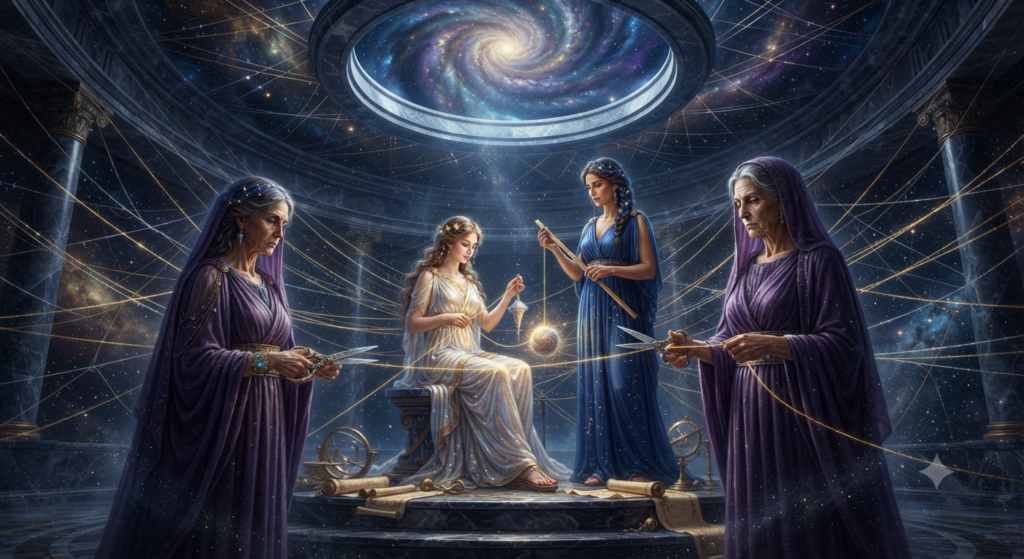
The Moirai are the goddesses of destiny in Greek myth, usually numbered as three: Clotho, Lachesis, and Atropos. Hesiod presents them as daughters of Night in some traditions, while other sources connect them with Zeus and Themis, showing that their ancestry was not fixed in a single early version. What remains consistent is their authority over the “portion” each life receives. Fate in this sense is not merely an event that happens later; it is the allotment of life itself, the measured span and condition under which a being lives.
Greek thought often treated fate as something both personal and cosmic. A person’s lot could refer to fortune, hardship, lifespan, or the kind of death they would meet. The Moirai stand at the point where order becomes limitation. They do not simply punish or reward; they assign. This makes them different from gods who intervene out of desire or rivalry, because their work belongs to the deeper pattern of the world.
What bind means in mythic and ritual language
To “bind” in mythic language is to fasten a life to its allotted course, to hold it under constraint, or to place it within a fixed order. In Greek religious and poetic thought, binding can mean both physical restraint and metaphysical obligation. A person can be bound by oath, by curse, by prophecy, or by the inescapable measure of fate itself. The word carries a sense of being tied to something that cannot easily be broken.
Ritual language reinforces this idea. Oaths in Greek culture were not casual promises but sacred bonds witnessed by gods. Curses could “bind” a person to suffering, exile, or madness in mythic narratives. The Moirai represent the strongest version of such binding, because their decree is not temporary and cannot be undone by negotiation. The life-thread is held within their authority, and that is why their work is often imagined through textile imagery, one of the oldest symbols of control and limitation in the ancient world.
Clotho, Lachesis, and Atropos in order
Clotho is the spinner, the one who begins the thread. In the traditional triad, she brings life into motion by drawing out the strand that represents a being’s existence. Lachesis follows as the allotter, measuring what has been spun and determining its length or share. Atropos, whose name suggests the “unturning” or “inflexible” one, cuts the thread and brings life to its end. Their sequence is orderly and irreversible.
The order of the three reflects a complete vision of life as fabric. Beginning, measure, and end are all part of one process. Greek sources do not always describe the Moirai in exactly the same way, and early tradition sometimes speaks of them more abstractly than later art does. Yet the image of three goddesses dividing life into stages became enduring because it expresses the Greek understanding of fate with unusual clarity: existence is not random, but neither is it fully owned by the one who lives it.
Thread, lot, and the measure of human life
The Greek idea of fate is often linked to thread, lot, and measure because each image captures a different aspect of limitation. Thread suggests continuity, fragility, and a life that can be lengthened or cut. Lot points to allocation: what one receives from birth, whether status, strength, happiness, or suffering. Measure implies proportion, as though each life has a rightful span that cannot be exceeded without violating the order of things.
This is why the Moirai are not simply death-goddesses. They are broader than death itself, because they govern life’s portion from beginning to end. In epic and tragedy alike, a character may speak as though a great life or glorious death has been “measured out” in advance. Such language does not erase human action; it places action within a bounded design. A hero may win fame, but he does so within the limits of what has been allotted.
Fate in Homer, Hesiod, and early epic song
In Homer, fate often appears as moira or aisa, terms that can mean doom, share, or destined outcome. The epics do not always personify fate as the three Moirai in the later sense; instead, fate may function as a powerful abstract reality even when the goddesses are not named. Heroes know that death awaits them, and even their moments of glory are shadowed by the knowledge that no man outruns his appointed end. The language of the epics gives fate an older, more immediate force than later philosophical systems would.
Hesiod’s works help frame the Moirai more distinctly, though even there the tradition is layered. The Theogony places them within the divine genealogy of order and necessity, linking them to the broader structure of the cosmos. Early Greek song treats fate as both individual and universal: each person has a share, and the universe has its law. This balance between personal destiny and cosmic necessity became one of the defining features of Greek mythology.
Zeus and the limits of divine control
Zeus is the king of the gods, but he is not always master over fate. This is one of the most important and subtle features of Greek mythology. In some traditions, Zeus is closely associated with fate, even called its guardian or executor. In others, he is constrained by it. Homer’s epics especially preserve moments where Zeus weighs outcomes, yet the final limit is not simply his will. Fate stands above or alongside divine decision, depending on the source.
The tension between Zeus and the Moirai reveals a central Greek insight: sovereignty is real, but not absolute. A god may delay, protect, or avenge, but not necessarily erase what has been allotted. This is why mythic scenes involving Zeus can feel tragic even when he is supreme. His power is vast, yet the order of fate remains a boundary no ruler can entirely dissolve. The gods govern within the world; the Moirai express the world’s deeper law.
Mortals, prophecy, and the shape of destiny
For mortals, prophecy is one of the main ways fate becomes visible. Oracles, seers, dreams, and warnings do not always change what will happen; often they reveal it. Greek myths frequently show that knowledge of destiny does not guarantee freedom from it. A character may try to avoid a prophecy and thereby walk into its fulfillment, a pattern familiar from stories such as those surrounding Oedipus. The power of prophecy lies in exposure, not rescue.
Yet Greek myth does not treat all prophecy as meaningless. Sometimes foreknowledge allows preparation, delay, or the choosing of a noble response. Fate may determine the end, but the manner of meeting it still matters. A mortal’s character, courage, and restraint remain significant even within a bounded life. The Moirai do not erase personality; they frame the conditions in which personality becomes visible.
Binding oaths, curses, and inescapable doom
Binding in Greek myth also appears in the language of solemn oaths and destructive curses. Oaths could invoke divine witnesses and create a moral and sacred tie stronger than ordinary speech. Breaking such a bond invited ruin, because the oath itself was treated as a force that held the speaker fast. Curses worked similarly, especially in tragic and epic traditions where a family line can become trapped in inherited disaster.
This is why Greek myths so often connect binding with doom. A person may be bound by blood guilt, by a divine promise, or by the consequences of one act that ripples outward through generations. The Moirai embody the deepest version of this pattern: not an arbitrary snare, but the final structure that makes doom inevitable when the allotted time arrives. In that sense, “bind” in mythic language means both to attach and to constrain, to hold within a destiny that cannot be unmade.
The Moirai in later classical and Roman thought
In later classical religion and philosophy, the Moirai continued to matter, though their meaning expanded. Greek thinkers could treat fate more abstractly, as necessity or cosmic order, while poets and dramatists kept the old divine imagery alive. In civic cult and popular practice, the Moirai were honored alongside other powers of necessity and justice, showing that they remained part of lived religion rather than only literary symbolism. Pausanias records local cults and images that preserve their presence in the landscape of worship.
Roman thought inherited these figures largely through the Parcae, the Roman equivalents of the Moirai. Ovid and other Latin writers continued the spinning-and-cutting imagery, often adapting it to Roman literary tastes. The basic idea remained unchanged: life is measured, allotted, and ended according to powers beyond human bargaining. Later philosophy would often try to rationalize this, but the mythic image of the three goddesses remained persuasive because it gave form to a universal human experience.
Why Greek fate was not simple predestination
Greek fate is sometimes mistaken for a rigid system in which nothing human matters. The sources suggest something more complex. Fate sets boundaries, but within those boundaries choice, honor, folly, courage, and timing still shape the story. A hero can act well or badly; a king can rule justly or destroy his house; a mortal can meet destiny with dignity or resistance. The allotted end remains, but the path toward it is morally and narratively significant.
That is why the Moirai endure as symbols. They do not reduce life to mechanism. They express a world where freedom exists inside measure, where no one escapes death, yet not everyone meets it in the same way. Greek mythology presents fate as binding, but not empty. The thread is fixed to the loom of existence, yet the pattern still bears the marks of those who live it.
The Moirai represent one of the clearest expressions of the Greek vision of fate: life as a portion granted, measured, and finally closed. To ask what “bind” means in this world is to ask how destiny holds a person within an order older than desire, stronger than pride, and beyond the authority of even the highest gods. The answer is not that everything is meaningless or mechanically set, but that every life is both constrained and meaningful within its appointed span. In that balance of limit and purpose, Greek mythology found one of its most enduring truths.

Orin Vale has spent the better part of two decades tracing the threads that connect the world’s oldest stories — from the halls of Asgard to the banks of the Nile, from Olympus to the jungles of the Maya. What began as a childhood fascination with flood myths and trickster gods grew into years of independent study across comparative mythology and ancient religion, always chasing the same question: what did these stories mean to the people who first told them? Orin writes for readers who want more than trivia — the ones looking for the beliefs, fears, and truths that myths were built to carry.