Who Is Bennu in Egyptian Mythology?
The Bennu bird is one of the most fascinating figures in ancient Egyptian mythology. Often linked with creation, rebirth, and the rising sun, Bennu was a sacred bird associated with some of Egypt’s most important religious ideas. If you have ever heard of the phoenix, the legendary bird that rises from its own ashes, you have already encountered a later idea that may have been inspired in part by Bennu.
So, who is Bennu in Egyptian mythology? Bennu was a divine bird connected to the sun god Ra, the creator god Atum, and the cycle of death and renewal. In ancient Egyptian belief, Bennu represented the power of life to begin again.
The Meaning of Bennu
The name “Bennu” is often connected with the Egyptian verb weben, meaning “to rise” or “to shine.” This meaning fits the bird’s close association with the sunrise, creation, and renewal.
Bennu was not simply an ordinary bird. In Egyptian religious thought, animals often symbolized divine forces. The Bennu bird embodied the mystery of beginnings: the first light, the first sound, and the first life emerging from chaos.
Because of this, Bennu was strongly tied to creation myths. He was seen as a being that existed at the start of the world and helped bring order out of the dark, watery chaos that came before creation.
Bennu and the Creation of the World
In ancient Egyptian cosmology, the universe began in a state of endless primordial waters called Nun. From these waters rose the first land, often imagined as a mound. On this mound, creation began.
Bennu was closely linked to this moment. Some traditions describe Bennu as appearing on the primeval mound, where he let out a cry that marked the beginning of time. This first cry was not just a sound; it was a creative act that helped set the universe in motion.
Because of this role, Bennu was associated with Atum, one of the creator gods of ancient Egypt. Atum was believed to have created himself and then brought other gods into existence. Bennu, as a symbol of self-creation and renewal, reflected similar ideas.
Bennu and the Sun God Ra
Bennu was also deeply connected to Ra, the powerful sun god. Every sunrise was a symbol of rebirth in Egyptian religion. When the sun appeared each morning, it represented victory over darkness and the renewal of life.
The Bennu bird came to symbolize this daily solar cycle. Just as the sun “died” each night and was “reborn” each morning, Bennu represented the endless rhythm of death and rebirth.
In this way, Bennu was more than a creation symbol. He also represented the ongoing maintenance of the universe. Each new day was a small act of creation, and Bennu stood at the heart of that mystery.
What Did Bennu Look Like?
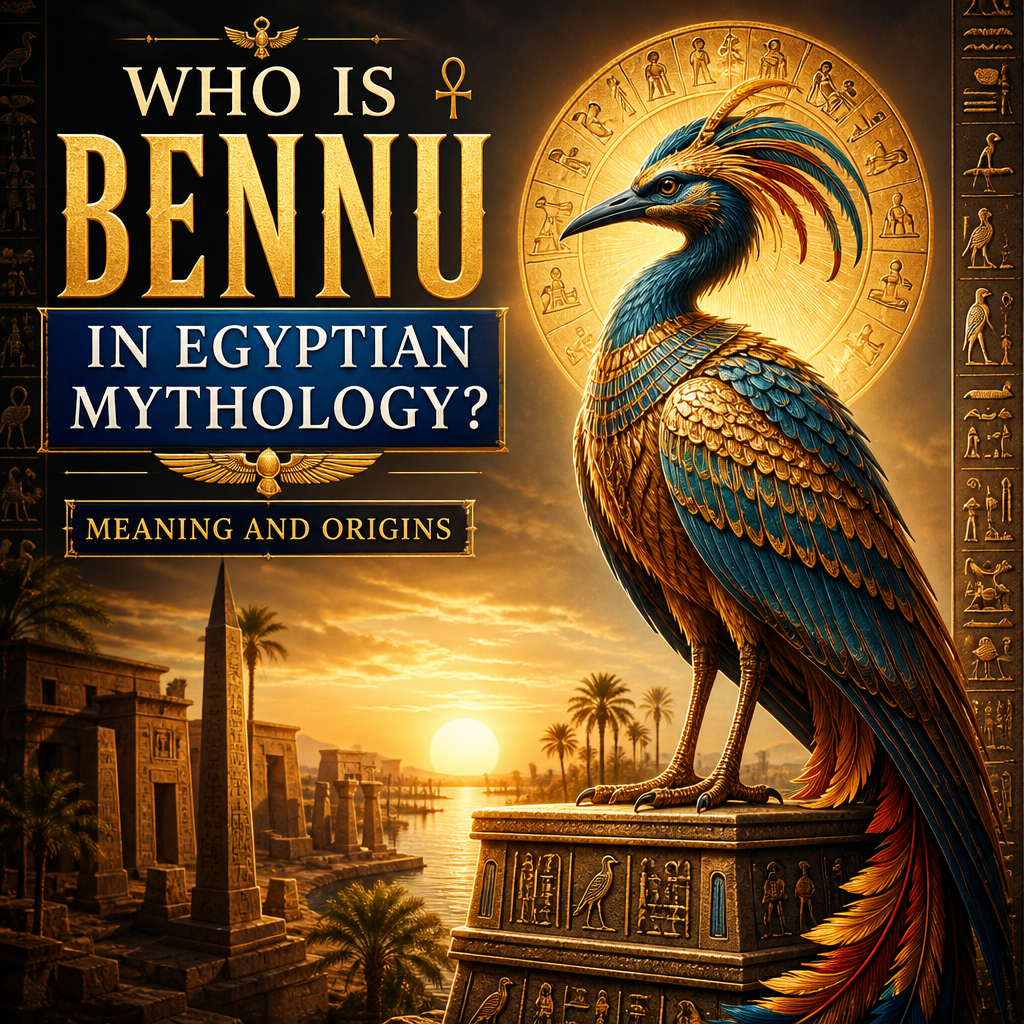
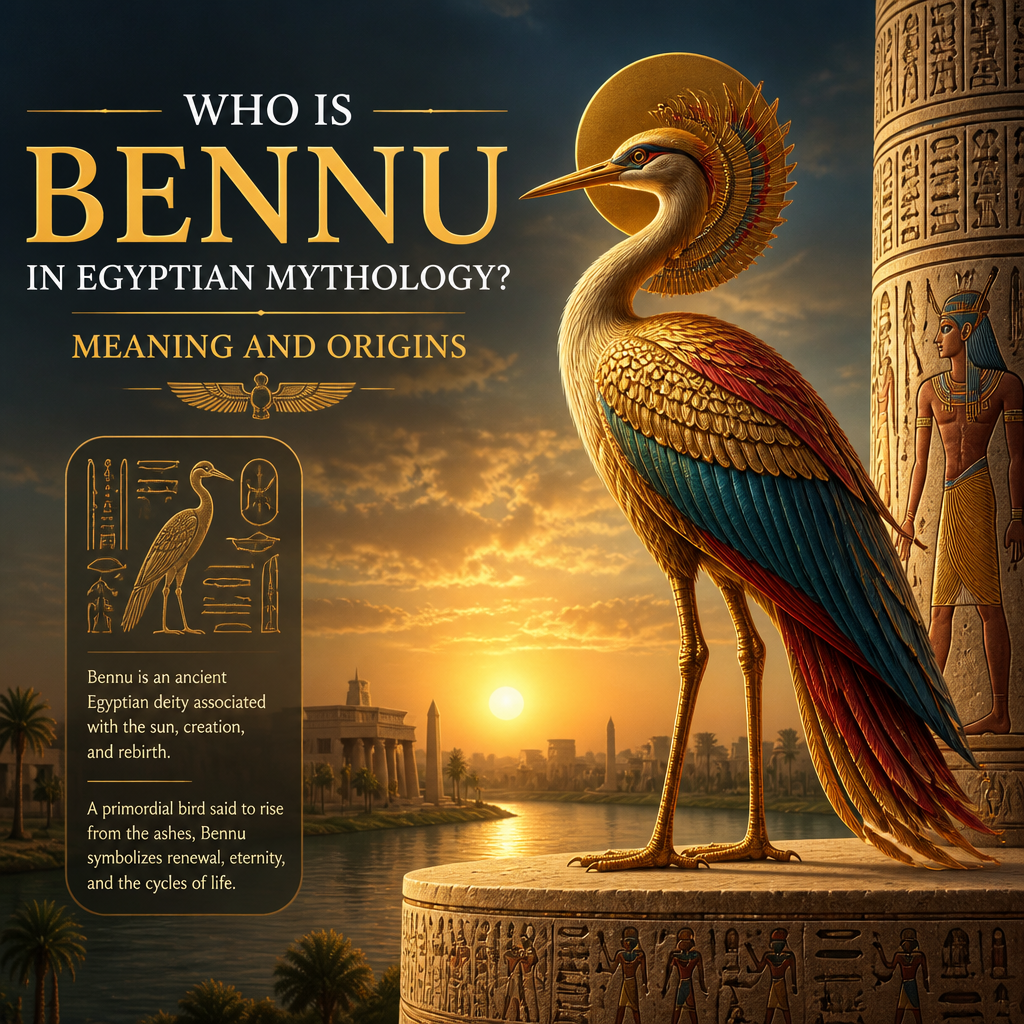
Bennu was usually depicted as a heron-like bird. In Egyptian art, he often appears with long legs, a slender body, and a long beak. Sometimes he is shown wearing a crown or a solar disk, emphasizing his divine and solar connections.
The bird most commonly associated with Bennu may have been the grey heron, a bird often seen along the Nile. Herons stand still in shallow waters, then suddenly rise into the air, a behavior that may have reminded Egyptians of creation emerging from the waters of Nun.
Common features of Bennu imagery include:
- A heron-shaped body
- A long beak and legs
- A two-feathered crown in some depictions
- A solar disk in certain religious images
- A connection to sacred trees, stones, or temples
These visual details helped identify Bennu as a holy being, not merely a natural bird.
Bennu and the City of Heliopolis
The cult of Bennu was especially important in Heliopolis, one of ancient Egypt’s major religious centers. Heliopolis was closely associated with sun worship and creation theology. It was a city dedicated to gods such as Ra and Atum, making it a natural home for the Bennu tradition.
In Heliopolis, Bennu was linked to sacred objects and places, including the benben stone. The benben stone represented the primeval mound that rose from the waters at the beginning of creation. Its shape may also have influenced later obelisks, which symbolized rays of sunlight.
Because Bennu was associated with the benben stone, the bird became part of a larger religious system centered on creation, sunlight, and divine kingship.
Bennu, Rebirth, and the Afterlife
Ancient Egyptian religion placed great importance on the afterlife. Death was not seen as a final end, but as a transition. With the right rituals, knowledge, and divine protection, a person could be reborn into eternal life.
Bennu played an important role in this belief system. As a symbol of renewal, the bird represented hope that life could continue beyond death. The image of Bennu reminded Egyptians that rebirth was part of the natural and divine order.
This is why Bennu sometimes appears in funerary texts and religious writings. The bird’s connection to resurrection made him a meaningful symbol for the deceased, especially those hoping to join the gods in the afterlife.
Is Bennu the Same as the Phoenix?
Bennu is often compared to the Greek phoenix, but they are not exactly the same. The phoenix is usually described as a bird that burns itself and rises again from its ashes. This dramatic image became famous in Greek and later Roman traditions.
Bennu, on the other hand, was not originally described in the same way. His symbolism centered on creation, sunrise, self-generation, and renewal rather than fiery death and resurrection from ashes.
However, the two figures share important themes:
- Both are sacred birds
- Both symbolize rebirth
- Both are connected to the sun
- Both represent cycles of renewal
- Both became symbols of immortality
It is possible that Greek ideas about the phoenix were influenced by Egyptian beliefs about Bennu, especially through contact between Greek and Egyptian cultures.
Why Bennu Still Matters
Bennu remains an important figure because he captures some of the deepest ideas in Egyptian mythology. He represents the beginning of creation, the daily rebirth of the sun, and the hope for life after death.
His mythology shows how the ancient Egyptians viewed the universe as cyclical. Life, death, darkness, and light were not separate forces but parts of a repeating pattern. Each sunrise renewed the world. Each death held the possibility of transformation.
To understand who Bennu is in Egyptian mythology is to understand a central part of Egyptian religious thought: creation was not just something that happened once. It happened every day, every dawn, and perhaps even after death.
Conclusion
Bennu in Egyptian mythology is the sacred bird of creation, sunlight, and rebirth. Closely connected with Ra, Atum, and the city of Heliopolis, Bennu symbolized the power of life to rise again from darkness and chaos.
Though often compared to the phoenix, Bennu has his own unique place in Egyptian belief. He is the bird of the first dawn, the first cry, and the eternal cycle of renewal. Through Bennu, the ancient Egyptians expressed one of their most enduring hopes: that life could always begin again.

Orin Vale has spent the better part of two decades tracing the threads that connect the world’s oldest stories — from the halls of Asgard to the banks of the Nile, from Olympus to the jungles of the Maya. What began as a childhood fascination with flood myths and trickster gods grew into years of independent study across comparative mythology and ancient religion, always chasing the same question: what did these stories mean to the people who first told them? Orin writes for readers who want more than trivia — the ones looking for the beliefs, fears, and truths that myths were built to carry.