What Is a Serpopard in Egyptian Mythology?
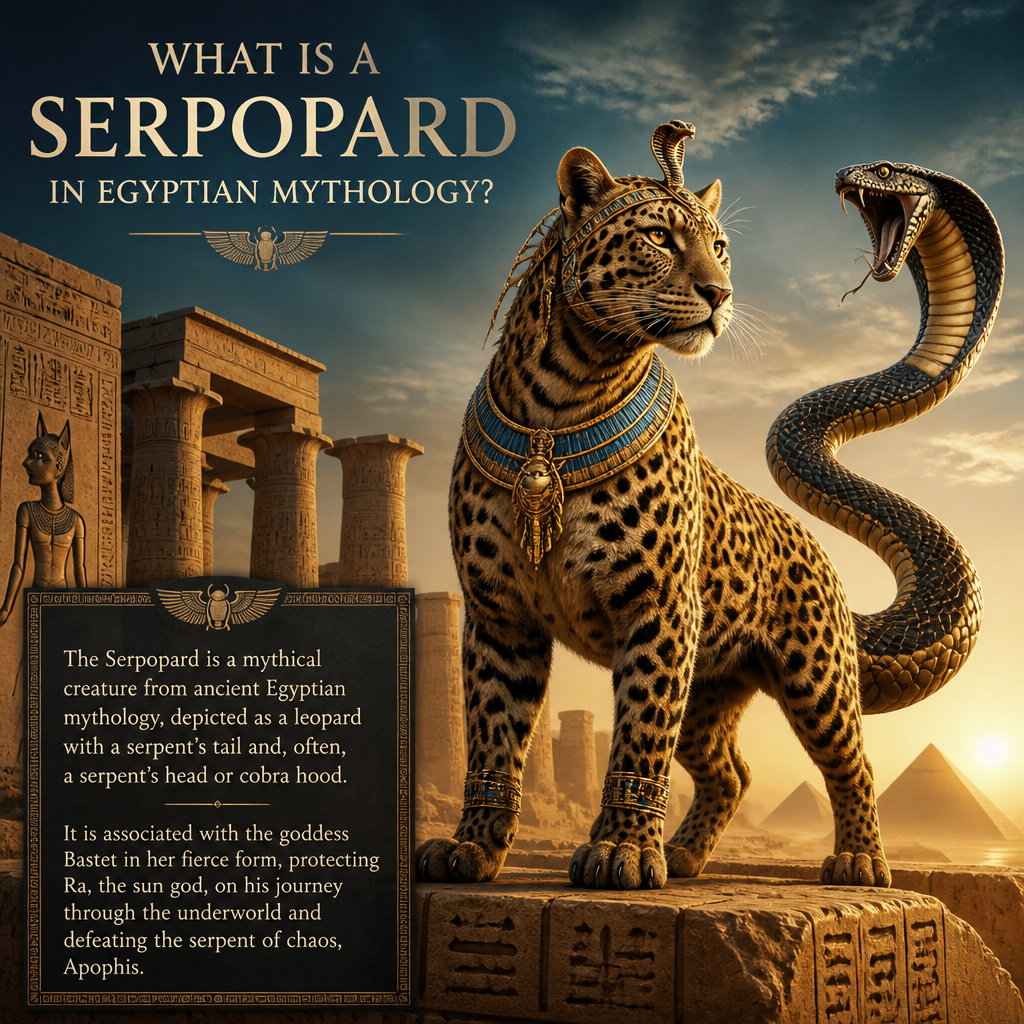
The serpopard is one of the most intriguing hybrid creatures associated with ancient Egyptian art and symbolism. Often shown with the body of a leopard or lioness and the long, winding neck of a serpent, this mysterious animal appears in some of the earliest surviving images from Egypt. While it is not as famous as gods like Anubis, Horus, or Bastet, the serpopard offers a fascinating glimpse into how ancient Egyptians used fantastic animals to express power, chaos, kingship, and cosmic order.
Although the creature is often discussed in relation to Egypt, the term “serpopard” is a modern name. Ancient Egyptians did not leave behind a clear label for it, so scholars use this word to describe its unusual combination of serpent and big-cat features.
The Appearance of the Serpopard
A serpopard is typically depicted as a large feline with an exaggeratedly long, snake-like neck. Its body resembles a leopard, panther, or lioness, while its head may look more feline than reptilian. The creature usually has:
- A sleek spotted or feline body
- Four legs with paws or claws
- A very long, flexible neck
- A small head, often cat-like
- A tail similar to that of a big cat
The name itself combines “serpent” and “leopard,” reflecting the creature’s strange visual form. In art, serpopards often appear in pairs, with their long necks intertwined or controlled by human figures.
Where Does the Serpopard Appear?
The most famous example of serpopards in Egyptian art appears on the Narmer Palette, one of the most important artifacts from early ancient Egypt. This ceremonial palette dates to around 3100 BCE and is often associated with King Narmer, who is traditionally linked to the unification of Upper and Lower Egypt.
On the Narmer Palette, two serpopards face each other with their long necks intertwined. Their bodies form a circular space in the center of the object. Two human attendants hold ropes attached to the animals, as if restraining or controlling them.
This image is one of the key reasons the serpopard is discussed in Egyptian mythology and symbolism. It appears at a crucial moment in Egyptian history, when kingship, political unity, and divine authority were becoming central themes in Egyptian visual culture.
What Does the Serpopard Symbolize?
Because there is no surviving Egyptian text that clearly explains the serpopard, its meaning is debated. However, scholars often interpret it through the broader symbolic language of ancient Egyptian art.
Chaos and Wild Power
The serpopard may represent forces of chaos, danger, or the untamed wilderness. In Egyptian thought, the world was often understood as a balance between order and chaos. The king’s duty was to maintain ma’at, the divine order that kept the universe stable.
Wild animals, especially fierce predators and strange hybrid creatures, could symbolize the chaotic forces outside the ordered world of Egypt. The serpopards on the Narmer Palette being restrained by human figures may suggest the king’s ability to control chaos.
Royal Authority
Because the serpopard appears on a royal object associated with Narmer, it may also relate to kingship. The image of humans controlling the creatures can be read as a statement of power: the ruler brings dangerous forces under control and imposes order.
This theme appears throughout Egyptian art. Pharaohs are frequently shown defeating enemies, hunting wild animals, or standing above chaotic creatures. The serpopard fits this pattern as a symbolic beast connected to royal dominance.
Unity and Balance
The intertwined necks of the two serpopards may also symbolize union. Since the Narmer Palette is often linked with the unification of Egypt, the paired animals could represent the joining of two lands, two powers, or two opposing forces.
Their bodies are separate, yet their necks meet in a shared circular form. This visual arrangement may suggest the blending of difference into a single controlled structure, a fitting theme for an object connected to political unity.
Is the Serpopard an Egyptian God?
The serpopard is not generally considered a god in Egyptian mythology. Unlike deities such as Ra, Isis, or Sobek, it does not have a known cult, temple, priesthood, or set of myths attached to it.
Instead, the serpopard is best understood as a mythic or symbolic creature. It belongs to the world of visual mythology: images used to communicate religious and political ideas without necessarily representing a named deity.
Ancient Egyptian art often included composite beings. Some were gods, while others were symbolic monsters, protective creatures, or emblems of cosmic forces. The serpopard seems to fall into this broader category of powerful hybrid animals.
Was the Serpopard Only Egyptian?
Interestingly, serpopard-like creatures also appear in the art of ancient Mesopotamia. Similar long-necked feline hybrids are known from cylinder seals and other objects from the Near East.
This has led some scholars to suggest that the image may have entered Egypt through cultural contact with Mesopotamia during the late prehistoric or early dynastic period. Trade, artistic exchange, and shared elite symbols may have influenced how early Egyptian rulers represented power and authority.
However, once the image appeared in Egypt, it took on meaning within the Egyptian worldview. On the Narmer Palette, the serpopard becomes part of a specifically Egyptian message about kingship, control, and cosmic order.
Why Is the Serpopard Important?
The serpopard is important because it shows how ancient Egyptians used imaginative creatures to express complex ideas. Even without a written myth explaining it, the creature communicates visually through its form and placement.
It combines several powerful concepts:
- The strength and danger of a big cat
- The mysterious, winding form of a serpent
- The theme of controlled chaos
- The authority of the king
- The possible unity of opposing forces
For modern viewers, the serpopard is a reminder that mythology is not only found in stories. It also appears in symbols, images, ritual objects, and the artistic language of ancient cultures.
Final Thoughts
So, what is a serpopard in Egyptian mythology? It is a mysterious hybrid creature with the body of a big cat and the long neck of a serpent, best known from early Egyptian art such as the Narmer Palette. While it was probably not worshiped as a god, it carried strong symbolic meaning.
The serpopard likely represented wild power, chaos, and the ruler’s ability to impose order. Its strange form made it an ideal symbol for forces that were dangerous yet controllable under royal authority. Though much about the creature remains uncertain, its image continues to fascinate historians, archaeologists, and anyone interested in the symbolic world of ancient Egypt.

Orin Vale has spent the better part of two decades tracing the threads that connect the world’s oldest stories — from the halls of Asgard to the banks of the Nile, from Olympus to the jungles of the Maya. What began as a childhood fascination with flood myths and trickster gods grew into years of independent study across comparative mythology and ancient religion, always chasing the same question: what did these stories mean to the people who first told them? Orin writes for readers who want more than trivia — the ones looking for the beliefs, fears, and truths that myths were built to carry.