Anyone asking who is Tantalus in Greek mythology encounters a figure whose story stands apart from most divine myths: a mortal king once favored by the gods, ultimately condemned to one of the most memorable punishments in the entire underworld. Tantalus in Greek mythology was not a god himself, but a son of Zeus granted the rare privilege of dining among the Olympians — a privilege he betrayed through an act so severe it changed how the Greeks understood divine trust for generations. Understanding who is Tantalus in Greek mythology means examining both the crime that led to his downfall and the punishment that made his name synonymous with unreachable, eternal desire.
Tantalus — A Mortal King Favored by the Gods
Tantalus held an unusual position within Greek mythology as a mortal granted extraordinary access to the divine world. As a son of Zeus, Tantalus ruled as a king, often associated with the region of Sipylus, and was welcomed to dine at the tables of the gods on Mount Olympus, a privilege almost no other mortal figure received in Greek mythological tradition. This closeness to the gods makes his eventual downfall all the more significant within the broader narrative of Greek mythology.
Being invited to share in divine feasts placed Tantalus in a position of immense trust, one that came with correspondingly high expectations regarding his conduct toward the gods. Understanding who is Tantalus in Greek mythology requires recognizing just how exceptional this privilege was — mortals were rarely granted such intimate access to Olympus, making Tantalus’s later betrayal all the more consequential in the eyes of the gods who had extended him this rare honor.
Tantalus’s initial favor with the gods reflects a broader theme common throughout Greek mythology: the precariousness of divine trust and the severe consequences that followed when mortals abused it. His story serves as a cautionary counterpart to myths celebrating loyalty and piety, illustrating instead what happened when a mortal, granted extraordinary privilege, chose to exploit or betray that trust rather than honor it.
This tension between privilege and betrayal forms the core of why Tantalus remains such a significant figure whenever people ask who is Tantalus in Greek mythology. His story is not simply about punishment, but about the consequences of squandering an almost unparalleled position of trust between mortal and divine worlds within ancient Greek belief.
Origins and Family of Tantalus
Tantalus was the son of Zeus and, according to various ancient sources, a nymph sometimes identified as Plouto, connecting him directly to the highest tier of divine lineage despite his mortal status. This parentage explains both his elevated position among mortals and his initial access to the gods, as his direct connection to Zeus set him apart from ordinary human kings within Greek mythological tradition.
Tantalus fathered two significant children, Pelops and Niobe, both of whom became central figures in their own right within later Greek mythology. Pelops in particular played a crucial role in the myth most closely associated with his father, while Niobe’s own story of tragic loss echoed the themes of hubris and divine punishment that defined the broader Tantalus family narrative.
The family of Tantalus became infamous not only through his own actions but through the generations that followed him, particularly via his descendants who founded the House of Atreus. This lineage, extending through Pelops to figures such as Atreus, Thyestes, and eventually Agamemnon, carried forward a pattern of betrayal, violence, and divine punishment that many ancient sources trace directly back to Tantalus’s original crime.
This connection between Tantalus and the cursed House of Atreus significantly expands his importance within Greek mythology, as his individual punishment in the underworld represents only the beginning of a much longer mythological legacy. Understanding who is Tantalus in Greek mythology, therefore, requires recognizing him not just as an isolated cautionary figure, but as the origin point for one of Greek mythology’s most consequential cursed bloodlines.
The Crime of Tantalus
Ancient sources offer differing accounts of Tantalus’s exact crime, though most versions agree that his offense involved a serious betrayal of the trust the gods had placed in him. One common version describes Tantalus stealing ambrosia and nectar, the food and drink of the gods, and sharing them with mortals, an act that directly violated the boundary between divine and human privilege that the Greeks considered essential to cosmic order.
A more severe and frequently cited version of the myth describes Tantalus committing an even more shocking act: killing his own son, Pelops, and serving him as a meal to test whether the gods could truly perceive all things. This version presents Tantalus’s crime not merely as theft, but as a direct assault on divine omniscience and trust, making it one of the most disturbing episodes involving a mortal figure within Greek mythology.
According to this myth, the gods immediately recognized the horrific nature of the meal and refused to partake, with only Demeter, distracted by grief over her daughter Persephone, unknowingly consuming a portion of the shoulder. The gods subsequently restored Pelops to life, replacing his missing shoulder with one made of ivory, a detail that became a lasting symbol associated with his descendants throughout later Greek mythology.
Regardless of which version is emphasized, the crime of Tantalus consistently represents a profound violation of trust between mortal and divine realms, whether through the theft of sacred substances or the horrific test of the gods’ perception. This severity explains why his punishment, examined in the following section, remains among the most memorable and symbolically resonant in all of Greek mythology.
The Eternal Punishment of Tantalus
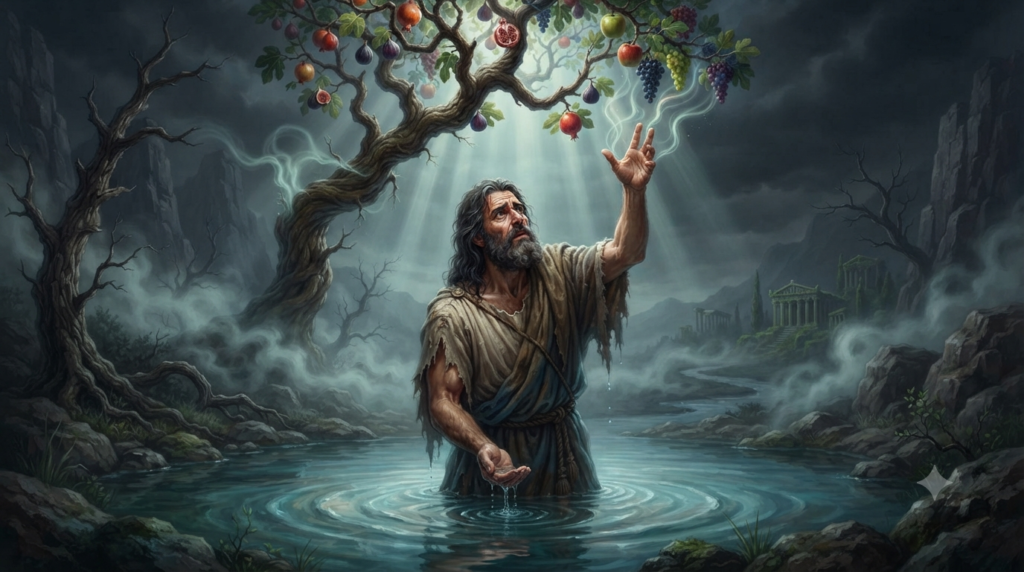
As punishment for his crime, Tantalus was condemned to eternal torment in Tartarus, the deepest region of the underworld reserved for those who committed the gravest offenses against the gods. His punishment involved standing in a pool of water beneath a fruit tree, with both food and drink positioned agonizingly close yet perpetually out of reach whenever he attempted to eat or drink.
Whenever Tantalus reached for the fruit hanging above him, the branches would rise just beyond his grasp, and whenever he bent to drink the water surrounding him, it would recede before he could taste it. This punishment created a state of eternal, unfulfilled desire, forcing Tantalus to exist in perpetual hunger and thirst despite being surrounded by exactly what he needed, a torment as psychological as it was physical.
This vivid punishment directly gave rise to the modern English word “tantalize,” meaning to torment someone with something desirable yet deliberately kept out of reach. This linguistic legacy remains one of the clearest examples of how thoroughly Greek mythology has embedded itself into modern language, ensuring that anyone using the word “tantalizing” is, often unknowingly, referencing the ancient myth of Tantalus in Greek mythology.
Beyond its linguistic legacy, the punishment of Tantalus carries deep symbolic significance regarding the nature of unfulfilled desire and the consequences of betraying trust. His eternal suffering represents not brief punishment but permanent consequence, reinforcing a central theme in Greek mythology: that offenses against divine order, particularly those involving the deliberate abuse of extraordinary trust, warranted correspondingly eternal and inescapable retribution.
Tantalus and the Curse of the House of Atreus
The crime of Tantalus did not end with his own punishment but initiated a broader curse that extended across multiple generations of his descendants, collectively known as the House of Atreus. This lineage, beginning with his son Pelops, became associated with recurring cycles of betrayal, violence, and tragedy that many ancient sources trace directly back to Tantalus’s original offense against the gods.
Pelops himself became entangled in further conflict and treachery, setting in motion a pattern that continued through his sons Atreus and Thyestes, whose bitter rivalry produced additional horrific acts echoing their grandfather’s original crime. This continuation reinforced the idea, common throughout Greek mythology, that the consequences of severe offenses against the gods could ripple forward across generations rather than remaining confined to the original offender alone.
The curse eventually extended to Agamemnon, a descendant of Tantalus whose own tragic fate became central to major works of Greek tragedy, including plays by Aeschylus and Euripides. These later dramatic works frequently reference the family’s origins, using the initial crime of Tantalus as a foundational explanation for the seemingly inescapable suffering that continued to define the House of Atreus for generations.
This extended mythological legacy significantly deepens the importance of Tantalus within Greek mythology as a whole. Rather than existing as an isolated cautionary tale, his story functions as the origin point for one of the most influential cursed lineages in Greek tragic literature, illustrating how thoroughly ancient Greek storytellers used individual myths to explore broader themes of inherited consequence and generational suffering.
Why Tantalus Matters in Greek Mythology Today
Tantalus continues to hold cultural relevance today primarily through the survival of the word “tantalize” in modern English, a direct linguistic descendant of his ancient punishment. This everyday usage demonstrates how deeply Greek mythology has embedded itself into contemporary language, often without users realizing the specific mythological origin behind such familiar vocabulary.
Beyond language, the myth of Tantalus continues to serve as a powerful metaphor for unattainable desire, frequently invoked in literature, psychology, and popular discourse to describe situations involving persistent, unfulfilled longing. This metaphorical use demonstrates the lasting symbolic power of his punishment, which resonates even among audiences with limited familiarity with Greek mythology overall.
The broader narrative connecting Tantalus to the House of Atreus also continues to influence modern storytelling, particularly in works exploring themes of generational trauma, inherited consequence, and cyclical tragedy. This enduring narrative structure demonstrates how thoroughly ancient Greek mythology anticipated storytelling themes that remain relevant to contemporary audiences examining family legacy and consequence.
Ultimately, Tantalus matters in Greek mythology today because his story combines memorable, symbolically rich punishment with a broader cautionary narrative about the abuse of trust and privilege. Few figures in Greek mythology offer such a direct linguistic and thematic bridge between ancient storytelling and modern cultural understanding, ensuring that the question of who is Tantalus in Greek mythology remains genuinely relevant centuries after his myth was first told.
FAQ — Quick Answers About Tantalus in Greek Mythology
Who is Tantalus in Greek mythology?
Tantalus is a mortal king in Greek mythology, son of Zeus, who was punished eternally after betraying the trust the gods placed in him during divine feasts on Mount Olympus.
What crime did Tantalus commit?
Tantalus is most commonly said to have killed and served his own son, Pelops, to the gods as a test, though some versions describe him stealing ambrosia and nectar instead.
What was the punishment of Tantalus?
Tantalus was condemned to stand in water beneath fruit-laden branches in Tartarus, with both food and drink perpetually out of reach whenever he attempted to eat or drink.
Where does the word “tantalize” come from?
The word “tantalize” comes directly from the myth of Tantalus, referencing his eternal punishment of being tormented by food and water he could never actually reach.
How is Tantalus connected to the House of Atreus?
Tantalus is the ancestor of the House of Atreus, a cursed lineage including Pelops, Atreus, Thyestes, and Agamemnon, whose generations of tragedy trace back to his original crime.
Conclusion
Anyone who sets out to answer who is Tantalus in Greek mythology finds a mortal king whose extraordinary privilege among the gods ended in one of the most memorable punishments in all of Greek storytelling. From his position at the divine table on Olympus to his eternal torment in Tartarus, Tantalus’s myth captures the severe consequences the Greeks associated with betraying sacred trust.
His legacy extends far beyond his own punishment, shaping the cursed House of Atreus and influencing generations of later Greek tragedy, while his name lives on directly in the modern word “tantalize.” Few mythological figures offer such a clear bridge between ancient narrative and everyday modern language.
Ultimately, Tantalus endures in Greek mythology not simply as a symbol of punishment, but as a lasting exploration of desire, betrayal, and the inescapable consequences of abusing extraordinary trust — themes that remain as resonant today as they were in ancient Greece.

Orin Vale has spent the better part of two decades tracing the threads that connect the world’s oldest stories — from the halls of Asgard to the banks of the Nile, from Olympus to the jungles of the Maya. What began as a childhood fascination with flood myths and trickster gods grew into years of independent study across comparative mythology and ancient religion, always chasing the same question: what did these stories mean to the people who first told them? Orin writes for readers who want more than trivia — the ones looking for the beliefs, fears, and truths that myths were built to carry.