Anyone asking who is the god of wine in Greek mythology arrives at Dionysus, a deity whose influence extended far beyond wine itself into the realms of ecstasy, celebration, theater, and even madness. As the god of wine in Greek mythology, Dionysus occupied a uniquely dual position among the Olympians, embodying both the joyful liberation of festive celebration and the darker, uncontrollable forces that excess and altered consciousness could unleash. Understanding who is the god of wine in Greek mythology means recognizing a figure whose power to bring people together through celebration was matched by his equally significant capacity to bring chaos and destruction to those who defied him.
Dionysus — The Greek God of Wine and Ecstasy
Dionysus ruled over wine, ecstatic religious experience, fertility, and theater, making him one of the most experientially focused deities within the Greek pantheon. As the god of wine in Greek mythology, Dionysus governed not merely the production or consumption of wine itself, but the entire emotional and spiritual transformation that wine and ritual ecstasy could produce, connecting him to some of the most intense human experiences the Greeks recognized within their religious framework.
Dionysus held an unusual status among the Olympian gods, having been born to a mortal mother and only gradually accepted into the full ranks of Olympus after considerable struggle and eventual triumph. This origin distinguished him from gods born entirely of divine parentage, reinforcing his identity as a deity connected closely to the human experience of transformation, struggle, and eventual acceptance — themes that echoed throughout his own mythology as well as the rituals performed in his honor.
The god of wine in Greek mythology represented far more than simple indulgence; Dionysus embodied a genuine duality between liberation and danger. His worship offered participants a release from ordinary social constraints through ecstatic ritual, yet this same power carried the potential for violence and destruction when experienced without proper reverence or control, a tension that appears repeatedly throughout myths involving Dionysus and his followers.
This combination of joyous celebration and latent danger set Dionysus apart from more predictable Olympian figures, making him one of the more psychologically complex gods within Greek mythology. Understanding who is the god of wine in Greek mythology, therefore, requires appreciating both sides of his nature — the communal celebration he inspired and the very real threat he posed to those who dismissed or opposed his worship.
Origins and Family of Dionysus
Dionysus was the son of Zeus and Semele, a mortal princess, making his origin story one of the most dramatic among the Olympian gods. Semele, tricked by a jealous Hera into demanding that Zeus reveal his true divine form, was destroyed by the overwhelming sight, leaving Zeus to rescue the unborn Dionysus and sew him into his own thigh until he was ready to be born — an event that earned Dionysus the title of the “twice-born” god within Greek mythological tradition.
This extraordinary birth story reinforced Dionysus’s unique position as a deity who straddled the line between mortal and immortal origins, having been carried by both a mortal mother and his divine father before his eventual birth. This duality in his origin mirrors the broader duality present throughout his mythology, connecting his very entrance into the world with the themes of transformation and boundary-crossing that would define his worship as the god of wine in Greek mythology.
Following his birth, Dionysus was raised by nymphs on Mount Nysa, hidden away from Hera’s continued jealousy and anger toward Zeus’s illegitimate offspring. This secluded upbringing, away from the direct oversight of Olympus, further reinforced Dionysus’s connection to the natural world and to communities existing outside conventional social structures, themes that remained central to his later worship and mythology.
Dionysus’s difficult path to acceptance among the Olympian gods — born of a mortal, hidden in his youth, and forced to prove his divinity repeatedly throughout his myths — distinguishes his family history from gods who held uncontested divine status from birth. This struggle for recognition adds meaningful context to understanding who is the god of wine in Greek mythology, as his eventual acceptance into the full pantheon reflects a narrative of earned rather than inherited authority.
Symbols and Depictions of Dionysus
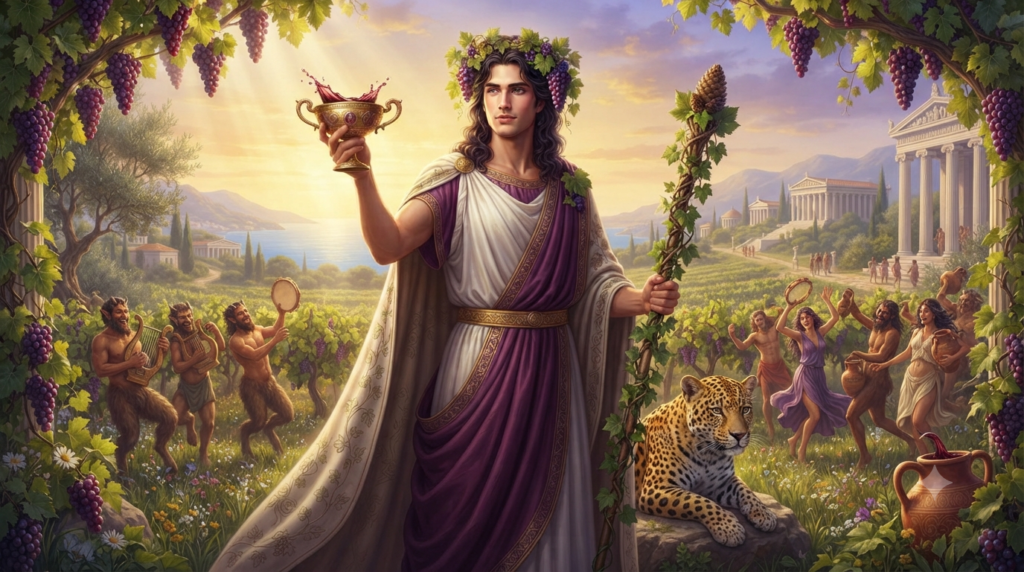
The thyrsus, a staff topped with a pinecone and often entwined with ivy, stands as one of the most recognizable symbols associated with Dionysus, carried by both the god himself and his followers during ecstatic rituals. This symbol represented fertility, wild nature, and the transformative power associated with Dionysian worship, reinforcing his identity wherever depicted throughout ancient Greek art and religious iconography.
Grapevines and ivy served as consistent botanical symbols tied directly to Dionysus, representing both the literal source of wine and the broader themes of growth, intoxication, and cyclical renewal associated with his worship. These plants appeared frequently in artistic depictions of the god, immediately signaling his identity as the god of wine in Greek mythology even in scenes where he was not explicitly named.
Dionysus was often accompanied by leopards or panthers, animals associated with untamed, powerful natural forces that paralleled the uncontrollable aspects of his own character. This animal association reinforced the wilder, more dangerous dimension of Dionysian worship, distinguishing him from gods associated with more docile or domesticated symbolic animals within Greek mythology.
Artistic depictions of Dionysus varied considerably across different periods of Greek art, ranging from a mature, bearded figure in earlier representations to a more youthful, androgynous form in later classical art. This evolution in his visual portrayal reflects the complex, shifting nature of his worship over time, illustrating how the god of wine in Greek mythology continued to be reimagined even within ancient Greek culture itself.
Dionysus’ Followers and Role Among the Gods
Dionysus’s most distinctive followers were the Maenads, women who participated in ecstatic rituals honoring the god, often described entering trance-like states of religious frenzy during his worship. These followers represented the liberating aspect of Dionysian religion, offering participants — particularly women, who held limited roles in other areas of Greek civic life — an outlet for intense spiritual and emotional expression through ritual celebration.
Satyrs and the older figure of Silenus also accompanied Dionysus throughout his mythology, representing the wilder, more chaotic elements associated with his worship. These companions, often depicted in states of revelry, reinforced the boundary-crossing nature of Dionysian celebration, blending human, animal, and divine characteristics in ways that distinguished his entourage from the more orderly retinues associated with other Olympian gods.
Dionysus faced a notably difficult path toward acceptance among the established Olympian gods, often portrayed as a foreign or newly arrived deity whose legitimacy required repeated proof throughout various myths. This struggle for recognition set him apart from gods whose Olympian status went largely unquestioned, reinforcing his identity as a figure who existed somewhat outside conventional divine hierarchy even after achieving full acceptance.
This tension between celebration and danger extended into Dionysus’s broader role among the gods and mortals alike, as his worship demanded genuine reverence rather than casual participation. Those who honored Dionysus appropriately experienced the joyous, communal aspects of his worship, while those who dismissed or opposed him frequently faced severe consequences, reinforcing why understanding who is the god of wine in Greek mythology requires appreciating both his generous and his punishing capacities.
Key Myths Featuring Dionysus
One notable myth describes Dionysus being captured by pirates who failed to recognize his divine nature, intending to sell him into slavery. In response, Dionysus transformed the ship’s mast into a grapevine, filled the vessel with the sound of flutes, and turned himself into a lion, terrifying the sailors until they leapt into the sea, where he transformed them into dolphins. This myth illustrates both his protective power and his willingness to punish those who failed to show him proper respect.
The tragic myth of Pentheus, dramatized extensively in Euripides’s play “The Bacchae,” describes a king who refused to acknowledge Dionysus’s divinity and attempted to suppress his worship in Thebes. This resistance led to catastrophic consequences, as Pentheus was ultimately torn apart by his own mother and the Maenads under Dionysus’s influence, representing one of the most severe and memorable examples of the god’s capacity for punishment throughout Greek mythology.
Dionysus’s descent into the underworld to rescue his mother, Semele, represents a rare example of a god making a compassionate journey into Hades on behalf of a mortal, ultimately succeeding in bringing her back and securing her place among the immortals. This myth reinforced Dionysus’s connection to both death and rebirth, themes closely tied to his identity as the twice-born god of wine in Greek mythology.
The myth of Dionysus and Ariadne, in which he discovers and marries the abandoned princess after Theseus leaves her on the island of Naxos, adds a romantic dimension to his mythology, illustrating his capacity for genuine devotion alongside his more chaotic characteristics. This relationship further demonstrates the multifaceted nature of Dionysus, whose myths consistently combine celebration, danger, loyalty, and transformation.
Dionysus vs. Bacchus — Greek vs. Roman God of Wine
When Roman religion adopted Greek mythology, Dionysus became known as Bacchus, retaining his core identity as god of wine while taking on additional emphasis within Roman religious practice. The Roman Bacchanalia, festivals dedicated to Bacchus, became known for their intense, sometimes controversial celebrations, reflecting a continuation of the ecstatic worship originally associated with Dionysus in Greek mythology.
While the core domains remained consistent between the two figures, Roman authorities eventually grew concerned about the perceived excesses associated with Bacchic worship, leading to significant restrictions on Bacchanalian festivals during certain periods of Roman history. This official concern demonstrates how the same dual nature present in Dionysus — joyous celebration alongside potential chaos — carried forward directly into Roman religious and political anxiety surrounding Bacchus.
Despite these cultural differences in reception, the fundamental identity of the god of wine remained remarkably stable across the transition from Dionysus to Bacchus, preserving core elements such as his association with grapevines, ecstatic ritual, and theatrical performance. This continuity reinforces just how deeply embedded the concept of a wine deity tied to transformation and celebration was within the broader ancient Mediterranean religious tradition.
Understanding the relationship between Dionysus and Bacchus provides useful context for anyone exploring who is the god of wine in Greek mythology, illustrating how his worship evolved and adapted while retaining its essential character across two closely related but distinct ancient cultures.
Why Dionysus Matters in Greek Mythology Today
Dionysus holds particular significance in the history of Western culture due to his direct connection to the origins of Greek theater, as dramatic performances developed specifically from festivals honoring him, known as the Dionysia. This connection means that modern theatrical tradition traces its roots directly back to religious celebrations of the god of wine in Greek mythology, giving Dionysus a legacy that extends well beyond wine itself.
Modern discussions of altered states, ritual celebration, and the tension between order and chaos frequently draw on Dionysian themes, even when not explicitly referencing Greek mythology by name. This conceptual legacy demonstrates how thoroughly Dionysus’s dual nature — celebratory yet dangerous — has influenced broader cultural and philosophical discussions about human experience and social boundaries.
The complexity of Dionysus’s mythology, combining joyful communal celebration with genuine danger and consequence, continues to offer modern audiences a more nuanced figure than a simple deity of indulgence. This depth is central to why the question of who is the god of wine in Greek mythology continues to invite serious exploration rather than a purely lighthearted or superficial answer.
Ultimately, Dionysus matters in Greek mythology today because he represents an enduring exploration of the boundary between celebration and chaos, community and danger. His lasting influence on theater, ritual, and modern understanding of ecstatic experience confirms that his mythology continues to resonate well beyond its original ancient Greek context.
FAQ — Quick Answers About the Greek God of Wine
Who is the god of wine in Greek mythology?
Dionysus is the god of wine in Greek mythology, also associated with ecstasy, fertility, and theater, known for his dual nature of celebration and danger.
Who are Dionysus’s parents?
Dionysus is the son of Zeus and the mortal princess Semele, born through an unusual process that earned him the title of the “twice-born” god.
Why is Dionysus called twice-born?
Dionysus is called twice-born because after Semele’s death, Zeus carried the unborn Dionysus in his own thigh until he was ready to be born.
Who are the Maenads?
The Maenads were female followers of Dionysus who participated in ecstatic rituals honoring the god, often entering trance-like states during his worship.
What is the Roman equivalent of Dionysus?
The Roman equivalent of Dionysus is Bacchus, who retained the same core identity as god of wine and was honored through festivals known as Bacchanalia.
Conclusion
Anyone who sets out to answer who is the god of wine in Greek mythology arrives at Dionysus, a deity whose story combines an extraordinary birth, a difficult path to divine acceptance, and a mythology built around the powerful duality between celebration and chaos. From his rescue by Zeus to his eventual triumph over mortals who dismissed his divinity, Dionysus’s myths consistently explore what happens when human experience is pushed toward its most intense, transformative extremes.
His symbols, from the thyrsus to the grapevine, and his followers, from the Maenads to the satyrs, reinforce a mythology built around liberation, ritual, and the blurring of ordinary boundaries. His continuation into Roman worship as Bacchus further demonstrates how deeply this combination of joy and danger resonated across the ancient Mediterranean world.
Ultimately, Dionysus endures as the god of wine in Greek mythology not simply as a symbol of celebration, but as a lasting exploration of the fine line between liberation and destruction — a duality that continues to shape how his story is understood and told today.

Orin Vale has spent the better part of two decades tracing the threads that connect the world’s oldest stories — from the halls of Asgard to the banks of the Nile, from Olympus to the jungles of the Maya. What began as a childhood fascination with flood myths and trickster gods grew into years of independent study across comparative mythology and ancient religion, always chasing the same question: what did these stories mean to the people who first told them? Orin writes for readers who want more than trivia — the ones looking for the beliefs, fears, and truths that myths were built to carry.