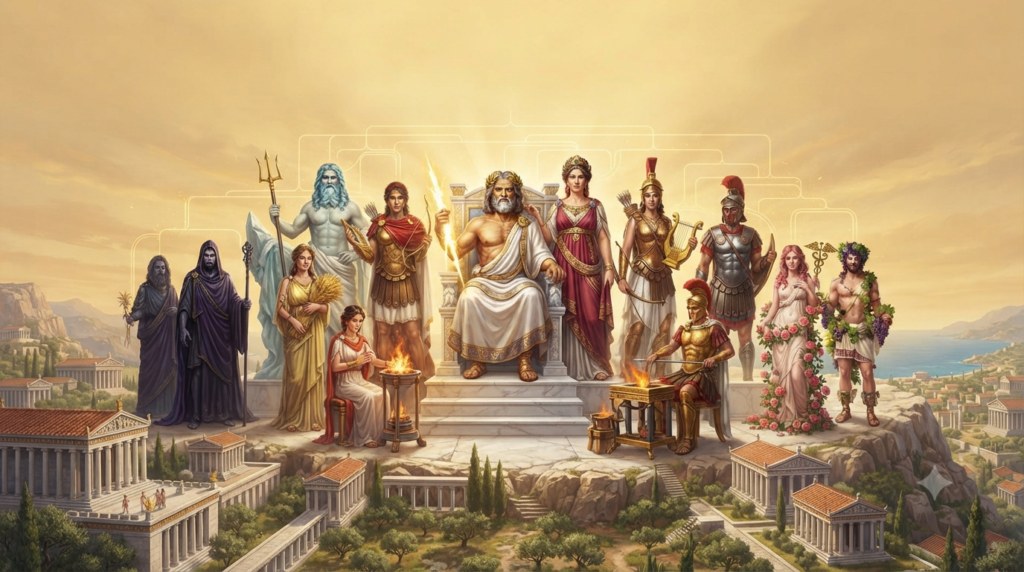
Anyone studying the genealogy of the Greek gods eventually asks why is there so much incest in Greek mythology, noticing that sibling and family unions appear repeatedly across the divine family tree, from the earliest primordial deities down through the Titans and the Olympians. This pattern is not incidental or accidental storytelling — it reflects specific cosmogonic, symbolic, and cultural logic embedded in how the ancient Greeks understood the origins of the universe and the nature of divine power. Understanding why is there so much incest in Greek mythology requires examining the structural constraints of early creation myths, the symbolic role of sacred unions, and the clear distinction the Greeks drew between the behavior expected of gods and the behavior expected of mortals.
Understanding the Pattern — Incest Among the Greek Gods
The pattern of sibling and family unions in Greek mythology begins at the very foundation of the cosmos, with Gaia, the primordial earth goddess, uniting with her own offspring Uranus, the sky, to produce the first generation of Titans. This union, described most fully in Hesiod’s Theogony, establishes a genealogical template that repeats throughout subsequent generations of Greek deities, making it one of the earliest and most consistent structural features of the entire mythological system.
This pattern continues directly into the generation of the Titans themselves, where siblings such as Cronus and Rhea unite to produce the first generation of Olympian gods. The trend persists further still among the Olympians, most notably in the marriage of Zeus and Hera, who were themselves siblings, reinforcing that incest in Greek mythology was not confined to the earliest, most abstract cosmological figures but continued into the more familiar, personality-driven deities central to later Greek storytelling.
Importantly, this pattern remained largely confined to the divine realm rather than extending broadly into mortal mythological narratives, where such relationships were treated as serious transgressions rather than accepted norms. This distinction is essential to understanding why is there so much incest in Greek mythology specifically among gods, while mortal characters in the same mythological tradition who commit similar acts, whether knowingly or through tragic circumstance, are typically portrayed as suffering severe consequences.
Recognizing this consistent pattern across multiple generations of Greek deities sets the foundation for understanding the deeper reasons behind it. Rather than reflecting arbitrary storytelling choices, the recurring presence of sibling and family unions among the gods points toward specific structural and symbolic explanations rooted in how the Greeks conceived of divine origin and cosmic order.
The Cosmogonic Reason — Limited Divine Population
One of the clearest explanations for why is there so much incest in Greek mythology lies in the practical constraints of early creation narratives. In the earliest stages of Hesiod’s cosmogony, only a limited number of primordial entities existed, meaning that any continuation of divine generations necessarily required unions among these same limited figures. With no external population of deities available, family unions became the only structurally available mechanism for generating new gods.
This constraint appears clearly in the union of Gaia and Uranus, whose offspring, the Titans, then paired among themselves to produce subsequent generations, including figures such as Oceanus and Tethys. Because these early myths describe the literal formation of the universe from a small set of foundational forces, incest in Greek mythology at this cosmogonic level functions less as a moral or relational choice and more as a narrative necessity dictated by the limited cast of existing divine figures.
This same logic extended into the generation of Cronus and Rhea, whose union produced the primary Olympian gods, including Zeus, Hera, Poseidon, and their siblings. As the population of significant deities gradually expanded across each generation, the practical necessity for exclusively family-based unions decreased, though the established pattern continued to influence later divine relationships even after alternative partnerships became mythologically possible.
This cosmogonic explanation reframes the recurring pattern not as a reflection of cultural preference, but as an artifact of how ancient Greek creation mythology structured the emergence of the universe itself. Understanding why is there so much incest in Greek mythology at its earliest stages, therefore, requires recognizing the genealogical mechanics of cosmogony rather than assuming any direct commentary on acceptable relationship norms.
Symbolic and Religious Meaning
Beyond practical genealogical necessity, sibling and family unions among the Greek gods often carried symbolic weight tied to the concept of hieros gamos, or sacred marriage, representing the union of complementary cosmic forces rather than a literal family relationship in the human sense. The pairing of Gaia, the earth, with Uranus, the sky, exemplifies this symbolic dimension, representing the union of fundamental elements necessary to generate further creation rather than emphasizing familial closeness as understood in mortal terms.
This symbolic framing helps explain why is there so much incest in Greek mythology without requiring the audience to interpret these unions through the same lens applied to human family relationships. The marriage of Zeus and Hera, for instance, carried significant symbolic weight as the union of the king and queen of the gods, representing stability and authority at the head of the Olympian order, with their sibling relationship functioning more as a structural detail than a central narrative focus.
Divine endogamy — the practice of gods marrying within their own family or generation — also reflected a broader cultural logic concerning the concentration and preservation of divine power and authority. By maintaining unions within the established divine lineage, Greek mythology reinforced the idea that supreme cosmic authority remained consolidated among a defined set of powerful figures, rather than diffusing outward through unpredictable external alliances.
This symbolic and religious dimension distinguishes divine incest in Greek mythology from any direct reflection of accepted human behavior. The Greeks generally understood these unions as operating according to a separate cosmic logic, one concerned with maintaining order, power, and symbolic completeness among the gods, rather than serving as a literal model for how mortal families should conduct themselves.
Divine Norms vs. Mortal Norms in Greek Culture
Ancient Greek society maintained clear and firmly enforced taboos against incest among mortals, treating such relationships as serious transgressions against both social order and religious law. This strong mortal taboo stands in notable contrast to the acceptance of similar relationships among the gods, highlighting a deliberate distinction the Greeks drew between divine and human behavioral standards throughout their mythological and religious tradition.
This distinction reflects a broader pattern in Greek religious thought, in which the gods were frequently understood to operate according to rules fundamentally different from those governing mortal conduct. Divine figures in Greek mythology regularly performed actions — including transformations, acts of extreme power, and unconventional relationships — that would have been considered unacceptable or even monstrous if attempted by mortal humans, reinforcing the gods’ position as entities existing beyond ordinary moral constraints.
Mortal characters within Greek mythology who became entangled in incestuous relationships, whether knowingly or through tragic deception, were consistently portrayed as suffering severe consequences, reinforcing rather than undermining the strength of the human taboo. This treatment stands in direct contrast to divine unions, which were rarely framed as transgressive within their own mythological context, further emphasizing that incest in Greek mythology operated under separate rules depending on whether gods or mortals were involved.
Understanding this divine-mortal distinction remains essential to answering why is there so much incest in Greek mythology without misapplying ancient Greek attitudes toward human relationships onto the behavior of their gods. The myths functioned as explorations of cosmic order and abstract power rather than as instructive models for acceptable human conduct, a distinction the ancient audience would have understood intuitively within their broader religious framework.
Comparative Context — Other Mythologies
The pattern of sibling and family unions among primordial deities is not unique to Greek mythology, appearing across numerous other ancient mythological traditions with similarly structured cosmogonies. Egyptian mythology, for example, features the marriage of Osiris and Isis, siblings who became central figures in Egyptian religious tradition, reflecting a comparable pattern of divine endogamy rooted in early creation narratives.
Norse mythology also includes instances of sibling unions among early or lesser-known figures, such as references to a symbolic relationship between the twin deities Freyr and Freyja in certain sources, though this pattern is generally less pronounced than in Greek or Egyptian cosmogony. Mesopotamian mythological traditions similarly include family unions among early divine generations, reflecting comparable structural constraints tied to limited early divine populations.
This broader comparative pattern reinforces that the presence of incest in Greek mythology reflects a common feature of ancient cosmogonic storytelling generally, rather than representing a uniquely Greek cultural peculiarity. Many ancient civilizations, when constructing narratives explaining the origin of the universe from a limited set of primordial forces, arrived at structurally similar solutions involving family-based divine unions.
Recognizing this cross-cultural pattern helps contextualize why is there so much incest in Greek mythology within a much wider ancient tradition of cosmogonic storytelling. Rather than isolating Greek mythology as unusual in this respect, comparative analysis demonstrates that this genealogical structure emerged repeatedly wherever ancient cultures attempted to explain the origin of the divine world from a small, foundational set of cosmic entities.
Why This Topic Still Draws Curiosity Today
Modern readers encountering Greek mythology for the first time frequently express surprise at the prevalence of sibling and family unions among the gods, reflecting a significant shift between ancient and contemporary cultural attitudes toward such relationships. This gap in perspective explains much of the continued curiosity surrounding why is there so much incest in Greek mythology, as modern audiences naturally interpret these myths through a contemporary moral lens quite different from that of ancient Greek religious thought.
This recurring curiosity also reflects a genuine interest in understanding ancient cosmogony on its own terms, as many readers seek to reconcile the apparent contradiction between accepting these myths as foundational cultural texts while recognizing how differently they treat family relationships compared to modern expectations. Engaging seriously with the cosmogonic and symbolic explanations behind this pattern offers a more complete understanding than simply noting its existence.
Academic and educational interest in this topic continues to grow as more readers engage with primary sources such as Hesiod’s Theogony, seeking to understand the original context behind these genealogical patterns rather than relying solely on secondhand summaries. This deeper engagement helps clarify that these myths functioned within a specific religious and cosmological framework rather than reflecting arbitrary or purely provocative storytelling choices.
Ultimately, the continued fascination with why is there so much incest in Greek mythology reflects a broader, legitimate interest in understanding how ancient cultures structured their explanations of cosmic origin and divine authority. Approaching this topic through its cosmogonic, symbolic, and cultural context offers a far more meaningful understanding than surface-level observation alone.
FAQ — Quick Answers About Incest in Greek Mythology
Why is there so much incest in Greek mythology?
Incest appears frequently in Greek mythology primarily due to the limited number of primordial deities in early cosmogony, along with symbolic meanings tied to sacred unions and the preservation of divine authority.
Did the ancient Greeks accept incest among mortals?
No. Ancient Greek society maintained strong taboos against incest among mortals, treating such relationships very differently from similar unions depicted among the gods.
Were Zeus and Hera siblings?
Yes, Zeus and Hera were siblings, both children of Cronus and Rhea, and their marriage reflected a broader pattern of divine endogamy among the early Olympian gods.
Is this pattern unique to Greek mythology?
No. Similar patterns of sibling or family unions among primordial deities appear in other ancient mythological traditions, including Egyptian and Mesopotamian cosmogony.
What is hieros gamos?
Hieros gamos, or sacred marriage, refers to the symbolic union of complementary cosmic forces in mythology, often used to explain divine unions beyond a literal human family context.
Conclusion
Anyone who sets out to answer why is there so much incest in Greek mythology finds an explanation rooted less in cultural endorsement and more in the structural mechanics of ancient cosmogony. From Gaia and Uranus to Zeus and Hera, these unions reflect the limited population of early divine figures, the symbolic logic of sacred marriage, and a clear cultural distinction between the behavior expected of gods and that expected of mortals.
Placed alongside similar patterns in Egyptian, Mesopotamian, and other ancient mythological traditions, the Greek case appears not as an isolated anomaly but as part of a broader ancient approach to explaining the origins of the cosmos from a small set of foundational forces. This comparative context reinforces that these myths operated according to their own internal logic rather than serving as commentary on acceptable human relationships.
Ultimately, understanding why is there so much incest in Greek mythology requires engaging with the genealogical, symbolic, and cultural framework the ancient Greeks used to structure their entire mythological system — a framework built to explain cosmic order, not to model mortal behavior.

Orin Vale has spent the better part of two decades tracing the threads that connect the world’s oldest stories — from the halls of Asgard to the banks of the Nile, from Olympus to the jungles of the Maya. What began as a childhood fascination with flood myths and trickster gods grew into years of independent study across comparative mythology and ancient religion, always chasing the same question: what did these stories mean to the people who first told them? Orin writes for readers who want more than trivia — the ones looking for the beliefs, fears, and truths that myths were built to carry.