Anyone asking is there a hell in Egyptian mythology will find an answer more nuanced than a simple yes or no. Egyptian mythology does not include a hell in the Western, Christian sense of a place of eternal, conscious punishment for sinners. Instead, ancient Egyptian belief centered on the Duat, a realm of the dead where souls underwent judgment, with outcomes ranging from a blissful afterlife to a far more severe fate involving the complete destruction of the soul. Understanding is there a hell in Egyptian mythology requires setting aside Western religious assumptions and examining how the ancient Egyptians actually conceived of judgment, consequence, and the afterlife within their own distinct cultural and religious framework.
The Duat — Egypt’s Realm of the Dead
The Duat represents the closest concept to an afterlife destination within Egyptian mythology, though it functions quite differently from the Western idea of hell. Rather than serving as a fixed location of punishment, the Duat was understood as an underworld realm through which the soul traveled after death, encountering various trials, deities, and dangers before ultimately facing judgment. This process-oriented structure distinguishes the Duat significantly from a hell in Egyptian mythology conceived purely as a destination of punishment.
Egyptian mythology described the Duat as a shadowy, complex landscape traversed by the sun god during his nightly journey, as well as by the souls of the deceased seeking passage toward judgment and, ultimately, a favorable afterlife. This dual association with both solar mythology and personal judgment gave the Duat a significance extending well beyond a simple afterlife holding area, incorporating it into the broader cosmic order the Egyptians believed governed both life and death.
Unlike a hell in Egyptian mythology imagined as a permanent destination for the wicked, the Duat functioned primarily as a transitional space, a realm of trial and passage rather than a fixed endpoint determined purely by moral judgment at the outset. Every soul, regardless of how they had lived, entered the Duat and faced the same fundamental process, reinforcing that judgment, rather than automatic condemnation, defined the Egyptian approach to the afterlife.
This distinction between a realm of judgment and passage versus a fixed location of eternal punishment forms the foundation for understanding why is there a hell in Egyptian mythology requires a more careful answer than the term “hell” typically implies. The Duat represented uncertainty and possibility rather than predetermined suffering, a structural difference with significant implications for how the ancient Egyptians understood morality and consequence.
The Judgment of the Dead
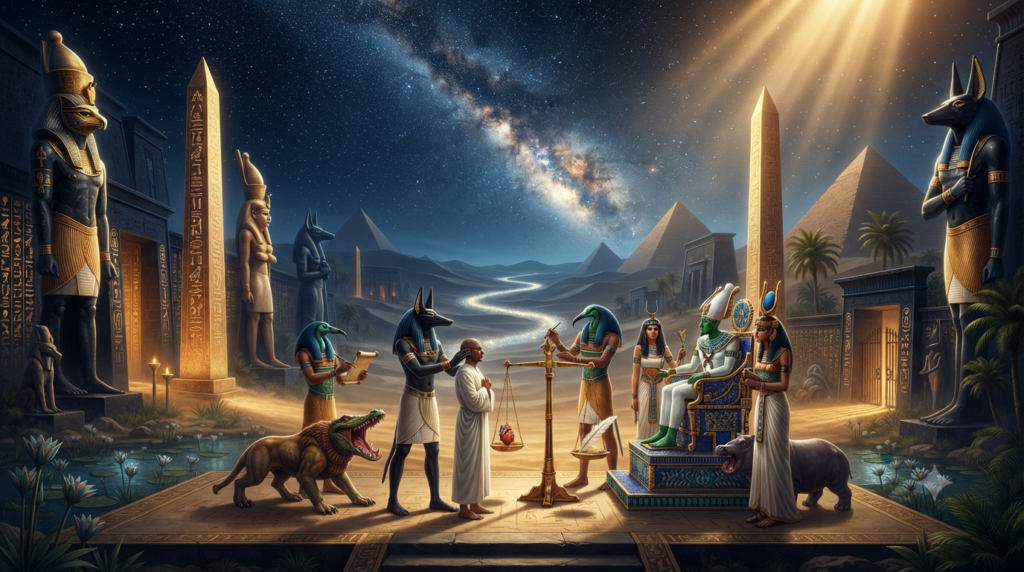
At the heart of the Egyptian afterlife process stood the Weighing of the Heart, a ritual judgment in which the deceased’s heart was placed on a scale against the feather of Ma’at, the goddess representing truth, balance, and cosmic order. This ceremony determined whether the individual had lived a life aligned with Ma’at’s principles, making it the central mechanism through which Egyptian mythology addressed questions of morality and consequence after death.
Anubis, the jackal-headed god associated with mummification and the afterlife, presided directly over this weighing ceremony, ensuring the scale’s accuracy and guiding the deceased through this critical stage of judgment within the Duat. His role reinforced the seriousness and precision the Egyptians attached to this process, treating the judgment of the dead as a matter requiring careful divine oversight rather than arbitrary or automatic condemnation.
Osiris, god of the afterlife and ruler of the Duat, served as the supreme judge presiding over the outcome of this weighing ceremony, ultimately determining the fate of each soul based on the result. As the central authority figure within Egyptian conceptions of judgment after death, Osiris’s role illustrates how deeply personal and individualized this process was intended to be, standing in contrast to any notion of a hell in Egyptian mythology defined by blanket, undifferentiated punishment.
This structured judgment process, involving Ma’at’s feather, Anubis’s oversight, and Osiris’s final authority, demonstrates that Egyptian mythology approached the afterlife through a framework of accountability and evaluation rather than predetermined fate. Understanding this judgment system remains essential to accurately answering is there a hell in Egyptian mythology, since the outcome for each soul depended directly on this careful, individualized assessment.
What Happens to Those Who Fail Judgment
For souls whose hearts proved heavier than the feather of Ma’at, indicating a life not lived in accordance with truth and balance, Egyptian mythology described a fate involving Ammit, a composite creature often depicted with the head of a crocodile, the body of a leopard, and the hindquarters of a hippopotamus. Ammit’s role was to devour the hearts of those who failed judgment, representing the most severe consequence available within Egyptian belief.
This consumption by Ammit represented something significantly different from the Western concept of hell as eternal, conscious torment. Rather than condemning the soul to ongoing suffering, the devouring of the heart by Ammit signified the complete annihilation of the individual’s identity and existence, effectively erasing them from continuation in any afterlife whatsoever. This concept of annihilation rather than eternal punishment marks one of the most significant differences when addressing is there a hell in Egyptian mythology.
The distinction between annihilation and eternal conscious punishment carries substantial weight in understanding ancient Egyptian religious thought. Where many Western traditions emphasize ongoing suffering as the consequence for wrongdoing, Egyptian mythology instead framed the ultimate negative outcome as complete cessation of existence, a conceptually different form of consequence that does not map neatly onto the traditional definition of hell in Egyptian mythology or elsewhere.
This structural difference reinforces why simply translating “hell” into an Egyptian context oversimplifies a genuinely distinct theological framework. The fear associated with failing judgment in Egyptian belief centered not on eternal torment, but on the total loss of identity and afterlife continuation, representing a fundamentally different conception of ultimate consequence than what the term hell typically evokes in Western religious tradition.
What Happens to Those Who Pass Judgment
Souls whose hearts balanced favorably against the feather of Ma’at proceeded toward the Field of Reeds, also known as Aaru, a paradisiacal realm representing the ultimate positive outcome within Egyptian conceptions of the afterlife. This destination stood in direct contrast to the fate awaiting those who failed judgment, reinforcing that Egyptian mythology structured the afterlife around genuinely divergent outcomes based on the individual’s moral conduct during life.
The Field of Reeds was envisioned as an idealized continuation of earthly life, offering abundance, fertility, and peace without the hardships and uncertainties present in mortal existence. This vision reflects the broader Egyptian approach to the afterlife as an extension and improvement of life rather than a wholly separate spiritual state, further distinguishing Egyptian belief from frameworks built primarily around punishment and reward in an entirely different metaphysical realm.
Reaching the Field of Reeds required not only passing the Weighing of the Heart but also successfully navigating the broader trials of the Duat, reinforcing the Duat’s role as a comprehensive testing ground rather than a singular judgment moment alone. This layered process illustrates the complexity Egyptian mythology attributed to achieving a favorable afterlife outcome, treating it as an earned continuation rather than an automatic guarantee.
This positive destination offers essential context for fully answering is there a hell in Egyptian mythology, since understanding the favorable outcome available through the Field of Reeds highlights just how differently the Egyptian afterlife system operated compared to traditions organized primarily around threat and punishment. Egyptian belief balanced consequence with genuine reward, reflecting a more evenly weighted moral framework.
Sources — The Book of the Dead and Egyptian Funerary Texts
The Book of the Dead, more accurately translated as the “Book of Coming Forth by Day,” served as the primary textual guide for navigating the Duat, offering spells, prayers, and instructions intended to help the deceased successfully pass through judgment and reach the Field of Reeds. This text remains one of the most important surviving sources for understanding how the ancient Egyptians conceptualized the afterlife and the trials awaiting the soul after death.
These funerary texts included specific spells designed to assist the deceased in addressing challenges encountered within the Duat, including guidance for the Weighing of the Heart ceremony itself. The inclusion of such practical guidance demonstrates that the Egyptians viewed the afterlife journey as something requiring active preparation and knowledge, rather than a passive process determined entirely by fate or divine whim.
Amulets and protective objects placed within burial sites complemented the written spells found in the Book of the Dead, reflecting a broader cultural emphasis on equipping the deceased with every possible advantage for successfully navigating the Duat. This combination of textual and material preparation underscores how seriously Egyptian society approached the journey through the afterlife realm most closely associated with the question of hell in Egyptian mythology.
These sources collectively demonstrate that Egyptian afterlife beliefs were neither vague nor arbitrary, but instead structured around detailed, actionable guidance meant to help individuals achieve a favorable outcome. This level of textual and ritual preparation further reinforces the distinction between the Egyptian Duat and a hell in Egyptian mythology imagined as an inescapable, predetermined fate.
Duat vs. Hell — Key Differences from the Western Concept
The most significant difference between the Duat and the Western concept of hell lies in the absence of eternal, conscious punishment within Egyptian belief. Where many Western religious traditions describe hell as a place of ongoing suffering for the condemned, Egyptian mythology instead offered annihilation through Ammit as the ultimate negative outcome, representing a fundamentally different approach to divine consequence.
Egyptian judgment also differed structurally from many Western frameworks by emphasizing a single, decisive weighing ceremony rather than an extended period of accumulated judgment across a lifetime interpreted through varying theological lenses. This more immediate, ritualized process reflects a distinctly Egyptian approach to determining moral outcome, centered on the specific moment of the Weighing of the Heart rather than a more abstract, ongoing accounting of one’s life.
The presence of a genuinely positive afterlife destination, the Field of Reeds, alongside the negative outcome involving Ammit, illustrates that Egyptian mythology maintained a more balanced structure between reward and consequence compared to traditions sometimes perceived as emphasizing punishment more heavily. This balance further complicates any simple equivalence between the Duat and hell in Egyptian mythology as commonly understood through a Western lens.
These structural and conceptual differences make clear that directly translating “hell” onto Egyptian mythology risks oversimplifying a genuinely distinct religious framework. The Duat represented a complex system of judgment, trial, and consequence built around Egyptian concepts of truth, balance, and identity, rather than a straightforward parallel to Western ideas of eternal punishment.
Why This Question Matters Today
The question of is there a hell in Egyptian mythology often arises from a natural tendency to interpret unfamiliar religious systems through the lens of more familiar Western frameworks, particularly Christian conceptions of heaven and hell. Recognizing where these frameworks genuinely align and where they diverge significantly improves understanding of ancient Egyptian religious thought on its own terms.
Approaching the Duat as a distinct system, rather than a direct equivalent to hell, allows for a more accurate appreciation of how the ancient Egyptians understood morality, consequence, and identity beyond death. This careful distinction avoids flattening a sophisticated theological system into an oversimplified translation that obscures its genuine complexity and cultural specificity.
Modern interest in Egyptian mythology continues to grow, particularly through popular culture and general historical curiosity, making it increasingly important to address common misconceptions such as the assumption of a direct Egyptian equivalent to hell. Providing an accurate, nuanced answer helps readers engage more meaningfully with ancient Egyptian religious belief rather than relying on oversimplified comparisons.
Ultimately, addressing is there a hell in Egyptian mythology thoughtfully offers valuable insight into how differently ancient cultures could conceive of judgment, consequence, and the afterlife, even when addressing seemingly universal human concerns about morality and what follows death. This nuanced understanding enriches broader engagement with Egyptian mythology as a whole.
FAQ — Quick Answers About Hell in Egyptian Mythology
Is there a hell in Egyptian mythology?
Egyptian mythology does not include a hell in the Western sense of eternal conscious punishment; instead, it features the Duat, a realm of judgment where souls face either a positive afterlife or annihilation.
What happens if you fail judgment in Egyptian mythology?
Souls who fail the Weighing of the Heart ceremony are devoured by Ammit, resulting in the complete annihilation of the soul rather than ongoing punishment.
What is the Egyptian version of heaven?
The Field of Reeds, or Aaru, represents the positive afterlife destination in Egyptian mythology, offering an idealized continuation of earthly life for souls who pass judgment.
Who judges the dead in Egyptian mythology?
Osiris serves as the supreme judge of the dead, with Anubis overseeing the Weighing of the Heart ceremony that determines each soul’s fate.
What is the Duat?
The Duat is the Egyptian underworld, a realm of trial and judgment through which souls travel after death before reaching their final afterlife outcome.
Conclusion
Anyone who sets out to answer is there a hell in Egyptian mythology finds a system built around judgment and consequence rather than a fixed destination of eternal suffering. The Duat, with its Weighing of the Heart, the watchful presence of Anubis, and the final judgment of Osiris, offered ancient Egyptians a structured path toward either the paradise of the Field of Reeds or the complete annihilation delivered by Ammit.
This structure, preserved through texts like the Book of the Dead, reveals a religious framework concerned with truth, balance, and identity rather than eternal torment, distinguishing Egyptian belief significantly from the Western concept of hell. Recognizing these differences allows for a far richer understanding of how the ancient Egyptians approached mortality and moral consequence.
Ultimately, the Egyptian answer to what awaits the unworthy was not eternal punishment, but complete erasure — a distinct and deeply meaningful alternative to hell in Egyptian mythology that reflects the culture’s unique relationship between identity, judgment, and the afterlife.

Orin Vale has spent the better part of two decades tracing the threads that connect the world’s oldest stories — from the halls of Asgard to the banks of the Nile, from Olympus to the jungles of the Maya. What began as a childhood fascination with flood myths and trickster gods grew into years of independent study across comparative mythology and ancient religion, always chasing the same question: what did these stories mean to the people who first told them? Orin writes for readers who want more than trivia — the ones looking for the beliefs, fears, and truths that myths were built to carry.