Anyone asking what is creation mythology encounters one of the most universal categories of storytelling found across human civilization. Creation mythology refers to the symbolic narratives cultures develop to explain the origin of the universe, the world, and humanity itself, typically emerging in the earliest stages of a culture’s religious and philosophical development. Understanding what is creation mythology means recognizing that nearly every recorded civilization, regardless of geography or era, produced its own version of these foundational stories, each attempting to answer the same fundamental questions about existence, order, and origin.
Defining Creation Mythology
Creation mythology, at its core, consists of symbolic narratives that explain how the universe, the earth, and living beings came into existence. Unlike historical accounts, these myths function through symbolic and often supernatural explanation rather than empirical description, offering a culturally meaningful framework for understanding origin rather than a literal, scientific account of how the cosmos formed.
What is creation mythology distinct from other mythological categories becomes clearer when compared to heroic myths, which focus on individual figures overcoming challenges, or eschatological myths, which describe the end of the world rather than its beginning. Creation mythology specifically addresses origin — the transition from nonexistence or chaos into an ordered, structured cosmos — making it foundational to nearly every broader mythological system that follows it.
Beyond simply explaining physical origin, creation mythology served crucial cultural functions within ancient societies, establishing the framework through which communities understood cosmic order, social hierarchy, and religious practice. These myths often provided the underlying justification for rituals, kingship, and moral systems, meaning that understanding what is creation mythology requires recognizing its role as far more than a simple origin story — it functioned as a foundational cultural document.
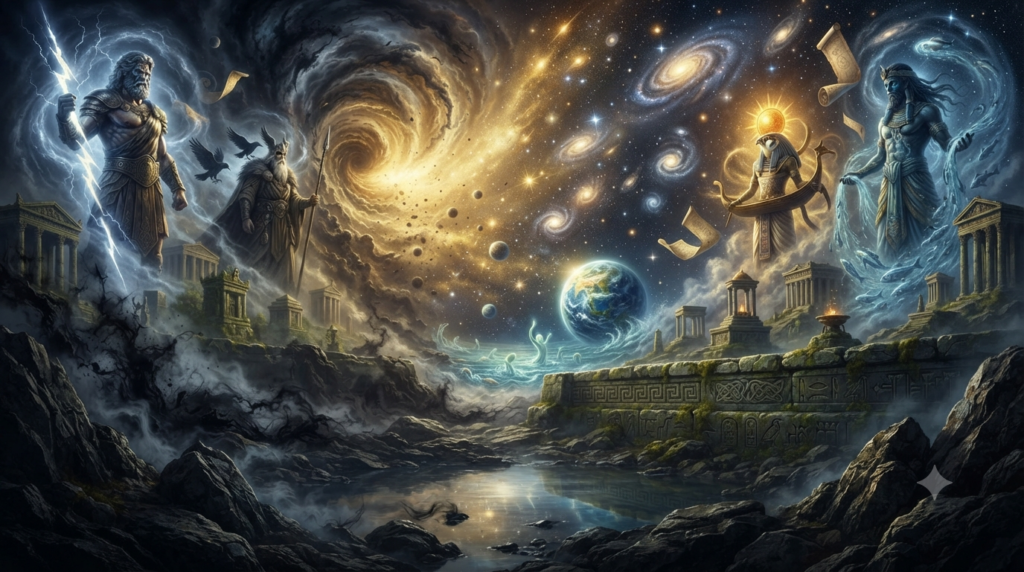
This combination of symbolic explanation and social function explains why creation mythology appears with such remarkable consistency across otherwise unrelated ancient civilizations. Whether examining Greek, Norse, Egyptian, or countless other traditions, creation mythology consistently addresses the same core question: how did an ordered world emerge from whatever existed, or did not exist, before it.
Common Types of Creation Myths
One of the most widespread patterns in creation mythology involves the emergence of the cosmos from primordial chaos, a formless or undifferentiated state preceding structured existence. This pattern appears prominently in Greek mythology, where Hesiod’s Theogony describes Chaos as the very first entity from which subsequent cosmic order gradually developed, establishing chaos-to-order as a foundational structure within Greek creation mythology specifically.
A related but distinct pattern involves creation “ex nihilo,” meaning creation from absolute nothingness through divine will alone, without any preexisting material or primordial substance to work from. This type of creation mythology emphasizes the singular power of a creator deity, distinguishing it from traditions where creation involves the transformation or reorganization of already-existing primordial elements.
The “world egg” motif represents another recurring pattern within global creation mythology, appearing in traditions ranging from Chinese to Hindu mythology, in which the universe emerges from a cosmic egg that splits or hatches to produce the sky and earth. This symbolic structure reflects a common human tendency to conceptualize creation through biological metaphors of birth and emergence rather than purely abstract or mechanical processes.
Earth-diver myths, common within various Indigenous North American and Siberian traditions, describe creation mythology in which an animal dives into a primordial ocean to retrieve a small amount of earth, which then expands to form the world. This pattern, along with myths describing creation from the body of a sacrificed primordial being, such as the Norse giant Ymir, demonstrates the remarkable diversity of specific mechanisms found within global creation mythology, even while addressing the same fundamental question of origin.
Creation Mythology Across Different Cultures
Greek creation mythology, as recorded primarily in Hesiod’s Theogony, begins with Chaos, followed by the emergence of Gaia, the earth, and subsequent generations of divine beings whose relationships and conflicts gradually establish cosmic order under the eventual rule of Zeus. This structure exemplifies chaos-to-order creation mythology, emphasizing genealogical development from abstract primordial forces toward personified, relatable deities.
Norse creation mythology describes the cosmos emerging from Ginnungagap, a primordial void positioned between the realms of fire and ice, ultimately giving rise to the giant Ymir, whose body was later used by the gods to construct the physical world. This example illustrates the “creation from a primordial being” pattern, combining elements of both chaotic origin and bodily transformation within a single, distinctly Norse mythological framework.
Egyptian creation mythology centers on the primordial waters of Nun, an infinite, undifferentiated ocean from which the first mound of earth emerged, providing the foundation upon which subsequent creation and divine order were established. This watery origin point reflects Egypt’s close relationship with the Nile River, demonstrating how geographic and environmental context frequently shaped the specific imagery used within regional creation mythology.
Beyond these examples, Mesopotamian, Hindu, and Chinese creation mythology each offer additional variations on these recurring themes, reinforcing that what is creation mythology fundamentally represents a universal human impulse expressed through culturally specific imagery and narrative structure. This consistency across otherwise unconnected civilizations highlights creation mythology as one of the most fundamental categories of human storytelling.
Common Themes Across Creation Myths
Despite significant cultural and geographic differences, creation mythology across the world consistently returns to the theme of order emerging from chaos, whether that chaos takes the form of formless void, primordial ocean, or undifferentiated darkness. This recurring structure suggests a shared human tendency to conceptualize existence as fundamentally ordered, requiring an explanatory narrative for how that order first came into being.
Many creation mythology traditions also feature an initial generation of abstract, primordial deities or forces preceding the more personality-driven gods who appear in later mythological narratives. This pattern, visible in Greek, Norse, and Egyptian traditions alike, suggests a common conceptual progression from abstract cosmic principles toward more relatable, anthropomorphized divine figures as mythology develops further.
Water, darkness, and emptiness appear with striking consistency as starting points within creation mythology across unrelated cultures, suggesting these elements held particular symbolic power for ancient societies attempting to conceptualize a state preceding structured existence. This recurring imagery reinforces just how universally human societies gravitated toward similar symbolic language when addressing the fundamentally similar challenge of explaining ultimate origin.
Finally, many creation mythology traditions distinguish between the creation of the cosmos itself and the subsequent, often separate creation of humanity, treating human origin as a distinct narrative event rather than an automatic byproduct of cosmic formation. This separation reflects a broader tendency within creation mythology to address not just physical existence, but humanity’s specific place and purpose within an already-established cosmic order.
Why Creation Mythology Matters
Creation mythology served essential religious and social functions within ancient societies, providing explanatory frameworks for otherwise incomprehensible questions about existence while simultaneously reinforcing religious practices, social hierarchies, and cultural values. Understanding what is creation mythology, therefore, requires recognizing its practical cultural role alongside its more obvious explanatory function.
These foundational narratives frequently provided the underlying justification for religious rituals, royal authority, and social order, connecting everyday cultural practices directly back to the cosmic events described within a society’s creation mythology. This connection reinforced the perceived legitimacy and sacred significance of established social and religious structures throughout many ancient civilizations.
Studying creation mythology comparatively also offers valuable insight into how individual mythological traditions, such as Greek, Norse, or Egyptian mythology, fit within a much broader global pattern of human storytelling. Recognizing these shared structural elements enhances understanding of any single tradition’s specific creation narrative by situating it within this wider comparative context.
Ultimately, creation mythology matters because it represents one of humanity’s oldest and most consistent storytelling impulses, addressing fundamental questions about existence that remain relevant regardless of cultural or historical context. This enduring relevance ensures that creation mythology continues to attract serious scholarly and popular interest well beyond the ancient societies that originally produced these foundational narratives.
FAQ — Quick Answers About Creation Mythology
What is creation mythology?
Creation mythology refers to symbolic narratives that explain the origin of the universe, the world, and humanity, found across nearly every recorded human culture.
What are the main types of creation myths?
Common types include creation from primordial chaos, creation from nothingness, the cosmic egg motif, earth-diver myths, and creation from the body of a primordial being.
Is creation mythology the same as cosmogony?
Yes, cosmogony is the formal term often used interchangeably with creation mythology, referring specifically to narratives explaining the origin of the cosmos.
Why do so many cultures have similar creation myths?
Many cultures independently developed similar creation mythology themes, such as chaos-to-order narratives, reflecting shared human approaches to explaining existence and cosmic order.
How does creation mythology differ from other types of myths?
Creation mythology specifically addresses the origin of the universe and humanity, distinguishing it from heroic, etiological, or eschatological myths that address different mythological themes.
Conclusion
Anyone who sets out to answer what is creation mythology discovers a category of storytelling as universal as it is diverse, spanning chaos-driven Greek cosmogony, the primordial void of Norse mythology, and the watery origins central to Egyptian belief. Despite significant cultural variation, these narratives consistently address the same fundamental human question: how did an ordered world emerge from whatever preceded it.
The recurring themes found throughout global creation mythology — chaos transforming into order, primordial deities preceding personal gods, and the symbolic use of water, darkness, and emptiness — reveal a shared human approach to confronting the mystery of existence itself. These patterns connect otherwise unrelated civilizations through a common narrative structure addressing humanity’s oldest question.
Ultimately, creation mythology endures as one of humanity’s most fundamental storytelling traditions, offering far more than simple origin stories. It provides cultural, religious, and philosophical frameworks that continue to shape how societies understand their place within a structured, meaningful cosmos.

Orin Vale has spent the better part of two decades tracing the threads that connect the world’s oldest stories — from the halls of Asgard to the banks of the Nile, from Olympus to the jungles of the Maya. What began as a childhood fascination with flood myths and trickster gods grew into years of independent study across comparative mythology and ancient religion, always chasing the same question: what did these stories mean to the people who first told them? Orin writes for readers who want more than trivia — the ones looking for the beliefs, fears, and truths that myths were built to carry.