Anyone asking do people still believe in Greek mythology today might expect a simple no, given that Greek mythology is typically discussed as ancient history rather than active religious practice. The honest answer, however, is more nuanced: while the overwhelming majority of people engage with Greek mythology purely as cultural, literary, or historical material, a genuine, if relatively small, community of modern practitioners does still believe in and actively practice a revived form of ancient Greek religion today. Understanding do people still believe in Greek mythology requires distinguishing clearly between widespread cultural appreciation and the smaller but genuine religious community actively worshipping the Greek gods in the present day.
Greek Mythology as Historical Belief vs. Modern Practice
For nearly two thousand years following the decline of ancient Greek religious practice, Greek mythology existed primarily as historical and cultural material, studied and appreciated for its literary, artistic, and philosophical significance rather than practiced as active religious belief by any substantial community. This long historical period without organized worship shapes how most people today automatically assume Greek mythology to be.
This assumption reflects genuine historical reality for the vast majority of the intervening centuries, during which engaging with Greek mythology meant studying ancient texts, admiring classical art, or drawing on mythological themes within literature, rather than participating in any living religious tradition centered on the Greek gods.
The crucial distinction relevant to do people still believe in Greek mythology lies between this widespread historical and cultural engagement, which remains extremely common today, and genuine religious belief involving actual worship, ritual practice, and theological commitment to the Greek pantheon, which represents a considerably smaller and more specific phenomenon.
Understanding this distinction between historical study and active belief provides essential context before exploring the modern religious movement that has, in fact, revived genuine worship of the Greek gods, demonstrating that Greek mythology’s relationship to belief is more complex than a simple historical-versus-contemporary divide might initially suggest.
Hellenism — Modern Revival of Ancient Greek Religion
Hellenism, sometimes referred to as Hellenic polytheism or Hellenic reconstructionism, represents a genuine modern religious movement dedicated to reviving and practicing ancient Greek religious tradition, directly addressing do people still believe in Greek mythology through organized, contemporary religious practice rather than purely historical study.
This modern religious revival movement emerged significantly during the twentieth century, with visibility and organizational structure becoming particularly notable from the 1990s and early 2000s onward, as various communities began formally organizing around the specific goal of reconstructing and practicing ancient Greek religious belief and ritual within a contemporary context.
Hellenism specifically distinguishes itself from broader neopagan movements through its focus on reconstructing historically documented ancient Greek religious practice as accurately as possible, rather than blending Greek mythological elements more loosely with other spiritual or religious traditions, as some broader neopagan approaches might do.
This reconstructionist approach reinforces that modern Hellenism represents a serious, historically grounded religious movement rather than a casual or purely symbolic engagement with Greek mythology, providing a genuinely significant answer to do people still believe in Greek mythology through organized contemporary religious practice.
Who Practices Modern Hellenism
Organized Hellenic communities exist in various countries today, including notable groups such as Ellinais in Greece itself, which has worked toward establishing recognition and support for modern Hellenic religious practice within its country of origin, providing one clear, documented example relevant to do people still believe in Greek mythology today.
The global community of modern Hellenic practitioners remains relatively small compared to major world religions, representing a genuine but numerically limited religious movement rather than a widespread contemporary belief system, an important detail for accurately understanding the scale of modern belief in Greek mythology.
Certain countries have taken specific legal or official steps regarding modern Hellenic religious practice, with Greece notably taking measures toward recognizing Hellenism within particular legal or ceremonial contexts, reflecting genuine institutional acknowledgment of this modern religious movement within its historical country of origin.
This combination of organized communities, international presence, and certain forms of official recognition demonstrates that do people still believe in Greek mythology has a genuinely affirmative, documentable answer, even though the scale of modern practice remains considerably smaller than during antiquity itself.
What Modern Practitioners Actually Believe and Do
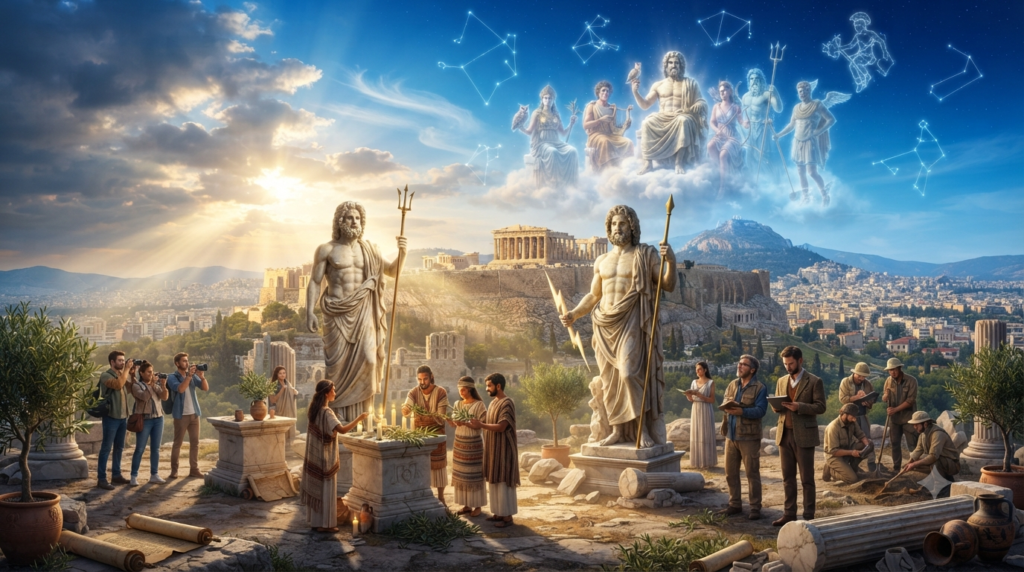
Modern Hellenic practitioners generally worship the traditional Olympian gods, including Zeus, Athena, Apollo, and other major deities from ancient Greek mythology, adapting ancient religious practice to fit contemporary circumstances while maintaining strong connection to historically documented ancient Greek religious tradition.
Ritual practice among modern Hellenic communities frequently includes festivals, offerings, and ceremonies directly inspired by documented ancient Greek religious practice, attempting to recreate historically accurate forms of worship and religious observance as closely as available historical sources allow.
An important distinction exists among modern practitioners regarding how literally specific mythological narratives are understood, with some practitioners engaging with traditional myths in a more literal theological sense, while others approach the same narratives symbolically or archetypally, reflecting a range of theological interpretation within the broader modern Hellenic community.
This combination of ritual practice, deity worship, and varying theological interpretation demonstrates that modern answers to do people still believe in Greek mythology involve a genuinely functioning religious community with real diversity of belief and practice, rather than a single, uniform approach to reviving ancient Greek religious tradition.
Cultural Appreciation vs. Religious Belief
The vast majority of people who engage meaningfully with Greek mythology today do so through cultural appreciation, entertainment, or academic study, rather than through genuine religious belief or worship, representing an entirely different category of engagement than the smaller Hellenic religious community discussed previously.
This distinction matters significantly for accurately addressing do people still believe in Greek mythology, since widespread cultural interest, including popular media, literature, and educational engagement with Greek mythology, should not be conflated with the considerably smaller phenomenon of genuine religious belief and practice found within modern Hellenism specifically.
Recognizing this distinction prevents both overstating and understating the true scope of contemporary belief in Greek mythology, acknowledging genuine cultural fascination as widespread while accurately identifying actual religious practice as a smaller, more specific phenomenon limited to dedicated Hellenic religious communities.
This careful distinction between appreciation and belief provides essential precision when addressing do people still believe in Greek mythology, ensuring the question receives an accurate, nuanced answer rather than an oversimplified response in either direction.
Why This Question Matters
Understanding do people still believe in Greek mythology reveals an important broader truth: mythological traditions often assumed to be entirely historical are not always completely extinct as living religious practice, even when significantly reduced in scale compared to their original historical prominence.
This insight connects to broader questions regarding the relationship between mythology and religion generally, illustrating that the line between “historical mythology” and “living religious tradition” can shift or blur under certain circumstances, as demonstrated clearly through the modern Hellenic revival movement specifically.
Recognizing modern Hellenism’s existence also encourages more careful, precise language when discussing mythological traditions broadly, avoiding blanket assumptions that any particular ancient mythology necessarily lacks contemporary religious practitioners without first verifying this assumption against documented modern religious movements.
This nuanced understanding reinforces why do people still believe in Greek mythology deserves a genuinely researched, careful answer rather than an assumed response based purely on Greek mythology’s predominant historical and cultural status over the past two millennia.
FAQ — Quick Answers About Belief in Greek Mythology Today
Do people still believe in Greek mythology today?
Yes, though on a small scale. Modern Hellenism, a reconstructed form of ancient Greek religion, involves genuine practitioners who worship the traditional Greek gods today.
What is Hellenism?
Hellenism, or Hellenic polytheism, is a modern religious movement dedicated to reviving and practicing ancient Greek religious belief and ritual in a contemporary context.
How many people practice modern Hellenism?
The global community of modern Hellenic practitioners remains relatively small compared to major world religions, though organized communities exist in several countries.
Is Hellenism the same as neopaganism?
Hellenism is generally distinguished by its focus on historically accurate reconstruction of ancient Greek religion, compared to broader neopagan movements that may blend multiple traditions.
Do most people who like Greek mythology believe in it religiously?
No. Most engagement with Greek mythology today involves cultural appreciation, entertainment, or academic study rather than genuine religious belief or practice.
Conclusion
Anyone who sets out to answer do people still believe in Greek mythology finds a more nuanced truth than a simple yes or no. While the vast majority of contemporary engagement with Greek mythology remains cultural, literary, or academic in nature, a genuine, organized religious community, practicing modern Hellenism, continues actively worshipping the traditional Greek gods today.
This distinction between widespread cultural appreciation and smaller-scale genuine religious practice provides essential nuance for understanding Greek mythology’s true contemporary status, avoiding both the oversimplification of complete historical extinction and any exaggeration regarding the scale of modern religious practice.
Ultimately, do people still believe in Greek mythology finds its most accurate answer in recognizing both realities simultaneously: Greek mythology remains overwhelmingly a matter of cultural and historical interest for most people today, while also continuing as a genuine, if small, living religious tradition for dedicated modern practitioners.

Orin Vale has spent the better part of two decades tracing the threads that connect the world’s oldest stories — from the halls of Asgard to the banks of the Nile, from Olympus to the jungles of the Maya. What began as a childhood fascination with flood myths and trickster gods grew into years of independent study across comparative mythology and ancient religion, always chasing the same question: what did these stories mean to the people who first told them? Orin writes for readers who want more than trivia — the ones looking for the beliefs, fears, and truths that myths were built to carry.