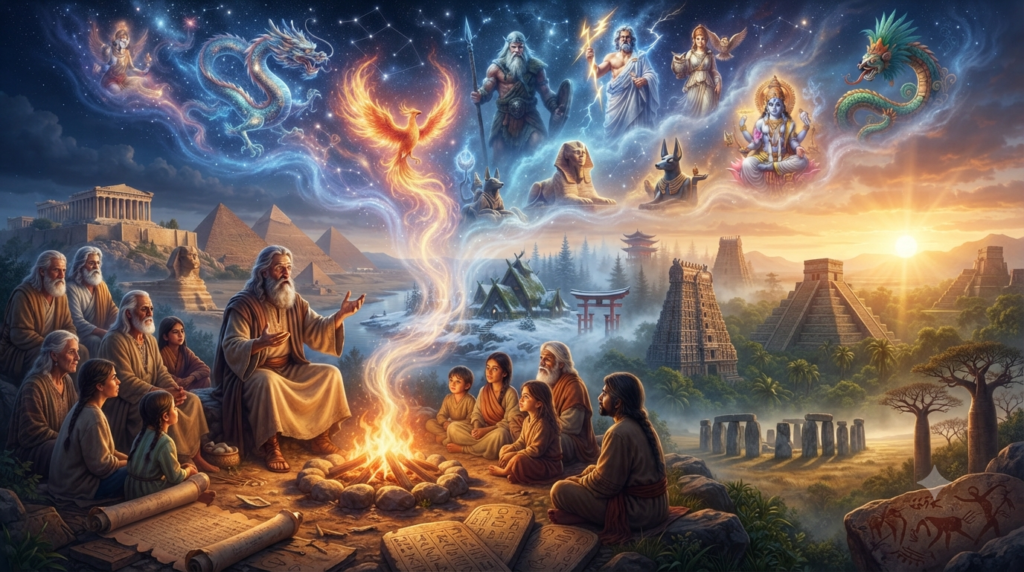
Anyone asking why is mythology important discovers that these ancient narrative traditions extend far beyond entertainment or historical curiosity, shaping cultural identity, moral understanding, psychological insight, and artistic expression in ways that remain relevant well into the present day. Mythology is important because it represents one of humanity’s oldest and most consistent tools for making sense of existence, transmitting values, and preserving cultural memory across generations. Understanding why is mythology important requires examining its many overlapping functions, from ancient explanations of natural phenomena to its continued influence on modern language, art, and psychology.
Mythology Shapes Cultural Identity
Mythology plays a foundational role in shaping cultural and national identity, providing origin narratives and founding hero stories that communities use to understand their own historical and cultural distinctiveness. This function represents one of the clearest answers to why is mythology important, as these narratives frequently serve as the symbolic foundation upon which broader cultural self-understanding is built.
Founding myths, whether describing the origin of a specific people, city, or nation, provide communities with shared narrative touchstones that reinforce collective identity across generations, connecting present-day individuals to a deeper, symbolically significant cultural past. This connection between mythology and identity remains evident across numerous cultures worldwide, regardless of whether their mythological traditions remain actively practiced today.
Beyond individual origin narratives, mythology reinforces cultural cohesion by transmitting shared values, expectations, and cultural knowledge from one generation to the next through consistently repeated, culturally significant storytelling. This transmission function highlights why is mythology important not simply as historical artifact, but as an active mechanism for cultural continuity across time.
This role in shaping identity explains why mythological traditions often retain deep emotional and cultural significance even long after their original religious context has faded, continuing to function as meaningful cultural touchstones that communities draw upon when articulating their own historical and cultural distinctiveness.
Mythology Provides Moral and Ethical Frameworks
Mythology has long served as a primary vehicle for transmitting moral and ethical lessons, using narrative consequence rather than abstract rule-making to illustrate the outcomes of behaviors such as pride, betrayal, or greed. This narrative approach to moral instruction represents a significant answer to why is mythology important within the broader context of cultural and ethical education.
Myths involving figures who suffer severe consequences for specific moral failings, such as the punishment of Tantalus for betraying divine trust, demonstrate how mythology historically communicated ethical lessons through memorable, emotionally resonant storytelling rather than through purely abstract moral instruction disconnected from narrative context.
This preference for narrative-based moral instruction reflects a broader recognition that stories often communicate ethical lessons more effectively and memorably than direct rule-based teaching alone, reinforcing why is mythology important as an educational and cultural tool capable of shaping behavior and values across successive generations within a given society.
The continued relevance of mythological moral lessons, even within contemporary contexts far removed from their original cultural setting, demonstrates mythology’s lasting capacity to communicate ethical insight through narrative, reinforcing its ongoing educational value well beyond its original historical and religious context.
Mythology Reflects Human Psychology
Mythology consistently features recurring archetypal figures, including heroes, wise mentors, and tricksters, reflecting deep and universal patterns within human psychological experience that appear across otherwise unrelated cultural and mythological traditions worldwide. This psychological dimension provides another significant answer to why is mythology important beyond its purely cultural or moral functions.
Modern psychology has drawn extensively on mythological figures and narratives when developing concepts describing various aspects of human behavior and development, using mythology as an accessible, symbolically rich vocabulary for exploring complex psychological phenomena that might otherwise resist straightforward explanation.
This continued psychological relevance demonstrates that mythology addresses genuinely universal aspects of human experience, explaining why similar mythological patterns and archetypal figures emerge independently across culturally unrelated mythological traditions throughout human history, despite significant differences in specific cultural content and detail.
Recognizing mythology’s psychological dimension reinforces why is mythology important well beyond ancient historical context, illustrating its continued relevance as a symbolic framework for understanding fundamental aspects of human psychological experience that remain consistent across vastly different historical and cultural circumstances.
Mythology Helped Explain the Natural World
Before the development of modern scientific method, mythology served as humanity’s primary explanatory framework for understanding natural phenomena, providing causal narratives that connected observable events, such as thunder, seasonal change, or celestial movement, to comprehensible divine action and intention.
This explanatory function represents a historically significant answer to why is mythology important, demonstrating that mythology functioned as a genuinely useful cognitive tool for organizing human understanding of an otherwise unpredictable natural world, long before alternative scientific explanations became available to ancient societies.
Even though modern science has since replaced mythology’s explanatory function regarding natural phenomena specifically, understanding this historical role remains valuable for appreciating how human thought and understanding developed over time, illustrating an important intellectual stage preceding the emergence of modern scientific methodology.
This historical explanatory function reinforces why is mythology important as a subject of continued study, offering meaningful insight into the broader development of human cognition and understanding, even in areas where mythology’s original explanatory role has since been superseded by more empirically grounded scientific knowledge.
Mythology Preserves Historical and Cultural Memory
Mythology frequently preserves symbolic, if not always literally accurate, records of significant historical events, migrations, and social changes experienced by ancient cultures, encoding this historical memory within narrative and symbolic form rather than through direct historical documentation alone.
Historians and anthropologists regularly draw on mythological narrative when reconstructing understanding of ancient cultures, recognizing that even symbolically encoded mythological content can provide valuable clues regarding historical events, cultural values, and social structures that might otherwise remain poorly documented through purely archaeological or textual historical sources.
This preservative function further reinforces why is mythology important as more than simple entertainment or religious belief, positioning mythology as a genuinely valuable historical and anthropological resource capable of illuminating aspects of ancient cultural experience that other historical sources alone might fail to fully capture or explain.
Recognizing mythology’s role in preserving historical and cultural memory encourages more serious scholarly engagement with mythological sources, treating them as legitimate historical evidence worthy of careful analysis rather than dismissing them purely as fictional or purely religious material disconnected from genuine historical significance.
Mythology Continues to Shape Art, Literature, and Language
Mythology’s influence extends significantly into modern art, literature, and everyday language, with countless creative works throughout history drawing directly on mythological figures, narratives, and themes as source material for artistic and literary expression across many different cultural and historical contexts.
Everyday vocabulary and idiomatic expressions frequently trace their origins directly to specific mythological narratives, demonstrating how thoroughly mythology has embedded itself within ordinary language use, often without contemporary speakers recognizing the specific mythological origin behind familiar words and phrases they use regularly.
This continued creative and linguistic influence reinforces why is mythology important within contemporary cultural production, illustrating that mythology remains an active source of inspiration and expression rather than existing purely as historical or academic subject matter disconnected from ongoing artistic and cultural relevance.
Recognizing this lasting creative influence provides additional context for understanding why is mythology important today, demonstrating that mythology’s significance extends well beyond its original historical context into the ongoing creative and linguistic fabric of contemporary culture and artistic production worldwide.
Why Mythology Still Matters Today
Considered together, mythology’s roles in shaping cultural identity, transmitting moral values, reflecting human psychology, explaining the natural world historically, preserving cultural memory, and continuing to influence art and language collectively demonstrate why is mythology important across multiple overlapping dimensions of human experience and cultural development.
This multifaceted significance explains why mythology continues attracting serious scholarly attention and popular interest alike, offering genuine insight into human cultural, psychological, and historical development that extends well beyond simple entertainment value or outdated religious belief disconnected from contemporary relevance.
Understanding why is mythology important ultimately requires recognizing that these ancient narrative traditions addressed, and often continue addressing, genuinely universal human needs regarding identity, meaning, moral understanding, and psychological insight that remain relevant regardless of significant historical and cultural change over time.
This enduring relevance confirms that mythology deserves serious, ongoing engagement rather than dismissal as merely historical curiosity, reflecting its continued capacity to illuminate meaningful aspects of human experience across vastly different historical periods and cultural contexts throughout recorded history.
FAQ — Quick Answers About the Importance of Mythology
Why is mythology important?
Mythology is important because it shapes cultural identity, transmits moral values, reflects human psychology, historically explained the natural world, and continues influencing art and language today.
Does mythology still matter in the modern world?
Yes, mythology remains relevant through its continued influence on psychology, literature, art, and everyday language, even though its original religious function has changed significantly.
How does mythology relate to human psychology?
Mythology reflects recurring psychological archetypes, such as heroes and tricksters, that modern psychology continues drawing on to describe universal aspects of human behavior and development.
Can mythology help us understand history?
Yes, mythology often preserves symbolic historical memory, providing historians and anthropologists valuable insight into ancient cultures, migrations, and social change.
Why did ancient cultures rely on mythology instead of science?
Ancient cultures relied on mythology because it provided the primary explanatory framework available before the development of modern scientific method for understanding natural phenomena.
Conclusion
Anyone who sets out to answer why is mythology important discovers a subject whose significance extends far beyond ancient religious practice, shaping cultural identity, moral understanding, psychological insight, historical memory, and ongoing artistic and linguistic expression across human history. Mythology’s continued relevance reflects its genuine capacity to address fundamental, enduring aspects of human experience.
From founding myths reinforcing cultural identity to archetypal figures reflected within modern psychology, mythology’s influence remains woven throughout contemporary culture in ways that often go unrecognized despite their genuine significance and continued presence in everyday life and creative expression.
Ultimately, why is mythology important finds its clearest answer in mythology’s remarkable persistence across radically different historical periods and cultural contexts, confirming that these ancient narrative traditions continue serving meaningful cultural, psychological, and historical functions well beyond their original ancient origins.
Anyone looking into how to write mythology for their own fictional world is taking on one of the more ambitious

Orin Vale has spent the better part of two decades tracing the threads that connect the world’s oldest stories — from the halls of Asgard to the banks of the Nile, from Olympus to the jungles of the Maya. What began as a childhood fascination with flood myths and trickster gods grew into years of independent study across comparative mythology and ancient religion, always chasing the same question: what did these stories mean to the people who first told them? Orin writes for readers who want more than trivia — the ones looking for the beliefs, fears, and truths that myths were built to carry.