Anyone asking who killed Thor in Norse mythology arrives at a single answer rooted in the mythology’s climactic final battle: Jörmungandr, the Midgard Serpent, killed Thor during Ragnarök, the prophesied apocalyptic conflict that brings about the destruction of the gods. This death did not occur in isolation but formed one of the central confrontations within Ragnarök itself, representing the culmination of a rivalry between Thor and Jörmungandr that Norse mythology had long foreshadowed. Understanding who killed Thor in Norse mythology requires examining both the long-standing enmity between these two figures and the specific, symbolically significant circumstances surrounding Thor’s ultimate death.
Thor and Jörmungandr — A Rivalry Foretold
Jörmungandr, also known as the Midgard Serpent, was born as one of Loki’s monstrous children, alongside Fenrir and Hel, and was cast into the ocean surrounding Midgard by Odin, where the serpent grew so large it eventually encircled the entire world, biting its own tail. This origin established Jörmungandr as one of the most significant threats to cosmic order within Norse mythology, setting the stage for its eventual role in answering who killed Thor in Norse mythology.
Thor and Jörmungandr encountered one another on at least one notable occasion prior to Ragnarök, during a fishing expedition Thor undertook with the giant Hymir, in which Thor used an ox head as bait and very nearly succeeded in catching and killing the serpent before Hymir, overcome with fear, cut the fishing line. This earlier confrontation established a clear pattern of hostility between Thor and Jörmungandr well before their final, fatal encounter during Ragnarök.
This established rivalry between Thor and Jörmungandr was widely understood within Norse mythological tradition as destined to culminate in a final, decisive confrontation during Ragnarök, reflecting the broader mythological pattern in which specific gods and monstrous adversaries were fated to face one another in mutually destructive combat during the apocalyptic final battle.
Understanding this earlier rivalry provides essential context for who killed Thor in Norse mythology, demonstrating that Jörmungandr’s role in Thor’s eventual death was not a random or unexpected development, but rather the fulfillment of a long-foreshadowed conflict between two of Norse mythology’s most significant and consistently opposed figures.
The Battle at Ragnarök
Ragnarök represents the prophesied apocalyptic battle within Norse mythology, marking the destruction of the gods and the broader cosmic order they maintained, involving numerous simultaneous confrontations between the Aesir gods and the forces of chaos, including giants, monstrous offspring, and other adversaries aligned against Asgard.
Thor played a central role among the defenders of Asgard during Ragnarök, standing alongside Odin, Freyr, and other significant gods as they faced the combined forces arrayed against them, including Fenrir, Surtr, and Jörmungandr, each of whom faced a specific, fated opponent during the chaotic final battle described throughout Norse mythological sources.
The direct confrontation between Thor and Jörmungandr occurred as one of several major individual battles taking place simultaneously within the broader chaos of Ragnarök, reflecting the mythology’s structural pattern of pairing specific gods against specific adversaries in mutually significant, often mutually fatal combat during this final cosmic conflict.
This battle context proves essential for understanding who killed Thor in Norse mythology, situating Jörmungandr’s role not as an isolated attack, but as one carefully structured element within the broader, cosmically significant destruction unfolding across Ragnarök as a whole.
How Thor Dies — The Nine Steps
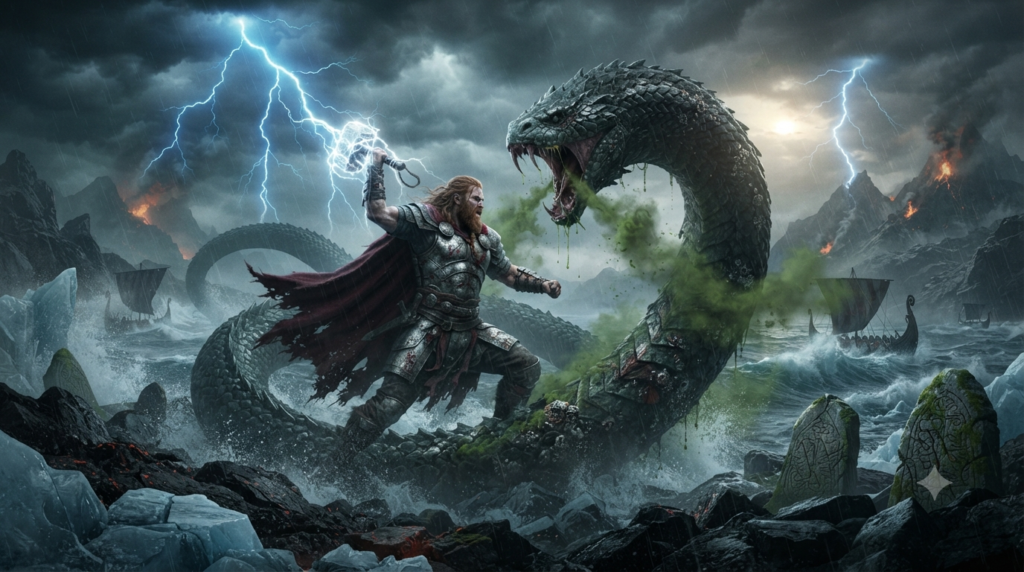
According to Norse mythological sources, Thor ultimately succeeds in defeating Jörmungandr during their Ragnarök confrontation, striking the serpent with his hammer Mjölnir and killing it in a final display of the strength and combat prowess long associated with the god of thunder throughout Norse mythology.
However, this victory comes at a fatal cost, as Jörmungandr’s venomous breath, released during their fatal confrontation, poisons Thor even as the serpent falls dead. This detail proves central to fully answering who killed Thor in Norse mythology, since Thor’s death results directly from this venom rather than from any physical wound inflicted during the battle itself.
Norse mythological sources specifically describe Thor managing to walk only nine steps after killing Jörmungandr before collapsing and dying from the serpent’s venom, a specific and symbolically resonant detail that has become one of the most memorable elements associated with Thor’s death within the broader narrative of Ragnarök.
This outcome represents a genuinely pyrrhic victory, illustrating a recurring theme within Ragnarök in which even successful combat against a fated adversary ultimately results in the victor’s own death. This pattern reinforces why who killed Thor in Norse mythology requires understanding both direct causation, through Jörmungandr’s venom, and the broader mythological structure of mutual destruction defining Ragnarök as a whole.
Why This Death Matters Within Ragnarök
Thor’s death alongside Jörmungandr reflects a broader pattern within Ragnarök in which major gods face mutually fatal confrontations against specific fated adversaries, including Odin’s death at the jaws of Fenrir and Freyr’s fatal battle against the fire giant Surtr, each following a similarly structured pattern of mutual destruction during the final battle.
This recurring narrative structure reinforces that who killed Thor in Norse mythology fits within a broader, intentional mythological pattern rather than representing an isolated or unique death, illustrating how Ragnarök systematically pairs major gods against significant adversaries in confrontations resulting in death for both parties involved.
Thor’s death carries significant symbolic weight beyond its immediate narrative function, representing the end of an entire divine order and the specific protective role Thor had long served for both gods and mortals throughout Norse mythology. His death, alongside the broader destruction of Ragnarök, signals the definitive conclusion of the old cosmic order the Aesir gods had maintained.
Understanding this symbolic dimension enriches any exploration of who killed Thor in Norse mythology, demonstrating that Jörmungandr’s role in this death carries meaning extending well beyond simple narrative causation into the broader themes of cosmic ending and renewal central to Ragnarök’s significance within Norse mythological tradition.
Sources — Where This Myth Comes From
The account of Thor’s death during his confrontation with Jörmungandr appears within the Poetic Edda, particularly within the poem Völuspá, which provides one of the primary poetic sources describing the events of Ragnarök, including the specific fates of major Norse gods such as Thor, Odin, and Freyr during the final battle.
Snorri Sturluson’s Prose Edda, composed in the thirteenth century, provides a more detailed narrative account of these same events, offering additional context and structure regarding how Thor’s confrontation with Jörmungandr and subsequent death unfolded within the broader chaos of Ragnarök as described within this influential medieval Icelandic source.
These two primary sources generally maintain consistency regarding the core details of who killed Thor in Norse mythology, both confirming Jörmungandr as the specific cause of Thor’s death through venom following their fatal mutual confrontation, reinforcing the reliability of this particular mythological detail across the surviving textual tradition.
This consistency across multiple significant Norse mythological sources reinforces confidence in the specific details surrounding who killed Thor in Norse mythology, demonstrating that this element of Ragnarök’s narrative remained stable across the various texts that have preserved Norse mythology for modern audiences and scholars alike.
Why This Myth Still Resonates Today
The confrontation between Thor and Jörmungandr continues to resonate strongly within modern popular culture, frequently referenced or adapted within contemporary literature, games, and other media that draw on Norse mythology, reflecting the enduring dramatic and symbolic power of this particular mythological confrontation.
This continued cultural relevance reflects the genuinely compelling narrative structure underlying who killed Thor in Norse mythology, combining long-foreshadowed rivalry, decisive victory, and immediate fatal consequence into a single, dramatically satisfying mythological sequence that continues to captivate audiences well beyond its original Norse cultural context.
The pyrrhic nature of Thor’s victory, defeating his greatest adversary only to die from the same encounter, offers a particularly resonant narrative structure that continues appearing across various forms of modern storytelling, reflecting universal themes about sacrifice, mutual destruction, and the cost of ultimate victory that extend well beyond this specific Norse mythological context.
This lasting resonance confirms that who killed Thor in Norse mythology remains a genuinely significant question for contemporary audiences engaging with Norse mythology, reflecting both scholarly interest in the original mythological sources and continued popular fascination with this particularly dramatic and symbolically rich confrontation.
FAQ — Quick Answers About Thor’s Death in Norse Mythology
Who killed Thor in Norse mythology?
Jörmungandr, the Midgard Serpent, killed Thor during Ragnarök, poisoning him with venom after their fatal final confrontation.
Did Thor kill Jörmungandr before dying?
Yes, Thor successfully killed Jörmungandr with his hammer Mjölnir before succumbing to the serpent’s venom shortly afterward.
How many steps did Thor take before dying?
According to Norse mythological sources, Thor walked nine steps after killing Jörmungandr before collapsing and dying from the serpent’s venom.
Where does the story of Thor’s death come from?
Thor’s death is described primarily in the Poetic Edda, particularly the poem Völuspá, and further detailed in Snorri Sturluson’s Prose Edda.
Is Thor’s death part of a larger pattern in Ragnarök?
Yes, Thor’s death reflects a broader Ragnarök pattern in which major gods, including Odin and Freyr, face mutually fatal battles against specific fated adversaries.
Conclusion
Anyone who sets out to answer who killed Thor in Norse mythology arrives at Jörmungandr, the Midgard Serpent, whose long-foreshadowed rivalry with Thor culminated in a fatal confrontation during Ragnarök. Thor’s ultimate victory over the serpent, achieved through his hammer Mjölnir, came at the cost of his own life, as Jörmungandr’s venom claimed him after only nine steps.
This death fits within a broader mythological pattern defining Ragnarök, in which major gods faced mutually destructive confrontations against fated adversaries, reinforcing the cosmic scale and symbolic significance of this final battle marking the end of the old divine order within Norse mythology.
Ultimately, the story of who killed Thor in Norse mythology endures as one of the most dramatically resonant moments within the entire Norse mythological tradition, combining long-building rivalry, decisive victory, and immediate fatal consequence into a narrative that continues to captivate audiences long after its original telling.

Orin Vale has spent the better part of two decades tracing the threads that connect the world’s oldest stories — from the halls of Asgard to the banks of the Nile, from Olympus to the jungles of the Maya. What began as a childhood fascination with flood myths and trickster gods grew into years of independent study across comparative mythology and ancient religion, always chasing the same question: what did these stories mean to the people who first told them? Orin writes for readers who want more than trivia — the ones looking for the beliefs, fears, and truths that myths were built to carry.