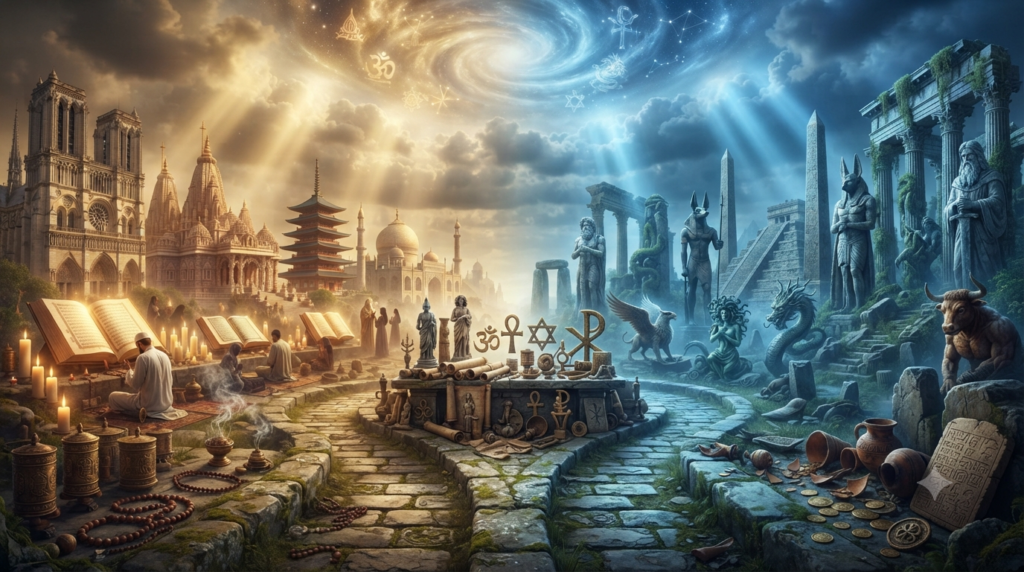
Anyone asking is mythology a religion is exploring a genuinely important conceptual distinction, since the two terms, while closely related, are not simply interchangeable. Mythology refers specifically to a body of symbolic, culturally significant narratives, while religion encompasses a broader system that typically includes belief, ritual practice, community, ethics, and institutional structure, of which mythology often forms just one component. Understanding is mythology a religion requires examining how these two concepts relate to one another across different traditions, recognizing that the relationship varies considerably depending on whether a given mythology remains connected to active religious practice or exists primarily as historical and cultural narrative.
Defining Mythology
Mythology, at its core, refers to a body of symbolic and often sacred narratives through which a culture expresses its understanding of the cosmos, the divine, and human existence. These narratives can exist either as an active component of a currently practiced religious tradition or, alternatively, as historical cultural material no longer connected to living religious practice, a distinction essential to properly addressing is mythology a religion.
This flexibility in definition means that mythology itself does not require ongoing religious practice to remain meaningful or worthy of serious study, as traditions like Greek or Norse mythology continue to be studied and appreciated for their narrative, historical, and cultural significance despite lacking active religious communities built around their original worship today.
At the same time, mythology can and often does exist as a genuinely active component within currently practiced religious traditions, where mythological narratives continue functioning as meaningful religious content for actively worshipping communities rather than existing purely as historical or literary material.
This dual capacity, existing either as living religious content or as historical cultural narrative, forms the essential foundation for understanding is mythology a religion, demonstrating that mythology’s relationship to religious practice depends significantly on the specific tradition and historical context being considered rather than following a single, universal pattern.
Defining Religion
Religion represents a considerably broader concept than mythology alone, typically encompassing structured belief systems, ritual practice, ethical frameworks, community organization, and institutional structures that extend well beyond narrative content. This broader scope means religion generally includes far more than simply the mythological stories associated with any particular tradition.
Understanding this broader definition proves essential when addressing is mythology a religion, since mythology functions as one potential component within the larger structure of religion rather than representing religion’s complete definition. A religious tradition typically integrates mythological narrative alongside ritual practice, moral teaching, and community worship, combining these elements into a comprehensive religious system.
This relationship means mythology can meaningfully contribute to religious identity and practice without mythology itself constituting the entirety of what makes a tradition religious. Ritual observance, ethical instruction, and communal worship practices often carry equal or greater weight within a religious tradition’s overall structure compared to its mythological narrative content alone.
Recognizing religion as this broader, multi-component system provides essential context for understanding is mythology a religion, clarifying that mythology represents a significant but ultimately partial element within the considerably more expansive concept of organized religious tradition and practice.
How Mythology Functions Within Religion
Within actively practiced religious traditions, mythology frequently serves as a core component of religious cosmology and liturgical practice, providing the narrative framework through which believers understand divine action, cosmic order, and their tradition’s specific theological perspective. This integration illustrates one significant way is mythology a religion can be meaningfully addressed through specific, real-world examples.
Hinduism offers a particularly clear example of mythology functioning as a genuinely active component within a living religious tradition, where mythological narratives involving deities and cosmic events remain directly connected to ongoing worship, ritual practice, and religious community life practiced by hundreds of millions of people today. This example demonstrates mythology operating fully integrated within an active, contemporary religious system.
This distinction between simply “having a mythology” and mythology itself constituting the entire religious tradition remains crucial for accurately addressing is mythology a religion. Even within traditions where mythology plays a highly significant role, such as Hinduism, religious practice extends considerably beyond mythological narrative alone to include ritual, ethical teaching, and community religious life.
This integrated relationship between mythology and active religious practice illustrates one clear pattern relevant to is mythology a religion, showing that in certain traditions, mythology functions as a genuinely essential, actively practiced component of contemporary religious life rather than existing merely as historical or literary material.
When Mythology Exists Without Active Religion
Many well-known mythological traditions, including Greek, Norse, and Egyptian mythology, no longer maintain active religious communities organized around their original worship, existing instead primarily as historical, cultural, and literary subjects of study rather than as components of currently practiced religion. This pattern represents an important counterpoint when addressing is mythology a religion.
These historical mythologies continue receiving substantial scholarly attention and popular cultural interest despite lacking contemporary religious practice, demonstrating that mythology retains genuine cultural and intellectual value independent of any ongoing religious function. This continued relevance illustrates mythology’s capacity to exist meaningfully outside active religious practice entirely.
An important distinction exists between describing these traditions as “historical mythology” versus characterizing them simply as “extinct religion,” since the former framing more accurately captures their continued cultural relevance and scholarly significance without implying complete disappearance or irrelevance. This nuanced framing matters considerably for accurately addressing is mythology a religion across different historical contexts.
This pattern of mythology existing without active religious practice reinforces that mythology and religion, while frequently connected, remain conceptually distinct categories capable of existing independently of one another, further clarifying the genuinely complex relationship at the heart of is mythology a religion as a broader conceptual question.
Can Mythology Exist Without Religion?
Mythology frequently exists and functions meaningfully within entirely secular contexts, appearing throughout literature, art, psychology, and popular culture without requiring any associated religious belief from those engaging with these mythological references and narrative structures. This secular usage further demonstrates mythology’s capacity to exist independently from religious practice.
Modern psychology, for instance, regularly draws on mythological figures and narratives to describe various aspects of human behavior and experience, using mythology as a symbolic and conceptual tool without this application requiring any religious commitment or belief regarding the original mythological tradition being referenced.
This secular application illustrates that mythology functions effectively as an independent cultural and narrative tool, valuable for storytelling, symbolic communication, and conceptual framing regardless of whether any religious belief accompanies its use. This flexibility reinforces mythology’s distinct identity separate from religion when addressing is mythology a religion comprehensively.
Recognizing mythology’s capacity for meaningful secular application provides important context for understanding is mythology a religion, demonstrating clearly that mythological narrative retains significant value and function even when entirely disconnected from religious belief or practice.
Can Religion Exist Without Mythology?
Certain religious traditions place comparatively greater emphasis on law, ethical practice, or direct religious experience rather than extensive mythological narrative, suggesting that religion itself does not strictly require substantial mythological content to function as a coherent, meaningful religious system for its practitioners.
This variation across religious traditions regarding the relative emphasis placed on mythological narrative versus other religious components, such as ethical teaching or ritual practice, further illustrates that mythology, while common within religious tradition, does not represent an absolutely essential or universal component required for something to qualify as religion.
This observation deserves careful, balanced treatment rather than extensive theological analysis, simply acknowledging that religious traditions vary considerably in how heavily they rely on mythological narrative relative to other religious elements, without this variation implying any judgment about comparative religious validity or significance.
This flexibility regarding mythology’s role within different religious traditions reinforces the broader complexity underlying is mythology a religion, demonstrating that neither concept strictly requires the other to function meaningfully, even though the two frequently intersect significantly within many religious traditions worldwide.
So, Is Mythology a Religion?
Based on this examination, mythology is not simply synonymous with religion, but frequently functions as a significant component within religious tradition, with the specific nature of this relationship varying considerably depending on the particular tradition and historical context under consideration. This nuanced conclusion reflects the genuine complexity underlying is mythology a religion as a broader question.
In traditions like Hinduism, mythology remains deeply integrated within active, contemporary religious practice, while in traditions like Greek or Norse mythology, the mythological narrative persists as historically and culturally significant material without corresponding active religious practice today. Both patterns represent legitimate, meaningful relationships between mythology and religion.
This variation demonstrates that addressing is mythology a religion accurately requires examining each specific tradition individually rather than applying a single, universal answer across all mythological and religious systems, since the relationship between these two concepts genuinely differs based on historical, cultural, and religious context.
Ultimately, mythology and religion remain related but distinct concepts, with mythology capable of functioning as either an actively practiced religious component or as historically significant cultural narrative, depending entirely on the specific tradition being considered when addressing is mythology a religion thoughtfully.
FAQ — Quick Answers About Mythology and Religion
Is mythology a religion?
Not exactly. Mythology refers to symbolic narrative, while religion is a broader system including belief, ritual, and community, with mythology often functioning as one component of religion.
Can mythology exist without religion?
Yes, mythology frequently exists in secular contexts, including literature, art, and psychology, without requiring any associated religious belief or practice.
Is Greek mythology still a religion today?
No, Greek mythology no longer has active religious communities practicing it, existing instead as historical and cultural material studied for its narrative and scholarly significance.
Is Hindu mythology part of an active religion?
Yes, Hindu mythology remains deeply integrated within actively practiced Hindu religious tradition, including ongoing worship, ritual, and religious community life today.
Does religion always require mythology?
Not necessarily. Some religious traditions emphasize law, ethics, or direct experience over extensive mythological narrative, though mythology remains common across many world religions.
Conclusion
Anyone who sets out to answer is mythology a religion finds that the two concepts, while closely related, are not simply the same thing. Mythology represents a body of symbolic narrative that can function either as an active component of contemporary religious practice, as seen in Hinduism, or as historically significant cultural material disconnected from active worship, as seen in Greek or Norse mythology.
This variation demonstrates that mythology’s relationship to religion depends heavily on specific historical and cultural context rather than following a single universal pattern, with mythology capable of existing meaningfully both within and entirely outside active religious practice depending on the tradition involved.
Ultimately, understanding is mythology a religion requires appreciating this genuine complexity, recognizing mythology and religion as related but distinct concepts whose relationship shifts meaningfully across different traditions, historical periods, and cultural contexts throughout human history.

Orin Vale has spent the better part of two decades tracing the threads that connect the world’s oldest stories — from the halls of Asgard to the banks of the Nile, from Olympus to the jungles of the Maya. What began as a childhood fascination with flood myths and trickster gods grew into years of independent study across comparative mythology and ancient religion, always chasing the same question: what did these stories mean to the people who first told them? Orin writes for readers who want more than trivia — the ones looking for the beliefs, fears, and truths that myths were built to carry.