Anyone asking how many mythologies are there in the world encounters a question that, despite its seemingly simple phrasing, resists any precise numerical answer. Nearly every human culture throughout history has developed some form of mythology to explain existence, morality, and the natural world, meaning the true scope of how many mythologies are there extends far beyond the handful of well-known traditions typically discussed in Western education and popular media. Understanding how many mythologies are there requires shifting the question away from an impossible exact count and toward a more meaningful exploration of how mythological traditions are identified, classified, and studied across the full breadth of human cultural history.
Why There’s No Exact Number
A precise count of how many mythologies are there in the world remains fundamentally impossible, largely because countless smaller, regional, and oral mythological traditions were never formally documented, recorded, or preserved in written form before disappearing or merging into larger cultural narratives. These undocumented traditions represent an enormous, ultimately uncountable portion of humanity’s total mythological heritage.
Many mythological traditions also overlap significantly within broader cultural or linguistic families, making it genuinely difficult to determine where one distinct mythology ends and a closely related regional variation begins. Indigenous mythological traditions across North America, for example, encompass numerous distinct nations and communities, each maintaining its own specific mythological narratives while sharing certain broader cultural and regional connections with neighboring traditions.
This challenge of distinguishing between fully independent mythological systems and closely related regional variations significantly complicates any attempt to answer how many mythologies are there with genuine numerical precision. Scholars studying comparative mythology generally acknowledge this limitation, focusing instead on meaningful classification rather than pursuing an ultimately unattainable exact count.
The vast difference between widely studied, well-documented mythological traditions and the much larger universe of smaller, less formally recorded local traditions further reinforces why how many mythologies are there functions better as a starting point for exploring cultural diversity than as a question seeking a single definitive numerical answer.
Major World Mythological Traditions
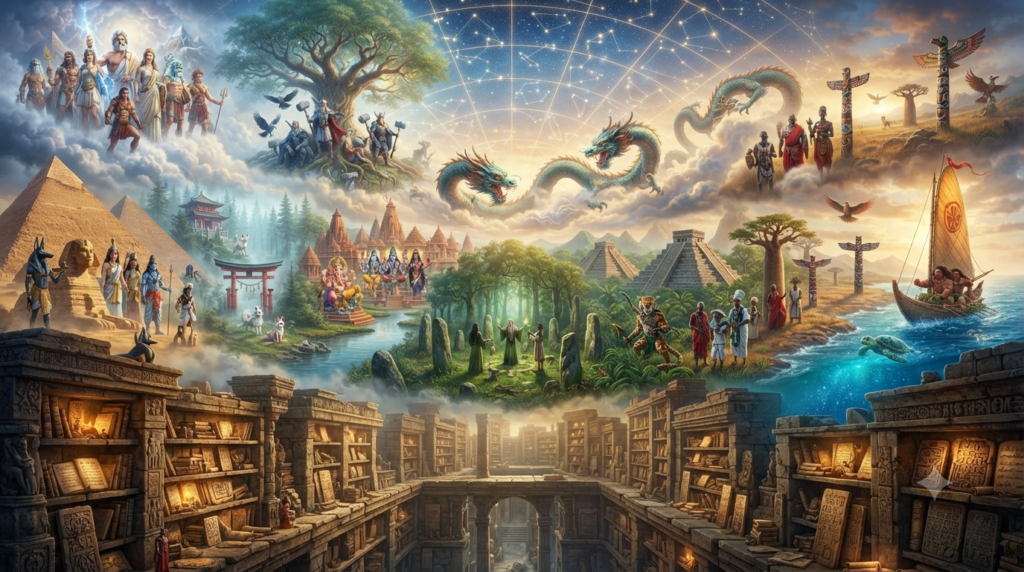
Among the most extensively studied mythological traditions in Western scholarship are the classical mythologies of Greece, Rome, Norse Scandinavia, and ancient Egypt, each possessing substantial surviving textual sources that have enabled detailed academic study and widespread popular familiarity. These traditions represent only a small portion of the broader picture when considering how many mythologies are there worldwide.
Asian mythological traditions contribute enormously to global mythological diversity, including Chinese mythology, Japanese mythology, Hindu mythology, and Thai mythology, each encompassing vast, richly developed systems of narrative, cosmology, and religious belief that rival or exceed the complexity of more commonly referenced Western classical traditions.
The Americas contributed significant mythological traditions as well, including Maya and Aztec mythology, alongside the numerous distinct mythological systems maintained by Indigenous peoples throughout North America, each reflecting specific regional, linguistic, and cultural contexts developed independently across an enormous geographic area.
African mythology represents a particularly striking example of internal diversity relevant to how many mythologies are there, encompassing hundreds of distinct regional and ethnic mythological traditions across the continent, each maintaining its own specific narratives, deities, and cosmological frameworks rather than existing as a single unified African mythological system. Additional significant traditions, including Mesopotamian, Celtic, Slavic, and Polynesian mythology, further expand this already substantial global picture.
Living Mythologies vs. Historical Mythologies
An important distinction relevant to how many mythologies are there involves separating mythological traditions still actively practiced as living religious belief from those that exist primarily as historical or literary material without ongoing religious practice. Traditions such as Hinduism and various forms of Chinese folk religion continue functioning as living mythological and religious systems actively practiced by millions of people today.
By contrast, traditions such as Greek and Norse mythology no longer maintain active religious communities built around their original worship, existing instead primarily as historical, literary, and cultural subjects of study rather than living religious practice. This distinction significantly affects how different mythological traditions are approached, studied, and classified within contemporary scholarship.
This living versus historical distinction adds meaningful nuance to how many mythologies are there, since counting currently practiced belief systems produces a genuinely different number than counting historically significant mythological traditions no longer connected to active worship, even though both categories remain equally legitimate subjects of serious mythological and cultural study.
Recognizing this distinction helps clarify why different sources might offer varying answers when addressing how many mythologies are there, depending on whether the specific inquiry focuses on historically significant narrative traditions broadly or specifically on mythological systems still connected to actively practiced religious belief today.
How Scholars Classify and Count Mythologies
Scholars approaching how many mythologies are there frequently organize mythological traditions by geographic region, grouping related narrative systems according to their originating continent or cultural area, such as European, Asian, African, or American mythology, providing a practical though admittedly broad framework for classification purposes.
An alternative classification approach organizes mythological traditions according to shared linguistic or cultural family relationships, recognizing that certain mythological systems share deeper structural or historical connections beyond simple geographic proximity, such as the broader Indo-European mythological connections linking certain Greek, Norse, and Hindu narrative elements.
The distinction between oral and written mythological traditions presents a significant practical limitation when addressing how many mythologies are there, since traditions preserved primarily through oral transmission before eventual documentation often present greater classification challenges compared to traditions with clearer, continuously maintained written textual records throughout their historical development.
These varied classification approaches demonstrate that answering how many mythologies are there depends significantly on which scholarly framework is applied, reinforcing that this question functions better as an invitation to explore different valid methods of organizing global mythological diversity rather than as a search for one single, universally agreed-upon numerical answer.
Why the Question Still Matters
Exploring how many mythologies are there holds genuine value beyond mere numerical curiosity, encouraging broader recognition of global mythological diversity that extends well beyond the small handful of traditions typically emphasized within standard Western educational contexts, such as Greek and Roman mythology specifically.
This broader recognition proves particularly important for ensuring that less widely represented mythological traditions, including many African, Indigenous American, and smaller regional Asian traditions, receive appropriate scholarly and popular attention alongside more extensively documented classical traditions that have historically dominated Western mythological education and popular media representation.
Approaching how many mythologies are there as an invitation toward broader exploration, rather than a search for a single fixed number, supports a more genuinely comprehensive and respectful engagement with the full scope of human mythological achievement across every inhabited region and culture throughout history.
Ultimately, meaningfully addressing how many mythologies are there requires embracing genuine complexity and diversity rather than seeking artificial numerical simplicity, recognizing that humanity’s mythological heritage represents one of its richest and most varied forms of cultural and intellectual achievement.
FAQ — Quick Answers About the Number of World Mythologies
How many mythologies are there in the world?
There is no exact number, as countless mythological traditions were never formally documented, and mythologies frequently overlap within broader cultural and linguistic families.
Why can’t scholars count mythologies precisely?
Many mythological traditions exist only through oral transmission, were never fully recorded, or overlap significantly with closely related regional traditions, making precise counting impractical.
What are some of the major world mythologies?
Major world mythologies include Greek, Norse, Egyptian, Chinese, Japanese, Hindu, Thai, Maya, Aztec, and numerous African and Indigenous American mythological traditions.
Are all mythologies still practiced today?
No. Some mythologies, like Hinduism and Chinese folk religion, remain actively practiced, while others, like Greek and Norse mythology, exist primarily as historical and cultural traditions.
How do scholars classify different mythologies?
Scholars typically classify mythologies by geographic region, linguistic or cultural family, or by whether they were preserved through oral or written tradition.
Conclusion
Anyone who sets out to answer how many mythologies are there ultimately discovers that the true value of this question lies not in reaching a precise number, but in appreciating the extraordinary diversity of human mythological tradition across every continent and culture throughout history. From well-documented classical traditions to countless smaller, undocumented oral narratives, mythology represents one of humanity’s most universal and varied forms of cultural expression.
Recognizing the distinction between living and historical mythologies, along with the various scholarly approaches used to classify these traditions, provides a far more meaningful framework than pursuing an ultimately unattainable exact count. This broader understanding also encourages greater appreciation for less widely represented mythological traditions deserving of equal scholarly and cultural attention.
Ultimately, how many mythologies are there finds its most honest answer not in a specific figure, but in recognizing that mythology, in some form, has accompanied nearly every human culture throughout history, reflecting a universal impulse to explain existence through story that remains genuinely impossible, and perhaps unnecessary, to reduce to a single number.

Orin Vale has spent the better part of two decades tracing the threads that connect the world’s oldest stories — from the halls of Asgard to the banks of the Nile, from Olympus to the jungles of the Maya. What began as a childhood fascination with flood myths and trickster gods grew into years of independent study across comparative mythology and ancient religion, always chasing the same question: what did these stories mean to the people who first told them? Orin writes for readers who want more than trivia — the ones looking for the beliefs, fears, and truths that myths were built to carry.