Anyone asking what is Thai mythology called quickly discovers that, unlike traditions with a single unifying name such as Norse or Greek mythology, Thailand’s mythological heritage is better understood as a collection of interconnected terms, texts, and traditions rather than one singular named system. In English, the term “Thai mythology” functions as the standard umbrella label used by scholars and general audiences alike, though this broad category actually encompasses specific named texts, cosmological frameworks, and figures drawn from multiple religious and cultural sources. Understanding what is Thai mythology called requires exploring these individual components, each carrying its own name and origin, that together form the broader mythological tradition of Thailand.
Thai Mythology as an Umbrella Term
“Thai mythology” serves primarily as an academic and popular umbrella term describing the broader body of mythological narrative, cosmology, and folklore associated with Thailand, rather than referring to a single, unified mythological system with one specific proper name. This naming pattern distinguishes Thai mythology from traditions like Norse or Greek mythology, which similarly function as umbrella terms but developed with somewhat more internally consistent narrative structures over their respective histories.
This umbrella classification reflects Thailand’s unique cultural and religious history, in which Buddhist cosmology, Hindu-derived narrative traditions, and indigenous local folklore combined over many centuries to produce a genuinely syncretic mythological landscape. Understanding what is Thai mythology called, therefore, requires recognizing that this term intentionally covers a blend of traditions rather than describing a single, self-contained mythological system comparable to more geographically isolated traditions.
Similar umbrella naming patterns appear across other regional mythological traditions, including Chinese mythology, which likewise encompasses multiple distinct religious and philosophical contributions rather than existing as one unified system. This comparative pattern helps contextualize why what is Thai mythology called does not yield a single, simple proper name, reflecting a broader tendency among culturally syncretic traditions to resist singular classification.
Recognizing “Thai mythology” as a functional umbrella term, rather than a specific proper name, provides essential context for exploring the individual texts, cosmological frameworks, and figures that actually constitute this broader mythological tradition, each of which carries its own distinct name and historical origin within Thai culture.
The Ramakien — Thailand’s National Epic
The Ramakien stands as Thailand’s national epic and arguably its single most significant contribution to what is Thai mythology called as a broader tradition, representing a distinctly Thai adaptation of the ancient Indian epic, the Ramayana. This adaptation reworked the original Indian narrative to reflect specifically Thai cultural, artistic, and religious sensibilities while retaining the core narrative structure of the source material.
The Ramakien holds a central position within Thai artistic and cultural life, most notably through its close association with Khon, a traditional masked dance-drama performance that dramatizes episodes from the epic using elaborate costumes, choreography, and musical accompaniment. This performative tradition has helped preserve and popularize the Ramakien across many centuries of Thai cultural history, ensuring its continued relevance within contemporary Thai artistic practice.
Many scholars and cultural commentators consider the Ramakien the single most representative text when addressing what is Thai mythology called, given its deep integration into Thai national identity, royal patronage, and continued artistic performance. Its widespread cultural presence makes it an essential starting point for anyone seeking to understand the specific texts underlying the broader category of Thai mythology.
This central position of the Ramakien illustrates how Thai mythology, despite lacking a single unifying proper name, nonetheless possesses genuinely significant named texts that anchor its broader mythological tradition, with the Ramakien serving as perhaps the clearest, most culturally prominent example available.
Buddhist Cosmology and the Traiphum
Buddhist cosmology contributes significantly to what is Thai mythology called, particularly through the Traiphum Phra Ruang, a foundational Thai Buddhist cosmological text describing the structure of the universe according to traditional Buddhist belief. This text provides essential cosmological context underlying much of Thailand’s broader mythological framework.
The Traiphum describes a cosmological structure centered on the concept of three interconnected realms: the realm of desire, the realm of form, and the formless realm, collectively organizing existence according to traditional Buddhist metaphysical categories. This tripartite cosmological structure significantly shapes how many mythological narratives and figures within Thai tradition are conceptually organized and understood.
This Buddhist cosmological framework demonstrates that what is Thai mythology called extends beyond narrative storytelling alone into structured religious cosmology, providing the underlying metaphysical architecture within which many specific mythological figures and narratives operate throughout Thai cultural and religious tradition.
Understanding the Traiphum’s role within Thai mythology reinforces that this broader tradition draws significantly from Buddhist religious thought alongside its more narrative-focused elements like the Ramakien, further illustrating the syncretic, multi-source nature underlying the umbrella term “Thai mythology” as commonly used today.
Key Figures and Creatures in Thai Mythology
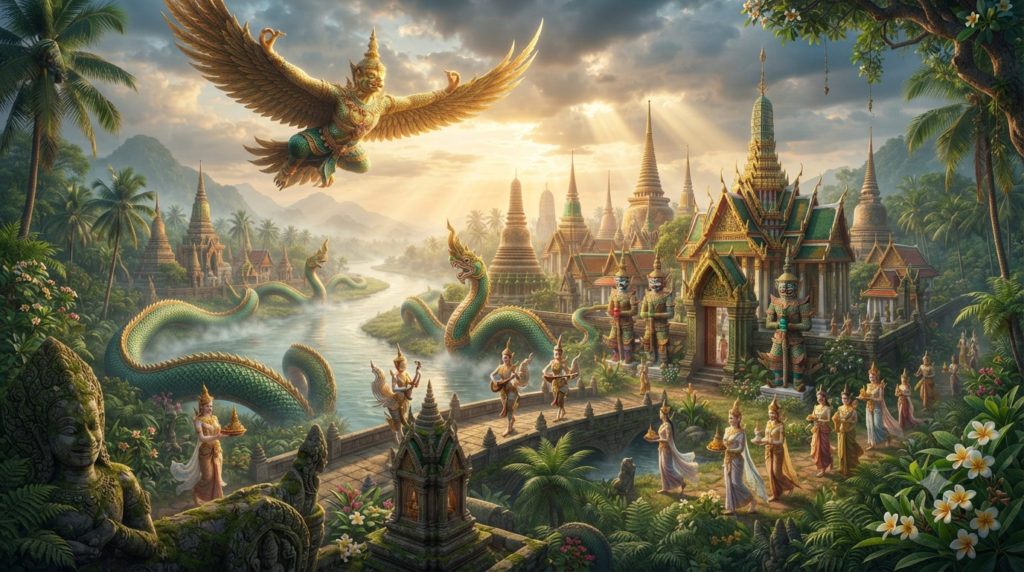
The Naga, a mythical serpent figure present throughout mainland Southeast Asian mythology, occupies a particularly significant position when exploring what is Thai mythology called, appearing prominently within Thai religious architecture, folklore, and popular belief. Nagas are frequently associated with water, protection, and spiritual power within Thai cultural tradition, reflecting their broader regional significance across Southeast Asia.
Garuda, a hybrid eagle-human creature drawn from Hindu-Buddhist mythological tradition, holds particular significance within Thai mythology as a national symbol, appearing prominently in Thai royal and governmental iconography. This adoption of Garuda as national emblem illustrates how thoroughly certain mythological figures have become integrated into contemporary Thai national identity beyond purely religious or narrative contexts.
The mythical forest of Himmapan represents another distinctive element within Thai mythological tradition, described as home to numerous hybrid mythological creatures combining features of different animals in imaginative, symbolically significant combinations. This forest and its inhabitants appear frequently within traditional Thai art and temple decoration, further reinforcing their significance within the broader mythological landscape.
These figures collectively demonstrate that what is Thai mythology called encompasses a rich array of specific named creatures and locations, each carrying distinct cultural and religious significance within Thai tradition, contributing substantially to the broader mythological framework beyond the major narrative texts and cosmological structures already discussed.
Hindu and Brahmanic Influence on Thai Mythology
Brahmanism, an earlier form of Hindu religious tradition, historically played a significant role within Thai royal court practice, particularly regarding coronation rituals, royal ceremony, and certain cosmological concepts that became integrated into broader Thai religious and mythological understanding. This Brahmanic influence represents another crucial thread within what is Thai mythology called as a comprehensive cultural category.
This Hindu and Brahmanic influence coexisted alongside Buddhism, Thailand’s predominant religious tradition, without generating significant religious conflict, instead blending relatively smoothly into a broader syncretic religious and mythological framework characteristic of Thai culture more generally. This peaceful coexistence between different religious influences distinguishes Thai mythology’s development from traditions shaped by more singular religious sources.
The integration of Hindu-derived narrative material, evident most clearly through the Ramakien’s adaptation of the Ramayana, alongside Buddhist cosmological frameworks like the Traiphum, illustrates how thoroughly Thai mythology developed through genuine cross-cultural religious synthesis rather than through a single, isolated religious or narrative tradition.
This layered religious influence reinforces why what is Thai mythology called resists simple, singular classification, reflecting instead a genuinely composite tradition shaped by multiple significant religious and cultural influences that combined over many centuries of Thai cultural development.
Why Thai Mythology Doesn’t Have a Single Fixed Name
The absence of a single, fixed proper name for Thai mythology reflects a broader pattern common among culturally syncretic mythological traditions, which frequently resist simple, singular naming precisely because they developed through the blending of multiple distinct cultural and religious sources rather than emerging from a single, isolated cultural context.
This pattern contrasts somewhat with more geographically isolated mythological traditions, such as Norse mythology, which developed within a more contained cultural and linguistic sphere, allowing for somewhat more straightforward singular naming despite still technically encompassing multiple related narrative sources and historical periods of development.
Understanding what is Thai mythology called, therefore, requires accepting that “Thai mythology” itself represents the most accurate and functional answer available, describing a genuinely composite tradition rather than reflecting any deficiency in naming or classification. This umbrella term accurately captures the syncretic, multi-source nature that fundamentally characterizes Thailand’s mythological heritage.
Recognizing this naming pattern provides valuable context for engaging with Thai mythology more broadly, encouraging exploration of its specific constituent texts, figures, and cosmological frameworks rather than searching for a single, more specific proper name that would inaccurately simplify this genuinely rich and multifaceted cultural tradition.
FAQ — Quick Answers About Thai Mythology
What is Thai mythology called?
Thai mythology is the standard umbrella term used to describe Thailand’s mythological tradition, which combines Buddhist cosmology, Hindu-derived narrative, and local folklore rather than existing under one single proper name.
What is the Ramakien?
The Ramakien is Thailand’s national epic, a Thai adaptation of the Indian Ramayana, central to Thai art, culture, and the traditional Khon dance-drama performance.
What is the Traiphum?
The Traiphum Phra Ruang is a foundational Thai Buddhist cosmological text describing the structure of the universe through three interconnected realms of existence.
What creatures appear in Thai mythology?
Key figures in Thai mythology include the Naga, a serpent associated with water and protection, and Garuda, a hybrid eagle-human creature serving as a national symbol.
Is Thai mythology based on Buddhism or Hinduism?
Thai mythology draws from both traditions, blending Buddhist cosmology with Hindu-derived narrative and Brahmanic royal court practices alongside local Thai folklore.
Conclusion
Anyone who sets out to answer what is Thai mythology called finds that “Thai mythology” itself remains the most accurate umbrella term available, describing a genuinely syncretic tradition built from the Ramakien’s Hindu-derived narrative, the Traiphum’s Buddhist cosmology, and figures like Naga and Garuda drawn from shared Southeast Asian mythological heritage.
This composite structure, rather than representing a gap in naming, reflects Thailand’s unique cultural history of blending Buddhist, Hindu, and indigenous influences into a cohesive, if multifaceted, mythological tradition. Understanding this composite nature offers far more insight than searching for a single alternative name that simply does not exist.
Ultimately, what is Thai mythology called finds its clearest answer not in a single proper noun, but in appreciating the rich collection of named texts, cosmological frameworks, and mythological figures that together define one of Southeast Asia’s most culturally significant mythological traditions.

Orin Vale has spent the better part of two decades tracing the threads that connect the world’s oldest stories — from the halls of Asgard to the banks of the Nile, from Olympus to the jungles of the Maya. What began as a childhood fascination with flood myths and trickster gods grew into years of independent study across comparative mythology and ancient religion, always chasing the same question: what did these stories mean to the people who first told them? Orin writes for readers who want more than trivia — the ones looking for the beliefs, fears, and truths that myths were built to carry.