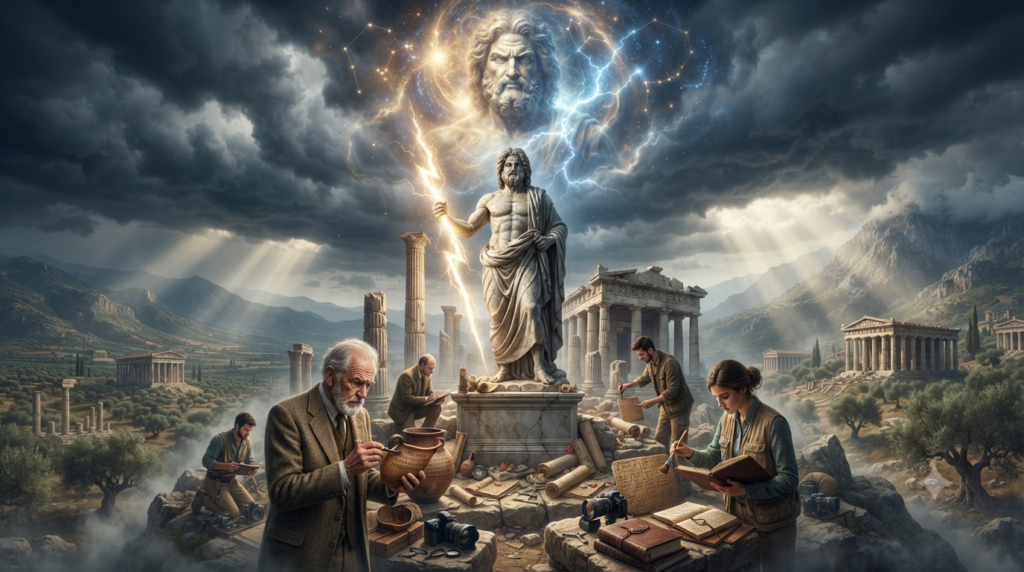
Anyone asking does Zeus exist is actually asking a question that shifts meaning considerably depending on the specific type of answer being sought. From a historical and academic perspective, Zeus is understood as a central figure of ancient Greek religion without empirical evidence supporting his literal existence as a deity. Yet for practitioners of modern Hellenism, Zeus remains a genuinely worshipped, living religious figure today. Understanding does Zeus exist requires separating these different dimensions of the question rather than collapsing them into a single, oversimplified answer that fails to respect either historical scholarship or genuine contemporary religious belief.
The Historical and Academic Perspective
Historians and archaeologists studying ancient Greek religion approach does Zeus exist primarily as a question about belief and practice rather than literal divine existence, documenting extensively how Zeus functioned as the central deity within ancient Greek religious life without claiming any empirical evidence confirming his actual, literal existence as a supernatural being.
This academic approach draws an important distinction relevant to does Zeus exist: historians can confidently confirm that belief in Zeus was genuinely, extensively practiced throughout ancient Greece, supported by substantial archaeological and textual evidence, while remaining entirely separate from any claim regarding whether Zeus actually exists as a real, literal divine entity.
This distinction between documented historical belief and metaphysical reality applies consistently across how historians and archaeologists approach virtually every ancient deity, meaning Zeus receives no different treatment in this regard compared to other historical religious figures studied within comparative religion and ancient history more broadly.
Understanding this academic framing provides essential context for does Zeus exist, clarifying that mainstream historical and archaeological scholarship neither confirms nor definitively denies Zeus’s literal existence, instead focusing specifically on documenting the genuine historical reality of ancient Greek religious belief and practice surrounding him.
Zeus as a Living Belief — Modern Hellenism
Beyond historical study, does Zeus exist carries genuine contemporary significance for practitioners of modern Hellenism, a revived religious movement in which Zeus remains an actively worshipped deity today, reflecting real, sincere religious belief rather than purely historical or academic interest in ancient Greek mythology.
For these modern practitioners, Zeus represents a genuine, living religious figure, approached through actual worship, ritual practice, and theological conviction, meaning that for this specific community, does Zeus exist receives a clear, sincerely held affirmative answer grounded in authentic contemporary religious faith and practice.
This modern religious dimension deserves the same genuine respect typically extended to any actively practiced religious belief, recognizing that questions of divine existence ultimately involve personal faith and conviction that extend well beyond what historical or scientific evidence alone can definitively confirm or deny for any religious tradition.
Acknowledging this living religious dimension provides essential balance when addressing does Zeus exist, ensuring that genuine contemporary belief receives appropriate recognition alongside historical and academic perspectives, rather than treating Zeus purely as a closed historical or literary subject disconnected from any present-day religious relevance.
Why “Does X God Exist” Is Ultimately a Question of Faith
Questions regarding whether any specific deity genuinely exists, including does Zeus exist, ultimately extend beyond what historical documentation or scientific method can definitively answer, since these disciplines can confirm what people have believed and practiced without being equipped to settle deeper metaphysical questions regarding divine reality itself.
This limitation applies consistently across virtually every religious tradition, meaning does Zeus exist faces the same fundamental epistemological challenge encountered when addressing similar existence questions about any deity from any religious or mythological tradition, ancient or contemporary, rather than representing a uniquely unanswerable question specific to Greek mythology alone.
Recognizing this broader pattern helps clarify why does Zeus exist cannot receive a simple, universally satisfying answer through historical or scientific means alone, since these disciplines are specifically designed to examine observable evidence and documented practice rather than to adjudicate ultimate metaphysical or theological truth claims.
This distinction between historically verifiable questions, such as whether a belief was practiced, and metaphysical questions, such as whether a deity truly exists, remains essential for thoughtfully addressing does Zeus exist without overstepping what any single academic discipline can genuinely and responsibly claim to determine.
How to Think About This Question Respectfully
Approaching does Zeus exist thoughtfully means holding multiple valid perspectives simultaneously: genuine historical documentation of ancient and ongoing belief, sincere contemporary religious conviction among modern practitioners, and honest acknowledgment of the philosophical limits regarding what can be definitively proven about any deity’s ultimate existence.
This balanced approach avoids both dismissively treating Zeus as purely fictional, which would disrespect genuine contemporary religious practitioners, and asserting definitive proof of his literal existence, which would overstate what historical and scientific evidence can actually support regarding this or any comparable religious question.
Readers encountering does Zeus exist are ultimately invited to distinguish clearly between historical and cultural curiosity, which this discussion can meaningfully inform, and personal conviction regarding divine reality, which remains a matter of individual faith, philosophy, and conscience that extends well beyond any single article’s capacity to resolve.
This respectful, multi-perspective approach to does Zeus exist reflects the same careful balance appropriate for addressing similar existence questions about any religious tradition, ancient or modern, ensuring genuine intellectual honesty without dismissing sincere belief held by real people today.
FAQ — Quick Answers About This Question
Does Zeus exist?
This depends on the type of question being asked: historically, Zeus is documented as a genuinely worshipped deity; for modern Hellenic practitioners, he remains a living object of sincere faith today.
Is there scientific evidence that Zeus exists?
No, there is no empirical or scientific evidence confirming Zeus’s literal existence, consistent with how science approaches claims about any deity.
Do people still worship Zeus today?
Yes, practitioners of modern Hellenism actively worship Zeus as part of a genuine, revived religious tradition in the present day.
Is asking if Zeus exists different from asking about other gods?
No, this same fundamental question and its limitations apply consistently across virtually every deity from any religious or mythological tradition.
Can historians prove or disprove Zeus’s existence?
No, historians can document belief and practice surrounding Zeus, but questions of literal divine existence extend beyond what historical evidence can settle.
Conclusion
Anyone who sets out to answer does Zeus exist finds that the honest response depends entirely on which dimension of the question is being addressed. Historically, Zeus is thoroughly documented as central to ancient Greek religious life; for modern Hellenic practitioners, he remains a genuinely worshipped deity today; and philosophically, questions of divine existence ultimately extend beyond what any single discipline can definitively resolve.
This layered answer reflects genuine intellectual honesty rather than avoidance, recognizing that historical scholarship, contemporary religious practice, and personal philosophical conviction each offer legitimate, distinct perspectives on this genuinely complex question.
Ultimately, does Zeus exist remains a question each reader must engage with according to their own values, curiosity, and convictions, informed by historical understanding and respectful awareness of genuine, living belief, rather than settled by any single, universally binding answer.

Orin Vale has spent the better part of two decades tracing the threads that connect the world’s oldest stories — from the halls of Asgard to the banks of the Nile, from Olympus to the jungles of the Maya. What began as a childhood fascination with flood myths and trickster gods grew into years of independent study across comparative mythology and ancient religion, always chasing the same question: what did these stories mean to the people who first told them? Orin writes for readers who want more than trivia — the ones looking for the beliefs, fears, and truths that myths were built to carry.