In the Odyssey, the hawk is not a casual detail of the landscape but a charged sign within the poem’s language of divine communication. Homer presents birds of prey as omens that can reveal the will of Zeus, and the hawk in particular belongs to that world of interpreted signs. It is a creature of swift violence and sharp vision, suited to an epic in which hidden justice moves quietly beneath the surface of human action.
Hawk omens in Homeric Greek epic tradition
In Homeric epic, birds often function as more than animals: they are carriers of meaning, especially when they appear in moments of tension or decision. The Greeks of the poem lived in a world where signs from the sky could be read as messages from the gods, and birds of prey were among the most potent of those signs. A hawk’s sudden appearance, flight pattern, or cry might be understood as an augury, especially when it coincided with prayer, sacrifice, or political assembly.
The Odyssey inherits this epic habit from the wider Homeric tradition. Homer does not treat every bird as symbolic in the same way, but hawks and eagles often stand near the border between the natural and the divine. Their behavior can suggest that a larger power is at work, and the poem repeatedly uses that assumption to shape the reader’s understanding of fate, judgment, and the gods’ unseen supervision of mortal affairs.
The bird sign sent by Zeus in the Odyssey
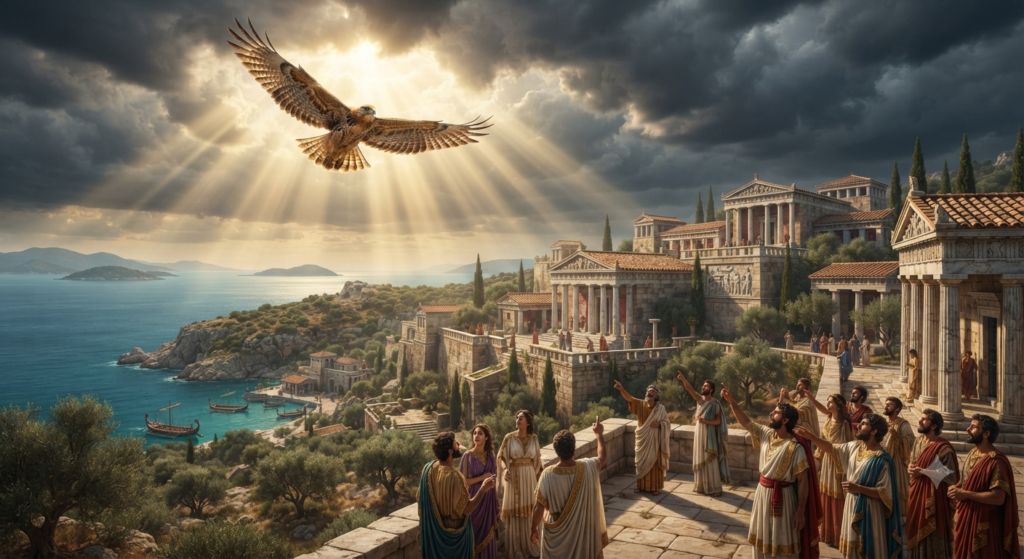
One of the clearest hawk omens in the Odyssey appears in Book 15, when a bird of prey is sent as a sign after Telemachus receives advice about his homecoming. The text describes an eagle carrying a dove in its claws, and the omen is interpreted immediately as a favorable message from Zeus. This scene matters because Homer gives the sign and its meaning in close sequence: the gods do not merely exist in the background, but actively confirm the path that events are taking.
Although the bird is often described in translations as an eagle rather than a hawk, Homeric Greek can use broad terms for birds of prey, and ancient readers would have recognized the family resemblance in function. What matters in the poem is not ornithological precision but divine authorization. The omen signals that the return of Odysseus and the restoration of order in Ithaca are under Zeus’s oversight, even if the human characters do not yet understand the full design.
Hawks, eagles, and other divine messengers
In Homer, hawks do not stand alone; they belong to a larger system of avian signs that includes eagles, vultures, and other birds associated with divine speech. The eagle is especially linked to Zeus, who is the king of the gods and the source of many portents. Hawks can appear with similar force, as birds of prey whose hunting nature makes them fitting images for power, pursuit, and judgment.
This wider network of signs helps explain why Homeric audiences would read a hawk differently from an ordinary bird. The creature’s speed and predatory focus make it an image of sudden divine intervention, while its appearance in a crucial scene encourages interpretation. In epic, such birds are never random decoration; they belong to a sacred grammar through which the gods allow mortals to glimpse what is coming.
Telemachus and the reading of avian signs
Telemachus is one of the few characters in the Odyssey who grows into an ability to interpret the world as his father does, and birds are part of that education. He begins the poem uncertain and passive, but his journey toward maturity includes exposure to signs, speeches, and forms of knowledge that belong to kings and heroes. The recognition of a bird omen becomes part of that larger transformation.
When an avian sign appears around Telemachus, it reinforces the poem’s interest in inherited discernment. He does not simply witness a wonder; he learns that the world can be read. This is important because the Odyssey repeatedly contrasts those who understand divine signals with those who ignore them, and Telemachus is moving toward the former group. His development mirrors the poem’s own belief that wisdom includes the ability to notice what the gods are saying through the natural world.
How Homer uses augury to guide the plot
Homer’s use of augury is not ornamental. Bird signs help arrange the sequence of the Odyssey by confirming decisions, anticipating reversals, and preparing the audience for outcomes that the characters cannot yet see. The poem’s action often advances by delay, recognition, and return, and omens fit that structure because they compress future truth into a present sign.
A hawk or eagle can therefore function as a narrative hinge. It marks a point where uncertainty gives way to pattern, where private hopes are validated by a cosmic order. Homer does not overexplain these moments; instead, he allows the sign and its interpretation to stand with ritual weight, letting the audience feel that the plot is moving in harmony with Zeus’s larger governance.
Hawk imagery and the authority of Olympus
The hawk in the Odyssey also contributes to the poem’s atmosphere of Olympian authority. Birds of prey belong to the sky, the domain above human struggle, and that vertical relation matters in Homer. What descends from above often carries judgment, approval, or warning, and the hawk’s sudden presence can therefore suggest that Olympus is watching closely.
This is especially meaningful in a poem where human beings frequently act as if they were alone, only to discover that their choices are embedded in divine plans. The hawk becomes a visual reminder of that hierarchy. Its flight implies distance, mastery, and control, qualities associated with Zeus’s rule and with the broader order that keeps the world from collapsing into mere human appetite.
The suitors, fate, and hostile portents
The suitors in Ithaca live under signs they do not fully respect, and this helps make their destruction feel not only violent but fated. Homer surrounds them with warnings, prophetic speech, and hostile portents that they dismiss or misread. Bird signs belong to that pattern, suggesting that the house they occupy is already under judgment.
A hawk, as a bird of prey, is especially suited to this atmosphere of threatened retribution. Even when the poem does not name a hawk in every ominous scene, predatory birds fit the moral logic of the suitors’ fate: those who consume Odysseus’s estate and abuse hospitality are themselves subject to a higher and more terrible justice. In Homeric terms, the bird of prey becomes an image of the reckoning awaiting them.
Birds of prey in ancient Greek divination
Ancient Greek divination included many forms, from sacrifice and the inspection of entrails to the reading of bird movements. Birds of prey held a special place because of their height, speed, and apparent independence from human control. Their behavior seemed to emerge from a realm that human beings could not command, making them suitable vehicles for divine communication.
The Odyssey reflects this divinatory culture without turning into a manual of augury. Homer assumes that his audience knows such signs matter. A hawk in this context is not merely a natural predator but a participant in a religious system in which the gods can communicate through visible phenomena. That belief gives the poem part of its power: reality is never flat, because every motion in the sky may carry significance.
Comparing the hawk with the eagle motif
The hawk and eagle are closely related in Homeric imagination, but they are not identical in emphasis. The eagle is the more overtly royal and Zeus-linked bird, often used for unmistakable divine endorsement. The hawk can feel narrower, swifter, and more piercing, an emblem of pursuit rather than majesty alone. Both birds of prey can announce the gods, but they do so with slightly different accents.
In the Odyssey, this distinction helps the poem vary its symbolic language. Where the eagle may suggest broad authority and celestial sanction, the hawk can sharpen the image of imminent action. Together, these birds of prey reinforce Homer’s habit of making the heavens legible through living creatures. Their shared presence shows that divine communication in epic is not limited to one species or one sign, but works through a whole vocabulary of aerial power.
What the hawk reveals about divine intervention
The hawk in the Odyssey reveals that divine intervention in Homer is often indirect, visible only to those willing to interpret it. The gods do not always appear in person; sometimes they speak through flight, shape, and timing. A hawk therefore stands at the edge of revelation, a small but forceful sign that the human world is not self-governing.
Its role also clarifies the poem’s moral structure. The return of Odysseus, the testing of Telemachus, and the downfall of the suitors are not random events but parts of a world ordered by Zeus and recognized through signs. The hawk is one of those signs: swift, watchful, and severe, a reminder that in the Odyssey, the sky itself can become a messenger of fate.
In Homer’s epic world, the hawk is a compact symbol of divine awareness and impending judgment. It belongs to the same sacred language as the eagle and other birds of prey, carrying the force of augury into the human story of Odysseus, Telemachus, and the suitors of Ithaca.
Its presence shows how the Odyssey links nature, fate, and Olympus. When a hawk appears, the poem invites its audience to see beyond surface action and recognize that Zeus’s order is already moving through the world.

Orin Vale has spent the better part of two decades tracing the threads that connect the world’s oldest stories — from the halls of Asgard to the banks of the Nile, from Olympus to the jungles of the Maya. What began as a childhood fascination with flood myths and trickster gods grew into years of independent study across comparative mythology and ancient religion, always chasing the same question: what did these stories mean to the people who first told them? Orin writes for readers who want more than trivia — the ones looking for the beliefs, fears, and truths that myths were built to carry.