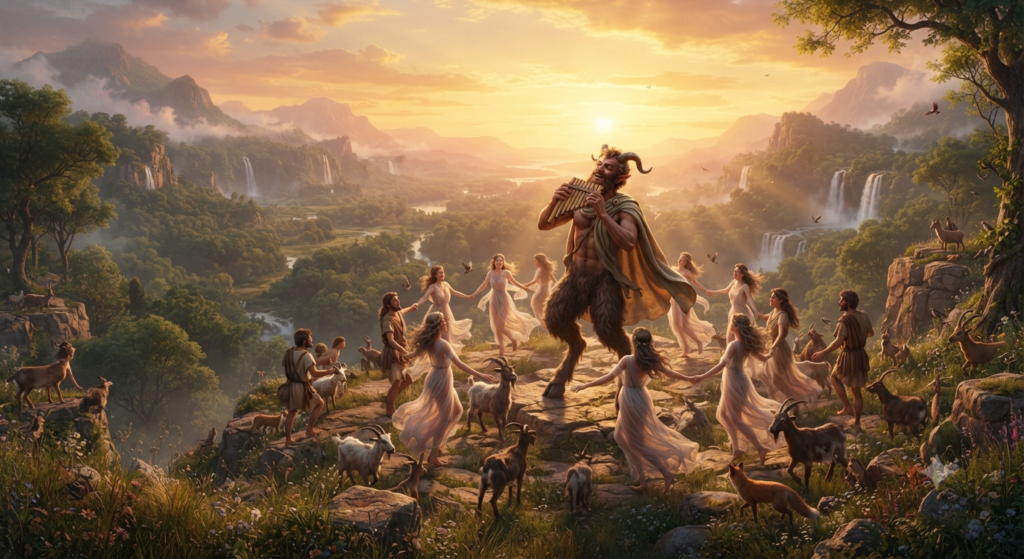
The Homeric Hymn to Pan is a brief but vivid Greek poem devoted to the rustic god Pan, the wild, goat-footed divinity of mountains, flocks, shepherds, and untamed nature. It is not an epic narrative in the style of Homer’s Iliad or Odyssey, but one of the so-called Homeric Hymns, a collection of archaic and early classical hymns sung in honor of the gods. In Pan’s case, the poem presents him as a deity whose power is felt far beyond his small place in the Olympian family: he is local to Arcadia, yet his influence reaches into music, fear, fertility, and the hidden life of the wilderness.
===INTRO: The hymn is especially important because it shows how the Greeks understood Pan as both charming and unsettling. He is a companion of shepherds and nymphs, a maker of reed music, and also a source of sudden terror in lonely places and on the battlefield. Through Pan, the hymn связывает the pastoral landscape with divine presence, making the mountains and caves of Arcadia feel alive with sacred force.
Pan in the Homeric Hymn and Arcadian cult
The Homeric Hymn to Pan is closely tied to Arcadia, the mountainous inland region of the central Peloponnese that became famous in Greek literature as a land of shepherds, wild slopes, and old local cults. Pan is presented as a god who belongs naturally to this terrain. Ancient sources associate him especially with Arcadian worship, though later his cult spread widely through the Greek world. The hymn preserves this local identity by emphasizing his rustic character rather than any grand Olympian role.
This Arcadian setting matters because Pan is not a polished city god. He belongs to the edges of civilization, where flocks graze and hunters move through rough country. In that sense, the hymn reflects a real feature of Greek religion: many gods were not only worshiped in major sanctuaries but also in local landscapes that shaped their character. Pan’s hymn turns Arcadia itself into sacred ground.
The rustic god behind the pastoral landscape
Pan is the divine embodiment of the pastoral world. In Greek imagination, he presides over mountains, caves, groves, and the lives of herdsmen who depend on the open land. The hymn’s portrait of him is not abstract. It evokes the daily realities of rustic life: grazing animals, isolated paths, and the sounds of pipes in the hills. Pan is therefore both a god of place and a god of experience.
At the same time, he stands for a more primal nature than the orderly world of the polis. Later Greek and Roman writers often linked him with the untamed, fertile energies of the countryside. That does not make him merely a symbol; in religious terms, he was believed to be active in these settings. The hymn captures this by treating the landscape itself as the field of Pan’s power.
Hermes, Pan’s birth, and his uncanny form
The hymn gives Pan a striking genealogy: he is the son of Hermes and a nymph, usually identified as Dryope in the poem’s tradition. The story is notable because Pan’s birth is strange even by mythic standards. Hermes brings the child to Olympus, and the gods are delighted by the sight of him. His appearance is unmistakably non-human: he has goat-like features, a shaggy body, and a wild, liminal nature that places him between the human and the animal.
That uncanny form is part of his meaning. Greek mythology often marks divine difference through physical hybridity, and Pan is one of the clearest examples. His goat legs and horns are not accidental details but signs of his domain. He is a god of boundaries, neither fully civilized nor fully bestial, and the hymn uses his birth to explain why he belongs to the margins where such distinctions blur.
Mountain herds, pipes, and shepherd song
Pan is inseparable from the reed pipes, or syrinx, that later tradition strongly associates with him. In the hymn, his musical presence is part of what makes him dear to rustic communities. Shepherd song, played in the open air, is one of the most recognizable forms of his worship and companionship. Pan is not a god of formal lyre music like Apollo; his sound is rougher, closer to the wind through reeds and the lonely music of the hills.
The connection to herds is just as important. Pan protects flocks and moves among goats and sheep as though he belongs to them. This makes him deeply pastoral, but not in a sentimental sense. The hymn suggests a world in which music, animals, and divinity are interwoven. Pan’s pipes are not mere entertainment; they are part of the sacred atmosphere of the shepherd’s life.
Panic in battle and the god’s sudden terror
Although Pan is a rural deity, Greek tradition also linked him to sudden fear, especially the overwhelming terror that can seize individuals or armies. The English word “panic” comes from his name, reflecting this ancient idea. The hymn does not develop the battlefield aspect in full detail, but it belongs to Pan’s wider mythic character and to the way Greeks understood his force. He can inspire delight in the hills and dread in lonely or exposed places.
This fear is not random. Pan is a god of the untamed, and the untamed can unsettle human order. In Greek thought, terror often had a divine source, and Pan was one of the clearest faces of that experience. His presence in wild terrain could charm shepherds, yet in another context it could unnerve travelers, hunters, or soldiers. The hymn’s portrait leaves room for both moods.
Nymphs, desire, and Pan’s wild woodland realm
Pan’s relationship to nymphs is central to his mythology. These female nature spirits belong to springs, woods, and remote places, and Pan often pursues them with desire. The hymn’s broader rustic atmosphere reflects this world of attraction, movement, and elusive woodland life. In later myth, the story of Syrinx becomes especially important, since Pan’s pursuit and the transformation of the nymph into reeds explain the origin of his instrument in some traditions.
The presence of nymphs also shows that Pan’s domain is fertile as well as wild. Greek religion often treats wilderness not as empty space but as inhabited by divine and semi-divine beings. Pan’s landscape is charged with life, sexuality, and metamorphosis. He belongs to the same natural world as the nymphs, and the hymn situates him within that charged, living environment.
The cave of Pan on rugged Arcadian slopes
Caves are one of Pan’s most characteristic places. The hymn and later tradition both place him in rough mountain interiors, where a cave can serve as shrine, dwelling, or meeting place with nymphs. Such locations were important in Greek cult, especially for deities tied to the earth, fertility, or hidden powers. Pan’s cave is not merely a backdrop; it is a fitting expression of his nature.
Arcadian slopes with caves and rocky passages create the right setting for a god who is neither fully domestic nor fully savage. The cave symbolizes retreat, secrecy, and ancient presence. It also reinforces Pan’s connection to the unseen life of the land. In the hymn, this setting helps make his divinity feel immediate and local, rooted in a landscape that seems older than human settlement.
How the hymn presents divine favor and awe
The Homeric Hymn to Pan presents the god as deeply favored by Hermes and welcomed by the other gods, despite his unusual appearance. This is significant: Pan is not treated as a monster or outsider, but as a divinity whose strangeness is accepted and even celebrated. The poem expresses awe without hostility, showing that the gods recognize value in forms that humans might find rough or unsettling.
That combination of favor and awe is central to the hymn’s religious tone. It does not simply describe Pan; it makes him worthy of reverence. The poem implies that divine power often appears in unfamiliar shapes. Pan’s goat-like body, mountain haunts, and music are all signs of a sacred presence that does not fit into urban ideals. The hymn teaches recognition as much as devotion.
Pan’s place among the Olympian divine circle
Pan is not usually counted among the Twelve Olympians, and the hymn does not try to place him at the center of divine politics. Yet he is clearly connected to the Olympian world through his parentage and reception by the gods. Hermes, his father, links him to divine movement, boundaries, and communication. Pan is thus part of the wider Olympian family, even if he remains outside the formal circle of major state gods.
That position suits his character. Pan is a god of edges, not thrones. His power is local, immediate, and bodily rather than institutional. Still, the hymn shows that such a god matters. Greek religion made room for divinities who governed specific experiences and landscapes, and Pan is a strong example of that flexibility. He belongs to the divine order without losing his wildness.
What the Homeric Hymn reveals about Greek religion
What the Homeric Hymn to Pan is about, at its core, is the sacred life of the countryside and the divine force hidden within untamed nature. It presents Pan as a god of mountains, shepherds, pipes, caves, desire, and sudden fear, while also grounding him in Arcadian cult and in the mythic world of Hermes and the nymphs. The poem is short, but it condenses a great deal of Greek religious imagination into a single figure.
The hymn also reveals how Greek religion could honor local gods whose power was felt in lived environments rather than in grand theological systems. Pan is not a distant cosmic ruler. He is encountered in wind, song, flocks, and remote places where human order thins out. The poem’s lasting importance lies in that vision: divinity is present not only in temples and cities, but in the wild hills where a shepherd hears pipes in the distance.

Orin Vale has spent the better part of two decades tracing the threads that connect the world’s oldest stories — from the halls of Asgard to the banks of the Nile, from Olympus to the jungles of the Maya. What began as a childhood fascination with flood myths and trickster gods grew into years of independent study across comparative mythology and ancient religion, always chasing the same question: what did these stories mean to the people who first told them? Orin writes for readers who want more than trivia — the ones looking for the beliefs, fears, and truths that myths were built to carry.