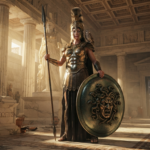
The Greek word for truth is aletheia (ἀλήθεια), a term that carries a meaning richer than simple factual correctness. In Greek thought, it could suggest truth as something revealed, uncovered, or brought out of concealment. That depth is one reason the word has remained important in discussions of language, philosophy, and ancient culture. In the world of Homer, Hesiod, and the later philosophers, aletheia stood close to the border between what is seen and what is hidden, between speech and reality.
Aletheia in Greek: the word for truth
Aletheia is the standard ancient Greek word for truth, and it appears across a wide range of Greek literature. It is not the name of a goddess here, but a common noun used to describe what is real, what is said honestly, or what is not concealed. In everyday usage, it could refer to truthful speech, while in philosophical writing it grew into a far more complex idea.
The word belongs to the core vocabulary of Greek thought. When Greek authors spoke of truth, they were not only asking whether a statement matched a fact. They were also asking whether something had been brought into the open, made evident, or stripped of illusion. That layered sense gives aletheia its enduring force.
Meaning and roots of Aletheia in Greek
The form aletheia is usually explained through its connection to Greek lethe, meaning forgetfulness or oblivion, with the privative prefix a- indicating negation. In this traditional interpretation, the word suggests “not hidden” or “not forgotten.” That etymology has deeply influenced later readings of the term, especially in philosophy.
Scholars do note that ancient etymology and modern linguistic explanation are not always identical, yet the association between truth and uncovering is firmly rooted in Greek usage. Whether in poetry or prose, aletheia often points toward what emerges from concealment into clarity. The word therefore carries both a linguistic and a symbolic resonance in Greek culture.
Truth, disclosure, and the hidden in Aletheia
In Greek thought, truth was often tied to disclosure rather than abstraction alone. Something true was something that had been shown as it really was, without concealment or distortion. This makes aletheia more active than a simple dictionary equivalent; it is truth as revelation, not only truth as correctness.
That relationship to the hidden appears in many Greek contexts. A secret may be concealed, a god may reveal a sign, a speaker may tell the truth, and a fact may come to light. All of these can fall under the larger sphere of aletheia, which suggests the movement from obscurity into presence.
How ancient writers used Aletheia in context
Ancient writers used aletheia in ordinary and elevated ways alike. A speaker might claim to tell the truth in a legal or moral sense, while a poet might invoke truth as something that stands apart from deception. The word appears in contexts of testimony, witness, and sincere speech, where reliability matters.
At the same time, Greek literature often sets truth against appearance, rumor, or misleading speech. The distinction is not always rigid, but it is central. Writers could present aletheia as what remains when error, falsehood, and illusion are stripped away, making the term vital to both narrative and argument.
Aletheia in Homeric and classical Greek texts
In Homeric Greek, truth is less abstract than in later philosophy, yet the language of honesty and reality is already present. Homeric heroes are judged by what they say and what they do, and speech can be tested against event and evidence. While the exact philosophical weight of aletheia develops later, the epic world already values truthful account over deceptive report.
By the classical period, the term becomes more explicit and more technical. In prose, drama, and history, aletheia can describe accurate narration, factual speech, or the reliable report of events. Herodotus, Thucydides, and the tragedians all work in a world where truth is essential, though often difficult to secure.
Philosophical ideas shaped by the word Aletheia
The Greek philosophers gave aletheia a lasting place in Western thought. For thinkers such as Plato and later Aristotle, truth became a subject of analysis, not merely a moral virtue. Plato often contrasts truth with appearance, opinion, and illusion, while Aristotle treats truth in relation to statement and reality.
Later philosophy deepened the term further. In some traditions, especially much later interpretation of Greek thought, aletheia is understood as unconcealment, the process by which being is revealed. That philosophical path did not belong to all ancient Greeks in the same way, but it grew from the original Greek sense of truth as something disclosed rather than invented.
Aletheia and the Greek view of reality
Greek culture often treated reality as something that could be partially hidden from human beings. Gods, fate, omens, and shifting appearances all complicated the search for certainty. Within that world, aletheia marked the moment when what is real becomes visible or knowable.
This view helped shape Greek ideas about wisdom and judgment. To know reality was not simply to collect information. It was to see through disguises, interpret signs correctly, and distinguish what is stable from what only seems true. Aletheia therefore stands close to the Greek effort to understand the world as it is, not as it merely appears.
Distinguishing truth from falsehood in Greek
Greek authors frequently contrast truth with falsehood, deception, and misleading speech. The language of lies, trickery, and illusion appears throughout myth and literature, from the clever disguises of gods to the false claims of human speakers. Against that background, aletheia becomes a marker of trust and credibility.
This distinction also carries moral weight. A truthful speaker is not simply accurate; in many contexts, truthfulness implies integrity and reliability. Falsehood can damage community, justice, and memory, while aletheia supports them. Greek culture thus treated truth as something both intellectual and ethical.
The Latin veritas and Greek aletheia compared
The Latin veritas and the Greek aletheia are often translated as “truth,” but they are not identical in flavor. Veritas tends to carry a stronger sense of correctness, reliability, and factual truth in later Roman and European usage. Aletheia, by contrast, often suggests uncovering, disclosure, and the removal of concealment.
Both words became central in their own traditions, yet they emphasize different aspects of the same idea. Where veritas may point more to faithful correspondence, aletheia often preserves the drama of truth coming into view. That difference helps explain why Greek discussions of truth have remained so influential in philosophy and literary studies.
Why Aletheia still matters in Greek heritage
Aletheia remains one of the most meaningful Greek words because it preserves an ancient way of thinking about truth. It reminds us that truth is not only a statement but also an event of revelation, a lifting of the veil. That idea still resonates in modern discussions of history, memory, and knowledge.
As part of Greek heritage, the word connects language, poetry, and philosophy. It appears in the same cultural world that produced Homeric epic, tragic drama, and classical inquiry, and it continues to shape how Greek civilization is understood. In that sense, aletheia is more than a term; it is a lasting expression of the Greek pursuit of what is real.
The Greek word aletheia endures because it speaks to a truth that is uncovered, not merely asserted. From epic poetry to philosophy, it reflects a culture deeply attentive to what is hidden, what is revealed, and what can be trusted. That layered meaning is one reason the word still stands at the center of Greek linguistic and intellectual heritage.

Orin Vale has spent the better part of two decades tracing the threads that connect the world’s oldest stories — from the halls of Asgard to the banks of the Nile, from Olympus to the jungles of the Maya. What began as a childhood fascination with flood myths and trickster gods grew into years of independent study across comparative mythology and ancient religion, always chasing the same question: what did these stories mean to the people who first told them? Orin writes for readers who want more than trivia — the ones looking for the beliefs, fears, and truths that myths were built to carry.