Hermes in the Odyssey is far more than a decorative divine presence. He is the swift messenger of the Olympian gods, the one who carries Zeus’s commands across the boundary between heaven and the human world, and he appears at decisive moments when Odysseus’ journey seems trapped by divine obstruction. In Homer’s poem, Hermes does not dominate the action, but when he enters it, the balance of power shifts.
His role is especially important because the Odyssey is a story about mediation: between gods and mortals, danger and survival, wandering and homecoming, concealment and revelation. Hermes embodies that in his own nature. He is fleet, eloquent, and difficult to contain, a god whose presence often signals that divine will is moving in the world of men.
Hermes as divine messenger in Homer’s Odyssey
In Homer’s Odyssey, Hermes functions first and foremost as the messenger of Zeus and the Olympian order. He is the god who receives a command and delivers it without hesitation, crossing from Olympus to the places where mortals are held in suspense by divine decisions. Homer often marks him by speed and certainty, qualities that distinguish him from the other gods who debate, resist, or delay.
That messenger function matters because the poem repeatedly shows Odysseus’ fate depending on the will of higher powers. Hermes is not the source of those decrees, but he is the one who makes them effective in the mortal world. Through him, Zeus’s authority becomes visible and audible, turning abstract divine intention into action that affects islands, captors, and seafarers.
The gods’ secret guide between Olympus and Ithaca
Hermes moves between worlds with unusual freedom. In the Odyssey, that mobility makes him a kind of secret guide, one who can pass from Olympus to remote places at the edges of the sea without friction. He is not the household god of Ithaca in the poem, yet his interventions help orient the story toward the home Odysseus seeks.
This movement between divine and mortal spaces also reflects Hermes’ older character in Greek religion and myth. He belongs to thresholds, roads, boundaries, and crossings, which makes him especially fitting for a poem about long-distance return. If other gods rule broad powers such as the sea or wisdom, Hermes governs the passage from one state to another, and that passage is the very shape of Odysseus’ journey.
Hermes and the command to free Odysseus’ path
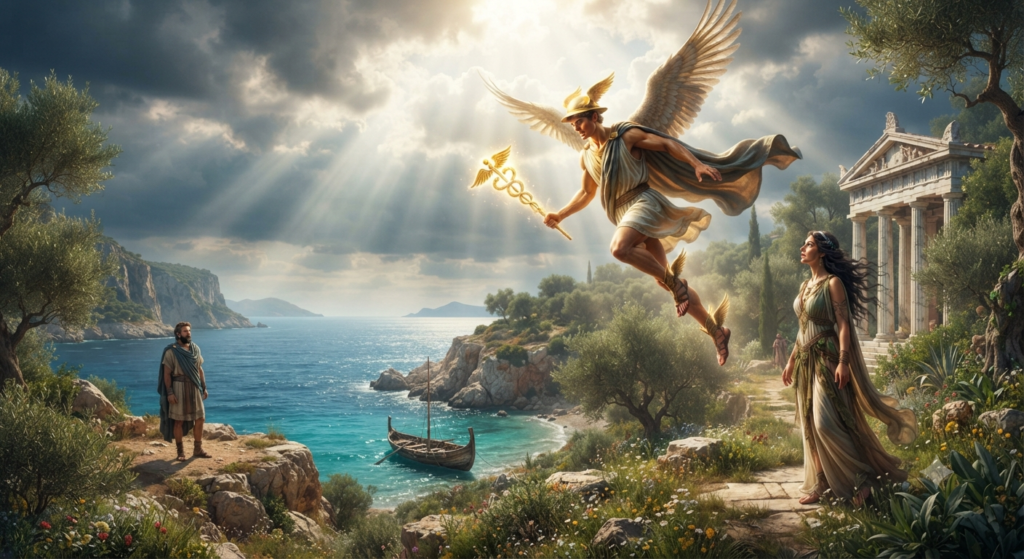
Hermes appears most memorably in the Odyssey when Zeus sends him to Calypso’s island with the command that Odysseus must be released. This is one of the clearest examples in Homer of a god acting as the executive agent of another god’s will. The order does not originate with Hermes, but without him it would remain unfulfilled.
The scene is important because it shows that Odysseus’ homecoming is not merely a matter of endurance or cleverness. Divine authority has to open the road for him. Hermes does not free Odysseus directly, but he clears the way by carrying Zeus’s decree to the nymph who has kept the hero from Ithaca for years.
Calypso’s island and the decree of Zeus
On Calypso’s island, Hermes arrives as an emissary from Olympus, and his words end the nymph’s resistance. Homer presents the moment with remarkable force: Calypso, though reluctant, cannot refuse the decree once it has been brought by Zeus’s messenger. Hermes therefore acts as the voice of final divine judgment, the point at which delay becomes impossible.
The episode also reveals something about the limits of divine desire in the poem. Calypso may wish to keep Odysseus, but the order from Zeus overrides private attachment. Hermes stands at the center of that tension, not as an enforcer in the violent sense, but as the bearer of a decision that even immortals must acknowledge. His arrival marks the turning point from enchantment toward departure.
The golden wand of Hermes and mortal sleep
Homer describes Hermes with his emblematic golden wand, the staff associated with magical authority, guidance, and the movement between waking and sleeping states. In Greek tradition this wand can induce sleep or wakefulness, depending on the god’s intention. In the Odyssey, that power belongs to Hermes’ broader identity as one who governs transitions and thresholds.
Although the wand is not the focus of the Calypso episode, it belongs to the same symbolic world. Hermes is not merely a courier; he is a deity whose touch can alter consciousness and whose authority is linked to liminal moments. Later Greek imagination would connect this instrument closely with the role of the psychopomp, the guide of souls, but even in Homer it signals a god who can cross the line between states that mortals cannot.
Hermes, lyre-maker, and echoes of divine skill
Hermes is also associated with inventive skill, especially through the famous Homeric Hymn to Hermes, where he invents the lyre. The Odyssey does not narrate that episode in detail, but it shares the same divine atmosphere: Hermes is clever, resourceful, and capable of transforming raw material into something ordered and powerful. That quality links him to craft as well as movement.
This matters for Odysseus because the hero himself is a master of adaptive intelligence. Hermes’ skill is not identical to Odysseus’ but it echoes it. Both are figures of intelligence operating under pressure, both rely on timing and ingenuity, and both succeed by moving through unstable situations with precision rather than brute force.
Odysseus and Hermes: cunning minds in contact
The Odyssey places Odysseus in direct symbolic relation to Hermes through the episode with Circe and the plant called moly, given by the god to protect him from enchantment. Hermes does not speak at length in that scene, but his intervention is crucial. He arms Odysseus with the means to resist magic, allowing the hero’s own intelligence to remain intact.
This meeting of divine and human cunning is one of the poem’s richest patterns. Odysseus is not a god, yet he survives partly because a god of intelligence and passage assists him. Hermes does not replace Odysseus’ judgment; he strengthens it. The relationship suggests that Greek epic sees cleverness not as opposed to divine power, but as one of the forms in which divine favor may appear.
When Hermes crosses the boundary of human fate
Hermes is especially significant in the Odyssey because he acts at points where human fate seems closed. Odysseus cannot simply decide to leave Calypso’s island, nor can he resist every magical threat on his own. Hermes enters precisely where mortal agency reaches its edge and divine intervention becomes necessary.
Yet he does not abolish human responsibility. Odysseus still must build the raft, sail, endure the sea, and choose his responses. Hermes opens the boundary, but the hero must pass through it. That balance is central to Homeric thought: the gods shape the conditions of life, while mortals still live out their destinies through action, intelligence, and endurance.
Argeiphontes in the wider Greek epic tradition
Hermes is often called Argeiphontes, an ancient epithet whose exact etymology is debated in scholarship, though it is traditionally associated with his role as slayer of Argus. In the epic tradition beyond the Odyssey, this name helps define Hermes as a god of subtle power, capable of defeating watchfulness and overcoming obstacles through speed and cunning rather than open force.
That broader tradition deepens his role in Homer’s poem. Even when he appears briefly, he carries the authority of a god whose mythic identity already includes crossing boundaries and neutralizing vigilance. In a narrative built around disguise, surveillance, and hidden identity, that makes Hermes an especially resonant figure. He belongs to the same imaginative world as the poem’s stealth and reversals.
Hermes’ role in shaping Odysseus’ return home
Hermes does not guide Odysseus every step of the way, but he helps make return possible. His intervention at Calypso’s island removes one of the major obstacles to nostos, the Greek idea of homecoming that lies at the heart of the Odyssey. Without that divine command, Odysseus might remain suspended indefinitely between longing and captivity.
More broadly, Hermes helps define what the poem believes about movement toward home: it is never purely human, never purely divine, but negotiated between both. As messenger, guide, and carrier of Zeus’s will, Hermes turns the abstract promise of return into a practical opening. In that sense, he is one of the quiet but essential powers behind Odysseus’ arrival in Ithaca.
Hermes in the Odyssey is a god of passage, but also of timing, instruction, and decisive mediation. He does not seek the spotlight, yet Homer gives him the kind of role that changes the course of events: he delivers Zeus’s command, loosens the grip of Calypso, and equips Odysseus against danger.
His presence reminds readers that the hero’s homecoming is never only a human achievement. In the epic world, the road to Ithaca must be opened by divine speech, and Hermes is the one who carries that speech across the divide between Olympus and the mortal sea.

Orin Vale has spent the better part of two decades tracing the threads that connect the world’s oldest stories — from the halls of Asgard to the banks of the Nile, from Olympus to the jungles of the Maya. What began as a childhood fascination with flood myths and trickster gods grew into years of independent study across comparative mythology and ancient religion, always chasing the same question: what did these stories mean to the people who first told them? Orin writes for readers who want more than trivia — the ones looking for the beliefs, fears, and truths that myths were built to carry.