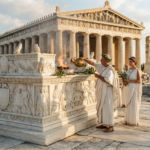
In Greek mythology, Elpis is the word for hope, but it is not always a simple or cheerful idea. In the oldest sources, especially Hesiod, Elpis can mean the hope that remains when everything else is stripped away, the expectation of something better, or even the anxious anticipation of what is still to come. Unlike a full divinity with a rich cycle of myths, Elpis is more often a force, a presence, or a concept whose meaning shifts depending on the author and context.
Elpis in Greek myth as the hope that endures
In Greek myth, Elpis is best understood as the hope that stays with mortals even when life turns harsh. The word itself can mean expectation, anticipation, or hope, and that broad range matters because the Greeks did not always treat hope as purely comforting. In a world shaped by fate, suffering, and divine power, Elpis could be the thin thread that kept human beings moving forward.
Hesiod gives Elpis her most famous place in mythic thought, and later writers inherited that image. She is not presented as a grand Olympian who changes events by force, but as something quieter and more inward. Hope endures in the human soul, and in that endurance it becomes one of the few things that can soften the weight of necessity.
Pandora’s jar and the release of hope
The best-known myth involving Elpis appears in Hesiod’s Works and Days, where Pandora opens the storage jar that contains the sufferings meant for humankind. As the evils escape into the world, Elpis remains inside the jar. The phrase has generated centuries of interpretation because Hesiod does not explain in direct terms whether this is a blessing or a loss.
Some readers have understood the preservation of Elpis as a mercy: all the evils have spread among humans, but hope is kept back as a last protection. Others have argued that if Elpis stayed sealed away, then mortals were denied hope altogether, and the jar becomes a symbol of suspended expectation. Hesiod’s text allows both readings, and that ambiguity is part of what makes Elpis such a lasting figure.
Hesiod’s account of Elpis among human woes
Hesiod places Elpis in a world marked by labor, disease, and the consequences of divine displeasure. In Works and Days, human life after Pandora is burdened by toil, and hope stands in relation to that suffering rather than outside it. Elpis is not described as a cure for hardship; she belongs to the same moral universe as labor, mortality, and the decline from a better age.
That placement matters because it shows how the Greeks often thought of hope as something bound to limitation. It is not freedom from pain, but a response to pain. Hesiod’s vision suggests that mortals continue because they can still expect, desire, and endure, even when the world offers no certainty of relief.
Hope as comfort or deceptive expectation
Ancient Greek thought did not always praise hope unreservedly. Elpis could console, but it could also mislead. To hope is to project oneself toward a future that has not yet arrived, and that future may never come. This double edge appears throughout Greek literature, where expectation can steady the soul or expose it to disappointment.
That tension helps explain why Elpis is sometimes treated with caution. Hope can keep human beings alive to the next day, but it can also bind them to illusion. In this sense, Greek mythology does not present hope as innocence; it is a powerful and uncertain condition, one that may shelter mortals from despair while also keeping them attached to what lies beyond their control.
Elpis and the limits of mortal suffering
Elpis is closely tied to the idea that mortal suffering has limits, even if those limits are invisible. Greek myth rarely offers humans perfect happiness, yet it often allows a space in which endurance becomes meaningful. Hope occupies that space. It does not erase death, aging, or loss, but it helps define the human ability to bear them.
In this way, Elpis reflects a deeply Greek concern: the boundary between gods and mortals. The gods possess power and long life; humans possess hope, memory, and anticipation. Elpis belongs to the mortal condition because mortals cannot know the future with certainty. Hope is therefore both a weakness and a strength, a sign that humans suffer, but also that they continue.
The goddess Hope in later Greek tradition
In later Greek and Greco-Roman tradition, Elpis could appear more clearly as a personified figure, sometimes approached as a minor goddess or divine presence. This development is part of a broader ancient habit of turning important abstractions into figures with cultic or poetic life. Hope, like Justice or Peace, could be imagined as something that walks among humans.
Even so, Elpis never became a major Olympian figure with a large mythic biography. Her importance remained conceptual and symbolic rather than narrative. Later authors and artists used her to express the same basic idea found in Hesiod: that hope is one of the last and most necessary companions of mortal life.
Elpis in Homeric and tragic Greek language
In Homeric Greek, elpis often means expectation rather than the more sentimental idea of hope common in modern English. A warrior may have hope of return, a family may hope for safe news, and the term can even imply anticipation that is morally neutral. The word points forward, toward what is expected, whether that expectation is joyful or terrible.
Greek tragedy intensifies this uncertainty. In tragic language, hope can be fragile, mistaken, or tragic in itself, because characters often hope for outcomes that destiny has already undermined. The result is a powerful literary theme: human beings live by hope, but hope is never fully trustworthy. It illuminates the path ahead without guaranteeing anything.
Prayer, expectation, and hopeful endurance
Greek religion was not built on blind optimism, yet prayer often carried an implicit hope for divine favor. When people sacrificed, consulted oracles, or made vows, they acted in expectation of response. Elpis therefore belongs not only to myth but to lived religious practice, where human beings approached the gods with uncertainty and trust at once.
This is why hope in Greek thought is so often linked with endurance. To pray is to admit dependence; to hope is to remain open to a future shaped by powers beyond oneself. Elpis is the inward form of that stance, the quiet persistence that makes ritual, petition, and waiting bearable.
Sanctuary dedications linked to Hope
There is some evidence in Greek and Roman religious life for dedications associated with Hope, though she was far less central than major gods or civic deities. Sanctuaries, altars, and votive offerings sometimes reflect the human need to give form to expectation, especially in settings shaped by healing, travel, or uncertain fortune. The religious landscape of the ancient Mediterranean often made room for such figures.
In later periods, Hope could be honored alongside related personifications such as Tyche, Peace, or Fortune. These associations show how adaptable Elpis was in worship and imagery. She could stand at the edge of a sanctuary as a reminder that petition is rarely made in certainty, only in expectation that the gods may yet be favorable.
The meaning of hope in Greek religious thought
In Greek religious thought, Elpis means more than encouragement. It is the human capacity to remain oriented toward the future despite suffering, ignorance, and fate. Depending on the source, it can be a blessing, a temptation, a restraint, or a final consolation. That complexity is exactly what makes Elpis so enduring in Greek mythology.
The mythic image left by Hesiod is especially powerful: after suffering escapes into the world, hope remains close at hand, whether inside the jar or held apart from it. In either reading, Elpis belongs to the human condition. She marks the narrow space where mortality, fear, and persistence meet, and where ancient Greeks saw the fragile dignity of life.
Hope in Greek mythology is never simple, and that is what gives Elpis her depth. She is not merely optimism, nor a promise that pain will disappear. She is the stubborn force that allows mortals to keep expecting, praying, laboring, and enduring in a world shaped by limits.

Orin Vale has spent the better part of two decades tracing the threads that connect the world’s oldest stories — from the halls of Asgard to the banks of the Nile, from Olympus to the jungles of the Maya. What began as a childhood fascination with flood myths and trickster gods grew into years of independent study across comparative mythology and ancient religion, always chasing the same question: what did these stories mean to the people who first told them? Orin writes for readers who want more than trivia — the ones looking for the beliefs, fears, and truths that myths were built to carry.