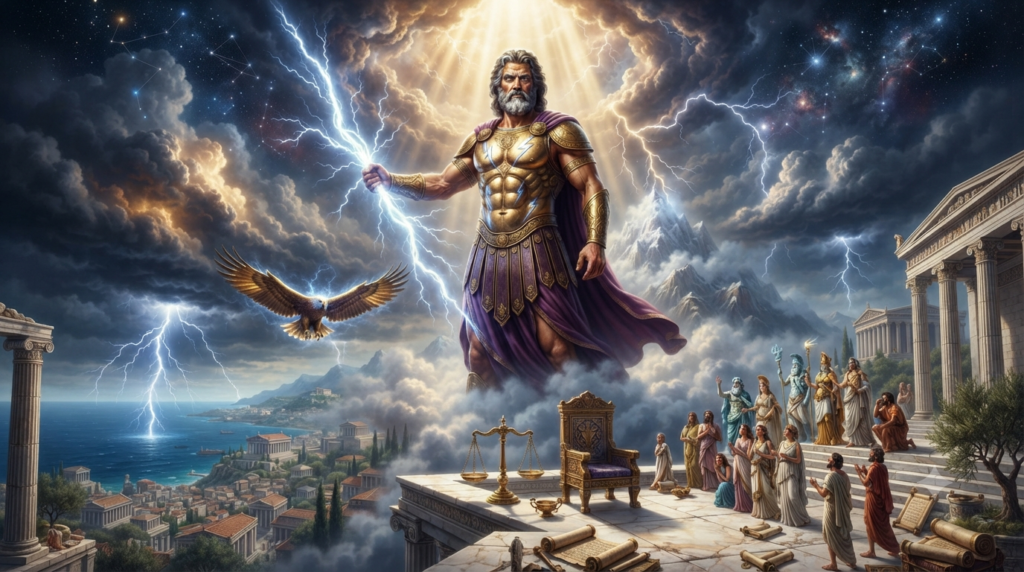
Anyone asking what is Zeus’s domain arrives at a clear, foundational answer: the sky and thunder form the core of his rule, extending outward into broader authority over cosmic order, justice, and the overall stability of the Olympian hierarchy. As king of the gods, Zeus’s domain extends considerably further than that of any other individual deity, reflecting his unique position atop the broader structure of Greek mythology. Understanding what is Zeus’s domain requires examining both his primary, most immediately recognized area of rule and the additional, broader responsibilities that extended his authority well beyond the sky alone.
The Sky and Weather
Zeus’s most fundamental and immediately recognized domain centers specifically on the sky, encompassing thunder, lightning, and broader weather phenomena, establishing the clearest and most direct answer to what is Zeus’s domain within Greek mythological tradition.
This specific domain was formally established following the Titanomachy, when Zeus, Poseidon, and Hades divided the cosmos among themselves through a drawing of lots, with Zeus specifically receiving authority over the sky while his brothers received the sea and underworld respectively, reinforcing why what is Zeus’s domain centers so clearly on this particular celestial realm.
This division distinguishes Zeus’s specific domain clearly from his brothers, ensuring that while all three shared comparable status as major ruling deities, each maintained distinct primary jurisdiction, with Zeus’s sky-based authority ultimately positioning him at the symbolic and practical center of the broader Olympian cosmic structure.
Understanding this foundational sky-based domain provides essential grounding for what is Zeus’s domain, establishing the specific, clearly defined jurisdiction that anchors his broader mythological identity before examining the additional responsibilities that extended his authority further still.
Cosmic Order and Kingship
Beyond his specific rule over the sky, Zeus held broader responsibility for maintaining cosmic order among the Olympian gods, positioning what is Zeus’s domain as extending significantly beyond simple elemental control into genuine governance and oversight of the divine community itself.
As king of the gods, Zeus served as the final authority in resolving disputes among the Olympians, reinforcing that what is Zeus’s domain included active governance responsibilities rather than remaining limited purely to passive rule over a specific natural element or celestial phenomenon alone.
This governing role reflects a crucial dimension of what is Zeus’s domain, distinguishing his authority from deities whose domain remained confined to a specific, narrower sphere, since Zeus’s kingship extended his effective jurisdiction across the entire Olympian community regardless of any individual god’s own specific area of rule.
Recognizing this broader governing dimension significantly enriches what is Zeus’s domain, confirming that his authority encompassed genuine leadership and oversight extending well beyond his more narrowly defined elemental control over sky and weather specifically.
Justice, Oaths, and Hospitality
Zeus held the specific epithet Horkios, reflecting his role as guardian of oaths, ensuring that what is Zeus’s domain included direct oversight of truthful speech and sworn commitments among both gods and mortals throughout ancient Greek religious and social tradition.
Zeus also held the epithet Xenios, identifying him specifically as protector of hospitality, the sacred relationship between hosts and guests carrying significant religious and social weight throughout ancient Greek culture, further expanding what is Zeus’s domain into this specific, socially significant area of oversight.
Beyond these specific epithets, Zeus maintained broader responsibility for justice and appropriate conduct generally, reinforcing that what is Zeus’s domain extended into genuine moral and social oversight, positioning him as guarantor of proper behavior throughout both divine and mortal spheres of ancient Greek life.
This combination of oath protection, hospitality oversight, and broader justice significantly expands what is Zeus’s domain beyond purely elemental or governmental authority, confirming his role as guarantor of proper social and moral conduct throughout the broader ancient Greek world.
Fate and the Limits of Zeus’s Domain
Despite his extensive authority, what is Zeus’s domain does maintain certain limits, particularly regarding fate itself, since even the king of the gods generally operated within broader cosmic principles governing destiny that existed somewhat beyond his complete, independent control.
This limitation reinforces an important distinction between administered domain and absolute control, confirming that what is Zeus’s domain, while genuinely extensive, did not represent entirely unlimited authority over every conceivable aspect of the broader Greek cosmological structure without exception.
Recognizing these limits provides important balance when addressing what is Zeus’s domain, ensuring an accurate, complete picture rather than an oversimplified portrayal suggesting entirely unrestricted authority across every dimension of Greek mythological cosmology without any meaningful boundary whatsoever.
This nuanced understanding completes a genuinely accurate picture of what is Zeus’s domain, confirming substantial, wide-ranging authority across sky, cosmic order, justice, and social conduct, while acknowledging the genuine structural limits that existed even for the supreme ruler of the Olympian gods.
FAQ — Quick Answers About Zeus’s Domain
What is Zeus’s domain?
Zeus’s domain includes the sky, thunder, and weather, along with broader authority over cosmic order, justice, oaths, and hospitality among gods and mortals.
Why does Zeus rule the sky specifically?
Following the Titanomachy, Zeus, Poseidon, and Hades divided the cosmos by lot, with Zeus specifically receiving authority over the sky.
What does “Zeus Horkios” mean?
Zeus Horkios refers to his role as guardian of oaths, overseeing truthful speech and sworn commitments in ancient Greek tradition.
What does “Zeus Xenios” mean?
Zeus Xenios refers to his role as protector of hospitality, the sacred relationship between hosts and guests in ancient Greek culture.
Does Zeus have complete control over everything?
No, even Zeus’s domain has limits, particularly regarding fate, which generally operated somewhat beyond his complete, independent control.
Conclusion
Anyone who sets out to answer what is Zeus’s domain finds a scope of authority extending well beyond the sky and thunder alone, encompassing cosmic order, justice, oaths, and hospitality throughout ancient Greek mythological and religious tradition. This breadth reflects his unique position as king of the gods.
Understanding both the foundational elemental domain established through his division of the cosmos with Poseidon and Hades, and his broader governing and moral responsibilities, provides a genuinely complete picture of his mythological authority and significance.
Ultimately, what is Zeus’s domain confirms a scope of rule matched by no other individual deity within Greek mythology, while also revealing that even this extensive authority operated within meaningful cosmic limits, reinforcing the nuanced, structured nature of Greek mythological hierarchy.

Orin Vale has spent the better part of two decades tracing the threads that connect the world’s oldest stories — from the halls of Asgard to the banks of the Nile, from Olympus to the jungles of the Maya. What began as a childhood fascination with flood myths and trickster gods grew into years of independent study across comparative mythology and ancient religion, always chasing the same question: what did these stories mean to the people who first told them? Orin writes for readers who want more than trivia — the ones looking for the beliefs, fears, and truths that myths were built to carry.