The question “Who is Kairos, the Greek god of opportunity?” introduces one of the most fascinating concepts in Greek mythology: the idea that certain moments in life carry unique potential. Unlike the great Olympian gods who ruled over specific aspects of nature and human existence, Kairos represents something more abstract and powerful — the perfect moment when circumstances, preparation, and action come together.
In ancient Greek thought, time was not understood only as a sequence of hours and days. The Greeks recognized different dimensions of time, including Chronos, which represents chronological and measurable time, and Kairos, which represents meaningful time, opportunity, and the moment when a decision can create a lasting impact.
Kairos is often described as the Greek god of opportunity, although he is more accurately understood as a personification of the ideal moment rather than a traditional Olympian deity. His symbolism expresses the idea that opportunities are temporary and require awareness, wisdom, and courage to be recognized.
The importance of Kairos in Greek mythology comes from the belief that success depends not only on ability or effort but also on timing. A skilled warrior needed to recognize the right moment to strike, a speaker needed to understand when to deliver a powerful message, and a leader needed to know when action would produce the greatest result.
The concept of Kairos remains relevant because it reflects a universal human experience. Throughout life, people encounter moments that can change their direction, but those moments often pass quickly. Kairos symbolizes the ability to perceive these opportunities and respond before they disappear.
Who Is Kairos in Greek Mythology?
Kairos is the Greek god of opportunity, favorable timing, and the decisive moment. In Greek mythology, he represents the idea that certain moments have a special quality that makes them different from ordinary time. His role was not connected with ruling the sky, sea, or underworld like Zeus, Poseidon, or Hades, but with the invisible force that determines whether an opportunity can be successfully achieved.
Unlike major Greek deities with extensive mythological stories, Kairos appears primarily as a symbolic figure. Ancient Greeks used him to represent an important principle: recognizing the right moment could be the difference between success and failure. His mythology focused less on dramatic adventures and more on the wisdom of timing.
The Greek word kairos refers to a suitable, appropriate, or favorable moment. This concept was deeply connected to ancient Greek ideas about strategy, philosophy, and decision-making. For the Greeks, a person who understood Kairos possessed a special type of intelligence — the ability to evaluate circumstances and act at the most effective moment.
Kairos was especially important in areas where timing determined outcomes. In warfare, a commander needed to identify the perfect moment to attack or retreat. In politics, leaders needed to know when to introduce ideas or negotiate agreements. In public speaking, a speaker needed to understand when an argument would have the greatest influence.
The figure of Kairos demonstrates that ancient Greeks viewed opportunity as something that required more than luck. A chance event might appear, but only someone prepared and aware could recognize its value. In this sense, Kairos represents the connection between external circumstances and human judgment.
Understanding who Kairos is in Greek mythology means understanding a deeper philosophical idea: opportunities do not exist only because they appear; they become meaningful when someone has the knowledge and awareness to act upon them.
The Meaning of Kairos: The Right Moment
The meaning of Kairos is closely connected with the concept of the right moment. In Greek philosophy and culture, not every moment had the same importance. Some moments were ordinary and passed without major consequences, while others contained the possibility of transformation.
Kairos represents the moment when everything aligns: the circumstances are favorable, the opportunity is present, and the individual is prepared to respond. It is the point where action becomes meaningful because the timing creates a greater impact.
This idea differs from the modern understanding of time as something purely measurable. For ancient Greeks, time was also experienced through significance. A single conversation, decision, or event could hold more importance than many years of routine activity.
The wisdom of Kairos was therefore not simply knowing what to do, but knowing when to do it. A correct action performed at the wrong moment could fail, while the same action performed at the perfect moment could create extraordinary results.
This principle explains why Kairos became associated with opportunity. An opportunity is not valuable only because it exists; it is valuable because it appears at a specific moment and may disappear if ignored.
Kairos vs Chronos: Two Different Concepts of Time
One of the most important ideas in understanding Kairos in Greek mythology is the difference between Kairos and Chronos. Both concepts relate to time, but they represent completely different ways of experiencing it.
Chronos represents chronological time. It is the continuous measurement of existence through seconds, minutes, days, and years. Chronos is the time used for calendars, schedules, and the natural progression of life.
Kairos, however, represents qualitative time. It refers to the significance contained within a particular moment. Instead of asking “how much time has passed?”, Kairos asks “what is the importance of this moment?”
| Concept | Meaning |
|---|---|
| Chronos | Sequential and measurable time |
| Kairos | The meaningful and opportune moment |
A simple example helps explain the difference. A person preparing for a business opportunity may spend years gaining knowledge and experience. That preparation belongs to Chronos. However, recognizing the exact moment to launch an idea or make a decision belongs to Kairos.
The Greeks believed that wisdom involved understanding both forms of time. Chronos provided experience and preparation, while Kairos provided the awareness needed to transform preparation into action.
This distinction made Kairos an important symbol of strategic thinking, adaptability, and practical wisdom. His message was clear: time alone does not create success; understanding the right moment does.
The Origins of Kairos in Greek Thought
The origins of Kairos are connected with ancient Greek reflections about fate, human choices, and the relationship between individuals and circumstances. Rather than representing a physical element of nature, Kairos emerged as a philosophical idea transformed into a divine figure.
Ancient Greeks understood that life was influenced by forces beyond human control. Luck, fate, and unexpected events could create challenges or opportunities. However, they also believed that human judgment played an essential role in responding to those situations.
Kairos represented the moment when external circumstances and human ability meet. An opportunity without preparation could be wasted, while preparation without the right opportunity might remain unnoticed.
This concept became especially significant in Greek philosophy and rhetoric, where timing was considered essential. A wise person needed not only knowledge but also the ability to apply that knowledge at the appropriate moment.
Through Kairos, Greek mythology expressed a timeless lesson: success is often created through the combination of preparation, awareness, and the courage to act when the right opportunity appears.
What Did Kairos Look Like?
The visual representation of Kairos, the Greek god of opportunity, is one of the most symbolic images in ancient Greek art. Unlike many Greek gods who were represented through powerful weapons, royal clothing, or recognizable objects connected with their domains, Kairos was portrayed through physical characteristics that communicated an idea: opportunity appears quickly and must be recognized immediately.
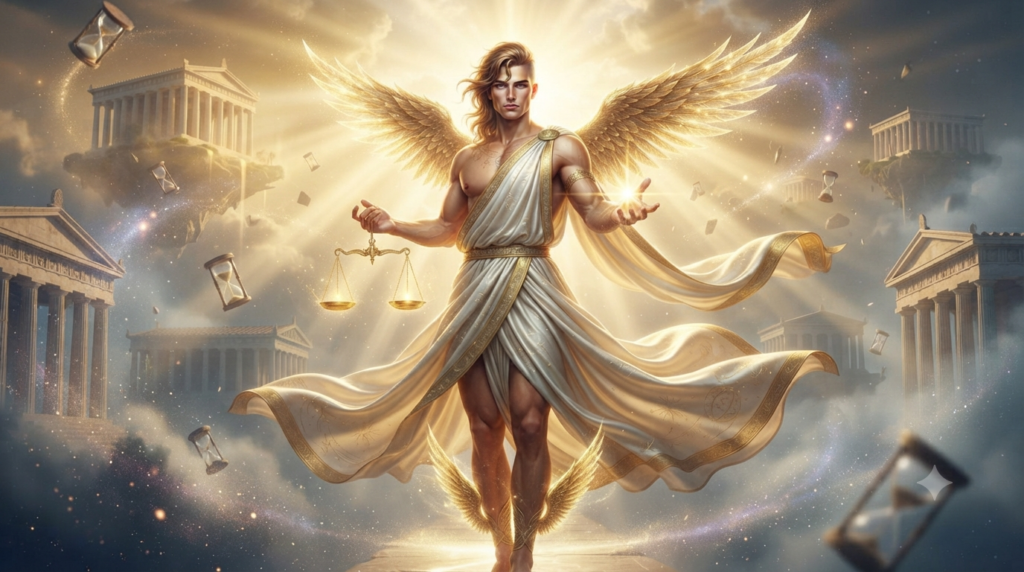
Ancient artists commonly represented Kairos as a young, athletic figure with wings attached to his feet or shoulders. His youthful appearance symbolized the fleeting nature of opportunities, suggesting that the right moment does not remain available forever. Like youth itself, Kairos represents something valuable that moves quickly and cannot easily be recovered once it disappears.
One of the most famous descriptions of Kairos comes from the Greek sculptor Lysippos, who created a bronze statue representing the personification of opportunity. Although the original sculpture has been lost, later descriptions and copies preserved the symbolism associated with the figure. The statue became one of the most important artistic interpretations of the ancient Greek concept of timing.
The image of Kairos was not designed merely to represent a god but to communicate a philosophical lesson. Every detail of his appearance carried meaning, teaching observers that opportunities must be recognized, approached, and captured before they pass.
Symbolism of Kairos’ Appearance
The appearance of Kairos contains several symbolic elements that explain his role as the Greek god of opportunity. Each physical characteristic represents an aspect of timing, awareness, and human decision-making.
Unlike traditional representations of gods who display permanence and authority, Kairos appears dynamic and temporary. His image communicates movement, urgency, and the importance of immediate action.
Wings
The wings of Kairos symbolize speed and movement. They represent the idea that opportunities do not remain still waiting for someone to act. A favorable moment arrives, moves quickly, and disappears if it is not recognized.
In Greek mythology, wings were often associated with divine movement and communication. However, in the case of Kairos, the wings carry a specific meaning: opportunity is fast. A person must be prepared to respond when the moment appears.
The wings also represent the unpredictable nature of circumstances. A person may encounter an opportunity unexpectedly, but only those who are attentive can take advantage of it.
This symbolism remains relevant today. In business, personal relationships, education, and leadership, opportunities often depend on recognizing changes quickly and responding before others do.
Hair on the Forehead
One of the most distinctive features of Kairos is his unusual hairstyle. According to ancient descriptions, he had long hair hanging over his forehead while the back of his head was bald.
This symbolic design represented the way opportunities should be approached. When Kairos approaches, his hair can be grabbed because the opportunity is within reach. However, once he passes, there is nothing to hold onto.
The image teaches a powerful lesson about awareness. Opportunities are easier to capture when they are recognized early. Waiting too long can mean losing the chance completely.
The symbolism of Kairos’ hair became one of the strongest visual representations of the idea that timing matters. The right moment must be seized when it appears, not after it has already passed.
Bald Back of the Head
The bald back of Kairos’ head represents the impossibility of recovering a missed opportunity. Once the moment has moved beyond reach, there is nothing left to grasp.
This image reflects the Greek understanding that some moments are unique. Although new opportunities may appear in the future, the exact circumstances of a particular moment may never return.
The symbolism encourages awareness and decisive action. It does not suggest acting without thought, but rather developing the wisdom to recognize when hesitation could lead to loss.
The bald back of Kairos remains one of the most memorable symbols in Greek mythology because it transforms an abstract idea into a simple visual message: opportunity must be recognized before it is gone.
Balance Scales
Some representations of Kairos include balance scales, symbolizing judgment, evaluation, and careful decision-making. The scales suggest that recognizing opportunity requires more than impulse; it requires wisdom.
Kairos is not simply about acting quickly. The concept involves understanding circumstances and determining whether a moment is truly favorable.
The scales represent the balance between preparation and action. A person must evaluate risks, understand the situation, and then decide whether the moment is right.
This symbolism separates Kairos from simple luck. Opportunity is not merely a random event; it is a moment that requires perception, intelligence, and strategic thinking.
What Was Kairos the God Of?
Kairos was the Greek god of opportunity, favorable timing, and the perfect moment. His domain was not physical territory like the realms controlled by Zeus, Poseidon, or Hades, but rather the invisible circumstances that determine when actions become meaningful.
The Greeks understood that opportunity was not simply about having a chance. A person could encounter the same situation as someone else but achieve a completely different outcome depending on whether they recognized the correct moment to act.
Kairos represented the idea that success comes from the combination of preparation and timing. A talented individual without awareness of the right moment might fail, while someone prepared and attentive could transform a brief opportunity into something significant.
This concept made Kairos especially important in areas where decisions had major consequences. Military commanders, politicians, merchants, philosophers, and public speakers all needed to understand timing to succeed.
Kairos as the God of Opportunity
As the Greek god of opportunity, Kairos symbolized favorable circumstances that appear only for a limited time. He represented the openings in life that require immediate recognition and intelligent action.
Unlike Tyche, the goddess associated with fortune and chance, Kairos was not simply about luck. Fortune may occur randomly, but Kairos involves awareness. An opportunity may appear, but someone must have the ability to identify its value.
For example, a person may receive the same information, resources, or possibility as others, but the individual who understands the timing and acts correctly gains the advantage. This is the essence of Kairos.
The Greeks believed that opportunity was connected with personal responsibility. A person could not control every event in life, but they could develop the wisdom needed to respond effectively when circumstances changed.
This idea continues to influence modern concepts of success. Entrepreneurs, leaders, and innovators often describe important achievements as the result of being prepared when the right moment arrived.
Kairos and Decision-Making
The connection between Kairos and decision-making shows how deeply ancient Greeks valued strategic thinking. Recognizing the right moment required observation, experience, and understanding.
A leader guided by Kairos would not act impulsively. Instead, they would analyze circumstances and wait until conditions created the greatest possibility of success.
In warfare, Kairos represented the moment when an army should attack or retreat. A commander could have the strongest soldiers and best weapons, but poor timing could still lead to defeat.
In politics, Kairos represented the ability to understand public opinion and introduce ideas when society was ready to accept them. Speaking too early could lead to rejection, while speaking at the right moment could create significant change.
In personal life, Kairos represents the moments when decisions can transform the future. Choosing when to begin a project, change direction, express an important idea, or take action can determine outcomes.
Kairos and Human Potential
The concept of Kairos is closely connected with human potential because it emphasizes that people are not only shaped by circumstances but also by their ability to recognize possibilities.
Kairos teaches that preparation creates the foundation for opportunity. A person who develops knowledge, skills, and awareness increases the ability to recognize valuable moments when they appear.
This idea can be compared to an athlete preparing for a competition. Years of training may be required, but victory often depends on a few critical moments during the event. The preparation belongs to time, but the decisive action belongs to Kairos.
The Greek understanding of opportunity was therefore not passive. Kairos was not about waiting for success to arrive. It was about developing the perception needed to identify the moment when action could create the greatest impact.
Through Kairos, Greek mythology presents a timeless lesson: opportunities favor those who are prepared enough to recognize them.
Kairos in Greek Philosophy and Rhetoric
The concept of Kairos in Greek philosophy reveals how deeply ancient Greeks valued the relationship between knowledge, action, and timing. For Greek thinkers, wisdom was not limited to understanding facts or possessing skills. True wisdom also involved knowing when and how to apply knowledge effectively.
The idea behind Kairos was that every situation has a specific context, and successful action depends on recognizing that context. A decision that is correct in one moment may become ineffective in another. Therefore, the ability to understand circumstances became an essential part of practical intelligence.
This principle influenced several areas of Greek society, especially politics, leadership, warfare, and communication. Greek thinkers recognized that human beings constantly interact with changing situations, and those who could adapt to those changes had a greater chance of achieving success.
Kairos became especially important in Greek rhetoric, the art of persuasive communication. Ancient Greek speakers understood that a powerful argument required more than logical reasoning. The speaker also needed to understand the audience, the emotional environment, and the appropriate moment to present an idea.
Kairos and the Art of Persuasion
In classical rhetoric, Kairos represented the importance of delivering the right message at the right time. A speech could contain excellent arguments but still fail if presented when the audience was not ready to accept them.
Greek orators developed the ability to analyze situations and adjust their communication accordingly. They understood that persuasion depended not only on what was said but also on when, where, and how something was expressed.
This concept remains influential in modern communication. A successful presentation, negotiation, or public message often depends on timing. The same information can produce different results depending on the circumstances in which it is delivered.
The connection between Kairos and rhetoric demonstrates that ancient Greeks viewed communication as an active relationship between speaker, audience, and moment. Effective communication required awareness of opportunity.
Kairos and Strategy: The Power of Timing
The idea of Kairos was closely connected with strategy because many successful decisions depend on recognizing the correct moment to act. In ancient Greece, timing could determine victory or failure in situations where preparation alone was not enough.
A military commander, for example, needed to understand when to advance, when to retreat, and when to wait. An army could possess strength and resources, but poor timing could transform an advantage into defeat.
The same principle applied to politics and diplomacy. Leaders needed to recognize when society was prepared for change, when negotiations had the greatest chance of success, or when decisive action was necessary.
This strategic interpretation of Kairos shows that opportunity is not simply a matter of luck. It requires observation, analysis, and the ability to transform circumstances into meaningful action.
In modern terms, Kairos represents strategic awareness: understanding market changes, recognizing emerging possibilities, and making decisions when conditions are most favorable.
Kairos and Greek Mythology: Stories and Symbolism
Unlike major Greek gods such as Zeus, Athena, Apollo, or Poseidon, Kairos does not possess a large collection of traditional myths filled with battles, adventures, or family conflicts. His importance comes primarily from his symbolic meaning rather than from narrative stories.
This makes Kairos a unique figure within Greek mythology. He represents an abstract concept transformed into a divine image. Instead of controlling a physical domain like the sea or the sky, he represents a moment of human experience that influences decisions and outcomes.
Ancient Greek culture often personified important ideas through divine figures. Concepts such as victory, justice, and fortune were represented through gods and goddesses because mythology provided a way to understand invisible forces.
Kairos fulfilled this role by giving a human form to the idea of opportunity. Through his image, Greeks expressed the belief that important moments must be recognized and acted upon.
His lack of dramatic myths does not make him less significant. In many ways, Kairos represents a deeper philosophical idea than traditional heroic stories: the ability to understand timing can determine the direction of life.
Kairos and Tyche: Opportunity Versus Fortune
The relationship between Kairos and Tyche is one of the most interesting comparisons in Greek mythology. Both concepts involve circumstances that influence human experiences, but they represent different aspects of chance and opportunity.
Tyche was the Greek goddess of fortune, luck, and unpredictable events. She represented the external forces that could bring success or failure regardless of preparation.
Kairos, however, represented the ability to recognize and act when favorable circumstances appeared. While Tyche could provide an unexpected opportunity, Kairos represented the awareness necessary to use it effectively.
| Deity | Symbolic Meaning |
|---|---|
| Kairos | The right moment and the ability to act |
| Tyche | Fortune, luck, and external circumstances |
The difference between them highlights an important Greek idea: people cannot control every event, but they can control how they respond to opportunities.
A person may experience good fortune, but without awareness and preparation, that fortune may be wasted. Kairos represents the human ability to transform possibility into achievement.
Kairos Compared to Other Greek Deities
Although Kairos was not one of the twelve Olympian gods, comparing him with other Greek deities helps explain his unique role in mythology.
Kairos and Chronos
The comparison between Kairos and Chronos represents two different understandings of time in ancient Greek thought.
Chronos represents chronological time: the continuous movement of hours, days, and years. It is measurable and predictable.
Kairos represents meaningful time: the specific moment when circumstances create an opportunity for action.
Together, they demonstrate that ancient Greeks viewed time in two ways: as something that passes and as something that carries significance.
Kairos and Hermes
Hermes, the messenger god of communication, travel, and exchange, shares some symbolic similarities with Kairos. Both are connected with movement, speed, and transitions.
However, Hermes represents the movement of information and connection between worlds, while Kairos represents the moment when those movements become meaningful.
Kairos and Athena
Athena, goddess of wisdom and strategic warfare, represents intelligent planning and rational decision-making. Her connection with Kairos comes from the importance of choosing the correct moment to act.
Together, Athena and Kairos represent two essential elements of success: knowledge and timing.
The Symbolism of Kairos in Ancient Greek Culture
The symbolism of Kairos reflects one of the central lessons of ancient Greek philosophy: success requires harmony between preparation and opportunity.
The Greeks understood that talent, resources, and knowledge were important, but they were not always enough. Without proper timing, even excellent plans could fail.
Kairos represented awareness, adaptability, and practical wisdom. He encouraged people to observe their environment and recognize moments when action could create meaningful results.
This idea influenced Greek views on leadership, education, politics, and personal responsibility. A wise individual was not someone who simply acted quickly, but someone who understood when action was necessary.
The symbolism of Kairos continues to be powerful because it reflects a reality experienced by all people: some moments have the ability to change everything.
Kairos in Modern Culture
The concept of Kairos remains relevant in modern discussions about success, leadership, entrepreneurship, and personal growth. Although ancient Greeks described it through mythology, the principle continues to influence how people think about opportunities today.
In business, Kairos represents the ability to recognize market changes, emerging trends, and strategic openings. Companies that identify the right moment to innovate often gain advantages over competitors.
In leadership, Kairos represents the importance of making decisions at the appropriate time. Leaders must understand when to introduce changes, when to negotiate, and when patience is the better strategy.
In personal life, Kairos symbolizes moments of transformation. Choosing when to begin a new project, change direction, express an important idea, or pursue a goal can have long-lasting consequences.
The modern idea of “seizing the opportunity” reflects the same principle represented by Kairos: success often belongs to those who are prepared when the right moment arrives.
The Difference Between Kairos and Carpe Diem
Although Kairos and Carpe Diem are often associated with similar ideas, they represent different approaches to time.
The Latin expression Carpe Diem, meaning “seize the day,” encourages people to appreciate the present and make the most of life’s experiences.
Kairos goes beyond enjoying the present moment. It refers specifically to recognizing the ideal time for action and understanding when circumstances create a unique opportunity.
Carpe Diem focuses on experiencing the moment, while Kairos focuses on identifying the moment that can create change.
Both concepts share an important message: time is valuable, and awareness determines how effectively people use it.
Conclusion
The question “Who is Kairos, the Greek god of opportunity?” reveals a profound concept from Greek mythology: the idea that success is not determined only by effort, knowledge, or ability, but also by recognizing the right moment to act. Kairos represents the importance of timing, awareness, and the ability to transform a temporary opportunity into meaningful results.
Unlike the major Olympian gods who controlled elements such as the sky, the sea, or war, Kairos represented something more subtle and deeply connected to human experience. As the Greek god of opportunity, he embodied the moment when circumstances become favorable and when preparation meets possibility. His symbolism teaches that opportunities are often brief, and those who fail to recognize them may lose a chance that cannot be recovered.
The distinction between Kairos and Chronos demonstrates the complexity of ancient Greek ideas about time. While Chronos represents the continuous passage of hours, days, and years, Kairos represents the moments within that timeline that carry special meaning. This difference shows that ancient Greeks understood that time is not only measured but also experienced through important events and decisions.
Through philosophy, rhetoric, and strategy, the concept of Kairos influenced the way Greeks viewed wisdom and success. A person who understood Kairos possessed the ability to analyze circumstances, recognize possibilities, and act with precision. This idea remains relevant today in areas such as leadership, entrepreneurship, communication, and personal development.
The symbolism of Kairos, with his wings, forward-reaching hair, and inability to be grasped from behind, expresses a timeless lesson: opportunities require attention and action. They move quickly, and only those who are prepared can recognize their value when they appear.
Although Kairos is not among the most famous Greek deities, his meaning has endured for centuries because it reflects a universal truth about human life. Every person encounters moments that can change their future, but those moments must be identified and embraced.
Understanding who Kairos is in Greek mythology means understanding the power of timing itself. His story reminds us that achievement is created not only by what we do, but also by when we choose to do it. The wisdom of Kairos lies in recognizing that the right moment may be brief, but its impact can last a lifetime.

Orin Vale has spent the better part of two decades tracing the threads that connect the world’s oldest stories — from the halls of Asgard to the banks of the Nile, from Olympus to the jungles of the Maya. What began as a childhood fascination with flood myths and trickster gods grew into years of independent study across comparative mythology and ancient religion, always chasing the same question: what did these stories mean to the people who first told them? Orin writes for readers who want more than trivia — the ones looking for the beliefs, fears, and truths that myths were built to carry.