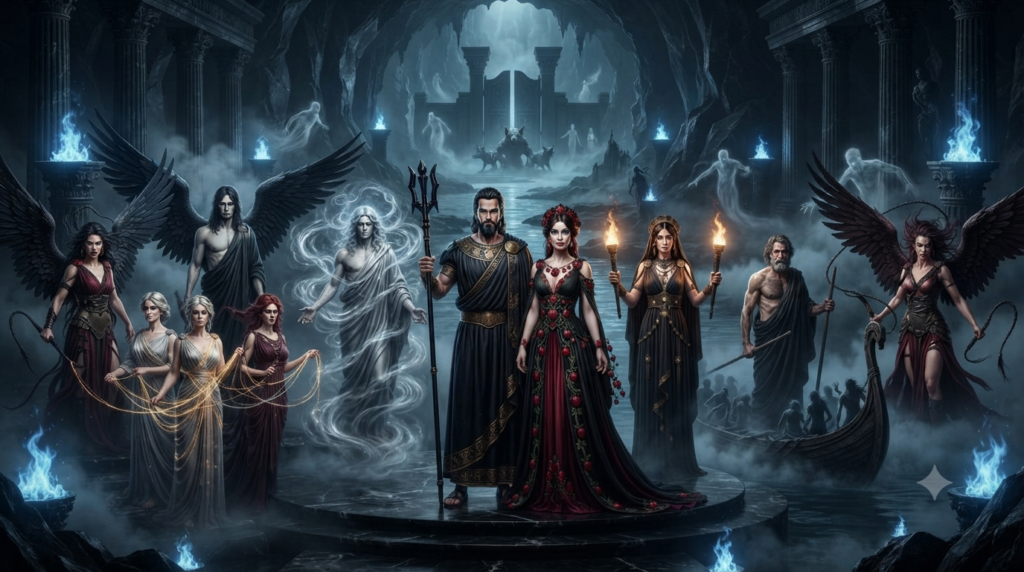
Introduction: The Divine World Beneath the Earth
The question “Who are the nine gods of the Greek underworld?” introduces one of the most mysterious and complex subjects in Greek mythology. The Underworld was not simply imagined as a dark place of punishment, but as a vast divine kingdom with its own rulers, guardians, judges, and supernatural forces responsible for maintaining the balance between life and death.
For the ancient Greeks, death was not viewed as the complete end of existence. Instead, it represented a transition from the mortal world into another realm governed by powerful deities. The Greek Underworld, often called Hades, was a carefully organized domain where every soul had a place and every aspect of the afterlife had a divine figure connected to it.
Although Hades is the most famous god associated with the realm of the dead, Greek mythology included several other important beings who shaped the experience of death and the afterlife. These figures represented different concepts such as judgment, spiritual transition, sleep, fate, ghosts, and the journey of souls.
Understanding who are the nine gods of the Greek underworld allows us to explore how ancient Greeks viewed mortality, justice, and the mysteries beyond human life. These deities were not simply symbols of fear but representations of natural forces that were considered essential to the order of the universe.
The Greek Underworld: A Realm of Order and Mystery
In Greek mythology, the Underworld was the kingdom where souls traveled after death. It was ruled by Hades, who governed the dead and ensured that the boundaries between the world of the living and the world of spirits remained intact.
The Underworld was divided into different regions with distinct purposes. The Elysian Fields were associated with peace and reward for heroic or blessed souls, while Tartarus was a place of punishment reserved for those who committed serious offenses. Between these realms existed the ordinary lands of the dead, where most souls continued their existence after passing from the mortal world.
The Greeks believed that the journey after death involved several stages. A soul needed guidance, transportation, and judgment before reaching its final destination. Because of this belief, different gods and divine beings were connected with specific responsibilities within the Underworld.
This explains why the Greek Underworld was not controlled by a single deity alone. While Hades held supreme authority, other gods and spirits performed essential functions that maintained the structure of the afterlife.
The Underworld deities represented ideas that were central to Greek culture: respect for death, the importance of justice, the uncertainty of what comes after life, and the relationship between humans and divine forces.
Hades: The King of the Greek Underworld
Hades is the central figure when discussing who are the nine gods of the Greek underworld. As the ruler of the realm of the dead, he controlled the world beneath the earth and governed the souls who entered his kingdom.
Hades was one of the three sons of Cronus and Rhea, alongside Zeus and Poseidon. After the defeat of the Titans, the three brothers divided the universe among themselves. Zeus received control of the heavens, Poseidon ruled the seas, and Hades became the ruler of the Underworld.
Unlike many modern interpretations, ancient Greeks did not usually view Hades as an evil god. He was a serious and distant deity whose role was maintaining order among the dead. His responsibility was not to cause death but to ensure that the natural boundary between life and death remained protected.
Hades was also associated with wealth and hidden riches beneath the earth. The precious metals and minerals found underground were considered part of his domain, which explains why he was sometimes connected with abundance and prosperity.
One of the most famous myths involving Hades is his relationship with Persephone. The story of Persephone’s descent into the Underworld and her return to the surface became a symbolic explanation for the changing seasons, representing themes of loss, transformation, and renewal.
As ruler of the Underworld, Hades represents the inevitability of death and the importance of balance within the universe. His presence in Greek mythology reflects the belief that even the most mysterious aspects of existence had their own order.
Persephone: The Queen of the Underworld
Persephone is one of the most important female figures connected with the Greek Underworld. Known originally as a goddess of spring, flowers, and fertility, she became the powerful Queen of the Underworld alongside Hades.
Her mythology represents one of the most significant themes in Greek culture: the connection between death and rebirth. According to tradition, Persephone spent part of the year in the Underworld and part of the year in the world of the living, creating the cycle of the seasons.
The myth of Persephone explains why nature appears to die during winter and return during spring. Her journey between two worlds symbolizes transformation, renewal, and the continuous movement between endings and beginnings.
As Queen of the Underworld, Persephone was not simply a companion of Hades. She held her own authority and represented the ability to exist between two different realms. She connected the world of life with the world of the dead.
Her dual identity makes her one of the most fascinating figures in Greek mythology. She represented both the beauty of life and the mystery of death, showing that these two forces were not opposites but interconnected parts of existence.
Persephone’s role demonstrates that the Greek Underworld was not only associated with darkness. It was also connected with transformation, hidden knowledge, and the possibility of renewal.
Thanatos: The Personification of Death
Thanatos represents the concept of death itself in Greek mythology. While Hades ruled the Underworld, Thanatos embodied the moment when human life came to an end.
Unlike the violent image often associated with death in modern stories, Thanatos was usually portrayed as a calm and inevitable force. He represented peaceful death and the natural transition from life into the afterlife.
Thanatos was the son of Nyx, the goddess of night, and the twin brother of Hypnos, the god of sleep. This connection between sleep and death reflected an important idea in Greek thought: both states represented a separation from ordinary awareness.
The Greeks often viewed sleep as a temporary form of unconsciousness and death as a permanent transition. Because of this similarity, Hypnos and Thanatos were frequently associated with one another.
Thanatos reminds us that death was not considered an enemy of existence but a necessary part of the cosmic order. His presence in mythology helped ancient Greeks understand mortality and the limits of human life.
Hypnos: The God of Sleep and Eternal Rest
Hypnos, the Greek god of sleep, was another important figure connected with the Underworld. Although he was not the ruler of the dead, his association with rest and unconsciousness placed him close to the ideas surrounding death.
The Greeks believed sleep and death shared symbolic similarities. Both involved a temporary separation from the physical world, which made Hypnos an important figure in myths involving gods and mortals.
Hypnos was the brother of Thanatos, and together they represented two different states of existence. Thanatos brought the final rest of death, while Hypnos provided temporary rest through sleep.
In mythology, Hypnos possessed the ability to make even powerful beings fall asleep. His influence demonstrated that sleep was a force capable of affecting everyone, regardless of strength or status.
The connection between Hypnos and the Greek Underworld reveals how ancient Greeks explored the relationship between consciousness, dreams, and mortality. Sleep was not simply a biological function but a mysterious state connected with divine power.
Hecate: Goddess of Magic, Crossroads, and Underworld Mysteries
Hecate is one of the most mysterious and fascinating figures connected with the Greek Underworld. Unlike Hades, who ruled the realm of the dead, or Thanatos, who represented death itself, Hecate was associated with the hidden and spiritual aspects of existence, including magic, night, crossroads, spirits, and transitions between worlds.
In Greek mythology, crossroads were considered symbolic places where different paths and possibilities met. Because of this connection, Hecate became a goddess associated with choices, transformation, and moments of uncertainty. She represented the unknown forces that influenced human lives and the invisible boundaries between the physical world and the spiritual realm.
Hecate was often depicted carrying torches, symbolizing her role as a guide through darkness. This imagery connects her with the journey of souls and the mysteries of the Underworld. She was not a goddess of evil, but rather a guardian of hidden knowledge and supernatural forces.
Her connection with Persephone is one of the most important aspects of her mythology. In some traditions, Hecate helped guide Persephone during her transition between the world of the living and the Underworld. This association strengthened her role as a divine figure connected with movement between different realms.
The importance of Hecate demonstrates that the Greek Underworld was not only about death but also about transformation, mystery, and spiritual transition. She represented the aspects of existence that humans could not fully understand but still respected.
Hermes Psychopompos: The Guide of Souls
Although Hermes is best known as the messenger of the gods, his role in the Greek Underworld was equally significant. Known as Hermes Psychopompos, meaning “guide of souls,” he was responsible for escorting the spirits of the deceased toward the realm of the dead.
The Greeks believed that the journey after death required guidance. A soul could not simply disappear; it needed to be led safely from the world of the living into the Underworld. Hermes fulfilled this role because he was one of the few gods capable of moving freely between different realms.
Hermes was a unique figure in Greek mythology because he connected separate worlds. He traveled between Mount Olympus, the human world, and the Underworld, making him a bridge between gods, mortals, and the dead.
His role as a psychopomp reflects the Greek belief that death was a journey rather than an immediate disappearance. The presence of Hermes provided a sense of order and protection during this uncertain transition.
The symbolism of Hermes as a guide remains powerful because it represents the human desire for direction when facing unknown experiences. In the context of the Greek Underworld, he represented movement, communication, and the connection between different states of existence.
Charon: The Ferryman of the Dead
Charon is one of the most recognizable figures associated with the Greek Underworld. Although he was not considered one of the major Olympian gods, his role in Greek mythology was essential because he transported souls from the world of the living into the realm of the dead.
According to ancient traditions, Charon carried souls across the rivers that separated the mortal world from the Underworld, especially the famous River Styx. This journey represented the final separation between life and death.
Greek burial customs were closely connected with the myth of Charon. Many Greeks placed coins with the deceased because they believed the payment would allow the soul to pay Charon for transportation across the river. Without proper burial rituals, a soul might be unable to complete its journey.
Charon was usually portrayed as an old and serious figure, emphasizing the solemn nature of death. Unlike heroic characters in Greek myths, he was not a warrior or ruler but a guardian of the boundary between two worlds.
The symbolism of Charon remains influential because he represents one of humanity’s oldest ideas: the need for a passage between life and death. His presence shows that the Greek Underworld was imagined as an organized realm with specific stages and responsibilities.
Minos: The Judge of the Dead
Minos was one of the judges responsible for determining the fate of souls after death. Before becoming an important figure in the Greek Underworld, Minos was known as a legendary king of Crete, famous for his wisdom and authority.
After death, Greek mythology transformed him into a divine judge who evaluated the actions of the deceased. Alongside Rhadamanthus and Aeacus, Minos helped decide where souls would go after entering the afterlife.
The idea of judgment after death reflects an important aspect of Greek religious thought: actions had consequences beyond earthly life. The Underworld was not simply a place where all souls existed equally; it contained systems of justice and moral evaluation.
Minos represented fairness, judgment, and responsibility. His role demonstrated that the Greeks believed the soul’s journey after death was influenced by the choices made during life.
The presence of judges in the Underworld also connected Greek mythology with broader philosophical questions about morality. The myths encouraged people to consider the consequences of their actions and the importance of living according to principles of justice.
Melinoe: Goddess of Ghosts and Nightmares
Melinoe is one of the lesser-known but most intriguing deities associated with the Greek Underworld. Her mythology comes mainly from Orphic traditions, where she was connected with ghosts, spirits, nightmares, and the mysterious aspects of death.
Unlike Hades and Persephone, who appear frequently in classical myths, Melinoe belongs to a more obscure tradition focused on spiritual mysteries and supernatural experiences. She represented the boundary between the living and the dead, especially through the appearance of spirits and restless souls.
Melinoe was associated with fear, dreams, and supernatural visions. Her presence reflected ancient Greek beliefs that the dead could continue to influence the world of the living through memories, dreams, and spiritual encounters.
Her connection with Persephone and Hades emphasizes the complexity of the Greek Underworld. Death was not only about the physical separation between life and death but also about the mysterious relationship between humans and the unseen world.
Although Melinoe was not among the most famous Greek deities, she provides important insight into ancient beliefs about ghosts, spirits, and the supernatural dimensions of the afterlife.
The Relationship Between the Nine Gods of the Greek Underworld
The nine gods and divine figures connected with the Greek Underworld represented different aspects of death and the afterlife. Together, they created a complete system that explained what happened after human life ended.
Hades represented authority and control over the realm of the dead. Persephone represented transformation and the connection between life and renewal. Thanatos represented the moment of death, while Hypnos represented rest and unconsciousness.
Hecate represented mystery and spiritual transition. Hermes guided souls on their journey. Charon provided passage into the Underworld. Minos represented judgment and justice. Melinoe represented the mysterious presence of spirits and the supernatural.
Each figure had a unique purpose, showing that ancient Greeks viewed death as a complex process rather than a simple event. The Underworld was a place where every stage of transition had meaning.
This organization reflects a broader theme in Greek mythology: the universe was governed by balance. Even death, one of humanity’s greatest mysteries, had structure and divine order.
Why the Greek Underworld Gods Were Not Evil
Modern stories often portray Underworld gods as dark or villainous figures, but this interpretation does not accurately represent ancient Greek beliefs. The gods associated with death were not evil forces; they were necessary parts of existence.
Hades was not a destroyer of life but a ruler who maintained the separation between the living and the dead. Thanatos was not a symbol of cruelty but the natural conclusion of mortal existence. Persephone represented both the end of life and the possibility of renewal.
The Greeks understood that death was unavoidable and therefore needed to be represented within their mythology. By creating divine figures connected with the afterlife, they gave meaning to one of the most universal human experiences.
The Underworld gods represented acceptance of mortality, respect for natural cycles, and the belief that every part of existence had a place within the cosmic order.
The Symbolism of the Greek Underworld Gods in Ancient Culture
The question “Who are the nine gods of the Greek underworld?” is not only about identifying mythological figures but also about understanding the ideas and values that shaped ancient Greek civilization. These deities represented fundamental aspects of human existence, including mortality, justice, transformation, fear, memory, and the search for meaning beyond life.
The Greek Underworld was a reflection of how ancient Greeks understood the universe. They believed that everything had a place and purpose, including death. The gods connected with the afterlife were not simply rulers of a dark realm; they represented the natural forces that maintained balance between the world of the living and the world of the dead.
Each Underworld deity carried a specific symbolic meaning. Hades represented authority and the inevitability of death. Persephone symbolized change, renewal, and the connection between life and death. Thanatos represented mortality, while Hypnos reflected the relationship between sleep, dreams, and eternal rest.
These concepts reveal that Greek mythology was not only a collection of stories about gods and heroes. It was also a philosophical system that explored questions humans continue to ask today: What happens after death? How should people live? What is the meaning of existence?
The Greek Concept of Death and the Afterlife
The beliefs surrounding the Greek Underworld reveal a sophisticated understanding of death. Ancient Greeks did not imagine the afterlife as a simple reward or punishment system. Instead, they created a complex spiritual landscape where souls experienced different destinations depending on their circumstances.
The journey of the soul involved several stages. Hermes guided the deceased toward the Underworld, Charon transported them across the rivers separating the living and the dead, and judges such as Minos determined their final destination.
This process shows that death was viewed as a transformation rather than a disappearance. The soul continued to exist, but in a different form and within a different realm governed by divine laws.
The presence of multiple Underworld gods demonstrates that ancient Greeks recognized different dimensions of death. Death itself, the journey after death, judgment, memory, and spiritual mysteries were all separate concepts represented by different divine figures.
This belief system helped ancient Greeks understand mortality while also creating a sense of order around one of humanity’s greatest uncertainties.
The Influence of the Greek Underworld Gods on Modern Culture
The gods of the Greek Underworld continue to influence modern literature, cinema, video games, and popular culture. Characters such as Hades, Persephone, Thanatos, and Charon remain among the most recognizable figures from Greek mythology.
Modern interpretations often transform these figures into heroes, villains, or complex characters with moral conflicts. However, their original meanings were much deeper. They represented universal themes that continue to exist in human society.
Hades, for example, is frequently portrayed as an evil ruler in modern entertainment, but ancient Greek mythology presented him as a necessary guardian of cosmic balance. His role was not destruction but organization and control over the realm of the dead.
Persephone has also experienced renewed interest because her mythology connects themes that remain relevant today, such as personal transformation, independence, identity, and the ability to exist between different worlds.
Thanatos has influenced psychology and philosophy, especially in discussions about mortality and human awareness of death. His name continues to appear in academic contexts related to the study of human behavior and the concept of death instincts.
The continued popularity of these figures demonstrates that Greek mythology remains powerful because it addresses experiences shared by all humans.
The Difference Between the Greek Underworld and Modern Ideas About Hell
One common misunderstanding is the belief that the Greek Underworld was the same as the concept of hell found in later religious traditions. Although there are similarities, the two ideas developed from different cultural backgrounds.
The Greek Underworld was not created exclusively as a place of punishment. It was the natural destination of all souls after death. While places such as Tartarus existed for punishment, they represented only one part of the larger Underworld.
Most souls were believed to continue their existence in a neutral state, while heroic or blessed individuals could reach places of peace and happiness such as the Elysian Fields.
This more balanced understanding shows that Greek mythology viewed death as a universal experience rather than simply a consequence of wrongdoing.
The gods of the Underworld were therefore guardians of a natural process. They maintained order and ensured that the boundaries between life and death remained protected.
The Lessons Behind the Nine Gods of the Greek Underworld
The stories of the Underworld deities contain important lessons about human existence. Each god represented an idea that ancient Greeks believed was essential for understanding life.
Hades teaches the importance of accepting what cannot be avoided. Death is a natural part of existence, and recognizing this reality allows humans to better understand life itself.
Persephone represents transformation and the possibility of renewal. Her story shows that change, although sometimes painful, can lead to new forms of existence and understanding.
Thanatos reminds humanity of mortality, encouraging reflection on the limited nature of life. Hypnos shows the importance of rest and the connection between consciousness and the unknown.
Hermes represents guidance during difficult transitions, while Charon symbolizes the passage from one stage of existence to another. Minos represents justice and accountability, and Hecate represents the mysteries that remain beyond human understanding.
Together, these figures create a complete philosophical vision of life, death, and everything between them.
Frequently Asked Questions About the Nine Gods of the Greek Underworld
Who is the main god of the Greek Underworld?
The main god of the Greek Underworld is Hades. He is the ruler of the realm of the dead and responsible for maintaining order among souls after death.
Are the gods of the Greek Underworld evil?
No. The gods of the Greek Underworld were not considered evil by ancient Greeks. They represented natural forces and maintained balance within the universe.
Is Persephone more powerful than Hades?
Persephone and Hades had different roles. Hades ruled the Underworld, while Persephone represented transformation, renewal, and the connection between life and death.
Who guides souls to the Greek Underworld?
Hermes Psychopompos guides souls toward the Underworld, while Charon transports them across the rivers separating the worlds of the living and the dead.
Why are there multiple gods associated with the Underworld?
Ancient Greeks divided different aspects of death and the afterlife among several divine figures. Each deity represented a specific part of the journey beyond life.
Conclusion: Understanding the Nine Gods of the Greek Underworld
The answer to “Who are the nine gods of the Greek underworld?” reveals a complex mythology built around the mysteries of death, transformation, and the afterlife. These figures were not simply characters from ancient stories but representations of ideas that shaped how Greeks understood human existence.
Hades ruled the Underworld and maintained its order. Persephone connected the world of the living with the realm of the dead. Thanatos represented death itself, while Hypnos symbolized rest and the mysterious state between consciousness and unconsciousness. Hecate guarded hidden knowledge and spiritual transitions. Hermes guided souls, Charon provided passage, Minos judged the dead, and Melinoe represented the supernatural aspects of the afterlife.
Together, these deities created one of the most detailed visions of death in ancient mythology. They demonstrated that the Greeks viewed the afterlife not as a simple ending but as another stage within the universal order.
The fascination with the Greek Underworld continues because these myths explore questions that remain important today. Humanity still searches for answers about mortality, destiny, justice, and what exists beyond physical life.
By studying the nine gods of the Greek Underworld, we gain more than knowledge about mythology. We discover how an ancient civilization used stories and divine figures to understand the deepest mysteries of human existence.

Orin Vale has spent the better part of two decades tracing the threads that connect the world’s oldest stories — from the halls of Asgard to the banks of the Nile, from Olympus to the jungles of the Maya. What began as a childhood fascination with flood myths and trickster gods grew into years of independent study across comparative mythology and ancient religion, always chasing the same question: what did these stories mean to the people who first told them? Orin writes for readers who want more than trivia — the ones looking for the beliefs, fears, and truths that myths were built to carry.