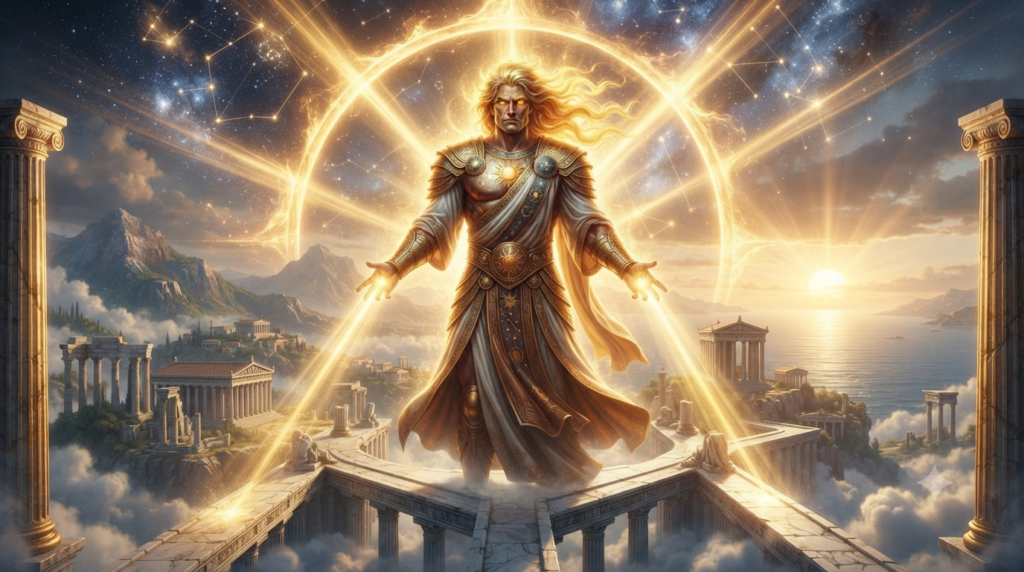
Hyperion occupies a foundational but often overlooked position within Greek mythology, remembered less for dramatic personal adventures and more for his essential genealogical role as the source of the sky’s most important sources of light. Anyone asking who is Hyperion in Greek mythology is uncovering one of the twelve original Titans, a generation of primordial deities who governed the cosmos before the Olympian gods rose to power under Zeus.
Unlike many of his fellow Titans, whose stories often involve dramatic conflict or specific punishment following their eventual defeat, Hyperion’s significance rests primarily on his role as father to three of the most important celestial figures in Greek mythology. This function places him at the very origin point of the sun, moon, and dawn, making him indirectly responsible for governing the daily and monthly rhythms that shaped ancient Greek understanding of time itself.
Hyperion’s relative lack of individual mythology, compared to more dramatically documented Titans, does not diminish his importance within the broader Greek cosmological framework. Instead, his story illustrates how some Titans functioned primarily through genealogical significance rather than personal narrative, establishing foundational family lines that later generations of deities would build upon throughout Greek mythological tradition.
What follows examines Hyperion’s origins as a child of Uranus and Gaia, his marriage to his sister Theia, his role as father to Helios, Selene, and Eos, the meaning behind his distinctive name, and his fate following the Titans’ eventual defeat during the Titanomachy.
Hyperion’s Origins: Son of Uranus and Gaia
Hyperion belongs to the original generation of twelve Titans, born directly to Uranus, the primordial sky god, and Gaia, the personification of the earth itself, according to Hesiod’s Theogony, one of the earliest and most authoritative sources on Greek cosmological mythology. This parentage places Hyperion among the very first generation of significant deities to emerge from the earliest stages of Greek creation mythology.
As one of the twelve original Titans, Hyperion shared his generation with several other significant figures, including Cronus, who would later become ruler of the cosmos before his own defeat by Zeus, and Oceanus, the Titan associated with the great river believed to encircle the entire world. This placement within the broader Titan generation establishes Hyperion’s fundamental importance within the earliest layers of Greek mythological history.
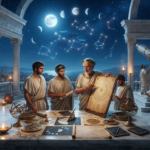
Among his fellow Titans, Hyperion held particular association with light and the celestial sky, a specialization that distinguished him from siblings governing entirely different domains, such as time, the sea, or memory itself. This early association with light would prove especially significant for understanding his later mythological role as father to some of Greek mythology’s most important light-bearing deities.
Understanding this Titan heritage provides essential context for who is Hyperion in Greek mythology, establishing him firmly within the foundational generation of deities whose collective story precedes and ultimately sets the stage for the more famous Olympian pantheon that would eventually succeed them.
Hyperion and Theia: Titan of Light
Hyperion’s mythology closely intertwines with his sister and wife, Theia, another of the original twelve Titans specifically associated with sight, brightness, and shining light within Greek cosmological tradition. This sibling marriage reflects a common pattern among the early generation of Titans, who frequently paired with their own siblings to produce subsequent generations of significant deities.
Together, Hyperion and Theia formed a divine partnership specifically centered on governing different aspects of celestial light, with Hyperion’s own name closely tied to concepts of height and elevation, while Theia’s specific domain emphasized brightness and the very capacity for sight itself. This combined focus on light and vision established their union as particularly significant within the broader mythology explaining how the ancient Greeks understood the sky’s illumination.
This partnership between Hyperion and Theia proved especially consequential given the offspring that would result from their union, since their combined domains over height, light, and vision directly anticipated the specific responsibilities their children would eventually inherit within Greek cosmology. Their marriage effectively concentrated authority over celestial light within a single family line before distributing it among their more individually famous offspring.
This union between Hyperion and Theia adds important context to who is Hyperion in Greek mythology, revealing a Titan whose personal significance emerged largely through this specific marital partnership and the resulting offspring who would carry forward his fundamental association with light into the next generation of Greek mythological figures.
Father of Helios, Selene, and Eos
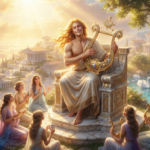
Hyperion’s most significant mythological legacy rests in his role as father to three of Greek mythology’s most important celestial deities: Helios, god of the sun; Selene, goddess of the moon; and Eos, goddess of the dawn. Together, these three children governed the complete cycle of light visible across the ancient Greek sky, from the daily rising and setting of the sun to the monthly phases of the moon and the recurring arrival of each new morning.
Helios inherited direct responsibility for driving the sun across the sky each day in his celebrated chariot, a role that made him one of the most consistently referenced deities throughout Greek mythology, particularly in stories requiring an all-seeing witness to events occurring anywhere beneath the sun’s daily path. Selene similarly governed the moon’s nightly journey, while Eos specifically presided over the dawn itself, opening the gates of heaven each morning to allow her brother Helios to begin his daily journey.
This division of celestial responsibility among Hyperion’s three children directly reflects and extends their father’s own earlier association with light and height, suggesting that Hyperion’s fundamental domain became distributed across his offspring rather than remaining concentrated within his own individual mythology. This pattern helps explain why Hyperion himself receives comparatively limited independent attention within surviving ancient sources.
This impressive lineage offers perhaps the clearest answer to who is Hyperion in Greek mythology, positioning him as the essential genealogical source behind three of the most important and consistently referenced light-based deities throughout the entire Greek mythological tradition, even as his own personal story remains comparatively understated.
The Meaning of Hyperion’s Name
The name Hyperion carries significant etymological meaning within ancient Greek, generally translated as “the one who goes above” or “the high one,” directly reflecting his fundamental association with elevated position and celestial height within Greek cosmological thinking. This meaning reinforces his broader connection to the sky and the concept of looking or moving upward toward the heavens.
Notably, Homer’s epic poetry frequently uses the name Hyperion not to refer to the Titan himself, but as a direct epithet applied to his son Helios, effectively using the father’s name as an alternate title for the son throughout significant portions of both the Iliad and the Odyssey. This literary convention has created considerable confusion across centuries of readers attempting to distinguish clearly between father and son within Greek mythological tradition.
This naming overlap likely stems from the close thematic connection between Hyperion’s own domain over height and light and his son Helios’s specific responsibility for the sun’s daily journey across the sky, making the shared name a natural poetic choice even as it complicates modern efforts to cleanly separate the two figures’ individual identities. Ancient audiences familiar with this convention likely understood the distinction more intuitively than many modern readers encountering these texts for the first time.
This etymological detail proves essential for anyone seeking a complete answer to who is Hyperion in Greek mythology, clarifying why confusion between Hyperion and Helios remains so common and emphasizing the importance of distinguishing between the original Titan and his son, who inherited both his father’s domain and, in certain literary contexts, his very name.
Hyperion’s Role in the Titanomachy
Unlike several of his fellow Titans, whose specific fates following their defeat by the Olympian gods receive detailed individual attention within surviving ancient sources, Hyperion’s personal role during the Titanomachy, the great cosmic war between the Titans and the Olympians, remains comparatively undocumented. Ancient sources generally treat the Titans as a collective force during this conflict rather than detailing each individual Titan’s specific actions or ultimate punishment.
This absence of a detailed individual narrative stands in notable contrast to figures like Cronus, whose specific defeat and subsequent fate receive far more extensive treatment throughout Greek mythological tradition, or Atlas, whose punishment of eternally holding up the sky became one of Greek mythology’s most visually memorable images. Hyperion’s fate following the broader Titan defeat simply is not specified with the same level of narrative detail.
This relative silence regarding Hyperion’s individual role likely reflects his broader characterization throughout Greek mythology as a figure defined primarily through genealogical significance rather than dramatic personal action, consistent with his limited independent mythology even before considering his role in this pivotal cosmic conflict. His importance rested more in what he produced than in what he personally accomplished or suffered.
This absence of detailed conflict mythology adds a final important dimension to who is Hyperion in Greek mythology, reinforcing his overall characterization as a foundational, genealogically significant Titan whose primary legacy operates through his celebrated children rather than through any specific dramatic narrative involving his own direct actions during the Titans’ eventual downfall.
Hyperion in Later Tradition and Pop Culture
Beyond his original mythological context, the name Hyperion has continued appearing across various later literary and cultural works, reflecting the lasting resonance of his association with height, light, and celestial grandeur even outside strictly mythological contexts. Poets and writers across different eras have occasionally invoked the name specifically to evoke these same underlying qualities originally associated with the Titan.
This continued cultural presence demonstrates how certain Greek mythological names retain symbolic power long after their original religious context has faded, often becoming detached from their precise mythological origins while still carrying recognizable thematic associations with light, elevation, or cosmic significance. Hyperion’s name has proven particularly durable in this respect, given its evocative etymological meaning.
While exploring every modern reference to the name Hyperion falls outside the scope of a mythologically focused examination, this lasting cultural presence reinforces just how deeply certain Titan names embedded themselves within broader Western cultural memory, even for figures like Hyperion whose original individual mythology remained comparatively limited within ancient sources themselves.
This enduring legacy adds one final layer to who is Hyperion in Greek mythology, confirming that despite his relatively understated presence within ancient mythological narratives, his name and its powerful etymological associations with light and height have continued resonating across centuries of subsequent literary and cultural reference.
Frequently Asked Questions
Is Hyperion the same as Helios?
No, Hyperion and Helios are father and son, though Homer frequently used “Hyperion” as a poetic epithet for Helios, creating lasting confusion between the two figures.
Who are Hyperion’s children?
Hyperion’s children, born to his wife Theia, were Helios, god of the sun; Selene, goddess of the moon; and Eos, goddess of the dawn.
What does Hyperion mean?
Hyperion translates roughly to “the one who goes above” or “the high one,” reflecting his association with celestial height and light.
Conclusion
Hyperion, though lacking the dramatic individual mythology of some fellow Titans, holds essential significance within Greek mythology as the foundational source of three of the sky’s most important light-bearing deities: Helios, Selene, and Eos. His story ultimately reveals how some Titans shaped Greek cosmology less through personal adventure and more through their lasting genealogical legacy, securing Hyperion’s place as the origin point behind the sun, moon, and dawn that ancient Greeks observed each day.

Orin Vale has spent the better part of two decades tracing the threads that connect the world’s oldest stories — from the halls of Asgard to the banks of the Nile, from Olympus to the jungles of the Maya. What began as a childhood fascination with flood myths and trickster gods grew into years of independent study across comparative mythology and ancient religion, always chasing the same question: what did these stories mean to the people who first told them? Orin writes for readers who want more than trivia — the ones looking for the beliefs, fears, and truths that myths were built to carry.