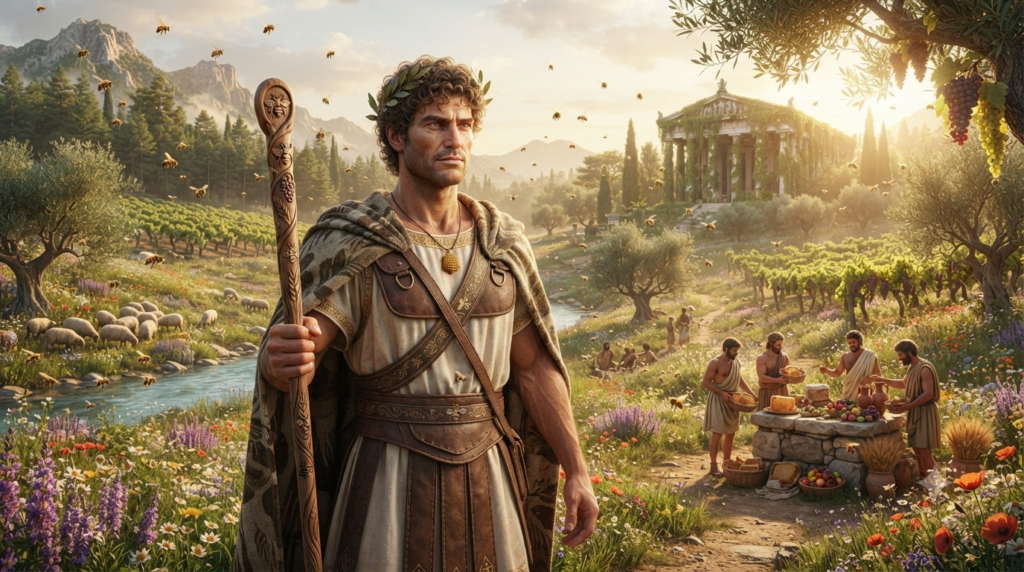
Aristaeus occupies a distinctive place within Greek mythology as a rural deity and culture hero, credited with introducing several practical arts that shaped everyday ancient Greek life, including beekeeping, cheesemaking, and olive cultivation. Anyone asking who is Aristaeus in Greek mythology is uncovering a figure whose worship once spread widely across the ancient Greek world, even though his mythology receives far less popular attention today compared to the major Olympian gods.
Born to Apollo and the huntress nymph Cyrene, Aristaeus combined divine parentage with a distinctly practical, earthbound set of responsibilities, positioning him closer to the daily concerns of farmers, herdsmen, and beekeepers than to the grand cosmic dramas typically associated with figures like Zeus or Poseidon. This connection to practical rural knowledge made him a genuinely important figure within ancient Greek agricultural and pastoral communities.
Despite his widespread historical worship, Aristaeus is perhaps best remembered today through his unintentional role in one of Greek mythology’s most tragic and enduring love stories, involving Orpheus and his wife Eurydice. This connection ties Aristaeus directly into one of antiquity’s most emotionally resonant myths, even though his own personal role within that story remains comparatively brief.
What follows traces Aristaeus’s divine origins, his significance as a culture hero, his family life and its tragic dimensions, his fateful encounter with Eurydice, his subsequent quest to restore his dying bees, and the widespread ancient worship that spread his name across the Greek world.
Aristaeus’s Origins: Son of Apollo and Cyrene
Aristaeus was born to Apollo and Cyrene, a nymph renowned specifically for her skill and courage as a huntress, distinguishing her from many other nymphs typically associated with more passive natural roles within Greek mythology. According to tradition, Apollo first encountered Cyrene while she was bravely fighting a lion on Mount Pelion, an act of courage that immediately captured the god’s attention and admiration.
Following this encounter, Apollo carried Cyrene to Libya, where she eventually gave the city of Cyrene its name and gave birth to their son Aristaeus in this distant, foreign setting. This unusual birthplace, far from mainland Greece itself, adds an important geographical dimension to Aristaeus’s origin story, connecting his mythology to the broader Greek colonial world extending into North Africa.
Ancient sources describe Aristaeus’s early upbringing in remarkably favorable terms, with the earth goddess Gaia granting him immortality while Hermes fed him nectar and ambrosia, the divine food and drink typically reserved for the Olympian gods themselves. Various nymphs, along with the wise centaur Chiron, subsequently took responsibility for teaching young Aristaeus the practical arts and mysteries that would come to define his entire mythological identity.
Understanding this divine parentage and remarkable upbringing provides essential context for who is Aristaeus in Greek mythology, establishing him as a figure whose extraordinary origins directly prepared him for his eventual role introducing valuable practical knowledge to Greek society more broadly.
The Culture Hero Who Taught Humanity Rural Arts
Aristaeus’s central mythological significance rests on his role as a culture hero, a figure credited with introducing specific, practically valuable skills to human civilization rather than simply governing an abstract cosmic domain. Among his most notable contributions, ancient sources consistently credit Aristaeus with teaching humanity the art of beekeeping, including the specific techniques required to tame and manage bee colonies successfully within hives.
Beyond beekeeping, Aristaeus also received credit for introducing the process of curdling milk to produce cheese, a practical innovation with obvious significance for ancient communities dependent on dairy farming for sustenable food production. His teachings additionally extended into olive cultivation, specifically the techniques required to successfully grow and harvest olives from wild oleaster trees, connecting him directly to one of ancient Greece’s most economically significant agricultural products.
This combination of practical skills positioned Aristaeus as a genuine patron deity of herdsmen, hunters, and agricultural workers throughout ancient Greece, his mythology directly addressing the specific, tangible concerns these communities faced in their daily working lives. Unlike deities whose significance rested primarily on abstract cosmic authority, Aristaeus’s importance stemmed directly from the practical, immediately useful knowledge attributed to his teaching.
This role as culture hero forms perhaps the clearest answer to who is Aristaeus in Greek mythology, revealing a figure whose lasting significance came not from dramatic heroic conquest, but from the genuine, practical value his teachings provided to ordinary Greek communities dependent on successful farming, herding, and beekeeping for their survival.
Family Life: Autonoe and the Tragedy of Actaeon
Aristaeus’s personal life connected him directly to one of the most prominent royal families within Greek mythology through his marriage to Autonoe, daughter of Cadmus, the legendary king credited with founding the city of Thebes. This union tied Aristaeus’s own mythology into the broader Theban mythological tradition, connecting his rural, practical divine identity to one of ancient Greece’s most significant royal lineages.
Their marriage produced Actaeon, a son whose own mythology would eventually become far more famous, though tragically so, than his father’s story of practical teaching and cultural benefaction. Actaeon grew into a skilled hunter, inheriting his family’s evident passion for hunting, before his own fatal encounter with the goddess Artemis while she bathed led to his transformation into a stag and subsequent death at the hands of his own hunting hounds.
Aristaeus and Autonoe also had a daughter, Macris, whose own mythology connects to another significant figure within Greek tradition: she served as nursemaid to the infant god Dionysus, further extending Aristaeus’s family into additional important mythological narratives beyond his own personal story.
This family history adds meaningful depth to who is Aristaeus in Greek mythology, revealing a figure whose personal life intersected with several other significant mythological traditions, even as the tragic fate of his son Actaeon introduced genuine sorrow into what might otherwise have remained a relatively fortunate, benevolent divine story.
The Myth of Aristaeus and Eurydice
Aristaeus’s most famous and consequential myth involves his unintentional role in the death of Eurydice, wife of the legendary musician Orpheus, an episode that connects his otherwise benevolent mythology to one of Greek mythology’s most tragic love stories. According to this myth, Aristaeus encountered Eurydice and, overcome by her beauty, began pursuing her with clearly unwanted advances.
As Eurydice fled from Aristaeus’s pursuit along a riverbank, she accidentally stepped upon a venomous snake, which bit her and caused her death, an outcome directly resulting from Aristaeus’s unwelcome romantic pursuit even though he never physically harmed her himself. This indirect but genuine responsibility for Eurydice’s death established the central conflict driving the remainder of Aristaeus’s mythology.
Eurydice’s sisters, nymphs deeply connected to the natural world, learned of Aristaeus’s role in causing their sister’s death and responded with severe punishment, deliberately causing his prized bees to sicken and die as retribution for his actions. This punishment directly threatened the very domain Aristaeus was most closely associated with, transforming his earlier role as beekeeping’s benevolent teacher into a cautionary example of divine consequence.
This tragic episode provides essential context for who is Aristaeus in Greek mythology, demonstrating that even a genuinely beneficial culture hero could face serious consequences for morally questionable actions, connecting his personal story directly to the broader, more famous tragedy surrounding Orpheus and Eurydice’s doomed relationship.
Consulting Proteus: How Aristaeus Restored His Bees
Facing the devastating loss of his bees, Aristaeus sought guidance from his mother Cyrene, who directed him toward Proteus, a shape-shifting sea god renowned for his prophetic knowledge but notoriously reluctant to share it willingly. This consultation required genuine effort and cunning on Aristaeus’s part, since Proteus would only reveal necessary information when physically compelled to do so.
Following his mother’s instructions, Aristaeus successfully captured and held onto Proteus despite the sea god’s various shape-shifting attempts to escape, eventually forcing him to explain the true cause behind the bees’ mysterious illness and death. Through this forced revelation, Aristaeus learned that his bees’ suffering directly resulted from the nymphs’ anger over his role in Eurydice’s death, connecting his agricultural punishment directly back to his earlier romantic misconduct.
Armed with this knowledge, Aristaeus performed the necessary atonement, sacrificing bulls specifically to appease the offended nymphs, following a ritual process later known as bougonia. According to this myth, new swarms of bees miraculously emerged from the carcasses of the sacrificed bulls several days later, successfully restoring Aristaeus’s lost bee population and resolving the punishment inflicted upon him.
This resolution completes a significant portion of who is Aristaeus in Greek mythology, illustrating both genuine consequence for his earlier actions and eventual redemption through proper ritual atonement, reinforcing broader Greek mythological themes regarding accountability, sacrifice, and the possibility of restoration following divine punishment.
Worship of Aristaeus Across the Greek World
Ancient worship of Aristaeus extended remarkably widely across the Greek world, reflecting his genuine practical significance to communities dependent on successful agriculture, herding, and beekeeping for their daily survival. In Thessaly, considered his birthplace within certain traditions, Aristaeus received veneration specifically as a protector of hunters and shepherds, reflecting the region’s own economic and cultural priorities.
On the island of Ceos, Aristaeus’s worship connected directly to a specific mythological intervention, where he reportedly delivered the island from a devastating drought by establishing an altar dedicated to Zeus Icmaeus, an act that led to Aristaeus himself becoming closely identified with Zeus specifically within Ceos’s local religious tradition. This regional variation illustrates how Aristaeus’s worship adapted to address the specific practical concerns facing different Greek communities.
Additional centers of Aristaeus’s worship included Sardinia, where his connection to olive cultivation held particular local significance, along with Sicily, Macedonia, and various other regions throughout the broader Greek and Mediterranean world. This widespread devotion eventually led Aristaeus to settle permanently on Mount Haemus in northern Thrace, where ancient tradition holds that he ceased appearing directly to mortals, instead becoming fully revered as a god by both Greek and neighboring non-Greek peoples.
This extensive geographic worship provides a final important dimension to who is Aristaeus in Greek mythology, confirming that despite his relatively limited presence in popular retellings today, ancient Greek communities genuinely valued his practical contributions enough to establish dedicated worship spanning multiple regions and centuries throughout the broader ancient Mediterranean world.
Frequently Asked Questions
What is Aristaeus the god of?
Aristaeus was the god of beekeeping, cheesemaking, olive cultivation, and hunting, credited with teaching these practical rural arts to ancient Greek communities.
Why did Aristaeus’s bees die?
Aristaeus’s bees died as punishment inflicted by Eurydice’s sisters, nymphs who blamed him for indirectly causing her death during his unwanted pursuit of her.
Is Aristaeus related to Actaeon?
Yes, Aristaeus was the father of Actaeon, the hunter who was transformed into a stag and killed by his own hounds after seeing the goddess Artemis bathing.
Conclusion
Aristaeus stands as a genuinely significant, if often overlooked, figure within Greek mythology, remembered both for his practical contributions as a teacher of beekeeping, cheesemaking, and olive cultivation, and for his tragic, indirect role in the death of Eurydice. His story, spanning divine parentage, practical benefaction, personal tragedy, and eventual redemption through the restoration of his bees, reveals a deity whose widespread ancient worship reflected the genuine, everyday value his mythology held for Greek agricultural and pastoral communities.

Orin Vale has spent the better part of two decades tracing the threads that connect the world’s oldest stories — from the halls of Asgard to the banks of the Nile, from Olympus to the jungles of the Maya. What began as a childhood fascination with flood myths and trickster gods grew into years of independent study across comparative mythology and ancient religion, always chasing the same question: what did these stories mean to the people who first told them? Orin writes for readers who want more than trivia — the ones looking for the beliefs, fears, and truths that myths were built to carry.