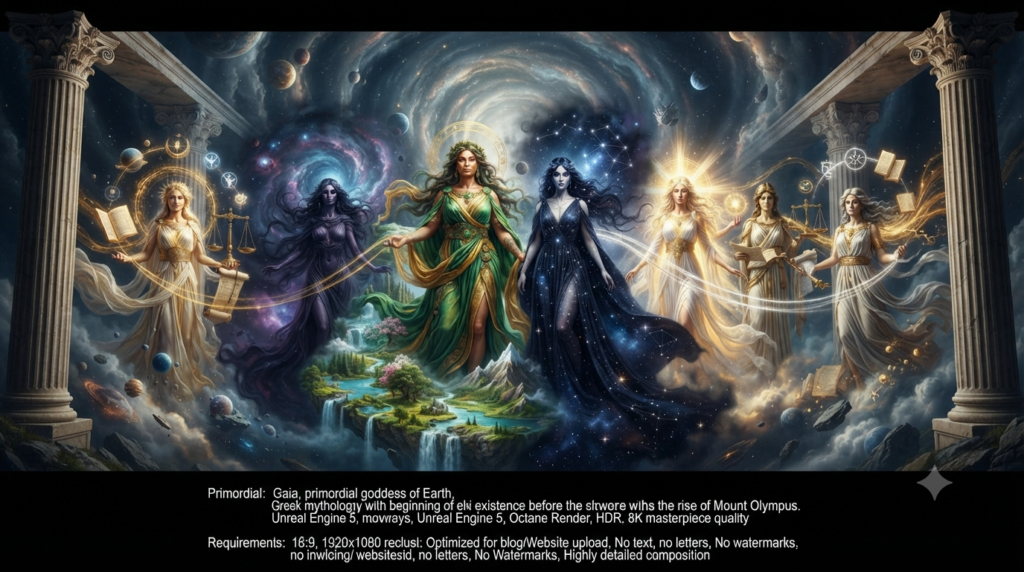
Long before Zeus and his fellow Olympians ruled from Mount Olympus, and even before the Titans held power over the cosmos, an older and far more fundamental layer of divine beings shaped the very structure of existence itself. Anyone asking who are the primordial goddesses of Greek mythology is reaching back to the earliest possible point in Greek cosmological thought, a realm described most authoritatively in Hesiod’s Theogony, one of antiquity’s oldest surviving accounts of divine origins.
These primordial goddesses differ fundamentally from the more familiar deities who dominate popular retellings of Greek mythology, since they represent foundational cosmic forces and structures rather than personalities defined through dramatic personal narratives. Rather than engaging in the romantic affairs, rivalries, and heroic conflicts that characterize later generations of gods, these earliest goddesses personify the basic architecture of the universe itself: the earth, the darkness of night, and the very concept of necessity governing all existence.
Understanding who are the primordial goddesses of Greek mythology requires setting aside expectations shaped by more familiar Olympian stories and instead approaching these figures as embodiments of cosmic structure, forces so fundamental that later generations of gods, including the Titans and Olympians alike, ultimately emerged from or depended upon them.
What follows traces the origins of Chaos, the formless void from which everything else emerged, Gaia’s role as the primordial earth mother, Nyx’s often overlooked but genuinely feared authority over night, Ananke’s association with cosmic necessity, and why this entire generation of goddesses predates and underlies the more famous mythology surrounding the Titans and Olympians.
Chaos: The Formless Void at the Beginning of Everything
According to Hesiod’s Theogony, Chaos represents the absolute starting point of Greek cosmology, described as the primordial void or gap from which all subsequent existence eventually emerged. Rather than representing disorder in the modern sense of the word, ancient Greek understanding of Chaos referred more specifically to an empty, undifferentiated space existing before any structured cosmos had taken shape.
Ancient sources present Chaos with notable ambiguity regarding gender and personification, sometimes treating this primordial state as an abstract cosmic condition rather than a fully personified deity in the same sense as later gods. Despite this ambiguity, many classical interpretations associate Chaos with feminine primordial energy, positioning this foundational void alongside the other early female cosmic forces that follow in Hesiod’s genealogical account.
This foundational status makes Chaos essential to any discussion of who are the primordial goddesses of Greek mythology, since every subsequent deity, force, and structured element within the Greek cosmos ultimately traces its origin back to this initial formless state. Without Chaos, none of the later, more elaborate mythology involving Titans or Olympians would have any foundation from which to emerge.
Recognizing Chaos’s role as this essential starting point provides crucial context for everything that follows, establishing the pattern through which subsequent primordial goddesses would emerge directly from this original void to begin structuring the previously undifferentiated cosmos into recognizable form.
Gaia: The Primordial Earth Mother
Gaia emerges directly from Chaos as one of the most significant primordial goddesses within Greek mythology, personifying the earth itself as a genuine living entity rather than simply an inert physical location. This personification made Gaia far more than a passive backdrop for later mythological events, positioning her instead as an active, foundational force directly responsible for generating much of the divine population that would follow.
As the primordial earth mother, Gaia became responsible for producing several subsequent generations of significant deities, beginning with Uranus, the sky, whom she generated independently before their subsequent union produced the twelve original Titans. This remarkable generative capacity extended even further, with Gaia also credited as mother to the Cyclopes and the Hecatoncheires, the hundred-handed giants, further cementing her role as a genuinely foundational source of divine life throughout early Greek cosmology.
Gaia’s significance extends beyond simple procreation into active involvement in some of Greek mythology’s most consequential early events, most notably her role in orchestrating Cronus’s overthrow of his own father Uranus, an act that fundamentally reshaped the balance of cosmic power during this earliest period of Greek mythological history. This intervention demonstrates that Gaia functioned as a genuinely influential force rather than a passive origin point alone.
Gaia’s central role provides one of the clearest answers to who are the primordial goddesses of Greek mythology, establishing her as perhaps the most consistently significant figure among this earliest generation, whose personification of the earth itself remained relevant throughout subsequent Greek mythology even as her own direct involvement in major events gradually diminished.
Nyx: The Primordial Goddess of Night
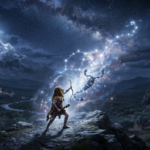
Nyx, the primordial personification of night, emerged from Chaos alongside Erebus, the primordial darkness, together representing two of the earliest structural forces to take shape following the initial formless void. Despite receiving comparatively limited attention in popular retellings of Greek mythology today, ancient sources consistently portray Nyx as a genuinely formidable and even feared figure among the gods themselves.
Homer’s poetry specifically describes Zeus himself holding a certain wariness toward Nyx, reluctant to directly oppose or anger her despite his own immense power as king of the Olympian gods. This detail proves particularly significant given how few figures throughout Greek mythology receive this kind of explicit deference from Zeus, underscoring Nyx’s genuinely substantial standing among the earliest and most powerful primordial forces.
Nyx’s mythological significance extends considerably through her remarkably extensive offspring, credited as the mother of numerous significant personifications including Thanatos, the personification of death; Hypnos, the personification of sleep; the Moirai, the three fates who governed mortal destiny; Nemesis, the personification of retribution; and Eris, the personification of discord. This extensive lineage connects Nyx directly to many of the fundamental forces governing both mortal existence and broader cosmic order.
This combination of genuine feared authority and extensive, significant offspring makes Nyx an essential figure when considering who are the primordial goddesses of Greek mythology, revealing a deity whose relatively understated modern reputation belies her substantial ancient significance as mother to some of Greek mythology’s most consequential personified forces.
Ananke: The Primordial Force of Necessity
Within certain strands of ancient Greek religious and philosophical tradition, particularly Orphic sources, Ananke appears as another significant primordial force, personifying necessity, compulsion, and the fundamental inevitability governing cosmic order itself. This association positioned Ananke as an abstract but genuinely powerful force determining the unavoidable structure underlying all subsequent divine and mortal existence.
Orphic cosmology, a somewhat distinct religious tradition running alongside more mainstream Hesiodic mythology, frequently paired Ananke with Chronos, the personification of time, presenting the two together as fundamental forces responsible for shaping the earliest structure of the cosmos according to this particular philosophical and religious perspective. This pairing reflects Orphic tradition’s tendency toward more abstract, philosophically oriented cosmological explanations compared to Hesiod’s more genealogically focused account.
It is worth noting that Ananke’s prominence remains somewhat less central within mainstream Greek mythological tradition compared to figures like Gaia or Nyx, since her significance rests primarily within these more specialized Orphic religious contexts rather than appearing consistently throughout the broader, more widely known Greek mythological corpus.
Including Ananke within any comprehensive answer to who are the primordial goddesses of Greek mythology acknowledges the genuine diversity present within ancient Greek religious thought, recognizing that multiple, sometimes distinct traditions contributed different primordial figures to the broader cultural understanding of the cosmos’s earliest, most fundamental forces.
Why These Goddesses Predate the Titans and Olympians
The primordial goddesses occupy a specific, foundational position within Hesiod’s broader genealogical structure, appearing before the Titans, who themselves preceded the eventual rise of the Olympian gods under Zeus’s leadership. This careful genealogical ordering reflects a deliberate ancient Greek effort to explain the cosmos’s development through successive generations, each building upon the structural foundation established by the generation before it.
This structural positioning distinguishes the primordial goddesses fundamentally from later divine generations, since figures like Chaos, Gaia, and Nyx represent basic cosmic architecture rather than personalities engaged in the kind of dramatic personal narratives that define much of Titan and Olympian mythology. Where later gods develop complex relationships, rivalries, and individual character traits, the primordial goddesses function more as embodiments of fundamental natural and cosmic principles.
This distinction helps explain why these earliest goddesses receive comparatively less popular attention today compared to figures like Zeus, Athena, or even Titans like Cronus, since their mythology centers on cosmic structure and generative function rather than the kind of engaging personal drama that has made later Greek deities so consistently popular across centuries of storytelling and cultural reference.
Understanding this genealogical positioning completes a full answer to who are the primordial goddesses of Greek mythology, confirming their essential but structurally distinct role within the broader Greek cosmological framework, existing as the foundational layer upon which the entire subsequent mythology of Titans and Olympians was ultimately built.
Frequently Asked Questions
Who is the first goddess in Greek mythology?
Gaia is typically considered among the very first goddesses in Greek mythology, emerging from Chaos alongside Nyx as one of the earliest personified forces in Hesiod’s account of creation.
Is Chaos a goddess?
Chaos is treated with some ambiguity in ancient sources, often described as a primordial void rather than a fully personified deity, though many interpretations associate it with feminine primordial energy.
What did Nyx give birth to?
Nyx gave birth to numerous significant personifications, including Thanatos (Death), Hypnos (Sleep), the Moirai (Fate), Nemesis, and Eris (Discord).
Conclusion
The primordial goddesses of Greek mythology, including Chaos, Gaia, Nyx, and Ananke, represent the oldest and most fundamental layer of ancient Greek cosmology, embodying not dramatic personal narratives but the essential structural forces of earth, night, and necessity upon which the entire cosmos was built. Predating even the Titans and Olympians, these foundational figures reveal how ancient Greek mythology sought to explain existence itself before turning to the more familiar, personality-driven stories of the gods who would eventually follow.

Orin Vale has spent the better part of two decades tracing the threads that connect the world’s oldest stories — from the halls of Asgard to the banks of the Nile, from Olympus to the jungles of the Maya. What began as a childhood fascination with flood myths and trickster gods grew into years of independent study across comparative mythology and ancient religion, always chasing the same question: what did these stories mean to the people who first told them? Orin writes for readers who want more than trivia — the ones looking for the beliefs, fears, and truths that myths were built to carry.