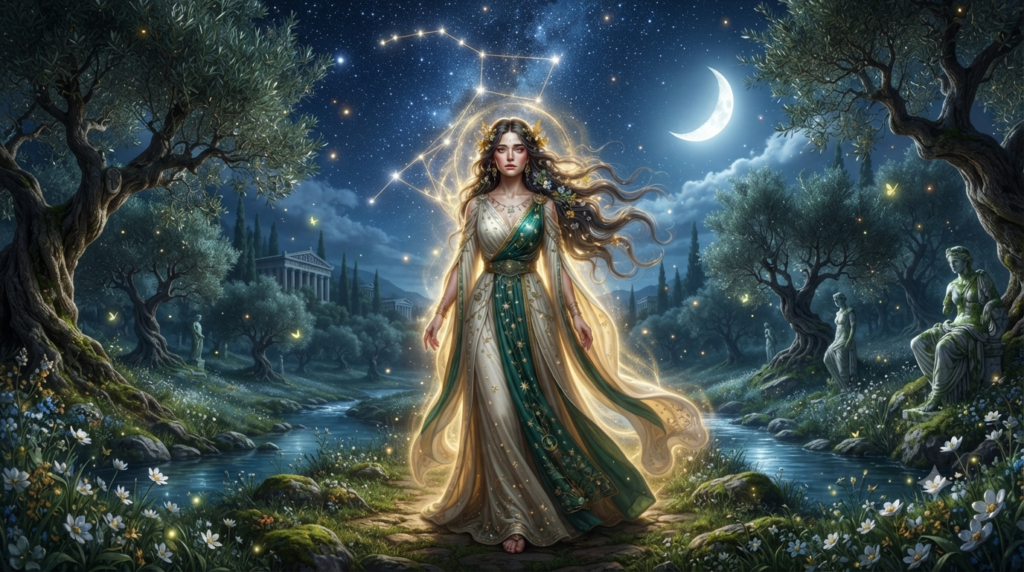
Calliste occupies a genuinely unusual position within Greek mythology, combining the identity of a personified nymph with the ancient name of an actual, physical island still visited by travelers today. Anyone asking who is Calliste in Greek mythology is uncovering a figure whose story literally connects myth directly to geography, since Calliste represents both a mythological woman born under extraordinary circumstances and the original name of the island later known as Thera, modern-day Santorini.
Her name itself, meaning “the most beautiful” in ancient Greek, reflects the reverence ancient storytellers held for both the mythological figure and the physical landscape she came to represent. This dual identity distinguishes Calliste from many other minor mythological figures, since her story does not simply explain an abstract concept but directly accounts for the origin of a real, tangible location within the Aegean Sea.
Calliste’s mythology unfolds specifically within the broader narrative of Jason and the Argonauts, connecting her story directly to one of Greek mythology’s most celebrated heroic adventures. Her appearance within this larger epic demonstrates how Greek mythology frequently wove smaller, more localized origin stories into its most famous overarching narratives, giving otherwise minor figures genuine significance through their connection to major heroic sagas.
What follows traces the myth of the magical clod of earth given to the Argonauts, Euphemus’s remarkable dream that led to Calliste’s birth, her specific request regarding where she wished to dwell, her transformation into the island itself, and the island’s eventual renaming as Thera.
The Myth of the Clod of Earth: Triton’s Gift to the Argonauts
Calliste’s mythology begins during the return voyage of Jason and the Argonauts, following their successful acquisition of the Golden Fleece from Colchis. As the Argonauts sailed along the coast near this region, the sea god Triton appeared before them, though not in his typical divine form, instead disguising himself as a wealthy young man named Eurypylus, claiming to be a son of Poseidon.
In this human guise, Triton offered the Argonauts a gift as a token of friendship and hospitality: a simple clod of earth, an object that seemed unremarkable at the time despite its ultimately extraordinary significance. Euphemus, one of the Argonaut crew members, accepted this gift, unaware that it carried the seeds of a genuinely miraculous transformation that would soon unfold.
This encounter with Triton reflects a broader pattern common throughout Greek mythology, in which gods frequently interacted with mortal heroes through disguised or altered forms, testing hospitality or offering gifts whose true significance remained hidden until later revealed through subsequent events. Triton’s disguise as Eurypylus allowed this exchange to occur naturally within the human social conventions of gift-giving and friendship that governed much of ancient Greek heroic interaction.
This seemingly minor exchange establishes the essential foundation for who is Calliste in Greek mythology, since this simple clod of earth would soon prove to contain the origin of both a remarkable mythological figure and, eventually, an entire island destined to become one of the most significant locations in later Greek history.
Euphemus’s Dream and the Birth of Calliste
Following his acceptance of Triton’s gift, Euphemus experienced an extraordinary dream that would fundamentally transform the significance of the seemingly ordinary clod of earth he now carried. In this dream, Euphemus found himself nursing the clod at his own breast, watching in astonishment as it gradually grew and transformed into a young woman before his very eyes.
The dream continued with Euphemus lying with this transformed woman, an act that afterward filled him with genuine guilt upon realizing she had been a virgin, and that his own actions in nursing her had created an unusual, almost paternal relationship complicating this subsequent intimacy. This combination of nurturing and romantic contact within a single dream sequence reflects the genuinely unusual, almost paradoxical nature of Calliste’s mythological origin.
Rather than leaving Euphemus troubled by this apparent transgression, the woman within his dream reassured him directly, introducing herself as Calliste, revealing her own parentage as daughter of Triton, the very god who had given Euphemus the original clod of earth, and Libya, a figure associated with the North African region bearing her name. This self-introduction immediately clarified the miraculous transformation Euphemus had witnessed, connecting the ordinary earth directly back to Triton’s earlier gift.
This remarkable dream sequence provides the essential mythological explanation for who is Calliste in Greek mythology, establishing her birth through an extraordinary combination of divine gift-giving, prophetic dreaming, and miraculous transformation rarely matched in complexity elsewhere throughout Greek mythological tradition.
Calliste’s Request: A Home Among the Nereids
Having revealed her identity within Euphemus’s dream, Calliste made a specific request regarding her future dwelling place, asking to be given a home near the island of Anaphe, specifically among the Nereids, the sea nymphs closely associated with the broader marine world her father Triton governed. This request connected Calliste directly to the established mythological geography surrounding the Aegean Sea’s various island communities.
According to the account preserved by the poet Apollonius of Rhodes in his Argonautica, Euphemus subsequently threw the clod of earth into the sea, an action directly connected to fulfilling Calliste’s expressed wish for a proper home within this specific marine region. This act of casting the earth back into the water represented the crucial transitional moment between Calliste’s mythological birth and her eventual physical manifestation as an actual island.
This specific request for placement among the Nereids near Anaphe reflects the careful geographical precision often found within Greek mythological origin stories, connecting Calliste’s eventual physical location to a broader, already established network of significant islands and marine locations throughout the Aegean world familiar to ancient Greek audiences.
This detail adds important specificity to who is Calliste in Greek mythology, confirming that her mythology carried genuine geographical intention rather than existing as vague, placeless legend, directly anticipating the emergence of an actual island in a specific, identifiable location within the broader Greek maritime world.
From Clod to Island: The Birth of Calliste as Land
Following Euphemus’s act of casting the transformed clod of earth into the sea, the earth itself rose from the water to form an actual physical island, taking the name Calliste directly from the mythological woman whose birth had originated from this very same earthen material. This transformation completed the remarkable journey from simple gift, to dream vision, to living island landmass.
Apollonius specifically describes this new island as serving as the “sacred nurse” of Euphemus’s own descendants, a poetic characterization that directly echoes the earlier nursing imagery from Euphemus’s original dream, creating a thematically consistent connection between Calliste’s mythological birth and her eventual physical role sustaining future generations of Euphemus’s lineage.
This transformation from mythological figure into actual physical land represents one of Greek mythology’s more distinctive examples of divine or magical origin stories directly explaining real, tangible geography rather than remaining confined to purely symbolic or abstract storytelling. Calliste’s story gave ancient audiences a concrete, physically verifiable connection between mythology and the actual landscape surrounding them.
This remarkable transformation provides perhaps the most significant answer to who is Calliste in Greek mythology, revealing a figure whose ultimate significance rests not merely in her personal mythological narrative, but in her direct, physical manifestation as an actual island that would continue existing and bearing historical significance long after this original mythological origin story had been told.
From Calliste to Thera: The Island’s Renaming
Following its mythological origin, the island of Calliste came to be inhabited by descendants of Membliarus, a Phoenician companion whom Cadmus had left on the island during his own earlier travels while searching for his sister Europa. These descendants continued dwelling on Calliste for approximately eight generations, maintaining continuous habitation on the island bearing this original mythological name.
This period of settlement eventually concluded with the arrival of Theras, a Spartan regent whose own lineage traced back directly to Cadmus himself, connecting the island’s later history to the same broader mythological family line already established through its earlier Phoenician inhabitants. Theras led a new colonizing expedition to the island, ultimately choosing to rename it after himself rather than retaining its original mythological designation.
This renaming from Calliste to Thera reflects a common pattern throughout ancient Greek history, where islands and settlements frequently took on new names honoring their most recent significant founder or colonizer, even when, as in this case, the location already carried a rich and established mythological history under its previous name. Ancient Theran communities continued honoring Theras annually through hero-based sacrificial rites even generations after this renaming occurred.
This historical transition completes an essential portion of who is Calliste in Greek mythology, demonstrating how the island’s mythological origin story eventually gave way to a more historically grounded naming convention, even as the earlier name and its rich mythological associations continued to be remembered and recorded by later Greek historians and geographers.
Calliste and the Modern Island of Santorini
The island originally known as Calliste, later renamed Thera, corresponds directly to the location known today as Santorini, one of the most visually striking and frequently visited islands within the modern Greek Cyclades. This continuity between ancient mythological origin and contemporary geographic reality gives Calliste’s story a genuinely rare, lasting significance extending well beyond typical Greek mythological narratives.
Santorini’s dramatic volcanic landscape, shaped significantly by a massive eruption around 1460 BCE that devastated nearby Minoan settlements, has become internationally renowned for its striking natural beauty, a modern reputation that resonates meaningfully with Calliste’s original ancient Greek name meaning “the most beautiful.” This connection between ancient naming and contemporary aesthetic reputation suggests a remarkable continuity in how this particular landscape has been perceived across many centuries.
This lasting physical connection between mythology and modern geography distinguishes Calliste’s story from countless other Greek myths whose significance remains purely narrative or symbolic, without any corresponding real-world location that visitors can still experience directly today. Calliste’s mythology therefore offers a uniquely tangible link between ancient storytelling and present-day physical reality.
This modern continuity provides a final, compelling dimension to who is Calliste in Greek mythology, confirming that her ancient mythological origin story continues to hold genuine relevance today, directly connected to one of the most celebrated and visually stunning islands within the entire modern Greek archipelago.
Frequently Asked Questions
What does Calliste mean?
Calliste means “the most beautiful” in ancient Greek, reflecting both the mythological figure’s name and the island’s later renowned natural beauty.
Is Calliste the same as Thera?
Yes, Calliste was the original name of the island later renamed Thera after the Spartan regent Theras led a colonizing expedition there.
Who was Calliste’s father in myth?
According to Greek mythology, Calliste’s father was Triton, the sea god who first gave the Argonaut Euphemus the magical clod of earth from which she was born.
Conclusion
Calliste stands as one of Greek mythology’s most distinctive figures, her story uniquely bridging mythological narrative and physical geography through her transformation from a magical clod of earth into an actual island within the Aegean Sea. From her extraordinary birth within Euphemus’s dream to her eventual renaming as Thera and modern identity as Santorini, Calliste’s mythology offers a genuinely rare example of ancient Greek storytelling directly explaining the origin of a location still recognized and celebrated for its beauty today.

Orin Vale has spent the better part of two decades tracing the threads that connect the world’s oldest stories — from the halls of Asgard to the banks of the Nile, from Olympus to the jungles of the Maya. What began as a childhood fascination with flood myths and trickster gods grew into years of independent study across comparative mythology and ancient religion, always chasing the same question: what did these stories mean to the people who first told them? Orin writes for readers who want more than trivia — the ones looking for the beliefs, fears, and truths that myths were built to carry.