Introduction: The Elusive Nature of Happiness in Greek Thought
In the vast and intricate pantheon of Greek mythology, where deities presided over every conceivable aspect of human existence, the concept of happiness presents a uniquely complex and multifaceted puzzle. Unlike love, war, or the sea, which were governed by singular, all-powerful Olympian figures such as Aphrodite, Ares, or Poseidon, happiness was not entrusted to a single divine ruler. Instead, the ancient Greeks understood happiness as a richly layered state of being, encompassing everything from fleeting moments of mirth and pleasure to a lifetime of virtuous flourishing and fulfillment. When we pose the fundamental question, “Who is the Greek god or spirit of happiness?”, we discover that the answer is not a solitary deity but a constellation of divine beings and philosophical concepts, each embodying a distinct shade of this profound human experience. These spirits range from the abstract and deeply philosophical to the intimately personal and exuberantly celebratory, reflecting the ancient Greek belief that happiness was simultaneously a gift from the gods and the result of a life lived with virtue, purpose, and wisdom. To understand the divine personifications of joy in Greek mythology is to appreciate how this ancient civilization conceptualized well-being, contentment, and the good life itself.
Euphrosyne: The Goddess of Good Cheer and Mirth
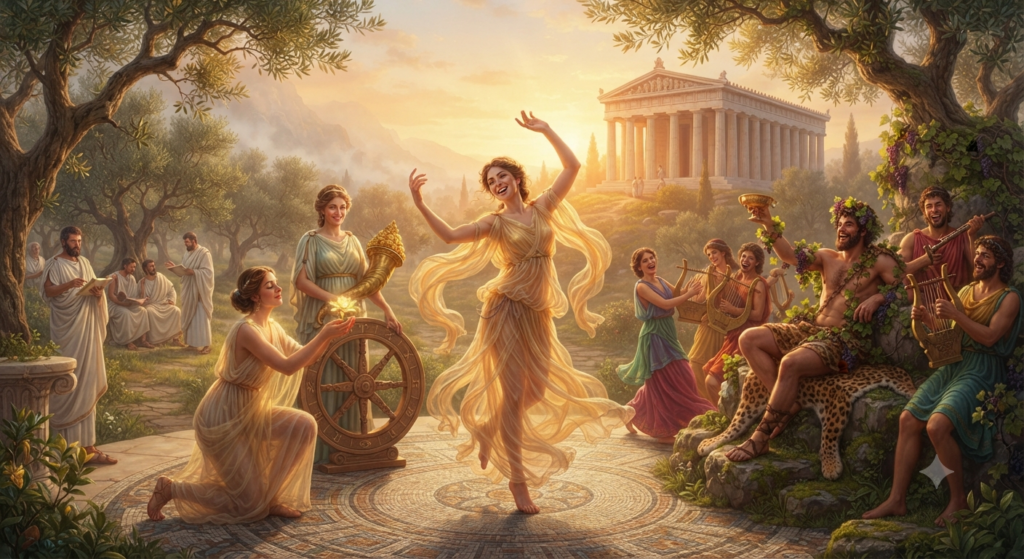
Among the most direct and joyous answers to the question of who is the Greek god of happiness is Euphrosyne, one of the three Charites, more widely known as the Graces. Her very name translates to “good cheer,” “mirth,” and “merriment,” encapsulating the light-hearted, social, and celebratory aspects of joy that animated Greek festivals and communal gatherings. As the daughter of Zeus, the king of the gods, and the Oceanid Eurynome, Euphrosyne, alongside her sisters Aglaea (Splendor) and Thalia (Good Cheer), served as an attendant to Aphrodite, the goddess of love and beauty, symbolizing the intrinsic connection between joy, grace, and aesthetic appreciation. In classical art and literature, she is typically depicted dancing in a harmonious circle with her sisters, their intertwined movements representing the graceful and harmonious nature of shared happiness that elevates the human spirit beyond mundane concerns. Euphrosyne represents joy as a social and aesthetic experience—the kind of delight one feels during a vibrant festival, at a beautiful musical performance, or in the warm company of trusted friends and loved ones. She is the spirit of the pleasant moment, the divine personification of mirth that reminds mortals that happiness is not merely an internal state but is often found in connection, celebration, and the beauty that surrounds us in the world.
Hedone: The Spirit of Pleasure and Joy
For a more philosophical and deeply personal interpretation of happiness, we turn to Hedone, the spirit of pleasure, delight, and enjoyment, whose very name has given rise to the philosophical school of hedonism. Her lineage is particularly significant: she is the daughter of Eros, the god of love, and Psyche, the personification of the human soul, a parentage that beautifully illustrates the Greek concept that true pleasure is born from the union of love and the soul’s deepest aspirations. While Hedone is often misunderstood in modern times as representing mere sensual indulgence or debauchery, the ancient Greek understanding of this spirit was far more nuanced and sophisticated. Philosophers like Epicurus argued that the highest form of hedone was actually ataraxia—a state of profound tranquility and freedom from mental disturbance and physical pain, achieved through moderation, wisdom, and the cultivation of meaningful friendships. In this context, Hedone represents not fleeting, momentary sensations but a profound and lasting sense of well-being and contentment that comes from living a balanced and contemplative life. The concept of hedone thus bridges the gap between simple pleasure and the deeper satisfaction that arises from a life well-lived, making this spirit essential to understanding the Greek approach to happiness as both an emotional experience and a philosophical pursuit.
Eudaimonia and Tyche: Happiness as Flourishing and Fortune
To fully grasp the Greek concept of happiness, one must understand Eudaimonia, a term often translated simply as “happiness” but more accurately rendered as “human flourishing,” “living well,” or “fulfillment.” Unlike the fleeting cheer of Euphrosyne or the pleasurable sensations of Hedone, Eudaimonia was not an emotion but a state of being, achieved by living a virtuous life in accordance with reason and fulfilling one’s potential as a human being. This profound concept was central to the philosophies of Socrates, Plato, and especially Aristotle, who argued in his Nicomachean Ethics that Eudaimonia was the ultimate goal of human existence and was inextricably linked to moral excellence, practical wisdom, and the active exercise of one’s rational faculties. However, the achievement of this flourishing was not solely within one’s own control; it was heavily influenced by external factors such as health, wealth, and social circumstances, which brings us to the capricious goddess Tyche. Tyche was the deity of good luck, chance, and fortune, representing the unpredictable elements of life that could elevate or destroy a person’s prospects for happiness regardless of their virtue or effort. The Greeks believed that while they could strive for virtue and wisdom, the external circumstances of life were largely governed by the whims of Tyche, meaning that a person could only be considered truly happy in retrospect, once their entire life had run its course and fortune had been fully revealed.
The Role of Dionysus and the Mystic Joy of the Soul
Beyond the more philosophical and social aspects of happiness, the Greek world also recognized a more ecstatic, transcendent form of joy embodied by the god Dionysus, the deity of wine, fertility, and ritual madness. While Dionysus is not typically categorized alongside the more serene spirits of happiness, his worship introduced a dimension of joy that was cathartic, transformative, and deeply connected to the human psyche’s release from societal constraints. The Dionysian mysteries offered initiates the promise of liberation from the burdens of mortal existence and the assurance of blessings in the afterlife, suggesting a form of happiness that transcended the earthly realm entirely. This ecstatic joy was expressed through music, dance, and the consumption of wine, which the Greeks believed temporarily dissolved the boundaries between the human and the divine, allowing participants to experience a state of euphoria and spiritual communion. The cult of Dionysus thus provided a counterbalance to the more rational and measured approaches to happiness advocated by philosophers, acknowledging that joy could also be found in surrender, in the loss of self-consciousness, and in the primal rhythms of nature and collective celebration. This mystical dimension of happiness reminds us that the Greeks recognized multiple pathways to well-being, from the philosophical pursuit of virtue to the ecstatic release of the soul.
The Dual Nature and Enduring Legacy of Happiness in Greek Mythology
Understanding who is the Greek god or spirit of happiness requires appreciating the complex interplay between these various divine figures and philosophical concepts, each contributing a unique perspective on what it means to live a joyful and fulfilling life. The Greeks did not view happiness as a simple, monolithic state but as a dynamic and multifaceted experience that could manifest as communal mirth, personal pleasure, virtuous flourishing, fortunate circumstances, or ecstatic transcendence. This nuanced understanding has profoundly influenced Western thought, shaping philosophical traditions, psychological theories, and cultural attitudes toward well-being that continue to resonate in the modern world. The legacy of Euphrosyne, Hedone, Eudaimonia, Tyche, and Dionysus can be seen in contemporary discussions about the nature of happiness, from positive psychology’s emphasis on flourishing to philosophical debates about the role of pleasure and virtue in the good life. Their enduring presence reminds us that the ancient Greeks grappled with many of the same questions we face today about how to find meaning, joy, and contentment in an uncertain world.
Conclusion: A Symphony of Divine Joys
In conclusion, there is no single Greek god or spirit who rules exclusively over happiness; instead, the ancient Greeks saw happiness as a complex, multi-faceted experience governed by a host of divine forces and philosophical ideals. It was the mirth and good cheer of Euphrosyne, the profound pleasure and tranquility of Hedone, the virtuous flourishing of Eudaimonia, the unpredictable favor of Tyche, and the ecstatic transcendence of Dionysus. These deities and concepts worked in concert, creating a divine symphony of joy, cheer, and fulfillment that acknowledged the full spectrum of human experience. To answer the question of who is the Greek god of happiness is to understand that for the Greeks, happiness was not a simple destination but a lifelong journey shaped by virtue, fortune, pleasure, connection, and the blessing of the gods. Their wisdom offers a profound and enduring lesson: that true happiness is found not in the pursuit of any single source but in the harmonious integration of all these elements, reminding us to seek joy in our relationships, our virtues, our pleasures, and our capacity for transcendence.

Orin Vale has spent the better part of two decades tracing the threads that connect the world’s oldest stories — from the halls of Asgard to the banks of the Nile, from Olympus to the jungles of the Maya. What began as a childhood fascination with flood myths and trickster gods grew into years of independent study across comparative mythology and ancient religion, always chasing the same question: what did these stories mean to the people who first told them? Orin writes for readers who want more than trivia — the ones looking for the beliefs, fears, and truths that myths were built to carry.