Theseus stands as one of the most significant figures in Greek mythology, embodying the heroic ideals of ancient Athens in a manner comparable to Heracles for the Peloponnese. Who is Theseus in Greek mythology? He is the legendary founder-king of Athens, a slayer of monsters, a political unifier, and a figure who represented the democratic and civic values of the city-state. He is best known for his daring slaying of the Minotaur in the labyrinth of Crete, but his influence extends far beyond this single feat, encompassing a series of labors, political reforms, and a life filled with both triumph and tragedy. His story, as recorded by ancient historians and poets, provides a rich tapestry of adventure and serves as a foundational myth for Athenian identity and democracy.
Theseus was more than just a warrior; he was an architect of a city and a symbol of its values . In the Classical period, he came to represent the ideal Athenian: a just man of action determined to serve his city and a staunch defender of its democratic principles . Unlike the more brutish and individualistic Heracles, Theseus’s heroism was often portrayed as intellectual and civic-minded, aligning him with the new political order of Athens. His many adventures served to clear the roads of bandits, unite the disparate communities of Attica, and establish Athens as a major power in the region. By exploring his multifaceted life, we can understand not only the man but also the cultural and political landscape of ancient Greece.
Origins and Divine Birth
The origins of Theseus are characterized by a unique duality—a common theme in Greek mythology for heroes of exceptional stature. He was, in the most famous tradition, the son of Aegeus, king of Athens, and Aethra, daughter of King Pittheus of Troezen . However, an alternative and equally powerful tradition holds that his father was the sea god Poseidon himself . This divine parentage was a crucial element of his identity, marking him as a hero with both mortal and immortal lineage and foreshadowing his extraordinary abilities and adventures.
The circumstances of his conception are as unusual as his parentage. According to the most popular version, Aegeus, who was childless and desperate for an heir, consulted the oracle at Delphi and was given a famously cryptic prophecy. On his way home, he stopped at Troezen, where his host, Pittheus, understood the prophecy and arranged for his daughter Aethra to lie with him. On that same night, Aethra also waded out to the island of Sphairia and lay with the god Poseidon, making Theseus the child of both a mortal king and an immortal god . This double fatherhood was a familiar feature in Greek heroic myth, granting Theseus a combination of divine and mortal characteristics that set him apart from ordinary men .
Before Aegeus returned to Athens, he buried his sword and a pair of sandals beneath a massive rock. He instructed Aethra that when their son grew to manhood and was strong enough to move the rock and retrieve the tokens, he should be sent to Athens to claim his birthright . Theseus was raised in Troezen, developing into a strong and ambitious young man, and in due course, he proved his heroic nature by lifting the rock and recovering his father’s possessions. This act was the first indication of his future greatness, a test of strength and will that set him on the path to his destiny.
The Road to Athens: Labors of the Isthmus
Theseus’s journey from Troezen to Athens was not a simple voyage; it was a deliberate and perilous odyssey that established his reputation as a formidable hero. Instead of taking the safe sea route, he chose the dangerous land route along the Saronic Gulf, a path notorious for the bandits and monsters that plagued the region . By clearing these perils, Theseus demonstrated his commitment to making the world safe for travelers, a theme that resonated deeply with the values of Athenian society.
On his journey, Theseus encountered and defeated a series of infamous villains. His confrontations with these “ogres and monstrous beasts” were symbolic of the triumph of the new, civilized order over the old, chaotic forces that challenged it . Among his first victims was Periphetes, a son of Hephaestus who wielded a bronze club. Theseus killed him and took the club as his own weapon, a symbol of the strength he would wield in his future endeavors. He then encountered Sinis, who would tie his victims to two pine trees that he bent to the ground and then released, tearing them apart. Theseus defeated and killed him using his own method, an act of poetic justice that established a pattern of meting out a villain’s fate upon them.
Further along the road, he dealt with the Crommyonian Sow, a monstrous boar that terrorized the countryside, and Sciron, who would force travelers to wash his feet and then kick them off a cliff to be eaten by a giant sea turtle. Theseus defeated Sciron in the same manner, throwing him off the cliff . His final challenge on this road was Procrustes, the “Stretcher,” who offered travelers a bed to rest on and then adjusted their bodies to fit it perfectly, either by stretching them or cutting off their feet. Theseus forced Procrustes to lie on his own bed, dispatching him in a final act of justice . By the time Theseus arrived in Athens, his reputation as a hero was well-established, setting the stage for his confrontation with the city’s own monsters and challenges.
Arrival in Athens and Recognition
Upon arriving in Athens, Theseus found a kingdom in turmoil. King Aegeus was now married to the sorceress Medea, who had fled Corinth after her own treacherous acts. Medea, fearing that Aegeus would recognize Theseus as his son and heir, thus displacing her own ambitions, immediately saw the newcomer as a threat . She plotted to have him killed, first persuading Aegeus to send him to capture the fearsome Marathonian Bull, a creature that had been wreaking havoc on the Athenian countryside .
Theseus, however, was successful in capturing the bull, proving his strength once again. Unwilling to accept defeat, Medea then attempted to poison him at a banquet. At the last moment, Aegeus recognized the sword and sandals that Theseus carried—the very tokens he had left under the rock in Troezen—and knocked the poisoned cup from his son’s hand . Father and son were reunited, and Medea, along with her son, was banished from Athens. This recognition was a pivotal moment, confirming Theseus’s status as the rightful heir to the Athenian throne and setting the stage for his greatest achievement.
The Slaying of the Minotaur
The Tribute to Crete
The most celebrated episode in the life of Theseus is undoubtedly his slaying of the Minotaur, a monster that was half-man and half-bull. For years, Athens had been forced to pay a terrible tribute to King Minos of Crete. According to legend, this was punishment for the death of Minos’s son, Androgeus, who had been killed in Athens. As tribute, Athens was compelled to send seven young men and seven young women to Crete every nine years, where they were thrown into the Labyrinth to be devoured by the Minotaur .
The Minotaur, born of the union of Minos’s wife, Pasiphae, and a sacred bull, was a creature of immense strength and ferocity, locked away in an inescapable maze designed by the master craftsman Daedalus . This monstrous tribute was a source of deep grief and humiliation for the Athenians, and Theseus, upon learning of it, resolved to put an end to it. He famously volunteered to be one of the seven young men sent to Crete, determined to slay the monster and liberate his city from this fearful obligation . This act of self-sacrifice and civic duty would define his character in the Greek imagination.
The Role of Ariadne and the Labyrinth
Upon arriving in Crete, Theseus’s quest was aided by a crucial ally: Ariadne, the daughter of King Minos. Ariadne, captivated by the hero, fell in love with him and decided to help him survive the Labyrinth . She provided him with a ball of thread, or a skein of wool, which he was to fasten to the entrance of the Labyrinth and unravel as he ventured deeper into its winding passages . This thread would serve as a lifeline, allowing him to find his way back out after his encounter with the Minotaur. This act of Ariadne’s is one of the most famous examples of love conquering adversity in Greek mythology.
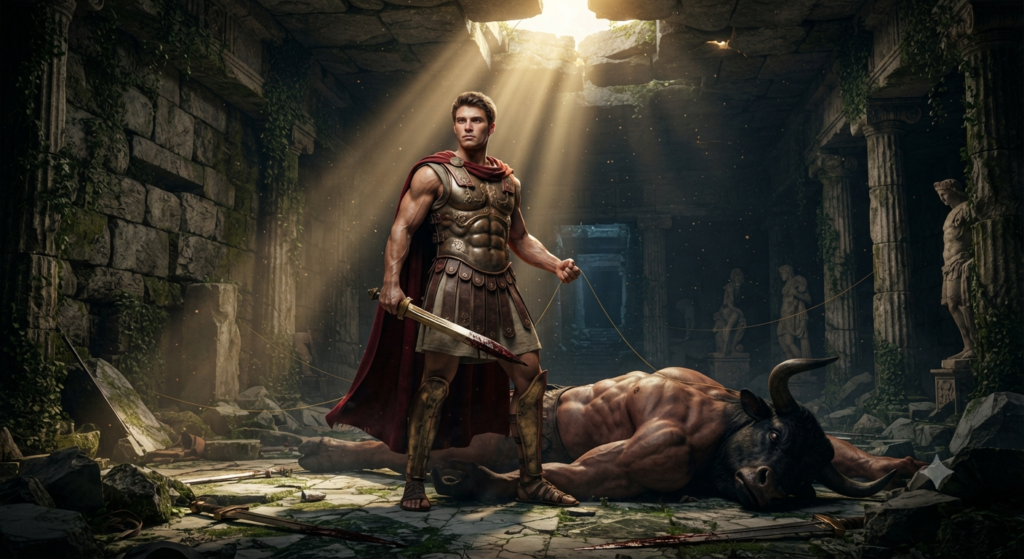
Armed with Ariadne’s thread and his sword, Theseus entered the Labyrinth. He navigated the treacherous maze, found the fearsome Minotaur in its lair, and engaged the monster in a brutal battle. Theseus was ultimately victorious, slaying the Minotaur with his bare hands or his father’s sword . Following the thread, he successfully emerged from the Labyrinth, and with his fellow Athenian youths, fled Crete with Ariadne by his side. This victory was a monumental achievement, demonstrating Theseus’s courage, intelligence, and the favor of the gods, securing his place as the premier hero of his generation.
The Tragic Return
The triumph of the Minotaur’s slaying was marred by a tragic episode that would profoundly affect Theseus’s life. Before setting sail for Crete, Theseus had promised his father, Aegeus, that if he returned alive, he would raise white sails on his ship as a signal of his success. The ship would otherwise continue to bear black sails, the symbol of mourning for the doomed youths .
In the excitement of his victory, Theseus forgot his promise. As his ship approached the Attic coast, Aegeus, scanning the horizon from his watchtower on Cape Sounion, saw the black sails. Convinced that his son had perished in the Labyrinth, the grief-stricken king threw himself into the sea, which has been known as the Aegean Sea ever since . Thus, Theseus’s homecoming was a bittersweet one. He was welcomed as a hero, but his heart was heavy with the knowledge that his oversight had caused his father’s death. The new king of Athens, though deeply saddened, was now ready to undertake the greatest challenge of his life: governing and unifying the people of Attica.
The King and Reformer of Athens
As king, Theseus proved to be a visionary leader, far surpassing the role of a mere military hero. His most significant accomplishment was the synoikismos, or the political unification of Attica . Before Theseus, the various towns and villages of Attica were independent, often fractious communities. Theseus persuaded them to give up their local governments and come together under a single, central authority in Athens, creating a unified and powerful city-state . This act of political consolidation was the foundational moment in the creation of a great Athenian state, and Theseus was remembered for centuries as its architect. He established Athens as the capital, built a palace on the Acropolis, and founded a new political order, for which he was credited with inventing many of Athens’ everyday traditions .
He also established religious and social institutions that were meant to solidify the new commonwealth. Pausanias reports that Theseus established a cult of Aphrodite Pandemos, or “Aphrodite of all the People,” on the southern slope of the Acropolis . This cult was a direct reflection of his policy of unification, as it was a shrine dedicated to the goddess of love and unity for all the citizens of Athens. Theseus was also credited with instituting the festival of the Panathenaea, a grand celebration that further fostered a sense of common Athenian identity.
Family and Relationships
The life of Theseus was marked by a series of complex and often tragic relationships with women. After his betrayal of Ariadne on Naxos, he went on to marry Hippolyta, the queen of the Amazons. His abduction of her was a major act that would trigger a war, as the Amazons later invaded Attica in an attempt to rescue her . This conflict is thought to be a mythological parallel to the historical Persian invasion of the 5th century BC . He had a son by Hippolyta, named Hippolytus, who was a great hunter and a devotee of the goddess Artemis.
After Hippolyta’s death, Theseus married Phaedra, another daughter of King Minos and the sister of Ariadne, adding another layer to his complex family ties. This marriage ended in tragedy of a different sort. Phaedra fell in love with her stepson, Hippolytus, and when he rejected her advances, she falsely accused him of attempting to rape her. Theseus, believing the accusation and unable to see the truth, cursed his own son, a curse that was answered by the god Poseidon, leading to Hippolytus’s death. The story of Theseus and his family became a fertile ground for the great Athenian playwrights, who used it to explore themes of love, betrayal, and the tragic consequences of human error.
Later in life, Theseus befriended Pirithous, the king of the Lapiths. The two formed a legendary bond of friendship, and together they participated in the Calydonian Boar Hunt and fought against the Centaurs at Pirithous’s wedding . Their friendship, however, led to their most infamous act: the abduction of the young Helen of Sparta. Intent on making her their bride, they were foiled by her brothers, the Dioscuri, and were forced to flee.
Descent to the Underworld and Death
The most hubristic act of Theseus and Pirithous was their attempt to abduct Persephone, the queen of the Underworld, to be Pirithous’s bride . This descent into the realm of Hades was a direct challenge to the gods, and it was met with swift and severe punishment. When they arrived, they were trapped, forced to sit on the “Chair of Forgetfulness,” where they were bound and unable to move. Theseus remained imprisoned in the Underworld for many years until he was eventually rescued by his old comrade, Heracles . However, even the mighty Heracles could not free Pirithous; he was forced to remain in the Underworld forever. This episode served as a stark warning against the dangers of excess ambition, a common theme in Greek myth.
When Theseus finally returned to Athens after his time in the Underworld, he found his kingdom in chaos. His friend had been killed, his family was in ruins, and the political order he had so carefully constructed had been dismantled. He was no longer welcome in his own city . Theseus, a king without a throne, fled to the island of Scyros, where he sought refuge with King Lycomedes. However, the king saw him as a threat and treacherously pushed him off a cliff to his death . In this manner, the great hero and king met his end, alone and betrayed, a poignant conclusion to a life of such high achievement and tragic flaw.
Artistic Representations and Cultural Influence
Theseus was a central figure in ancient Greek art and literature, his image and stories appearing on countless vases, sculptures, and in the plays of the great tragedians. Vase painters were particularly fond of depicting his battle with the Minotaur, often showing the hero grappling with the monster in the center of the Labyrinth. He is also frequently shown slaying the bandits on his journey to Athens, or abducting Ariadne, reflecting the rich narrative possibilities of his life .
In literature, Theseus appears as a symbol of justice and civic virtue in the works of the tragedians. In Sophocles’s Oedipus at Colonus, he gives sanctuary to the exiled Oedipus, protecting him from the threats of Thebes . In Euripides’s The Suppliants, he forces the Thebans to return the bodies of the fallen Argive chiefs for proper burial, acting as a champion of the law and the rights of the dead . In The Madness of Heracles, Theseus is portrayed as a compassionate friend, offering comfort and shelter to the grief-stricken Heracles. These portrayals cemented his reputation as an enlightened and just ruler.
The cult of Theseus grew in Athens after the Persian Wars. The Athenian statesman Cimon, seeking to strengthen Athenian unity, orchestrated the recovery of Theseus’s bones from Skyros around 475 BCE and brought them back to Athens with great ceremony . They were reinterred in a temple known as the Theseion. Thereafter, the hero was honored with an annual festival, the Theseia, and he became the central figure in a mythology of Athenian greatness . His image was used by political leaders like Cleisthenes to promote a democratic and unified vision for the state, contrasting the individual heroism of Heracles with the civic heroism of Theseus .
Frequently Asked Questions About Who is Theseus in Greek mythology?
What is Theseus best known for in Greek mythology?
Theseus is most famous for his heroic slaying of the Minotaur in the Labyrinth of Crete. He volunteered to be one of the seven young men sent as tribute and, with the help of Ariadne, navigated the maze, killed the monster, and liberated Athens from the burdensome sacrifice .
Who were the parents of Theseus?
Theseus’s parentage is a matter of dual tradition. He is widely considered the son of Aegeus, the king of Athens, and Aethra. However, an alternate tradition holds that he was the son of the sea god Poseidon, who lay with Aethra on the same night as Aegeus .
What was the synoikismos associated with Theseus?
The synoikismos refers to the political unification of Attica under the rule of Athens, an achievement credited to Theseus. He persuaded the independent towns and villages of the region to give up their local governments and unite into a single, powerful city-state, for which he was remembered as its founder .
What is the story of Theseus and the Minotaur?
To end the tribute of Athenian youths to Crete, Theseus sailed to the island as one of the victims. With the help of Princess Ariadne, who gave him a ball of thread, he navigated the Labyrinth, killed the Minotaur, and escaped, but he tragically forgot to raise a white sail on his return, causing his father, King Aegeus, to commit suicide in grief .
Why did Theseus have two fathers?
The double fatherhood of Theseus (Aegeus and Poseidon) is a common motif in Greek myth used to explain the hero’s extraordinary nature. It signified a union of mortal kingship and divine power, endowing him with the characteristics necessary to perform his great deeds and achieve a heroic status .
What happened to Theseus in the Underworld?
Theseus, along with his friend Pirithous, descended to the Underworld in a reckless attempt to abduct Persephone. They were captured and imprisoned on the “Chair of Forgetfulness” by Hades. Theseus was later rescued by Heracles, but Pirithous was forced to remain there forever .
How did Theseus die?
After returning to Athens from the Underworld, Theseus found his kingdom in disarray and was no longer welcome. He fled to the island of Skyros, seeking refuge with King Lycomedes, who treacherously pushed him off a cliff to his death .
What is the significance of Theseus’s sword and sandals?
The sword and sandals were tokens left by his father, Aegeus, under a large rock for Theseus to find when he came of age. Retrieving them was his first heroic act, proving his strength and identity, and they served as the proof of his royal lineage when he arrived in Athens .
Conclusion
Who is Theseus in Greek mythology? He is the emblematic hero of Athens, a figure who embodies the very soul of the city-state in its most dynamic period. His life was a grand narrative of adventure and statecraft, from his daring journey to Athens and his slaying of the Minotaur to his political unification of Attica and his tragic final years. Theseus was the architect of Athenian identity, a man who not only performed heroic labors but who also created a political and religious order that would define Athens for centuries. His story mirrors the emergence of Athens as a major power, transitioning from a kingdom plagued by monsters and internal strife into a unified, democratic, and culturally dominant force in the ancient world.
His legacy is one of both triumph and cautionary tale. He represents the best of Athenian ideals: courage, intelligence, civic duty, and the pursuit of justice. Yet his life also underscores the limitations of mortal greatness, as his accomplishments were ultimately overshadowed by personal tragedies and a hubristic end. The myths of Theseus provided the Athenians—and continue to provide modern audiences—with a foundational narrative, a story that explores the complexities of heroism, the delicate balance between personal ambition and public responsibility, and the enduring quest for a better society. In the end, the story of Theseus is the story of a man who sought to build a perfect city and, in doing so, became a legend.

Orin Vale has spent the better part of two decades tracing the threads that connect the world’s oldest stories — from the halls of Asgard to the banks of the Nile, from Olympus to the jungles of the Maya. What began as a childhood fascination with flood myths and trickster gods grew into years of independent study across comparative mythology and ancient religion, always chasing the same question: what did these stories mean to the people who first told them? Orin writes for readers who want more than trivia — the ones looking for the beliefs, fears, and truths that myths were built to carry.